


Imagining Ethereum in 2025: Users, Applications and Base Layer


Edit: Southwind
Edit: Southwind
Ethereum will serve as the global settlement layer, or in more technical terms, the global security and data availability layer.
Back then there was a thriving ecosystem of external execution layers on Ethereum, like Rollups and Volitions, where all the users and dApps lived.
These executive layers are not just "scalability solutions" but vibrant communities with their own culture, identity, governance and economy. This is where all the innovation will happen while Ethereum degenerates into a somewhat rigid settlement layer. These different communities will communicate, compete with each other, but also work hand in hand for Ethereum as a whole.
image description
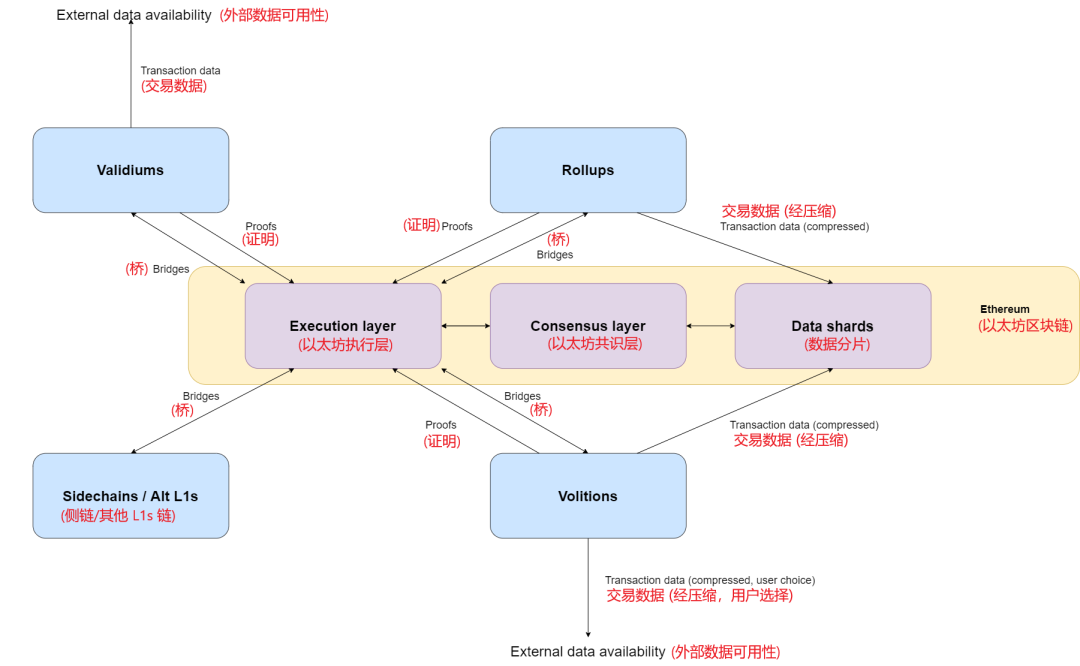
Cartography: u/emkoscp
As shown in the figure above, some execution layers will choose to be Rollups based on Ethereum, fully protected by the Ethereum L1 main network; some may choose to be Validiums with centralized data availability, and some Validiums have semi-decentralized data Availability, that is, has its own data availability consensus mechanism; others will be given to users to choose.
Others will choose to be sidechains with independent sovereignty. These sidechains have a relatively centralized consensus mechanism and do not need to submit any proofs to Ethereum L1. In this case, it may be an independent L1 public chain (such as Bitcoin) that has nothing to do with Ethereum, or it may actually be an Ethereum sidechain that is hostile to Ethereum (such as BSC), or it may be a Ethereum-friendly Ethereum sidechains (such as Polygon PoS). While a technically inferior solution to Validiums or Volitions, the marketing, memes, and network effects are here to stay. Given this, some L1s that are more pragmatic in 2021 will switch to Volitions or Rollups, but as mentioned earlier, others will stick to their monolithic blockchain model despite this The schema suffers from serious inefficiencies. A possible exception are zkL1s (L1s using zero-knowledge proofs), provided they are sufficiently decentralized.
What about users?
general user:They will use some form ofcentralized aggregator, these aggregators will settle in Rollups or directly on Ethereum. Think of them as similar to CEXs (centralized exchanges), except that they will expand their functionality,Integrate DeFi, NFTs and social functions, etc.
Tech-savvy users:Tech-savvy users capable of self-hosting will useSmart contract social recovery wallet. These wallets will be very advanced, with variousaggregation mechanism, which can aggregate smart contracts across multiple Rollups. Imagine a scenario where a user deposits fiat currency into a smart wallet and hopes to earn interest. All they have to do is deposit funds into it. Smart wallets will a) convert fiat to stablecoins, and b) automatically deposit stablecoins into opportunities with the best interest yield. Of course, there may be multiple interest aggregation pools like Yearn at that time.All of this will be taken away from the user end, users will only see the interest income they are earning! Similarly, most popular dApps will be integrated into smart wallets,This way you don't need to jump back and forth between the front end and Rollups.
Application-specific users:Some apps will be done entirely on the front end, with the back end invisible to the user. In fact, we’ve already seen this with Sorare, an Ethereum-based NFT fantasy football game: the app’s front-end is indistinguishable from a centralized fantasy football game, while its backend uses StarkEx-based Validium Carry out NFT settlement.
Fan users:These users will likely use Rollups directly for transactions; while enthusiasts who are more cost-sensitive will use Volitions or Validiums solutions.
finally,finally,Only a very limited number of participants will settle directly on Ethereum L1,Some of them are submitting user/citizen activity to Ethereum L1 for settlement in an aggregated fashion; others are looking to leverage Ethereum to remove their data responsibilities. For example, Libra (now renamed Diem) will have this problem: if they had deployed a Rollup chain on Ethereum instead of creating their own consensus mechanism, the project might have succeeded (of course, Rollups were not yet available). exist).
Another way of imagining for the user side is:
Who will use Ethereum?Financial institutions, governments, corporations, whales. And obviously, Rollups, Volitions and Validiums will be settled on Ethereum, and sidechains/other L1s chains will be bridged to Ethereum.
Who will use Rollups?Hobbyist users who prefer to self-host and interact directly with the Rollups chain.
Who will use Validiums or Volitions?Same as above, but more likely users who are more cost conscious and want to transact securely at a lower cost.
application
application
I don't think we can imagine what types of applications will be built on top of Rollups.This is a completely open design field, and there will be many applications that are simply impossible to implement on the traditional L1s blockchain.Non-consensus data availability will make significant progress,"Login with Ethereum"The same is true, and both will be critical. A whole new door of innovation will open to build innovative applications that will change the way people and society function.
first level title
Ethereum: the base layer
data shardingdata sharding(data shards) are active. State expiry will go live, making the Ethereum execution layer more sustainable. The block builder/proposer is separated, and the beacon chain has a single Slot finality. In addition, there is one last major project between the Ethereum Foundation and the wider Ethereum research and client development community - the realization of everythingzk-SNARK/STARK!
We might even see some non-EVMzkVMs(Zero-Knowledge Virtual Machine), possibly a zkVM shard built specifically for settling zero-knowledge proofs from Rollups or other advanced cryptography, parallel to the existing EVM. Eventually, the Ethereum EVM execution layer and the beacon chain itself will implement zk-SNARK/STARK. It's a daunting project that will take several years to complete.
There's a lot more I'm imagining, but that's about it. What do you think Ethereum will look like in 2025?





