


In the post-EIP1559 era, conflicts of interest between different ecological roles are inevitable?


This article comes fromNicCarterThis article comes from

, the original author: Nic Carter, compiled by Odaily translator Katie Ku.
In early August, the much-anticipated Ethereum London upgrade came into effect, including a series of Ethereum Improvement Proposals or EIPs series of proposals. The most critical of these is EIP-1559, whose appearance subverts the core cost logic.
Before the change, Ethereum block space was auctioned on a "first price" basis. Users will have to make predictions based on possible settlement prices for blockspace. They tend to pay a high price and are inefficient in order to ensure that the transaction can be successfully confirmed.
Based on the data we have so far, the EIP-1559 proposal does work. Fees are no longer the roller coaster ride they used to be. However, the price is not cheap, much to the chagrin of some users. Ethereum users who witnessed the process insisted that the adjustment was never about reducing block space. Insiders largely blame the NFT mania for the spike in fees. In fact, there is a cursory analysis that provides some support for this theory.
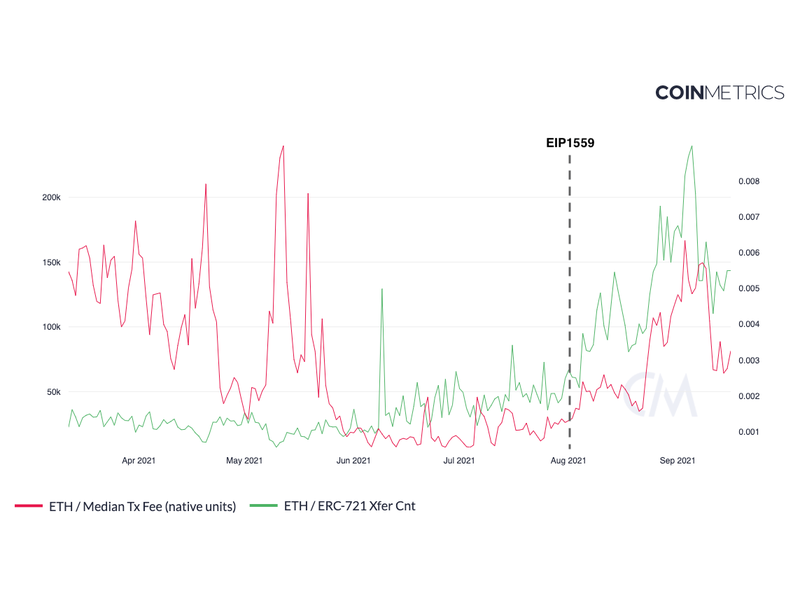
image description
Median fees grow as NFT transactions grow (Coin Metrics)
According to a visualization of gas prices after EIP-1559 went into effect created by data scientist Takens Theorem, the change appears to have eliminated most of the downside gas price volatility, but not the later volatility. Fee spikes can still occur during times of transaction congestion.
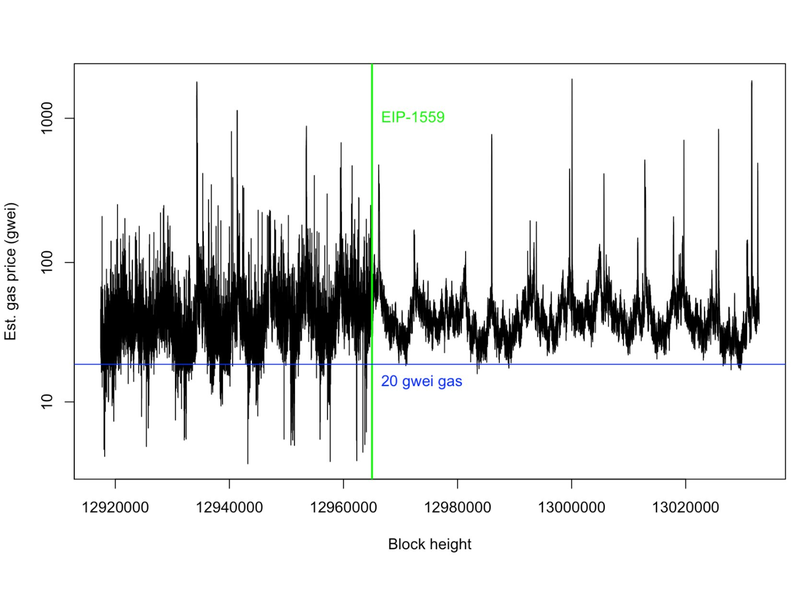
image description
The gas price of late blocks before EIP-1559 takes effect (from Takens Theorem)
Disenfranchise users who place low "limit orders" on gas. Effectively, this change homogenizes the way users bid for gas, knocking out price-sensitive users who would rather wait for lower gas prices.
Then there's the burn of fees. The base fee is now burned, while miners collect some leftover "tips". There are several reasons for including this mechanism: First, having Ethereum as the only local currency is similar to having only the US dollar to eliminate US tax obligations. In addition, it eliminates the attack mode where miners may block high-fee transactions to drive up gas settlement prices and force users to pay extortion fees. Fee recovery attacks don't work when the base fee is burned.
But the design choice of toll burning also has economic consequences. First, it works against miners, depriving them of much of the income they previously earned. As a result of this change, only about a quarter of what users pay to access the blockchain currently goes to miners. Previously, the entire fee went into the pockets of the miners.
If you look at the graph, it's clear that miners' fee income has dropped significantly, while most of the fees have been burned.
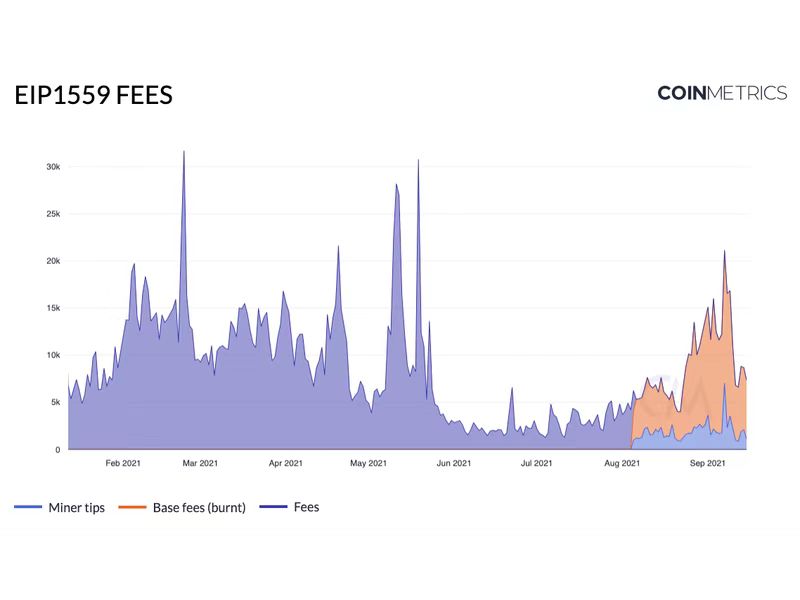
image description
Changes in the nature of fees before and after -EIP-1559 went into effect (Coin Metrics)
Ethereum is okay with this level of security spending, but underestimates what the miners pay. Their job is to create effectively linear block spaces without forks. Reducing the wages paid to the "mercenaries" who defend your domain may make it easier for attackers to exploit, and further declines in miner income will put Ethereum at risk.
secondary title
A more serious problem created by the change in fee logic is that it pits token holders against block space consumers
Ethereum insiders are well aware of the impact of this policy on miners, and in fact weakening miners’ power has always been on the agenda. Miners are not in V God's long-term plans. In the fully proof-of-stake future that Ethereum is slowly moving towards, miners simply won’t play a role. As a result, their interests are often not considered when it comes to protocol changes, and they are only short-term contractors who will eventually be abandoned.
There are some problems with this. If you treat miners as consumables, they have no sense of responsibility for the chain. Currently, miners still occupy a privileged position in the transaction lifecycle, as they control the order of transactions in a block. It is well known that reordering (or selectively including or omitting) transactions provides economic rewards to the entity that controls the choice of transactions.
Some miners have held off on exploiting so-called "miner mineable value" (MEV) from this principle, which is hostile to end users. Now that they are squeezed out, there is no reason for them to seek to maximize the long-term value of the agreement. In fact, especially when their fee income has plummeted, they are incentivized to find any gain possible, even at the expense of users. Less direct agreement revenue could mean more “miner mineable value” (MEV) based revenue and more exploitation of end users.
A more serious problem created by the change in fee logic is that it puts token holders at odds with block space consumers. Holders now directly benefit from ongoing high fees. The higher the fee, the more units of ether. This may increase the unit price of ETH. However, this comes at the expense of actual users of the blockchain, who of course prefer lower fees, other things being equal.
Ethereum has entered a new phase of life. From an inactive upstart to a mature protocol that now extracts rent from consumers of block space. The best proof of this is a graph of monthly active users versus unit price.
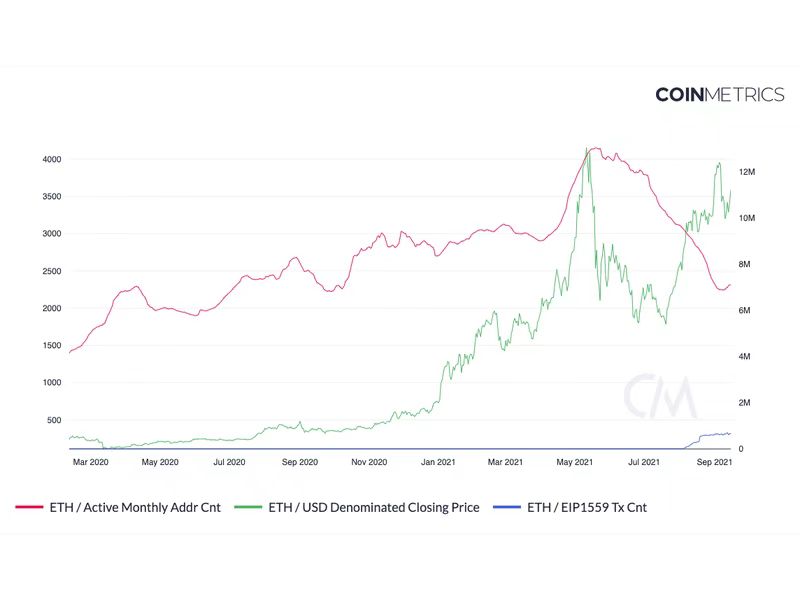
image description
Active Ethereum addresses per month compared to ETHUSD (Coin Metrics)
In fact, the two variables have been in sync throughout history. More usage means a greater demand for ether itself. But since July this year, that relationship has been decoupled. Monthly activity has steadily declined, but Ethereum has rebounded strongly. This uptick is due in large part to the hype over EIP-1559, and subsequent high burn fee rates. But one wonders how long this rally will last if the practice of burning fees plus high fees resents the big players in the block space.
This may culminate in future conflicts over, say, block sizes. I can easily imagine a faction of traders lobbying to increase the block size in an attempt to create more block space and drive down the gas settlement price. But would large token holders, benefiting from the deflationary effects of high fees, want to reduce the size of their user-funded perks? The truth is that due to the mechanism of burning fees, which is apparently doing quite well for the price of ether, the individuals who control the design of the ethereum protocol now have an incentive to keep fees high in perpetuity.
secondary title
Arbitrary changes in monetary policy are both short-term and dangerous
By precedent, arbitrary changes to monetary policy are both short-term and dangerous. It’s short-term because it disempowers the traders who build the investment case around Ethereum. If you can't attract companies and users to hold ether as working capital for transactions, then the source of booking demand will gradually disappear. Speculators end up speculating that the protocol will continue to be used well into the future. The value of Ether depends in part on the future expectations of token holders, which depends on future adoption. To live up to these expectations, they must continue to convince users that Ethereum is a stable and non-rent-seeking place to trade.
It also sets a troubling precedent. Of course, the price bounced back when expectations changed and a lot of ETH had been burned, but the decision was equally arbitrary. Sound monetary policy is about making monetary rules that cannot be intervened.
So far, Ethereum has not been able to promise a stable currency rule. That "gas pedal" could be opened at a later date if the release can be reduced after only a few months of discussions among insiders. Ethereum policymakers should consider creating a rule that can guide policy for decades, not months. Given that this policy is redistributable, one wonders what's next for protocol insiders. Of course, there is an unacknowledged political overtone to all of these decisions, which are described only as engineering choices.
Against this backdrop, the “Ethereum Killer” thrives. Alternative platforms such as Algorand, Avalanche, Near, and Solana market themselves on the basis of low fees and fast transactions. Of course, in order to achieve this goal, they need to make decentralization trade-offs (probably unacceptable), and these blockchains have their own problems. But if existing smart contract protocols charge extremely high fees (a single Uniswap transfer of $500 is not uncommon), and may collect rent in the process, their case for an alternative is easier to make.
In an environment where stablecoins are highly portable across chains and investors are eager to fund wallets, infrastructure, and DeFi applications on new blockchains, liquidity is no longer a moat. It has never been easier for large consumers of block space to migrate their transactions to a new protocol. Fee pressure on Ethereum (which large token holders now paradoxically benefit from) will likely push traders to find more fertile ground elsewhere. Why choose to transact on a blockchain when you can find cheap or even subsidized block space on another blockchain, when you will inevitably face high fees and burn insiders on their way to riches?
EIP-1559 may be good engineering in meeting its core goal of reducing variance in blockspace pricing. However, its largely unacknowledged externality, the redistribution of fees from miners to token holders, is troublesome. First, it was an arbitrary decision made by a small number of insiders that affected the core economics of the protocol.





