


The battle of smart contract platforms has entered a new stage, how will Ethereum develop?


Original title: "The battle of smart contract platforms has entered a new stage, how do you view the competition facing Ethereum?" ", by Ryan Watkins
Sometimes people forget that the market is forward looking. But before we delve into smart contract platform valuations, some background information.
Today, smart contract platforms are once again at the center of people's speculation, but this time there is a twist. Unlike previous cycles, smart contract platforms are no longer just ideas for the world’s computers, they are active ecosystems of users, capital, and applications that collectively drive trillions of dollars in economic activity.
Ethereum has led the way, and the Ethereum network currently secures over $700 billion in assets, with over $2.5 trillion in quarterly transaction volume, and hosts thousands of applications. In recent months, Ethereum's market capitalization once reached a record high of $450 billion.
But Ethereum is not alone in this surge.
text
image description
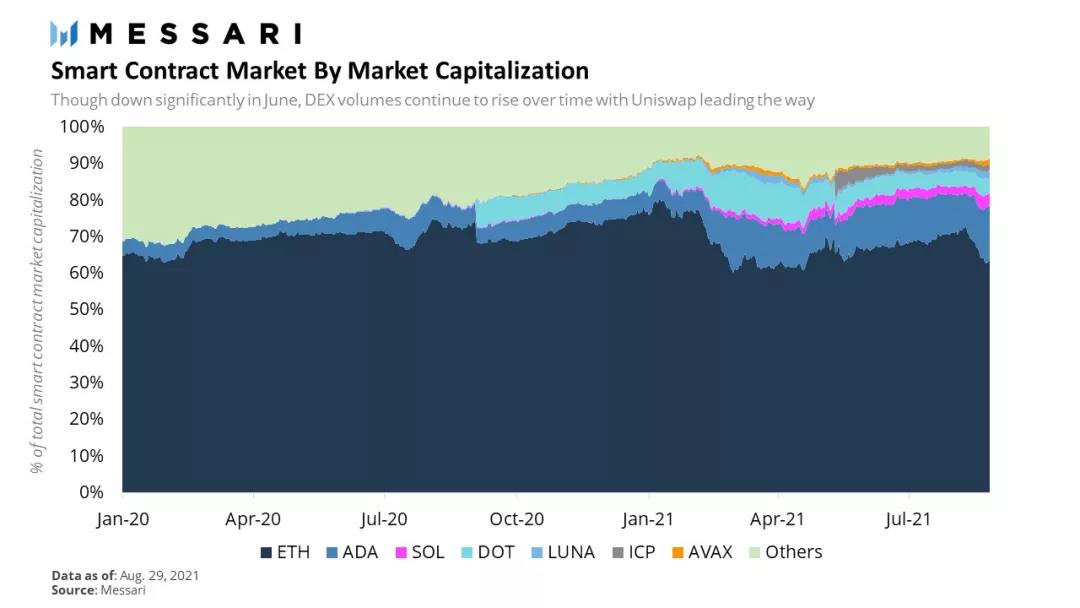
Above: Changes in market capitalization of major smart contract platforms since January 2020. Source: Messari
image description
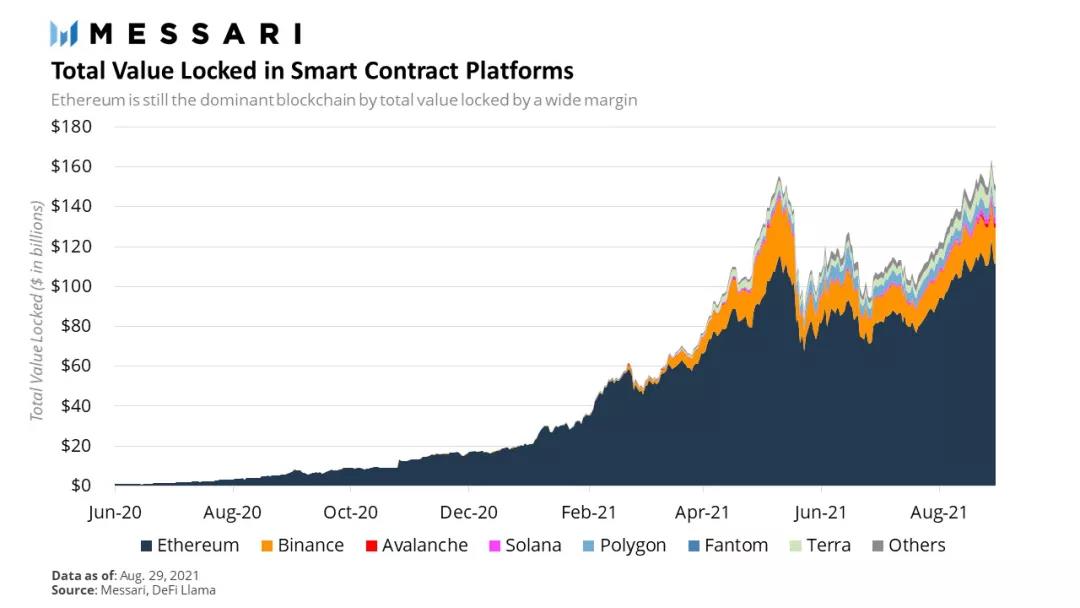
Above: Growth in Total Value Locked (TVL) in major smart contract platforms since June 2020. In terms of total TLV value, Ethereum still dominates, and other chains still have a large gap with Ethereum. Source: Messari
secondary title
Valuation 101
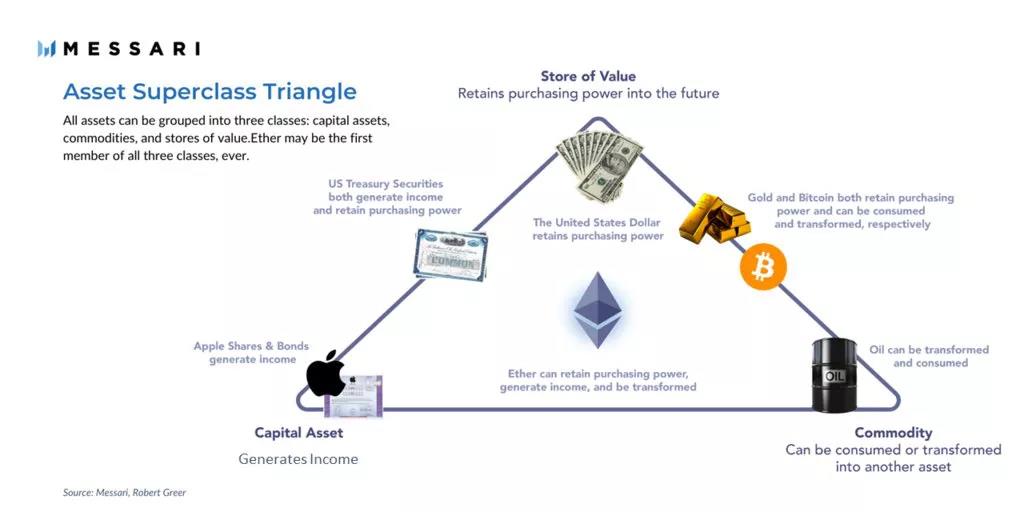
First, there is no consensus on a valuation framework for smart contract platforms. The native assets of these smart contract platforms offer a unique combination of properties that make them different from anything that existed before: in many ways, they are like currencies because they are the primary store of value and transactional currency in their own economy; In many ways, they are also like equity, because by staking these assets and processing transactions in these chains, you can get the fee income denominated in these native assets; in many ways, they are also like commodities, because holding them can earn Access to on-chain computation.
This combination of attributes gives these native assets the attributes of all three asset superclasses and drives the value of these native assets. But it also makes their valuation extremely difficult, especially given that these projects are still at such an early stage and face an uncertain future.
Nonetheless, investors attempt to value these assets to the fullest in absolute and relative terms, using a combination of quantitative and qualitative measures. One thing they all agree on is that whichever smart contract platform wins out will be worth a fortune (trillions of dollars).
At the most basic level, investors value assets based on two factors: fundamentals and willingness to pay.
Fundamentals typically include quantitative factors (KPIs) such as total value locked (TVL), transaction volume, and transaction fees, as well as qualitative factors such as competition, developer interest, and community. The assessment of these fundamentals is based both on looking back at the historical situation (to understand its historical performance) and looking forward (to understand its potential future performance). Historical performance gives us an idea of where it came from, and future performance gives us a glimpse into what the future might hold. Markets are always forward-looking, and the future value an asset will create is the driving force behind its valuation.
Willingness to pay also involves both quantitative and qualitative factors. Willingness to pay determines how much an investor is willing to pay now for fundamentals X years into the future. In terms of willingness to pay, this is more of an art than a science, influenced by direct data comparisons of different assets (relative valuations), macroeconomic conditions, market sentiment, narratives, memes, etc.
So, how does this apply to smart contract platforms?
Remember the quote about smart contract platforms at the beginning of this article?
"No one is using this chain. This ghostly chain shouldn't be valued that much compared to Ethereum." - Overheard on Twitter.
The reason this statement is false is because, as we already know, markets look forward, not backward. Speculators value Ethereum’s competitors not on their current fundamentals, but on their likely future fundamentals.
If Ethereum is any guide, the fundamentals can change quickly. 18 months ago, Ethereum settled less than $1 billion in transactions per day, had less than $20 billion in assets stored on-chain, and hosted only a few hundred applications; Fueled by incentives and supported by the strongest bull market in the history of the crypto industry, the Ethereum ecosystem has grown by nearly two orders of magnitude.
secondary title
A new phase in the battle of smart contract platforms

As all the major smart contract platforms have entered the mainnet launch, the application ecosystem is starting to develop on these platforms, and the bridge to transfer assets between them (the so-called "cross-chain bridge") has been launched, and the smart contract platform The war has entered a new stage. We no longer need to theorize about the competitiveness (strength) of one platform versus another; the competition between these platforms for users, developers, and funding is in full swing.
Gaining user interest from Ethereum is not easy given its multi-year head start and oft-cited developer network effects, but Ethereum's competitors are implementing a variety of creative strategies to do so.
In some cases, these incentives include introducing massive liquidity mining incentives to incentivize users to try out their platform and replicate the success of Ethereum’s DeFi summer of 2020; Provides incentives to attract users to provide liquidity; also includes connecting with the developer community outside of the crypto space, hosting hackathons, and providing grant funding for developers. At a time when the current window of opportunity is open and Ethereum is rolling out a suite of scaling solutions, all platforms are actively looking for growth.
So why does all this matter?
secondary title
text

We have been in a multi-chain world for some time now, and Bitcoin and Ethereum are still the two dominant forces in this industry. With the emergence of various blockchains in various industries, will there be a third dominant force? Perhaps there is a fourth or fifth force? Or might Ethereum not just be strong enough to beat every other smart contract platform, but replace Bitcoin as the primary store of value in the crypto industry?
The answer depends on how specialized blockchain ends up being, and to what extent it ends up being a dominant smart contract platform that serves most of blockchain's use cases.
This answer will have a major impact on how those leading blockchain platforms will ultimately share the trillion-dollar pie. A crypto-economy consisting of a handful of dominant blockchains would not be different from the world we live in today, which already has 5 tech companies worth over $1 trillion (Apple, Amazon, Microsoft, Google, Facebook). Perhaps this pattern applies to blockchains as well, given that they are becoming more composable with each other, and many blockchains offer functionality that others cannot due to design trade-offs. We may end up discovering that these blockchains create more value together than they could individually.
secondary title
Ethereum is like a magnet
For the rest of this bull market, Ethereum’s valuation will likely continue to be a magnet for other competing smart contract platforms, targeting Ethereum as a target to assess what it is worth when it becomes the industry’s number one smart contract platform. These competing platforms will continue to be priced relative to Ethereum based on their absolute and relative growth prospects. Likewise, as the market continues to heat up and sentiment rises, investors will likely continue to be willing to pay more for that growth.
Ethereum will likely continue as the dominant platform, with all other competing platforms catching up. It may continue to be the home of all grassroots innovation, DeFi and NFTs; it may become the first smart contract platform to attract institutional participation at the application level, and it may be the first through exchanges and brokerages A platform that integrates to achieve mass adoption. In all of these areas, Ethereum will continue to have an edge over its competitors with its large and diverse developer community, proven protocol, and vibrant community.
But its competitors will continue to advance in parallel. And, as long as the smart contract pie is growing and smart contract platforms have the potential to grow into trillions of dollars, speculation will remain at the heart of the smart contract space.





