


From the 1990s to the present: Bitcoin and the continuation of the cypherpunk


Original title: "Dry goods | The continuation of Bitcoin and Cypherpunk", author Jameson Lopp
From Bitcoin to blockchains to distributed ledgers, the field of cryptocurrencies is changing so fast that it can be hard to see where it's headed.
However, we can still find some traces. Although there are many innovative technologies in the cryptocurrency industry, they are all based on decades of research by predecessors. By tracing this history, we can understand the motivation behind the Bitcoin movement, and in turn understand Bitcoin's vision for the future.
Prior to the 1970s, cryptography was used mainly in secret by military agencies and spy agencies. However, two publications brought cryptography into the limelight: The Data Encryption Standard, published by the U.S. government, and New Public-Key Cryptography, the first published book on public-key cryptography by Dr. Whitfield Diffie and Dr. Martin Hellman. direction".
In the 1980s, Dr. David Chaum wrote numerous papers on cryptography. One of the papers, "Security Without Identification: A Transaction System That Makes Big Brother a Thing of the Past," mentions anonymous digital cash and anonymous reputation systems.
Over the next few years, these ideas coalesced to form a movement.
In late 1992, Eric Hughes, Timothy C May, and John Gilmore formed a small team that met monthly at Cygnus Solutions, John Gilmore's San Francisco Bay Area company. The team has a witty name "cypherpunks (cypherpunks)", which is short for "cipher (password)" and "cyberpunk (cyberpunk)".
The cypherpunks mailing list was created around this time. A few months later, Eric Hughes published "A Cypherpunk's Manifesto". He wrote:
"In the electronic age, privacy is a prerequisite for an open society. Privacy is not to be confused with secrecy. A private thing is something you don't want everyone to know, and a secret is something you don't want anyone to know. Privacy is selectively revealing yourself to the world right."
It sounds reasonable. But you might be thinking, I’m not a cypherpunk, I’ve done nothing wrong, what do I have to hide? But as Bruce Schneier says, "no need to hide" people get the premise wrong: not only criminals need privacy, and using privacy protections doesn't mean there's a ghost.
For example, you put curtains on the windows to prevent outsiders from seeing into the house. This does not indicate that you are engaging in anything illegal or immoral, just that you are concerned about the possible negative repercussions of exposing yourself to the outside world.
If you are reading this article, you will find yourself a direct beneficiary of the cypherpunk movement.
Here are some well-known cypherpunks and their contributions:
Jacob Appelbaum: Developer of Tor
Julian Assange: Founder of WikiLeaks
Dr. Adam Back: Inventor of Hashcash and Founder of Blockstream
Bram Cohen: Inventor of BitTorrent
Hal Finney: Lead author of PGP 2.0 and creator of Reusable Proof of Work
Tim Hudson: Co-author of SSLeay (the predecessor of OpenSSL)
Paul Kocher: Co-author of SSL 3.0
Moxie Marlinspike: Founder of Open Whisper Systems (developer of Signal)
Steven Schear: Proposer of the concept of "warrant canary"
Bruce Schneier: Well-known security research author
Zooko Wilcox-O'Hearn: Developer of DigiCash and Founder of Zcash
Philip Zimmermann: Proposer of PGP 1.0
(Translator's Note: Most of these achievements are about Internet privacy, and some have become Internet infrastructure, such as SSL.)
1990s
During the 10 years from the 1980s to the 1990s, the cryptography war broke out, and the US government tried to kill the commercial trend of cryptography technology.
During this period, cryptography was almost completely monopolized as a military technology, and encryption technology was included in the 13th category of the US Munitions List, and "export" was strictly prohibited.
Due to export restrictions, "exportable" SSL encryption supports only 40-bit key lengths, which can be cracked using a personal computer in a few days.
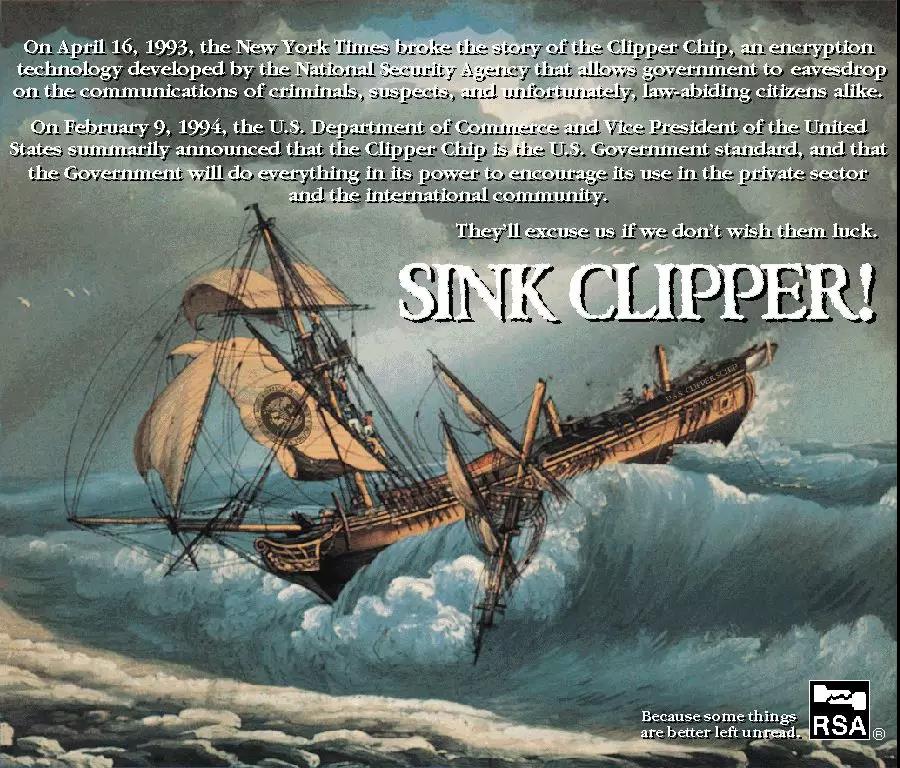
The U.S. government finally gave up on cryptography due to complaints from civil libertarians and privacy advocates that the U.S. government violated citizens' privacy, the popularity of encryption software outside the United States, and Matt Blaze's successful hacking of the Clipper chip with a backdoor proposed by the U.S. government. monopoly.
In 1997, Dr. Adam Back invented Hashcash. Hashcash is an anti-spam mechanism that makes spammers lose money by effectively increasing the (time and computational) cost of sending emails.
Adam Back thinks that Hashcash will be easier to use than Chaum's digicash because users don't need to create an account. In addition, Hashcash has also taken some measures to prevent "double spending" attacks.
In late 1998, Wei Dai proposed the idea of "b-money" to enforce agreements between anonymous participants. He put forward two interesting concepts, I think you will not feel unfamiliar. The first concept is to allow each participant to maintain an independent database to record the ownership of the user's funds; the second concept is a variant of the first one, where some participants record the user's account balance. Participants need to pay a deposit to prevent evil.
Bitcoin adopted the first concept, and many other cryptocurrency projects adopted a variation of the second concept (what we now call Proof of Stake).
21st century
Clearly, the cypherpunks built on each other's research for decades, experimenting and creating the framework needed in the 1990s. Most critical, however, is the birth of cryptocurrency in the 21st century.
In 2004, Hal Finney created Reusable Proof-of-Work (RPOW) based on Back's Hashcash. RPOW is a special cryptographic token that can only be used once, much like Bitcoin's unspent transaction output. However, verification and preventing double spend attacks are still performed by centralized servers.
Nick Szabo came up with "bit gold" in 2005 - a digital collectible created based on Finney's RPOW. However, instead of proposing a mechanism to limit the total issuance of bit gold, Szabo envisions that the value of each unit of bit gold will vary based on the amount of computation required to create them.
Finally, in 2008, Satoshi Nakamoto (a hitherto unknown individual/group) published the Bitcoin white paper, in which he mentioned hashcash and b-money. In fact, Satoshi mentioned in an email to Wei Dai that he learned about b-money from Dr. Back.
Satoshi Nakamoto specifically mentioned privacy in the Bitcoin white paper:
image description
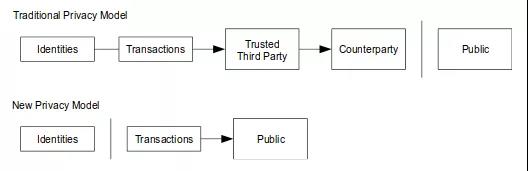
- Bitcoin's Privacy Model (Source: Bitcoin Whitepaper) -
Satoshi Nakamoto created a system that people can use, extend and fork, which greatly promoted the development of cryptography.
The birth of Bitcoin made the entire cypherpunk movement even more powerful. It allows organizations such as WikiLeaks to continue operating through Bitcoin donations after being blacklisted by the traditional financial system.
The Privacy Fight
However, privacy concerns appear to have been downplayed as the Bitcoin ecosystem has grown in recent years.
Many early Bitcoin users thought that the Bitcoin system would allow them to be completely anonymous, but we understand that many law enforcement agencies have revealed that they are able to identify Bitcoin users during investigations.
The Open Bitcoin Privacy Project fills this gap by educating users on privacy and recommending the best use cases for Bitcoin services. The group constructed a threat model of privacy attacks on Bitcoin wallets.
The model currently divides attackers into the following categories:
Blockchain Observer - Connecting different transactions to the same identity by observing patterns in value streams.
Network Watcher - Connects different transactions and addresses by observing activity on a peer-to-peer network.
Physical Attacker - Trying to find data on the wallet device to tamper with the wallet or analyze it.
Transaction Participants - Create transactions to track activity on the blockchain and identify transactors.
Wallet Providers - May ask users to provide personally identifiable information and then observe their transactions.
Blockstream's Jonas Nick has done a lot of research on privacy issues for Bitcoin users.
Jonas Nick exposed a lot of privacy holes in a great talk. Some of these vulnerabilities were devastating for SPV Bitcoin clients:
Address: https://youtu.be/HScK4pkDNds
In the case of Bitcoin, the biggest threat to privacy comes from blockchain observers - since every transaction in the network is permanently public, anyone can threaten the privacy of Bitcoin users, now or in the future .
Therefore, the best practice is to never reuse the same bitcoin address, which is also clichéd advice.
Satoshi Nakamoto even emphasized this in the Bitcoin white paper:
"As an extra privacy safeguard, traders should use a new key pair each time they send a transaction, in case someone finds out who owns those transactions. A multi-input transaction must show that the inputs are all from the same owner. , so it is inevitable that some correlation will be leaked. The risk here is that this correlation may leak other transactions of the owner of the key if the identity of the key owner is revealed."
Cypherpunk innovations in recent years
In order to improve the privacy of Bitcoin users, many systems and best practices have been created in recent years. The hierarchical deterministic wallet proposed by Dr. Pieter Wuille in BIP32 can greatly reduce the difficulty of managing addresses in Bitcoin wallets.
Although privacy protection is not the main purpose of Pieter Wuille, the hierarchical deterministic wallet can easily generate new addresses for transactions, helping users avoid address reuse.
Elliptic Curve Diffie-Hellmann-Merkel (ECDHM) addresses are a privacy-enhanced Bitcoin address scheme. ECDHM addresses can be shared publicly. ECDHM addresses can be used by transaction senders and receivers to secretly generate traditional Bitcoin addresses that blockchain observers cannot predict. Therefore, ECDHM addresses can be reused, unlike traditional Bitcoin addresses that will leak privacy due to reuse.
Examples of ECDHM address schemes include Stealth Addresses proposed by Peter Todd, BIP47 reusable payment codes proposed by Justus Ranvier, and BIP75 out-of-band address exchange proposed by Justin Newton et al.
Users can also use bitcoin mixers to enhance privacy, but this method requires more human resources. The concept of mixing tokens of network participants is similar to Dr. Chaum's "mix network".

Several existing currency mixing algorithms include:
CoinJoin - The first currency mixing algorithm is CoinJoin proposed by Gregory Maxwell, the co-founder of Blockstream. It allows users to create transactions with inputs from multiple parties, and then send bitcoins to multiple outputs (i.e., the same person), since each fund is mixed together, the correlation between inputs and outputs is difficult to find .
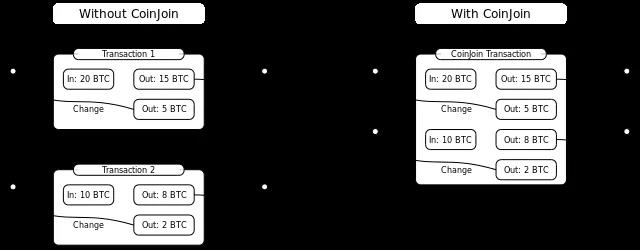
- Simple CoinJoin transaction diagram -
JoinMarket — The JoinMarket proposed by developer Chris Belcher allows Bitcoin holders to earn fees by providing Bitcoin to participate in CoinJoin mixing. JoinMarket uses some kind of smart contract to prevent the user's private key from leaving the local area, thereby reducing the risk of private key loss. In short, JoinMarket allows you to increase the privacy of Bitcoin transactions in a low-cost and decentralized way.
CoinShuffle — A group of researchers at Saarland University in Germany developed the decentralized currency mixing protocol CoinShuffle. CoinShuffle is an improved version of CoinJoin that does not require a trusted third party to create mixed currency transactions, so no additional mixed currency fees will be charged.
CoinSwap - CoinSwap proposed by Maxwell is very different from CoinJoin in that it uses a set of 4 multisig transactions (two escrow transactions and two escrow release transactions) to enable trustless token exchange between two parties. Although it is far less efficient than CoinJoin, it can provide stronger privacy and even realize cross-chain token transactions.
Mixing coins is tantamount to "hiding trees in the forest", but the forest is usually not very big. Mixing coins can only cause confusion and cannot achieve complete anonymity, because this type of scheme can only make it difficult for low-level observers to track the flow of funds, but high-level observers may still crack mixed currency transactions.
image description
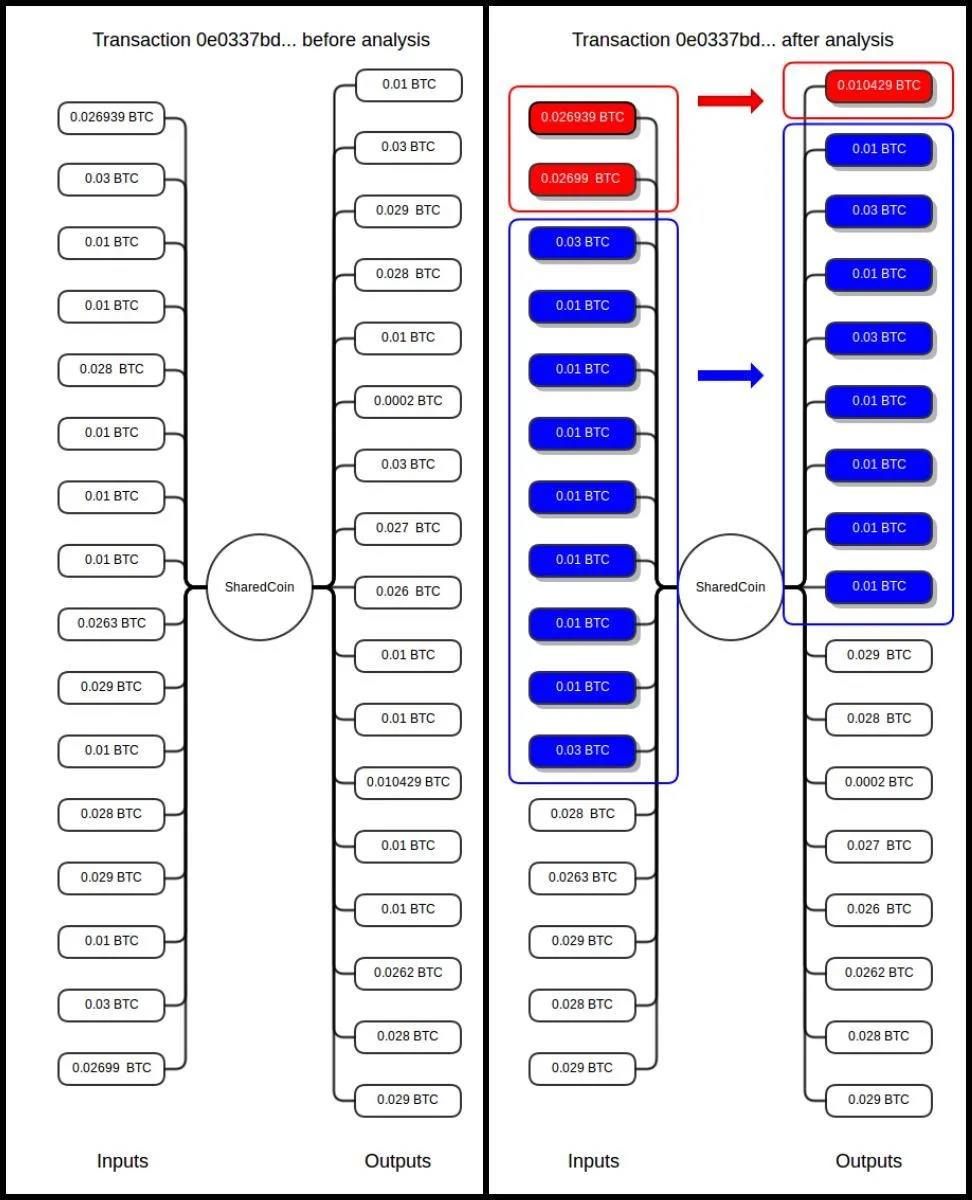
image description
Atlas noted that even with crude analysis tools, he was able to find 69% of the inputs and 53% of the outputs in a CoinJoin transaction.
There are even some privacy-focused cryptocurrencies.
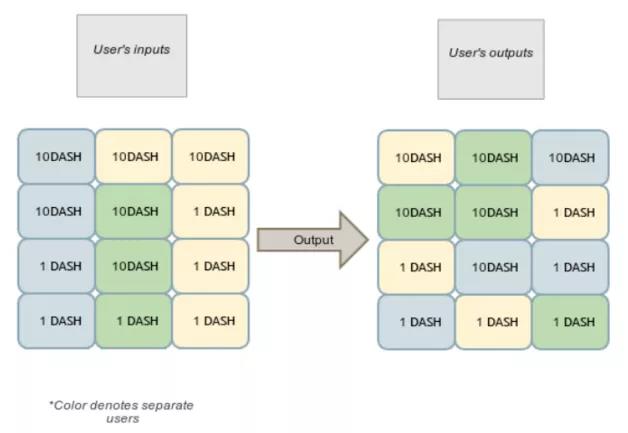
For example, Dash by Evan Duffield and Daniel Diaz has a feature called "Darksend". Darksend is an improved version of CoinJoin, which is mainly improved in the amount of use and the frequency of currency mixing.
Dash's currency mixing scheme uses common amounts such as 0.1 DASH, 1 DASH, 10 DASH, and 100 DASH, which greatly increases the difficulty of input and output grouping. In each mixing session, users submit the same amount as input and output.
image description
- DASH Mixing (Source: DASH White Paper) -
There is also a class of privacy coins that are not even built on top of Bitcoin. In 2014, Nicolas van Saberhagen released a white paper for CryptoNote. Some cryptocurrencies, such as Monero, are implemented based on the concept of CryptoNote. The main innovations are cryptographic ring signatures and one-time keys.
Common digital signatures (such as Bitcoin signatures) are created by a pair of keys (public and private). Therefore, as long as someone can use the private key to sign a transaction, it can be proved that the public address corresponding to the private key is owned by ta.
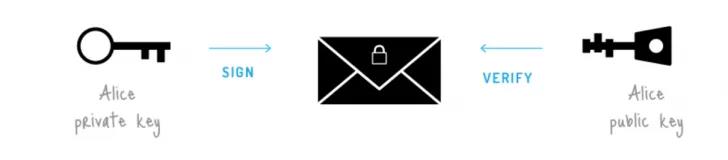
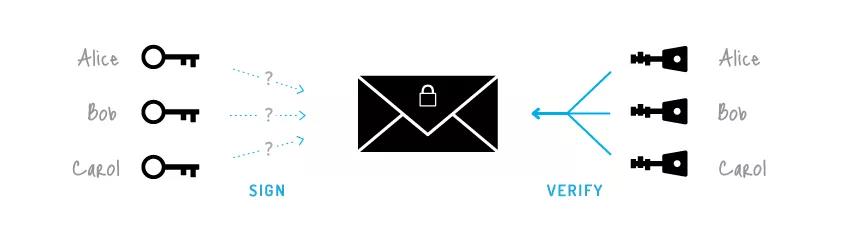
The ring signature was first proposed by (ring signature) Dr. Adi Shamir et al. in 2001, based on the group signature (group signature) proposed by Dr. Chaum and Eugene van Heyst in 1991. Ring signatures require a group of parties, each holding its own key pair.
Ring signatures can prove that the signer of a message is a group member. The main difference between it and ordinary digital signature schemes is that the signer only needs to hold a private key, but the verifier cannot determine the exact identity of the signer.
So if you see a ring signature containing the public keys of Alice, Bob, and Carol, you can only tell that the signer was one of the three, but you have no way of knowing who the signed transaction belongs to. Ring signatures provide another level of obfuscation, making it difficult for blockchain observers to trace who (the originator) is for each payment in the system.
image description
- Ring Signature (Source: https://cryptonote.org/inside/) -
CryptoNote is designed to mitigate the risks of key reuse and using inputs to track outputs. The payment address is a one-time key generated using the sender's and payee's data. As soon as you use ring signatures on inputs, it becomes harder to determine exactly which transaction's output it spent.
If a blockchain watcher tries to find out the association between used addresses based on the transactions on the blockchain and draw a graph of the relationship, one will get a tree diagram because no address has been used twice. The dendrogram possibilities grow exponentially with more transactions, as each ring signature adds uncertainty to the flow of value between addresses.
Therefore, you cannot determine the exact payment address.
Depending on the number of participants involved in the ring signature, the obfuscation of each transaction varies from "1/2" to "1/100". Each new transaction increases entropy and makes it harder for blockchain watchers to track.
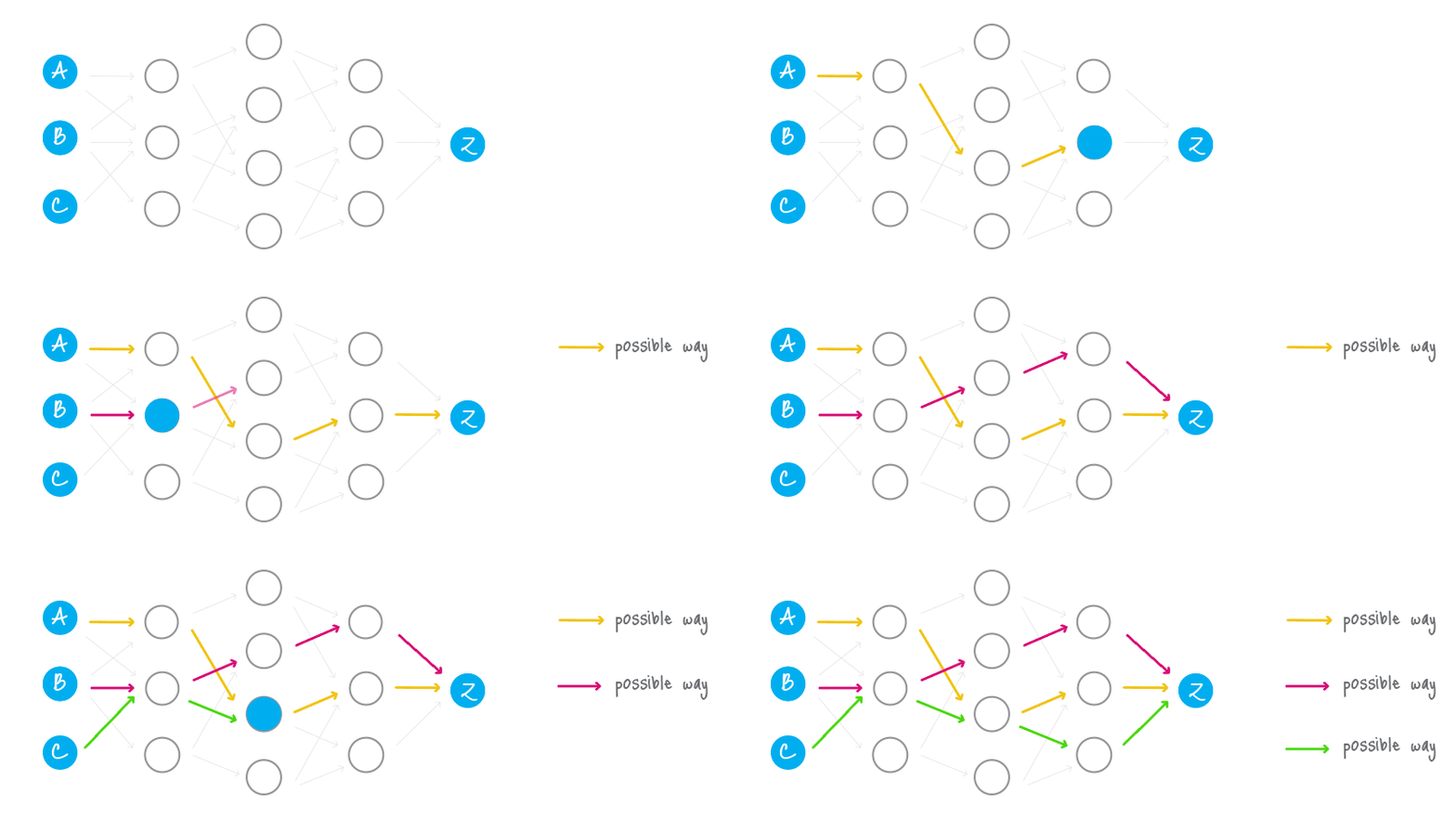
- Anti-Blockchain Analysis (Source: https://cryptonote.org/inside/) -
A cypherpunk innovation in the making
Although there are still many hidden dangers in the privacy and security of cryptocurrency users, with the continuous efforts of cypherpunks, the future will be bright.
Zero-knowledge proofs may be the next big leap forward in privacy protection. Zero-knowledge proofs were first proposed in 1985 to broaden the potential applications of cryptographic protocols.
Based on "Bitcoin with Homomorphic Value" written by Dr. Back in 2013, Maxwell has been concentrating on research on confidential transactions (Confidential Transaction). Confidential transactions use zero-knowledge range proofs to create Bitcoin transactions such that the value contained in the transaction is visible only to the parties involved.
Confidential transactions are a big step forward in themselves. However, if we combine it with CoinJoin, we can build a currency mixing service that cuts off all links between transaction inputs and outputs.
Maxwell once shared a topic on "Sidechain Elements" at the Bitcoin Developers Conference held in San Francisco. I remember him saying something like this: "One of the biggest regrets of the old men in the IETF (Internet Engineering Task Force) is that the Internet was not built with encrypted data transfers by default."
Maxwell apparently thinks the same about bitcoin's privacy: if only confidential transactions could be used in the first place. Today, Blockstream has implemented confidential transactions on the Liquid sidechain to mask transfers between exchanges.
Maxwell has implemented Zero-Knowledge Contingent Payment (ZKCP) on the Bitcoin network and successfully completed the first payment. ZKCP is a trustless transaction protocol that allows buyers to buy information from sellers using Bitcoin. The buyer will and will only receive the information when the payment is complete. Buyers and sellers do not need to trust each other, or rely on third-party arbitration.
A few years ago, I wrote an article about Zerocoin and pointed out that the system needed to solve some technical challenges before it could become truly usable. Since then, researchers have made proofs more efficient and addressed trust issues through initial system parameter generation. The vision of Zerocoin is about to be realized with Zcash, created by Wilcox-O'Hearn.
Zcash provides complete payment privacy while using a public chain to maintain a decentralized network. Zcash transactions automatically hide the sender, payee, and transfer amount for all on-chain transactions. Only the holder of the viewing key can view the content of the corresponding transaction. Since the contents of Zcash transactions are encrypted and private, the system needs to use new cryptographic methods to verify payments.
Zcash uses a zero-knowledge proof structure called zk-SNARK. zk-SNARKs were developed by a group of experienced cryptographers.
The transaction metadata is encrypted, and the transfer authorization and amount will not be disclosed. zk-SNARKs are used to prove the validity of transactions. Zcash is quite possibly the first digital payment system to achieve bulletproof anonymity.
Cypherpunks pass the torch
In the past ten years that the cypherpunks have been searching, computer technology has also made great progress. Both individuals and groups can communicate and interact in complete anonymity.
Two people can exchange information, conduct business and enter into electronic contracts without knowing the other's real name and identity. Governments, of course, will hinder or contain the spread of the technology on the grounds that it has the potential to threaten national security, facilitate crime, and cause social division.
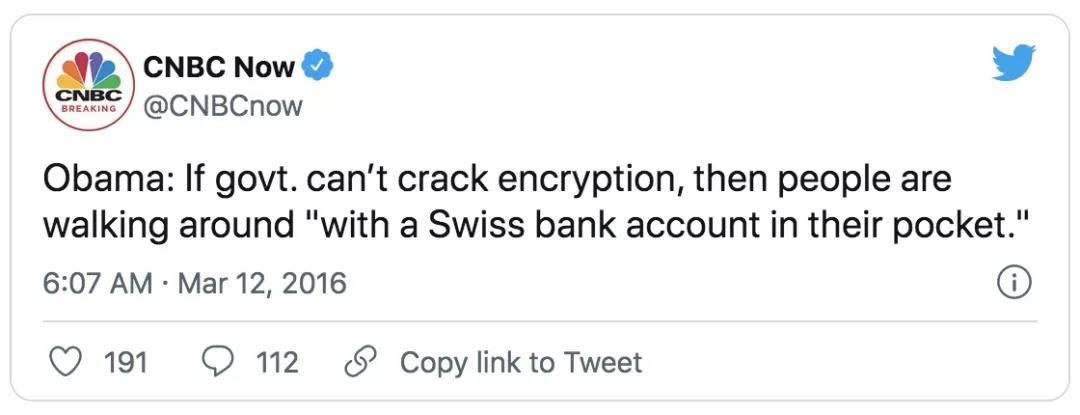
Cypherpunks know that to gain privacy, we must defend it. Over the centuries, in order to protect privacy, people have resorted to various means: whispering, secret meetings, sealed letters, closed doors, secret handshakes and personal messengers.
Before the 20th century there were neither strong privacy technologies nor technologies that could enable low-cost mass surveillance.
Despite the existence of privacy-enhancing technologies, the world still favors surveillance over privacy. We have entered what many people call Cryptography Wars 2.0.
Although the cypherpunks won the first cryptography war, we must not get carried away. Zooko has experienced the failure of cypherpunk projects, and he warned us to be mentally prepared for failure.
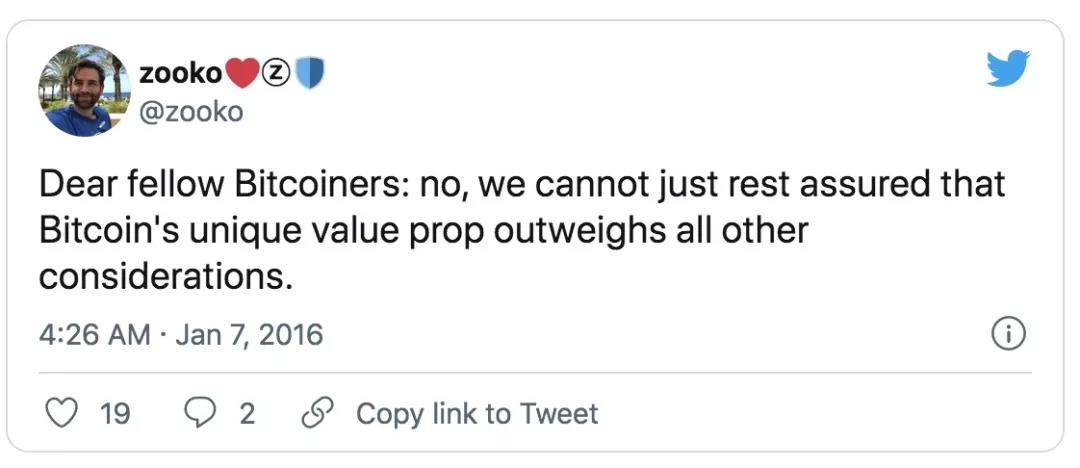
Cypherpunks believe that privacy is a fundamental human right, including privacy guaranteed by governments. They understand that any compromise of the security of the system for any reason (including the intervention of "trusted authorities") threatens the security of the system's users.
Cypherpunks write code. They knew someone had to write software to defend privacy, so they came forward. They also expose the code so that other cypherpunks can learn, attack and improve.
Cypherpunks allow anyone to use their code, and don't care if others approve of the software they write. They know their software cannot be compromised, and their widely distributed systems cannot be shut down.
—–BEGIN PGP SIGNED MESSAGE—–
Hash: SHA256
Public Key: https://keybase.io/lopp/key.asc
The original Cypherpunks mailing list no longer exists, but there are more Cypherpunks now than ever before. We discuss our ideas on a wide variety of email lists, chat rooms, and social media platforms. There is much work to be done; while great progress has been made designing and deploying privacy enhancing systems, they are still far from perfect and it is still far too difficult for the average person to benefit from them. There are many battles left to be fought in the Crypto Wars; take up your keyboards and let us proceed together apace.
—–BEGIN PGP SIGNATURE—–
wsFcBAEBCAAQBQJW9VrFCRAnjdn7DA6bSQAAI68QAKxMRyGXfr8g0xhNJadJFaH6
iXJlv+PA74h3oSKV97lOAejY8yGyhyb8UodF5H3YBqSrLUCEF2Xj8U4pCl5imvSe
uuRfxbSeyUcgMonxF8W4dswcU0Ls1znLbpVkoLiRNAkkFVG+LyGY0eC7dDQ17okf
mTzjaW6/3Ed289+yz7Lj5fE6pST4L7IsOEdlyPSm/1Rn6jLVaQ/WoNGB/xPUjNZw
zagpg5qHGgcTCHCPZR9i1obsJtKLHLCRhCCxHQ6ldAiLXJn0WeOCHYIRhaC4fr0P
C+yBB2BwzXccVh4PUvgc4OEXTFvZUCkvUd88Z3j5ZN8r0ZJB83ZPITk7TMueneYW
Ery21LXG2Wv+CACwPzE+LM9GkaOLkEDgiENDq20CsM6VQl3GkiCj3KdFl9btYvzw
tpiHbmvE4HMepiVc4TjhEmIiCTMAjkcn0MRQl/tJsPw5dyQBs22++O/cslzc3w+T
Ky+7DA4jIbMk993FpDsZwyqpvkPXWylLofbqq6DmLYCu1ahpdV8X18kApeY0W2E8
rsPDr4eukXnLdDemoqFDtsIYDPb/LdQe5RaXuH7/xpWzWuOccOe305pUZnic7CO3
5cVnSg7KgUjfZhfHPijyTzHKO8QShSl7bSMW/botaO9C/wha0/+qmnWVMdUwBVyj
BLDeMjqvB87UbJE5E7rl
=hR9e
—–END PGP SIGNATURE—–
(Signed message means: The original cypherpunk mailing list no longer exists, but the cypherpunk community has grown to an unprecedented size. We discuss our ideas on various mailing lists, chat rooms, and social platforms. Currently We still have a lot of work to do; while great progress has been made in the design and deployment of privacy-enhancing systems, they are far from perfect and difficult for ordinary people to benefit from. There are still many battles to be fought in the cryptographic wars; Grab your keyboards and let's charge forward together.)





