


Macroeconomics and Politics of YGG, AXS Gaming


Article translation: Block unicorn
Article translation: Block unicorn

I grew up in a brutal, stateless gaming world. A violent world ruled by a totalitarian emperor, the game developer, in which players have neither property nor other economic rights in exchange for their efforts to make the game great. In Metal Gear Solid, Skyrim, or Donkey Kong 3, the only glory is getting more currency. But the glory, and the sensory experience that gets more amazing every day, is enough to convince me to spend a lot of time on the screen at the expense of leisure time.
Then came the day when I left the game and pursued opportunities for intellectual and financial growth in the real world. I want an environment that promises to interact, build, innovate and get rewarded for my efforts and investments. In the mid-2000s, I was told that the world was Wall Street. But the results are not ideal: the effort required is enormous, the long experience is unpleasant, and the room for innovation and money shrinks every year under the onslaught of competition and regulation.
I'm not the only one with this idea, and definitely not the most experienced and accomplished. In March 2015, while at Morgan Stanley, I received an internal memo informing all employees that our CFO, Ruth Porat, was leaving the company to become Google's CFO. Ms. Porat, often referred to as the most powerful woman in finance, joined Morgan Stanley in 1987. I don't remember her last words, and I can't find a copy of the memo on the Internet, but I still remember the memo as follows: I joined Morgan Stanley when Wall Street was at the forefront of innovation, and for the same reason I Now leave the company and go to Google.
It was a strong move, but like I got into banking a few years ago, it was probably too late in its day. Patience is usually the least desirable quality, and in an ironic turn of events, my longtime and neglected friend may actually now be the best place to fulfill the ambition that got me out of it in the first place.
Axie Infinity and the explosion of P2E
In 2020, just after the end of the crypto winter, a game called Axie Infinity took the gaming world by storm. It combines the potential of CryptoKitties to make money from monetizing games with the cuteness and gameplay of the Pokemon franchise.
After Axie Infinity experienced explosive growth in the summer of NFT investing, many articles have been written about it, including Packy McCormick's spectacular work Infinity Revenue, Infinity Possibilities. Many but not all. Building on what others have done before, in typical crypto style, throughout this week I intend to look at Axie the way a macroeconomist would look at a country or a company.
First, is Axie Infinity a country or a company?
This is an impossible question to answer, but in order to use our mental models as investors we need to at least try to highlight some fundamental features of the game.
Centralized governance system with enforcement -> state. Using Weber's definition, a state is a body polity under a system of governance with monopoly power. Axie details a clear governance system in its whitepaper, which operates as a sort of constitution. The definition of power might need some extra color in the metaverse, but arguably nothing is stricter than hardcoding all the rules in the programming languages that make up reality. It's true that you can unplug yourself from the Metaverse, but that's not a unique feature of the Metaverse either.
Citizen representative -> company.Axie's ambition is to be a fully decentralized DAO where all decisions will be made by AXS token holders - this is not the case today, Sky Mavis has full control over decisions, top 10 addresses own 96% of governance tokens . The one-vote-one-vote model is more like a disintermediated corporate shareholder model than a universally representative democratic model. However, the AXS governance token, with a slight twist here, also needs to foster Axies, creating a link between monetary policy and citizen representation, which seems to be intentionally designed to reduce the reinforcing loop between wealth generation and political influence. In a way, it is also a form of taxation.
Sovereign Monetary Policy -> Country.Axie has its own internal form of currency: Smooth Love Potions, or SLPs. SLP is an uncapped utility token that can be used in-game to breed Axies according to a certain schedule. Once the SLPs are used up, they are burned. Players can basically obtain SLP in the game through the game, and can trade freely on DEX outside the game. Axie Infinity actually controls the currency base by changing burning and minting parameters.
Private ownership of assets -> state.image description
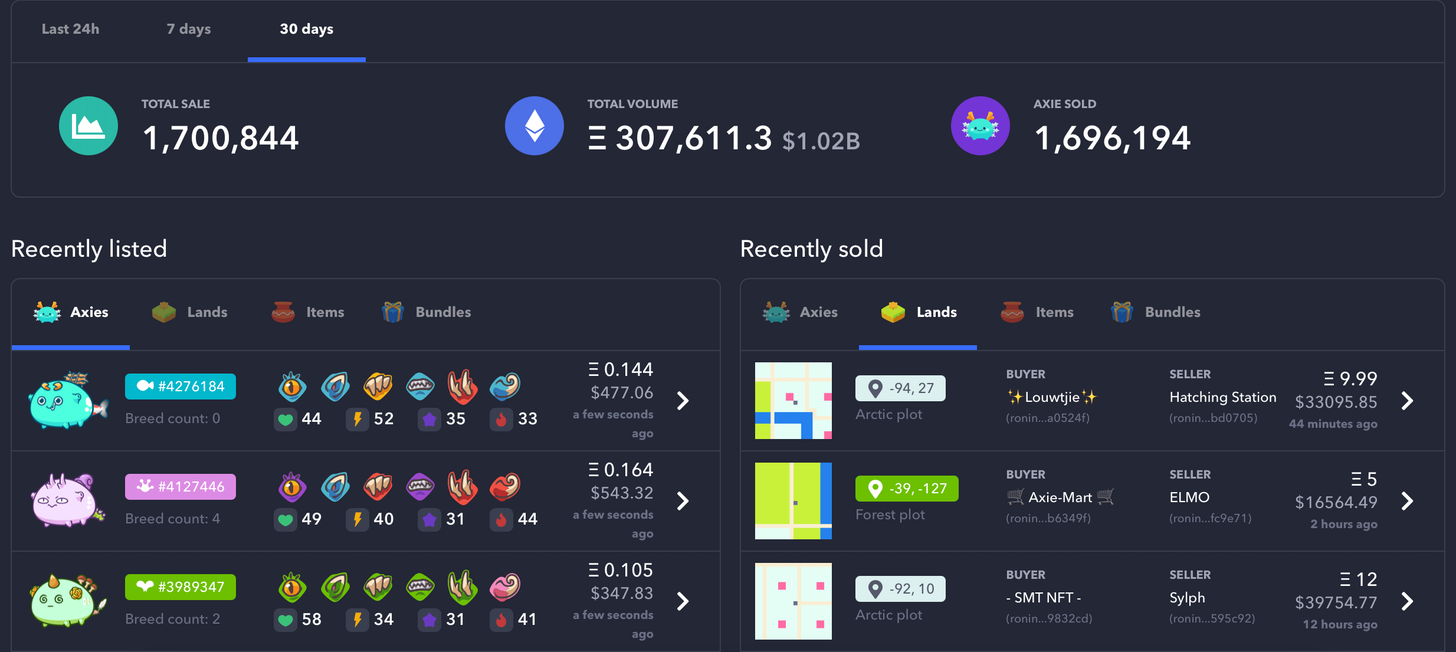
AXS Trading Market
Central Treasury -> Status.Axie Infinity generates revenue by taxing transactions and production. Axie NFTs are sold and purchased on its marketplace with a 4.25% discount and a breeding fee. Axie Infinity earns c. In the past 30 days, the protocol revenue is 350 million US dollars, which is 2 times that of Ethereum and 12 times that of OpenSea. Cumulative inflows to state coffers were $470 million, the vast majority of which came from breeding fees. The centralized vault is controlled by AXS token holders.
International Legal Sovereignty -> State.When it comes to offshore sovereignty, Axie Infinity is more of a country than a company. While Axie's relationship with the outer universe (and other metaverses) may be governed by an evolving set of rules, no regulatory body can significantly restrict activity within its boundaries.
Shared sense of purpose -> ?.response:
response:The state is a good proxy mental model to deal with Axie Infinity as an investor, although Axie is more of a kingdom than a modern democracy.
Axie Infinity, a macroeconomic view of the country
The ambition of Sky Mavis is to open up Axie Infinity to the community and grow it into a comprehensive, expanding, vertically integrated ecosystem. As investors, we should assess Axie's macroeconomic viability first, just like rating agencies assess sovereign risk before assessing corporate risk.
Stylized Traditional Frames: Reminders
A thriving export-oriented economy is characterized by a significant trade surplus and, on the other hand, a net inflow of the national currency from foreign markets. The net inflow of capital puts pressure on a currency that normally appreciates.
Currency appreciation increases citizens' purchasing power for foreign goods, has a deflationary effect on local prices, and distorts a country's industrial footprint. Because of the imbalance in its industrial policy, the economy remains exposed to fluctuations in foreign demand, often with damaging effects. It's often called the curse of commodities.
The mandate of monetary policy remains to balance the effects of deflation and inflation, and for the Treasury to direct spending and investment in a productive manner to achieve sustainable and balanced economic growth.
Axie Infinity Case Study
As a state, Axie is, broadly speaking, no different than any other state. Its economy is thriving, with a huge trade surplus and, based on the latest Treasury figures, we would imagine a fiscal surplus as well - with treasury revenues far exceeding development and running costs. In other words, Axie is currently a net importer of ETH — and indirectly fiat — due to strong demand for its native NFT. This puts a lot of pressure on its currency SLP.
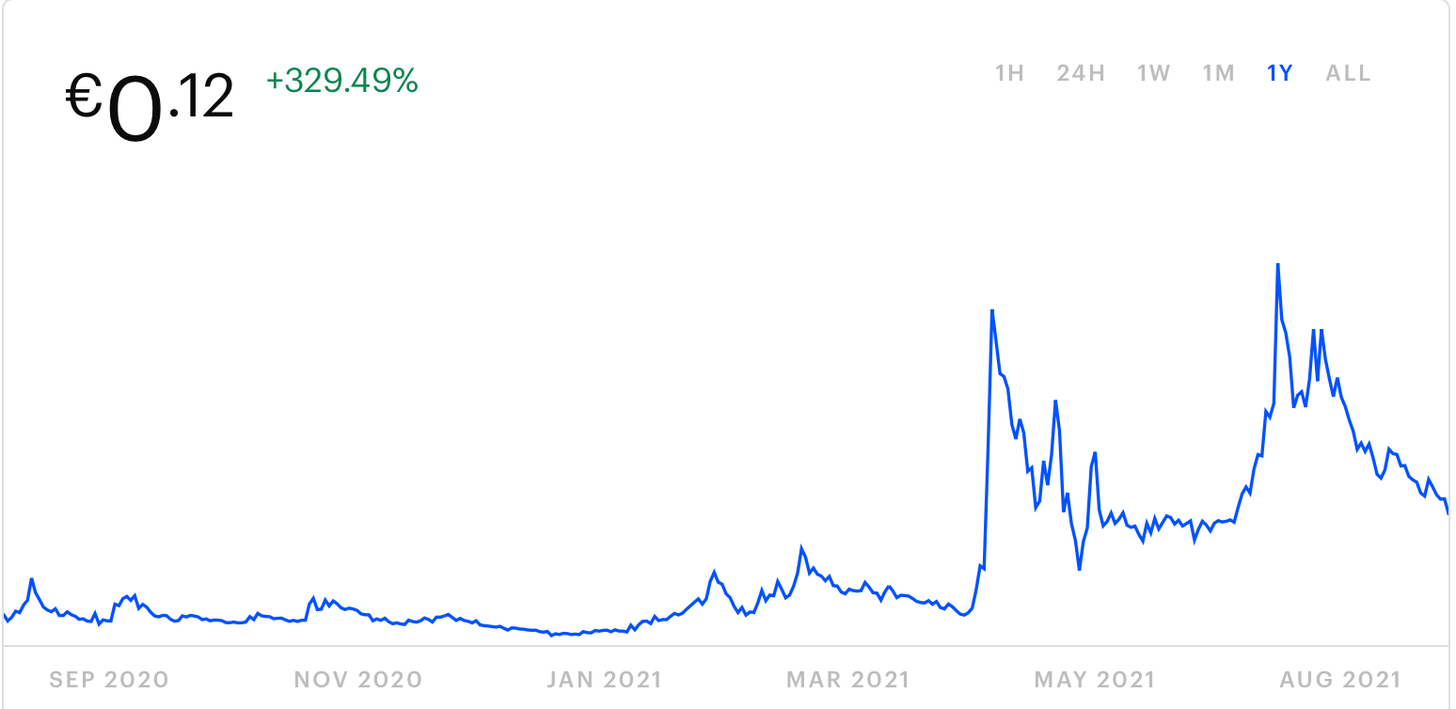
Since NFTs are the main commodity produced and exchanged in the economy, the effect of appreciating SLPs (and to a lesser extent AXS) will be deflationary, making it (relatively) more convenient for Axie players to swap SLPs for other tokens and buy NFTs Produce abroad, rather than domestically, to meet the needs of global investors. In the long run, this is bad for Axie as it reduces participation, currency and economic attractiveness, and future viability.
image description
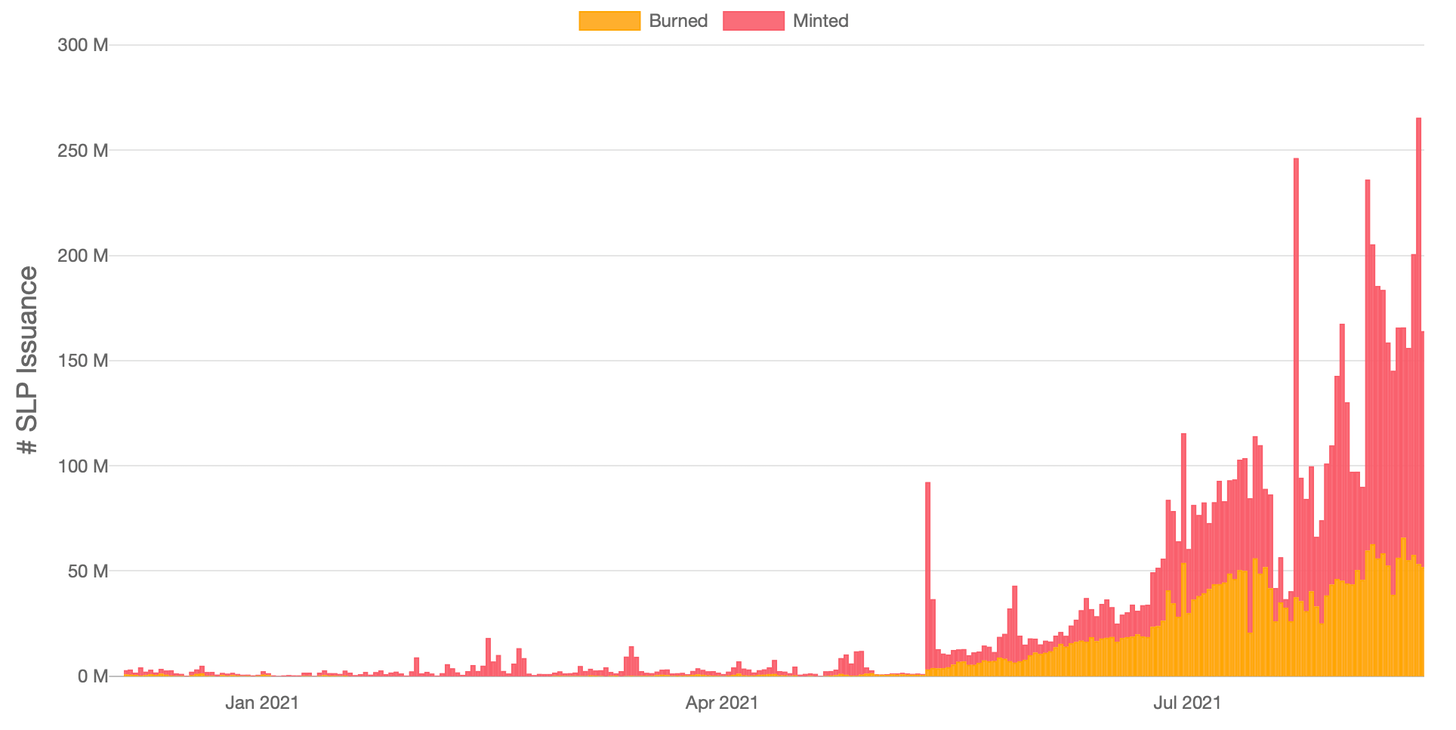
The world of AXS
However, hyperinflation is also bad for Axie, as it reduces the incentive to participate for players who earn in SLPs and spend them in ETH and fiat. In other words, it's a game of trial and error, and Sky Mavis is constantly trying to find the balance.
On August 9th, The Lunacian (Axie's substack) released some economic tweaks to the way SLP is earned, basically making minting harder and favoring expert players - i.e. using macroeconomic terms to curb inflation and promote skilled labor force. As exciting as it sounds, Sky Mavis is developing appropriate monetary, fiscal and industrial policies for its metaverse. The tone of the newsletter is clear (emphasis mine):
While we rarely comment on the scholarship system, we think these adjustments will put upward pressure on scholar salaries for skilled fighters and reward managers who spend time educating and training their scholars for Arena. As in the real world, higher compensation must be a function of variable outcomes. Transforming academics into skilled workers is a step in that direction.
short term
short term
Adjusted the AXS part of the breeding fee. The AXS portion of the breeding fee has become quite high recently and this is something we are considering adjusting.
Adjusts the amount of SLP required to breed Axies. If burning and casting still tend to oversupply SLP, we may increase the amount of SLP required for each variety in the future.
long
long
Launch our own decentralized exchange to attract greater liquidity for our game assets.
Need to release Axies to craft Axie sinks for materials. These crafting materials can be used to upgrade land, Axie body parts, and land items. They can also be used to craft consumables and buy/roll cosmetics.
Releases new features and Axie game modes that increase demand for Axies by accessing new experiences and utilities.
Yes, we're talking games. I have attempted to summarize these competing forces in the diagram below.
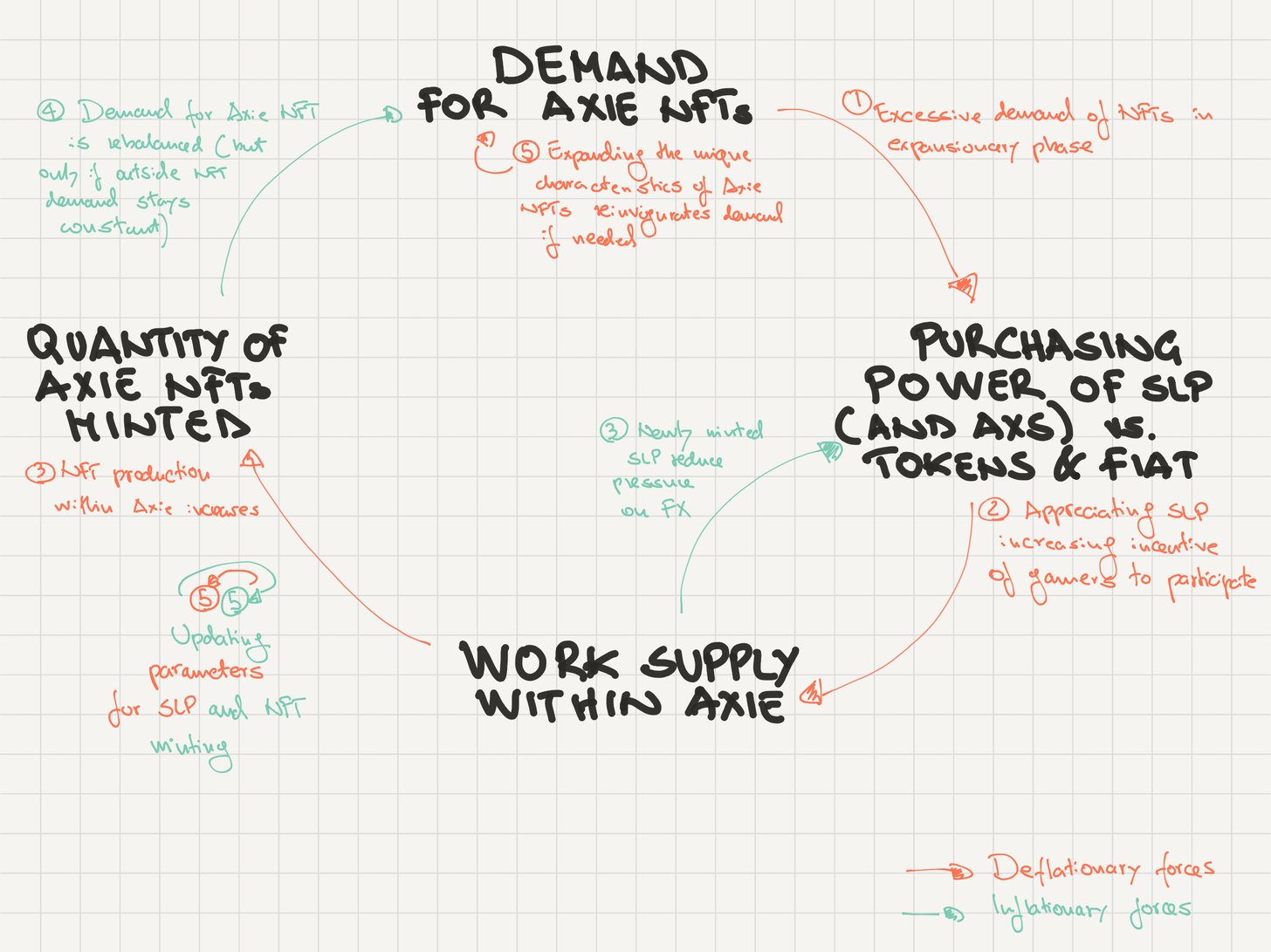
It remains to be seen whether Sky Mavis and later the DAO can achieve balanced growth of the Axie economy. Right now, investors are enjoying the explosive growth part of the story while ignoring the explosive risk that comes with it. We should continue to pay close attention to the growth rate of SLP's market capitalization.
The Emergence of the Metaverse Financing Industry
one
oneOnce the financial opportunity becomes a reality, it opens the door for actors who are ready to invest the initial capital in exchange for a portion of future earnings.
The rent-to-earn product is the first product line of Yield Guilt Games (YGG): allowing guilty members to use assets owned by YGG in exchange for a profit share. These profits, along with new capital from outside investors, will be used to buy additional NFTs in the Metaverse, much like real asset investors buy land, property, and other assets with the expectation of yield. A16z had invested $4.6 million in its latest funding round before YGG’s governance token sale completed on July 27.
Axie Infinity, The Sandbox and League of Kingdoms are just the first games YGG has decided to focus on. In its white paper, YGG describes itself as game agnostic, as long as the game has the following characteristics of the Metaverse:
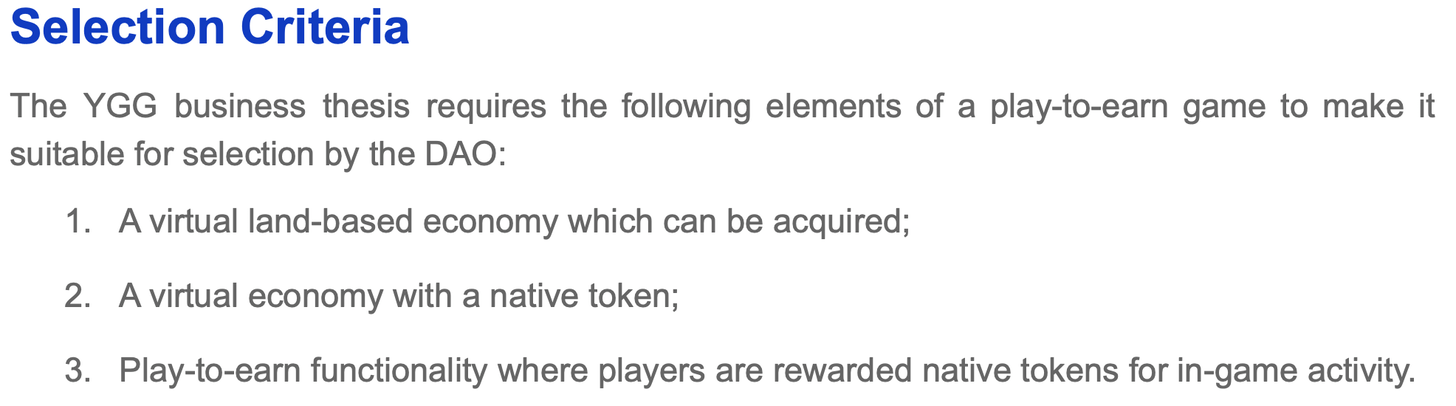
Aleksander Larsen, aka Psycheout, co-founder and COO of Sky Mavis, is one of YGG's advisors.
Establishment of Metaverse Investment Department
Not only does YGG's relationship remain agnostic to the underlying game, but it also involves situations where such activities may also be involved. Basically, the value of YGG can be inferred as all digital assets of the local metaworlds through any investment and management activities, making the company look like an old-school investment bank transplanted into the digital realm. Given the lack of regulation in these metaverses, there is a lot that entrepreneurs can do, including sponsorships, raids, merch sales, and land purchases, yield farms, and more.
There is a sense that, in response to increasing regulation, economic actors create and realize pockets of wealth where they replicate all the elements of the physical world they like, but none of the aspects they dislike. It will be interesting to see how long it takes for the red tape to catch up.
In addition, YGG is building a metaverse on top of the metaverse games it operates: YGG token holders can use these tokens to vote and receive financial benefits, as well as subscribe to the metaverse community with exclusive merchandise, content and benefits, My brain is going to explode.
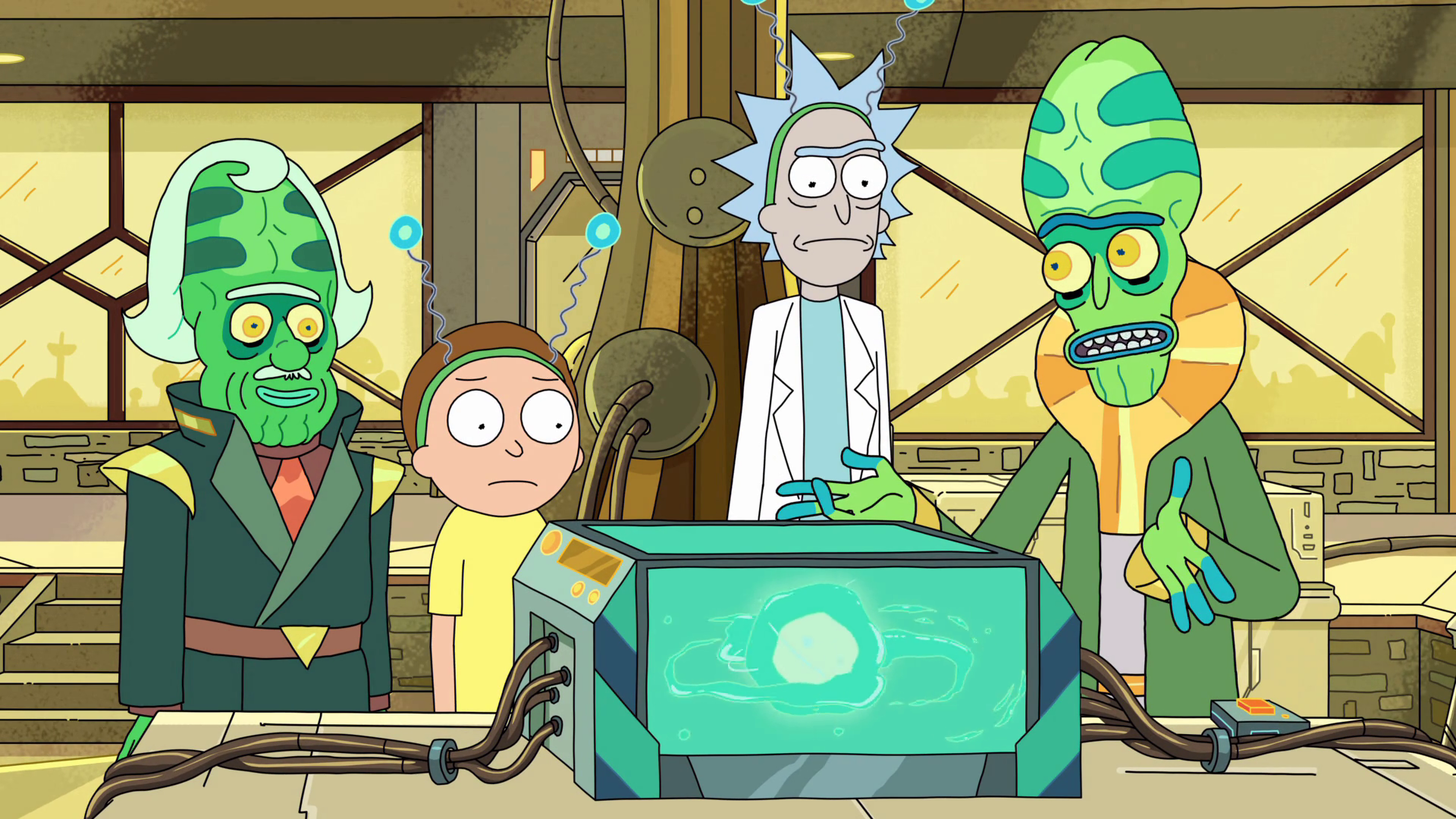
In Rick and Morty's S2.E6, Morty discovers that Rick's car battery is actually a microverse where he abuses the basic rights of citizens to generate electricity. But the microcosm itself does the same by creating a microcosm, and the microcosm and its microcosms are the same
Like many other crypto projects, YGG has ambitions to become a DAO. Of the 1b tokens planned to be issued, 45% will go to the community. However, the founders, investors and Treasury will still collectively control the majority vote on a fully diluted basis. As often happens, decentralization in theory does not necessarily translate into decentralization in practice. As of today, YGG has a tokenized capitalization of $565 million, or $800 million fully diluted.
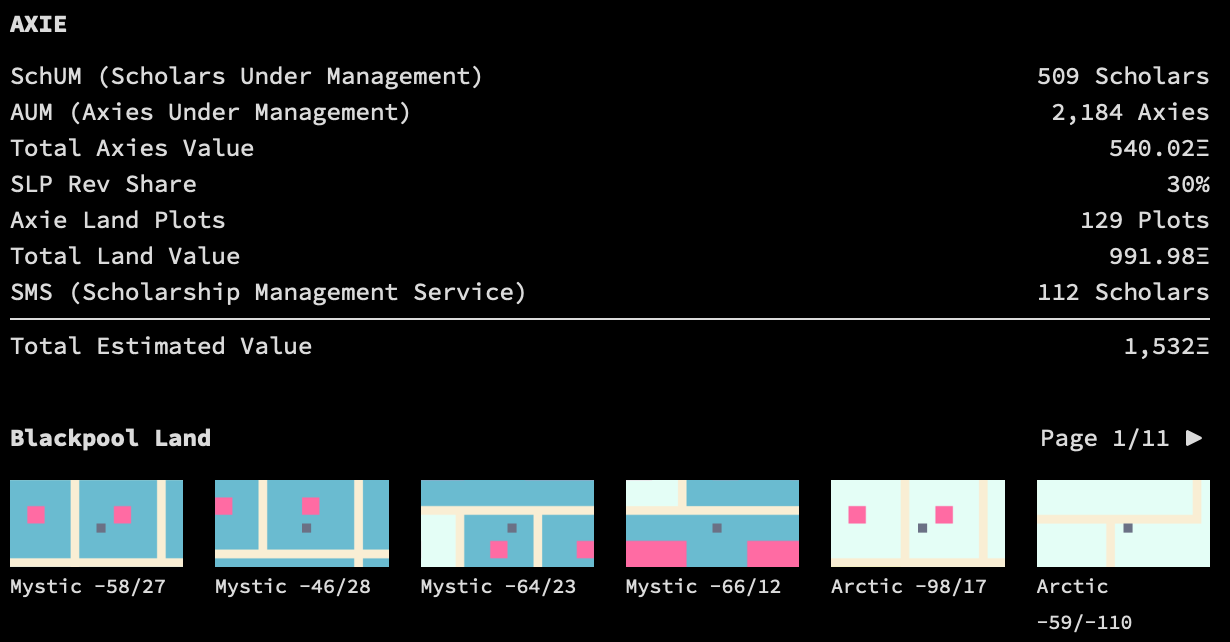
YGG is not alone in the game. Blackpool was launched in late 2020 with broader ambitions as a new asset management firm fully dedicated to the NFT industry. Like a more traditional capital allocator, it has a line of business (gaming), digital assets under management and custody, investment services - scholarships, proprietary investing, and a fully transparent balance sheet as pictured below - I think Know what accounting standards they use.
It's a game and it matters
Axie isn't just a game, it's an alpha version of something much bigger: a digital, trustless social operating system. It is much easier to stay within the system and develop endogenous solutions to endogenous problems for endogenous agents than to translate and port mechanisms that already exist externally. Digital agencies and digital services for a digital-native world, that might just be it. The bridge between the blockchain and the outside world is narrow and unstable, just ask the TradFi-DeFi facilitator.
Axie and other emerging metaverses may be training camps for simpler models with broader applicability. DeFi should listen. Over time, the old system shrinks and more substance emerges naturally in the new system directly. Likewise, patience is often the least popular quality.
It always starts with a game.





