


Can USDT continue to maintain its monopoly position if the United States releases stablecoin regulatory signals?


Original title: "Regulatory Factors Intensify Changes in the Stablecoin Market", author Kyle
After the encrypted asset market has experienced a round of explosive growth, the stablecoin market has expanded to hundreds of billions of dollars, making it difficult for this special encrypted asset class not to be valued by regulators.
In recent months, U.S. regulators have repeatedly mentioned that they will develop a regulatory framework for stablecoins to improve financial stability. In this context, Circle, the issuer of USDC, took the lead and announced on August 22 that it would convert its reserves into a combination of cash and short-term U.S. Treasury bonds.
Circle intends to increase the liquidity and stability of USDC reserves compared to the reserve portfolio announced in July that includes cash, U.S. Treasury bonds, Yankee certificates of deposit, commercial paper and bonds. In contrast, although USDT, the leader in the stablecoin market, has improved the transparency of reserves, according to the reserve combination form announced by its issuer Tether in May, only 3.87% of them are cash deposits, and the overall fund reserves are slightly inferior to USDC.
In the past few years, USDT's market monopoly has been eroded by latecomers. According to the data of Feixiaohao on August 25, the current circulation of USDT is 65.793 billion, accounting for 57.83% of the market share, and the circulation of USDC is 26.987 billion, accounting for 23.72% of the market. BUSD, a compliant stablecoin issued by Binance, also took a 10.7% market share with a circulation of 12.173 billion. In May last year, USDT's market share exceeded 80%.
secondary title
U.S. puts stablecoin regulatory signal USDC restructuring reserves
With the growth of the encrypted asset market, the issuance scale of stable coins is also increasing. According to the data of Feixiaohao on August 25, the current circulating market value of all stablecoins exceeds 110 billion US dollars, and the top two USDT and USDC are both in the top ten of the encrypted asset market value list.
This market of more than 100 billion U.S. dollars has attracted the attention of regulators in various countries, especially the U.S. regulators have repeatedly discussed the proposed regulation of stablecoins.
About a week ago, the Federal Reserve released the minutes of its July meeting, in which officials focused on the potential threat that stablecoins could pose to financial stability. Stablecoins appear to share the same vulnerabilities as major money funds and generally lack transparency, making it particularly important to monitor them closely and to develop an appropriate regulatory framework to address any financial stability risks associated with such products, participants said.
Previously, Federal Reserve Chairman Powell also publicly stated the urgency of implementing regulations on stablecoins. "At present, bank deposits and money market funds have a very strong regulatory framework, but stablecoins do not."
The regulatory signals released by the Federal Reserve have aroused the vigilance of stablecoin issuers. On August 22, Circle, the USDC issuer, announced that it would convert all USDC reserves into cash and short-term U.S. Treasury bonds. This move is obviously intended to convey to the outside world that the reserves behind USDC have sufficient stability and liquidity to ensure payment to the market at any time.
In contrast, the previous USDC reserve portfolio was much more complex and less stable. In the USDC reserve report disclosed by Circle in July, in addition to cash and U.S. Treasury bonds, USDC’s $22 billion reserve includes Yankee certificates of deposit (13%), commercial paper (9%), corporate bonds (5%), and municipal bonds. Bonds and U.S. agency bonds (0.2%).
After the disclosure of the reserves report at that time, it caused some concerns from the outside world. Some people believe that commercial paper, bonds and other assets in the reserve fund are highly volatile and lack liquidity, making it difficult to cope with large-scale redemption.
Today, the change in the form of USDC reserves reveals Circle’s cautiousness in the face of tightening regulations. USDT, the largest leader in the stablecoin market, also intends to increase the transparency of reserves this year in order to dispel long-standing doubts in the market.
image description
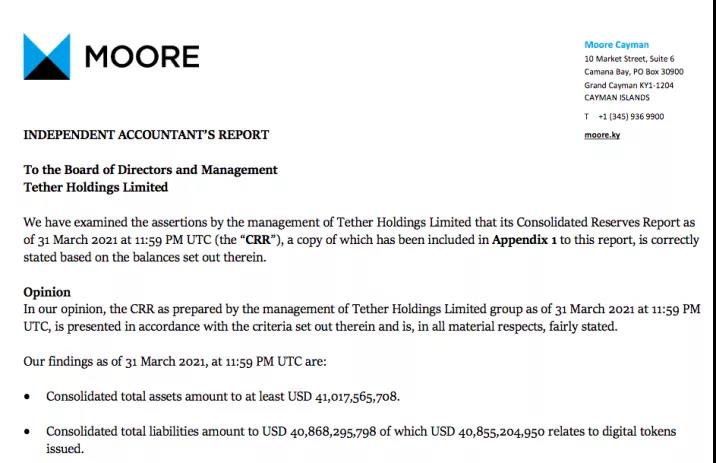
USDT Reserve Audit Report by Moore Cayman
In May, Tether disclosed the distribution of reserve assets. Among the assets held by the company, 76% are cash and cash equivalents, of which 65.39% are bulk commercial papers, and 24.2% are trust deposits. Cash deposits, which are most concerned by the outside world, only account for 3.87%; the remaining 24% are composed of credit loans, bonds, and other investment targets including cryptocurrencies.
secondary title
The market share of stable currency changes again, USDT gradually loses its monopoly position
Regulatory authorities formulate a regulatory framework around stablecoins, which is a protection for market investors. For stablecoin issuers, regulatory intervention will put forward higher compliance requirements, which is likely to become an important factor that intensifies the changes in the stablecoin market.
In the past few years, the stable currency market has been growing, and the market share has also quietly changed. Before 2018, the stable currency market was almost dominated by USDT, accounting for more than 90% of the market share. However, due to the lack of transparency of the reserves, the outside world has never stopped questioning USDT. Then, PAX, TUSD, USDC and other more transparent and compliant stablecoins came out, and the stablecoin market began to change.
In October 2018, Circle and Coinbase announced the establishment of the Center alliance, launched USDC, and the accounting firm Grant Thornton LLP issued a monthly reserve report. With the advantages of transparency and the adoption and endorsement of Coinbase, USDC started its way to catch up.
It is undoubtedly difficult to challenge the king in a field, but the biggest advantage of USDC has always been that it has audits and is more transparent. Credibility continues to decline. USDC seized the opportunity and began to be listed as a collateral asset by multiple DeFi lending agreements. At the same time, it was listed on FTX, Binance and other exchanges, and the market demand continued to increase.
Although USDT is still the most widely circulated stablecoin in the current market, its market share has gradually been eroded over the past few years.
According to the data of Feixiaohao on August 25, the current circulation of USDT is 65.793 billion, accounting for 57.83% of the market share, and the circulation of USDC is 26.987 billion, accounting for 23.72% of the market. BUSD, a compliant stablecoin issued by Binance, also took a 10.7% market share with a circulation of 12.173 billion.
image description
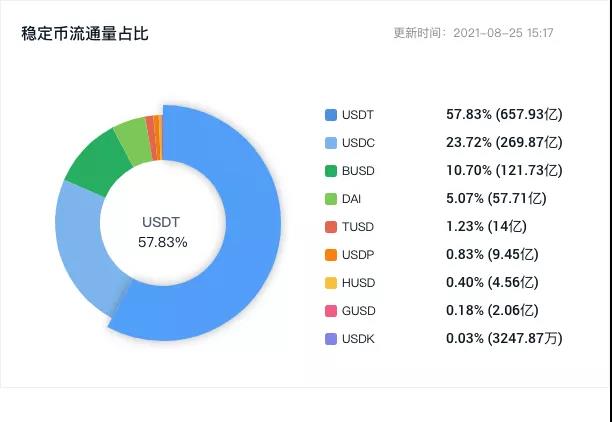
Current Stablecoin Circulation Proportion
For a long time, USDC has been promoting its advantages such as transparency and compliance, and it has begun to be adopted by more and more encrypted assets and blockchain application platforms. The perpetual contract of dYdX, a decentralized derivatives exchange, is denominated in USDC instead of USDT. In May of this year, when the Chinese regulatory authorities began to crack down on Bitcoin trading and mining, the OTC price of USDT also fell for a while. At that time, some people proposed to exchange USDT for USDC to avoid risks.
Today, the U.S. regulatory authorities have clearly proposed to strengthen the supervision of stablecoins, which is of course more beneficial to USDC, which is following the compliance route. As a latecomer in this market, USDC has obviously learned a lot of lessons from USDT. It has always used openness and transparency as its trump card, and has continuously taken away market share from USDT.
From the perspective of investors, whether it is the establishment of a stablecoin regulatory framework or the increasingly fierce competition among stablecoins, it will ultimately help the market change from disorder to order, thereby protecting the interests of investors.





