


A Look at DeFi Unicorns Episode 2


The last episode introduced more than a dozen projects, all of which belong to the scope of the DeFi protocol. Since the last episode has not been fully introduced, today we will continue to introduce DeFi unicorns.
If you haven’t read the first episode of DeFi unicorns, you can review the previous articles on the Block unicorn public account [How DeFi unicorns lead the development of the industry]. The content of the article is too rich and needs to be collected and read.
DeFi Perpetual Contract Agreement
A perpetual contract, also known as a perpetual swap contract, is a derivative of a futures contract. From a trading perspective, perpetual contracts are similar to traditional futures contracts, but with some differences. It has no expiration or settlement date and can be settled at any time. A perpetual contract is similar to a margined spot market, so it trades close to the underlying reference index price (current price).
There is a centralized perpetual contract, why do we need a DeFi perpetual contract agreement? First of all, let us first understand the centralized perpetual contract platform, which is the prerequisite for the need for decentralized contracts.
The cryptocurrency centralized perpetual contract was started by Arthur of BitMEX, who was not satisfied with the status quo of brick arbitrage. In January 2014, he found Ben Delo, a computer scientist who graduated from Oxford University, and the other was from the United States. Samuel Reed (Samuel Reed), a senior programmer of the company, the three hit it off and co-founded BitMEX.
In October 2020, the world's largest derivatives exchange, BitMEX, was investigated by the CFTC (U.S. Commodity Futures Commission), and then BitMex executives were directly arrested in the United States. He was questioned about maliciously manipulating the market, money laundering, and bribing U.S. overseas officials, and finally ended the SEC investigation with a fine of 24 million U.S. dollars.
After the unlucky BitMEX was fined. Its competitors on the same platform, such as Binance, Huobi, OK, etc., still often experience pin insertion. Under the big market, it goes down, the APP prompts various errors, and contract users cannot close their positions. This is their most difficult moment. I can see the text message prompting liquidation, and then shed tears of hatred, I have a deep understanding.
They have long been suspected of maliciously manipulating the market, and these scandals have not affected their continued profitability. Encrypted users frequently voice their resistance to centralized perpetual contracts. These helpless voices have attracted the attention of decentralized builders, and the encrypted market has become more in need of decentralized contracts than ever.
Perpetual Protocol Perpetual contract agreement
Two months after BitMEX was investigated, Perpetual Protocol launched their products.
Introduction to Perpetual Protocol
The agreement is a decentralized perpetual contract trading platform based on Ethereum, and it is also based on the XDAI side chain for perpetual contract transactions. The difference from the order book is that it adopts the same x*y=k constant product formula of VAMM and Uniswap, which can be said to be a combination of Uniswap and BitMEX.
What are VAMMs?
Perpetual Protocol improves the limitations of the previous AMM, uses a new VAMM mechanism, expands the application space of the previous AMM, and can have more possibilities, breaking through the use of AMM on perpetual contracts for the first time. The VAMM pool has no real assets. The actual assets are stored in the vault, which supports all types of asset mortgages. Compared with the traditional AMM, Perpetual Protocol uses vAMM as a price discovery mechanism, but it is not suitable for spot transactions.
Here is an example reference that will explain how VAMM works:
1. Before creating a vAMM on the blockchain, the creator sets the amount of virtual assets stored in the vAMM. Assuming that the price of ETH is 400 DAI, the creator can set the initial amount of ETH and DAI at a ratio of 1:400 on vAMM. For simplicity, let's assume the creator sets the initial state of this vAMM to 100 vETH and 40000 vDAI.
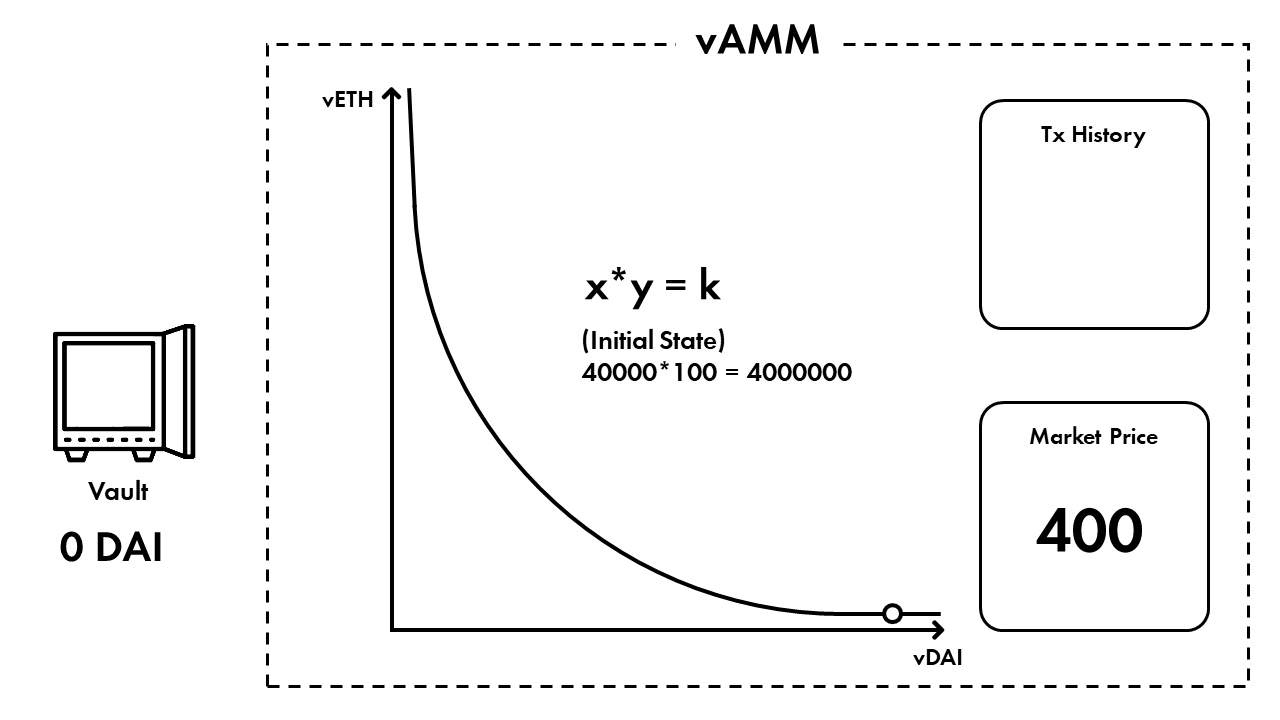
2. Trader Alice wants to make 10 times more ETH with 100 DAI as collateral:
Alice deposits 100 DAI into Perpetual Protocol's vault, which, as mentioned above, is a smart contract on Perpetual Protocol.
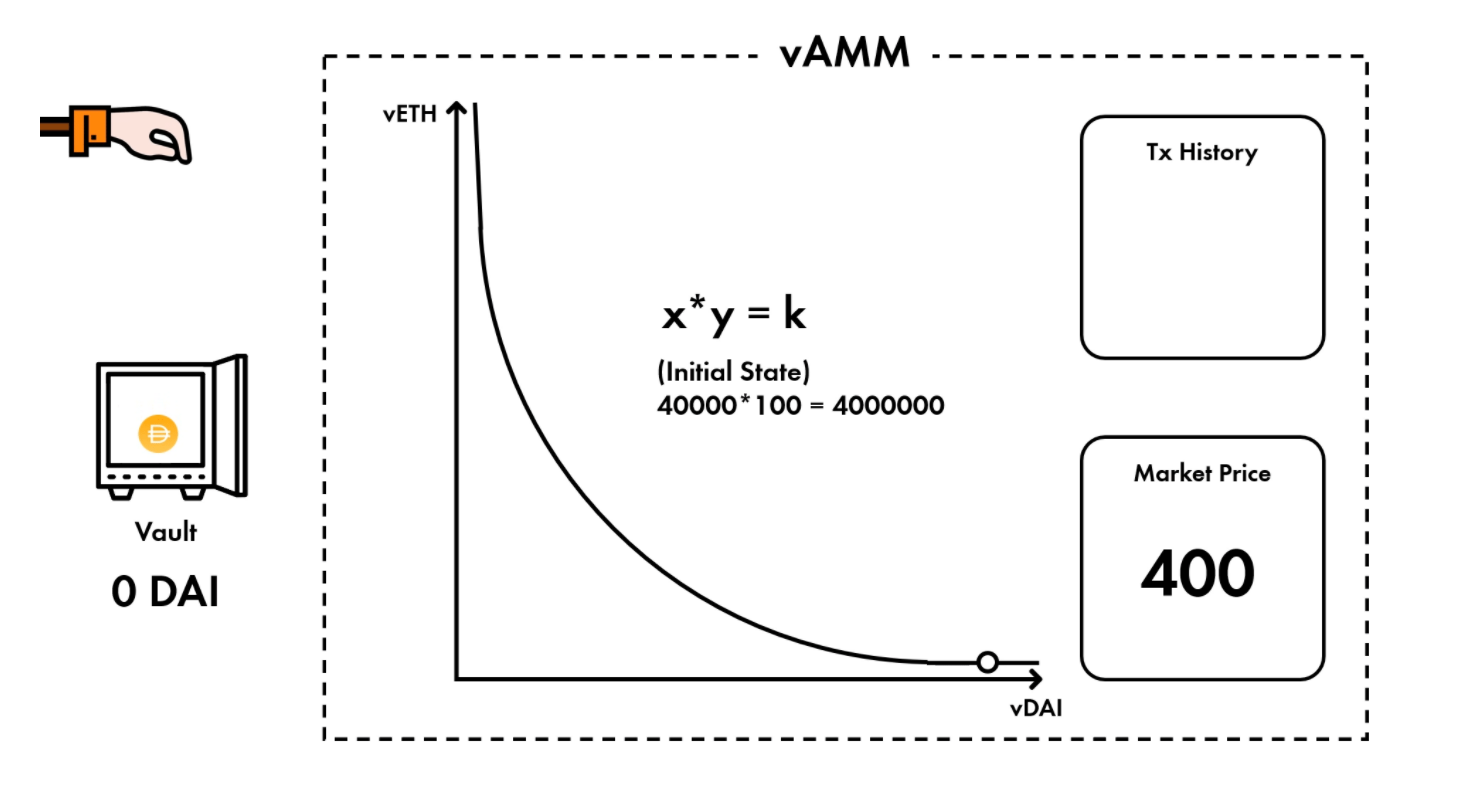
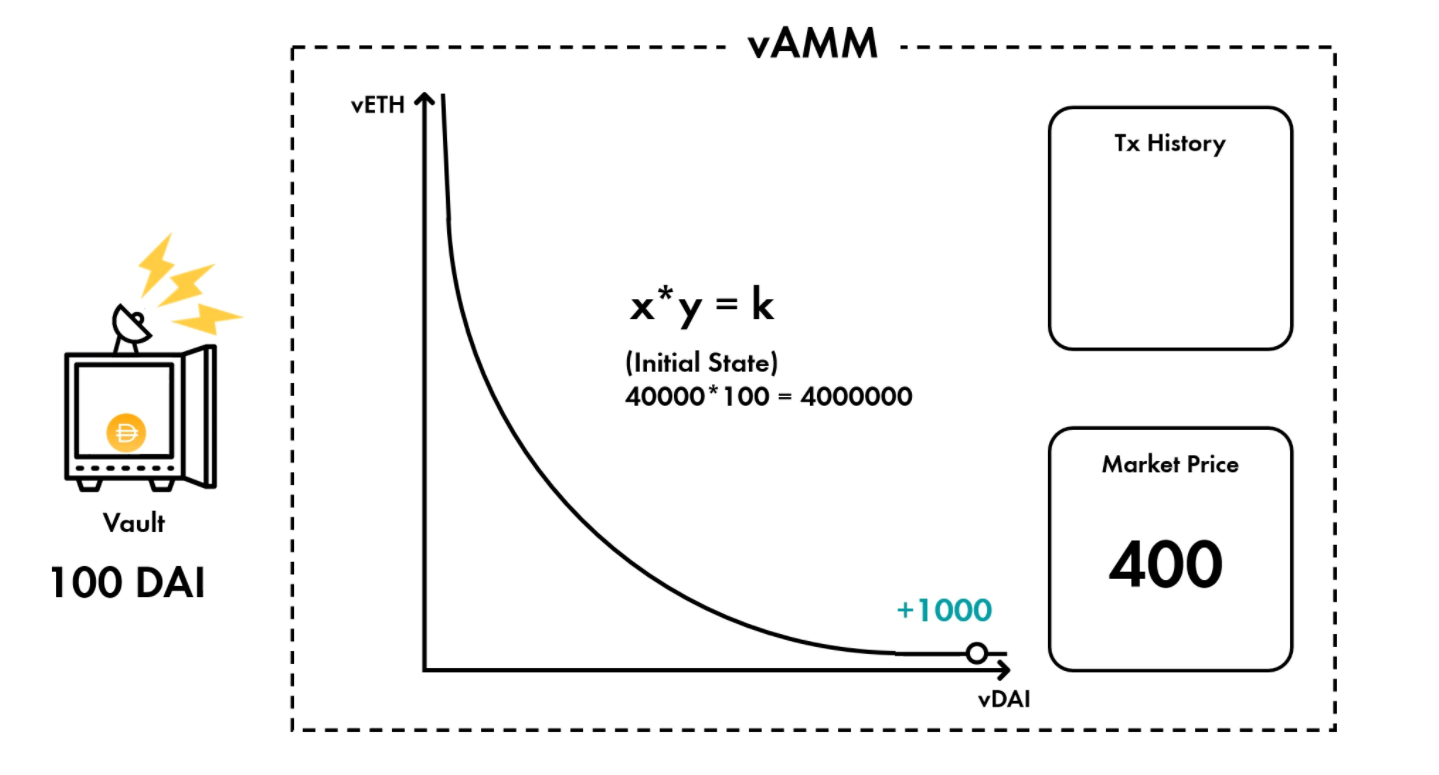
Perpetual Protocol credits Alice's 1,000 vDAI (10 times leverage of 100 DAI) into vAMM, and in return, it calculates the amount of vETH Alice received according to a constant function (x*y = k).
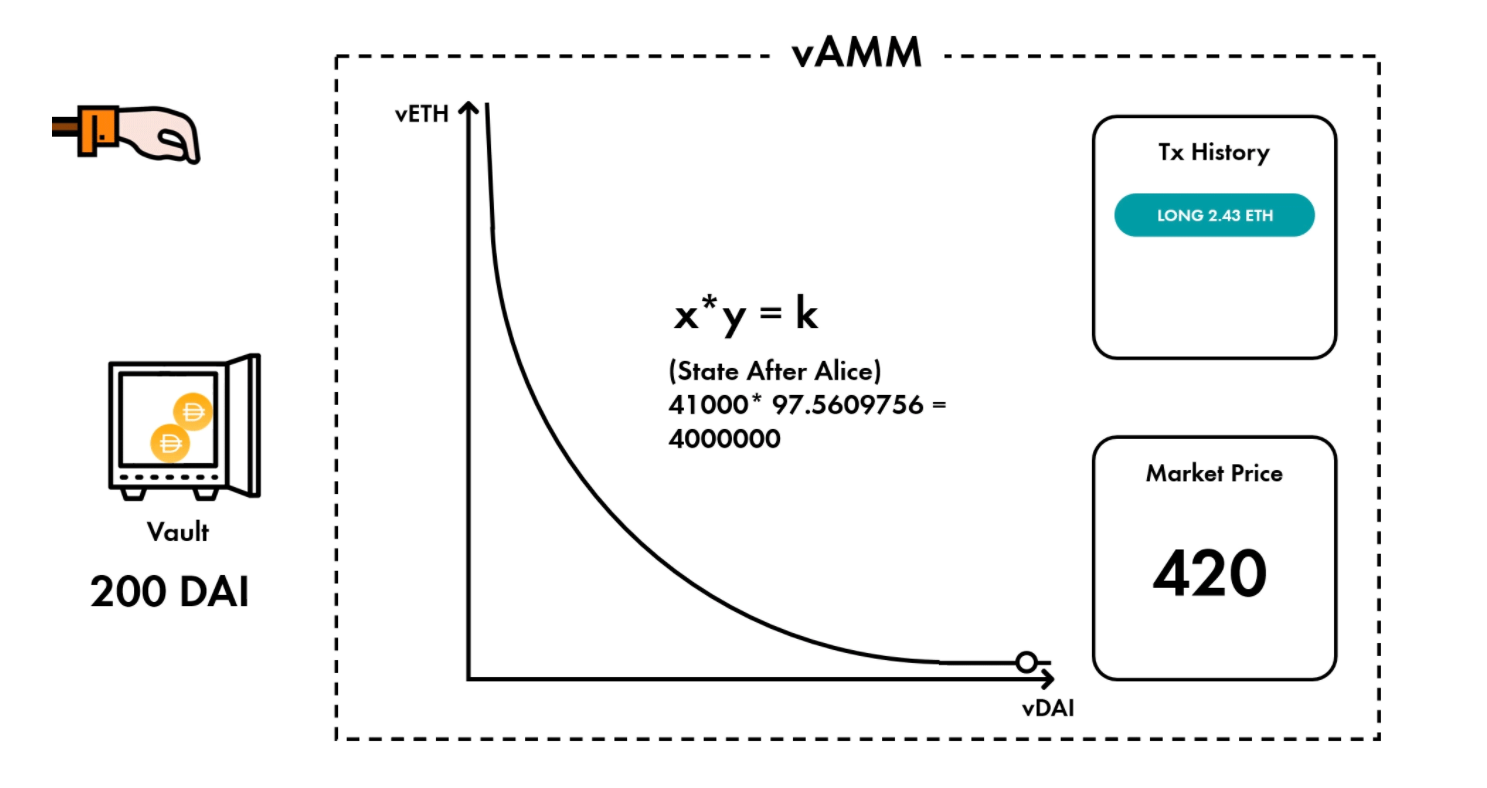
Perpetual Protocol records that Alice now has 2.4390244 vETH, and the internal state of this vAMM has changed to 97.5609756 vETH and 41000 vDAI.
3. Trader Bob then uses 100 DAI as collateral to short ETH 10 times, which means:
Bob deposits 100 DAI into the same vault.
Perpetual Protocol credits Bob's -1,000 vDAI to vAMM, and in return, it calculates the amount of negative vETH Bob receives according to a constant function (x*y = k).
Perpetual Protocol records that Bob has now shorted 2.4390244 vETH, and the internal state of this vAMM has now become 100 vETH and 40000 vDAI.
Unique property of vAMM, no liquidity provider required.
Due to path independence, the vault will always have enough collateral to pay back all traders using vAMMs for transactions (assuming all undercollateralized assets are successfully liquidated prior to bankruptcy). Unlike traditional AMMs whose liquidity comes from liquidity providers providing assets to facilitate transactions, vAMMs' liquidity comes directly from vaults located outside of vAMMs. In other words, the existence of a liquidity provider is not required to bring liquidity to a vAMM: traders provide liquidity for each order.
Since no liquidity provider is required in vAMM, there is no permanent loss in the first place.
Periodic Price Adjustment
vAMM itself acts as an independent cash settlement market. If we want the vAMM market price to be close to the underlying index, we need to add a funding rate, similar to funding payments for perpetual contracts on Central Limit Order Book (CLOB) exchanges. For example, the following is FTX's fund disbursement formula:

The payment of funds incentivizes arbitrageurs to keep the market price as close as possible to the underlying index and make the vAMM market track the underlying index.
Perpetual Protocol utilizes a similar funding rate formula to FTX, thus allowing new derivatives markets to trade with leverage while closely tracking the underlying index.
manage slippage
Similar to traditional AMMs, traders experience less slippage when vAMMs have higher K values, but the similarities end there.
For traditional AMM, the methods to increase the K value are:
(1) Encourage more liquidity providers to provide more liquidity.
(2) Increase transaction fees and recover transaction profits to provide more liquidity.
In contrast, in vAMM, since the K value is manually set by the vAMM operator at startup, K can be increased or decreased at will at any time even after the vAMM is created, which helps the market react to the latest situation. response. Having said that, despite having this power, a vAMM operator cannot transfer user funds stored in a vault. The vAMM operator will be the Perpetual protocol team in the first version and transition to a DAO structure later.
While the first version of the Perpetual protocol will set the K value manually, over time we expect the K value to be set algorithmically. For example, K can be set as a function of volume, open interest, financing payments, volatility, and other variables.
Setting the value of K requires a delicate balance. If the K value is too low, natural users of the protocol will generate excessively high slippage and inhibit their transactions in the system. However, if the K value is too high, then arbitrageurs will not have enough funds to keep the vAMM price in line with the underlying index price.
The above examples refer to the WeChat public account Perpetual Protocol, click here to learn more.
capital injection
Feng Yanwen, the founder of Perpetual Protocol, led his Taiwan team to obtain a leading investment from Multicoin Capital in August 2020, together with Three Arrows Capital, CMS Holding, and Alameda Research, to obtain US$1.8 million in strategic financing. In the early stage, it received USD 500,000 seed round financing from Binance.
In September of the same year, Perpetual Protocol also held a smoothing round. For details about smoothing, token distribution and its functions, please refer to the link: https://medium.com/perpetual-protocol/perp-token-distribution-2f1b6196744d
Perpetual Protocol data representation
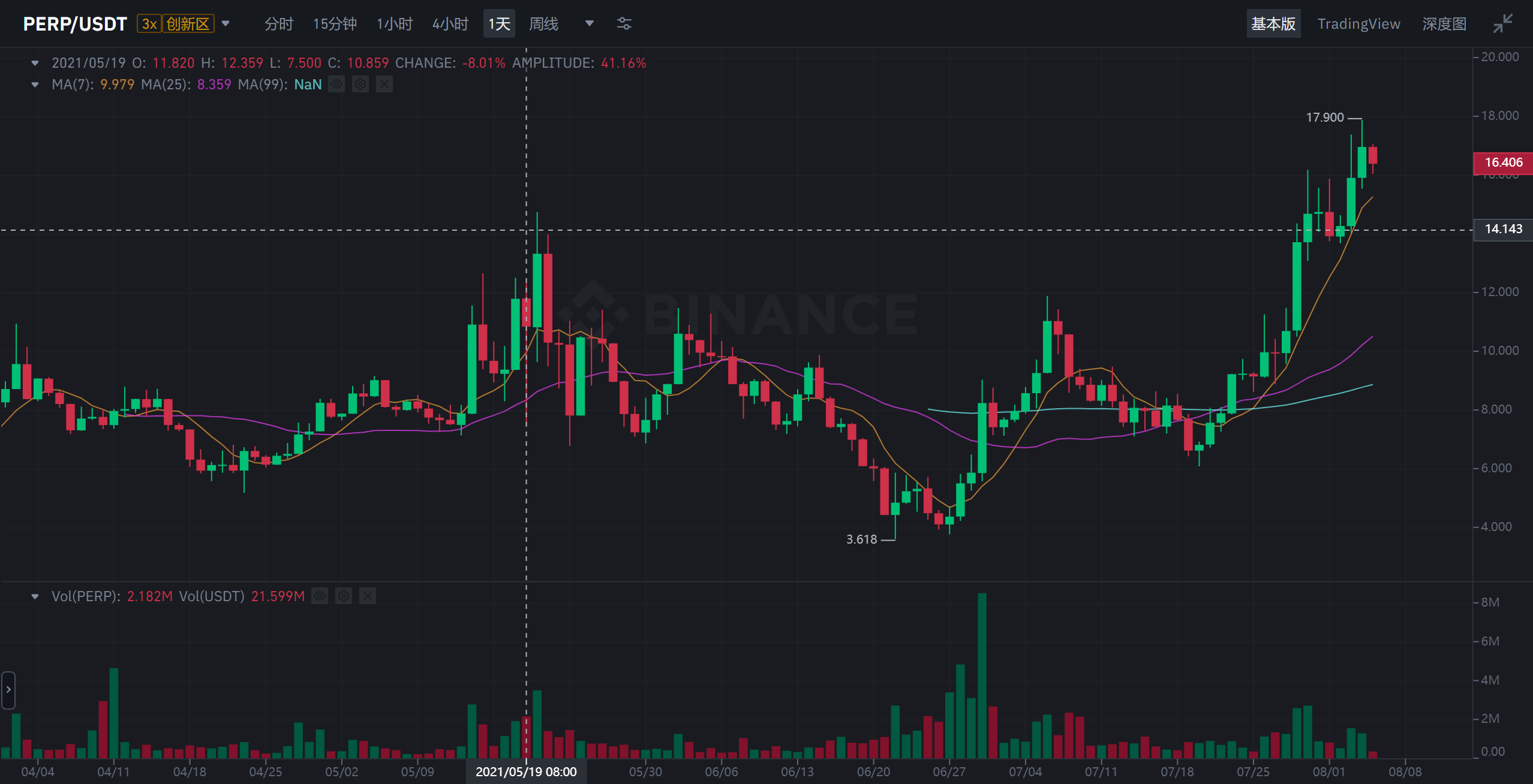
Under the negative policy of 519, Perpetual Protocol’s governance token PERP trended rock-solid, and it only fell by 8% on Binance that day. On May 20, the overall trend rebounded. PERP rebounded by 46%, and then fell again. After bottoming out, PERP rebounded more violently. As of press time, it rose from a historical low of 3.6 US dollars to a maximum of 17.9 US dollars.
There are 5,942 governance token holding addresses. The stable rise of PERP has a lot to do with the staking pool of the protocol. At present, the staking pool has locked PERP worth 300 million US dollars, reducing the selling pressure on the market. The total market value of tokens is only 720 million US dollars , enough for its tokens to easily climb to the top.
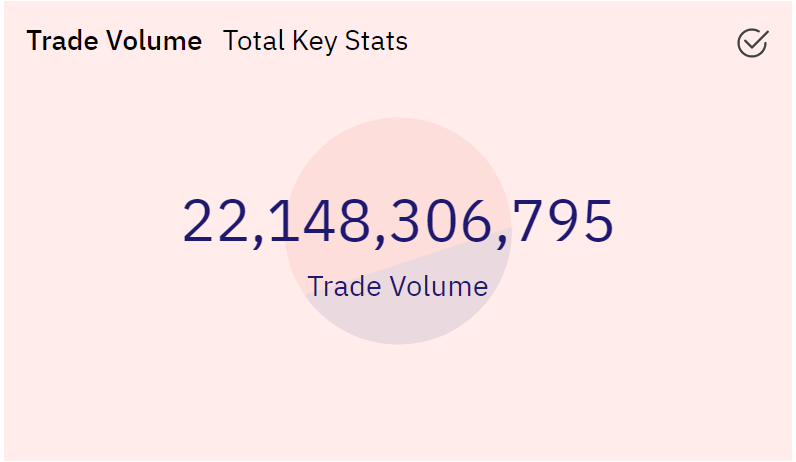
Launched in December 2020, Perpetual Protocol V1 pioneered the virtual market maker model and facilitated more than $22.1 billion in trading volume in less than a year.
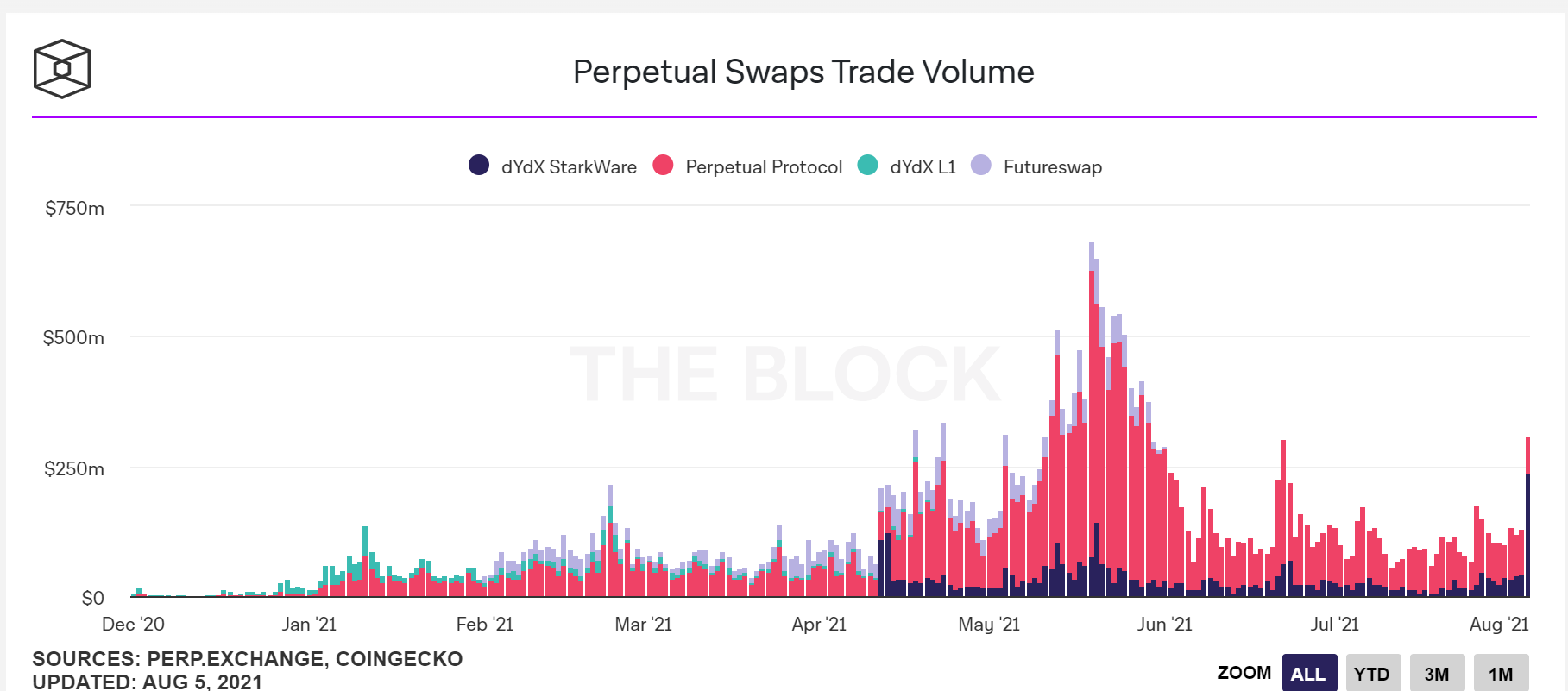
The 22.1 billion transaction volume of the agreement is insignificant for the centralized trading platform, and for the decentralized contract market, Perpetual Protocol is already the leader. THE BLOCK data shows that shortly after the agreement went live, it has occupied 80% of the decentralized derivatives market for a long time.
Debank shows that the total user addresses reached 3900 (accurate data should be more than this). The 24-hour trading volume was 79.68 million US dollars, the active user addresses were 266, and the number of transactions was 22,552. The agreement revenue on that day was 79,680 US dollars. According to the summary of previous data, the total income of the agreement reached 22 million US dollars.
When the decentralized derivatives exchange has not yet appeared, there is an old saying in the domestic centralized derivatives exchange industry that "the contract trading platform has 30 users and can support a small team." The data of Perpetual Protocol can support dozens of small team.
Petual Protocol competitor dydx
dydx introduction
The protocol was founded by Antonio Juliano and launched in 2017. Based on Ethereum L1 & L2 (based on Starkware), the decentralized leverage order book and perpetual contract order book transactions provide 22 popular token trading pairs, and the maximum leverage can be adjusted to 25 times. Link your little fox wallet to dydx's second-tier transaction in seconds, without waiting, and has the security level of the Ethereum network itself. It is very simple to operate, decentralized application, and centralized application operation experience.
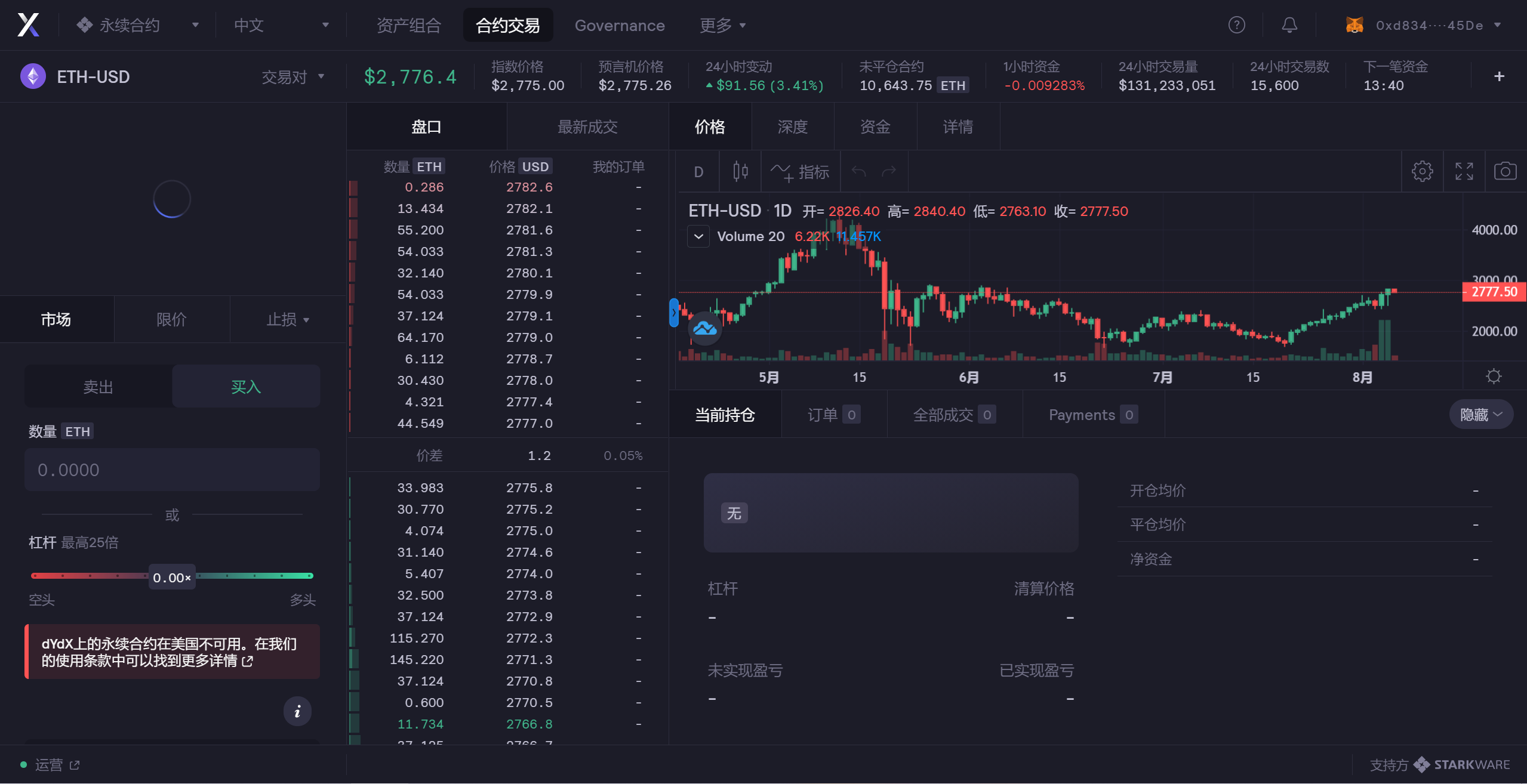
Investors in dydx
A total of four rounds of financing have gone through:
On December 22, 2017, the CEO of Coinbase participated in the seed round financing of dydx, and did not disclose the specific financing amount.
On October 19, 2018, it received $10 million in Series A financing from Bain Capital Ventures, Abstract Ventures, Craft Ventures and other individual investors.
On January 27, 2021, it received $10 million in Series B financing from Capital, Wintermute, GSR, Scalar, Capital, Andreessen Horowitz (A16z), and Polychain Capital.
A $65 million Series C round led by Paradigm on June 16, 2021.
economic model
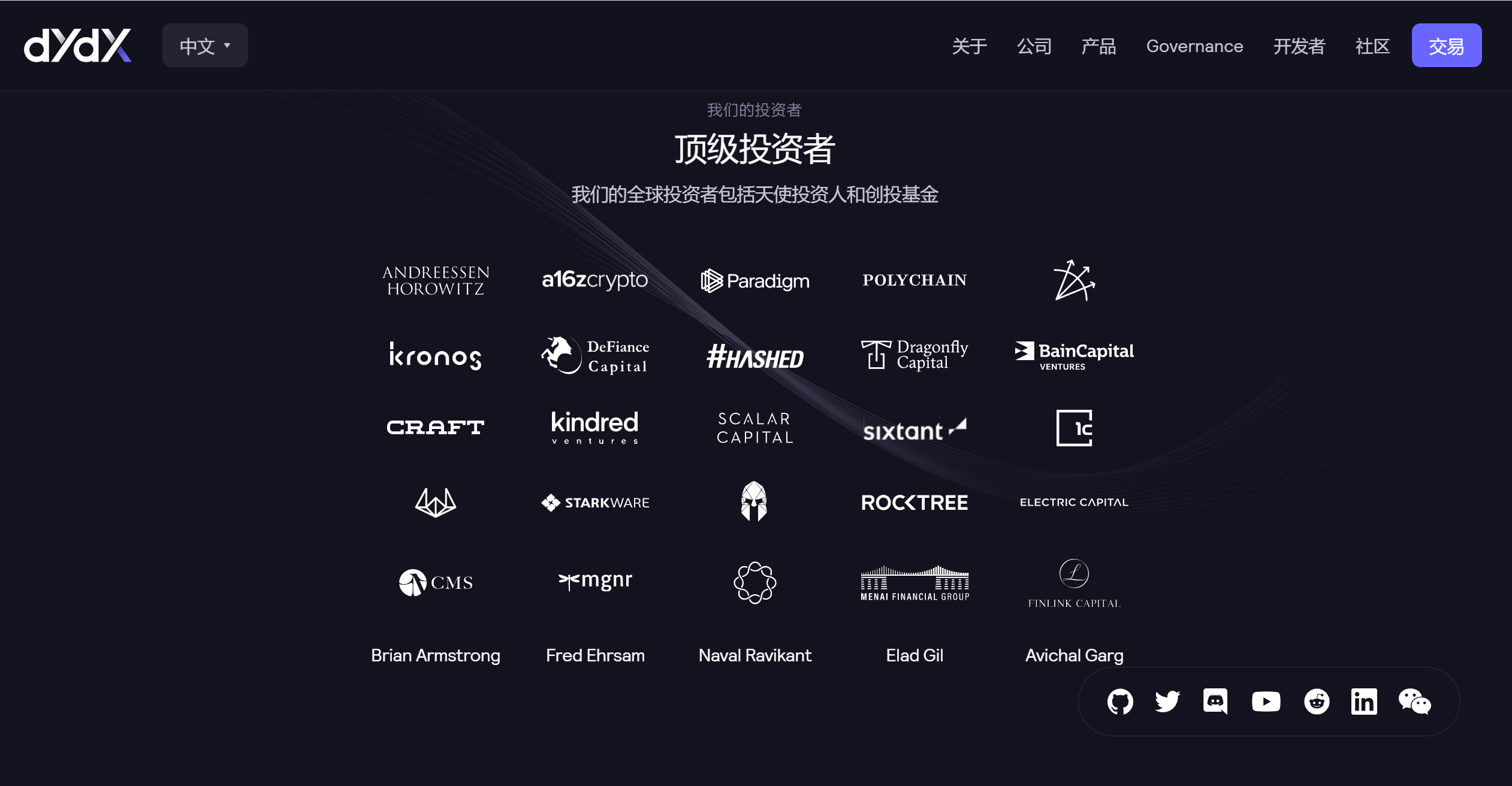
economic model
On August 3, dydx announced the launch of governance tokens. The total amount of DYDX tokens is 1 billion, which will be distributed to all dYdX ecological participants within five years, including community users, investors and the dYdX team. After five years, the community can vote to determine the inflation rate of DYDX tokens for additional issuance; the current maximum inflation rate is 2% per year.
For details of the economic model, please check the official column of dydx: https://www.odaily.com/post/5171254
dydx data
According to Token terminal data, dydx currently has a total asset lock-up of $190 million. Calculated from March 2020, the agreement generated a total of US$36 million in revenue within 18 months, with an average monthly agreement income fee of US$1.7 million.
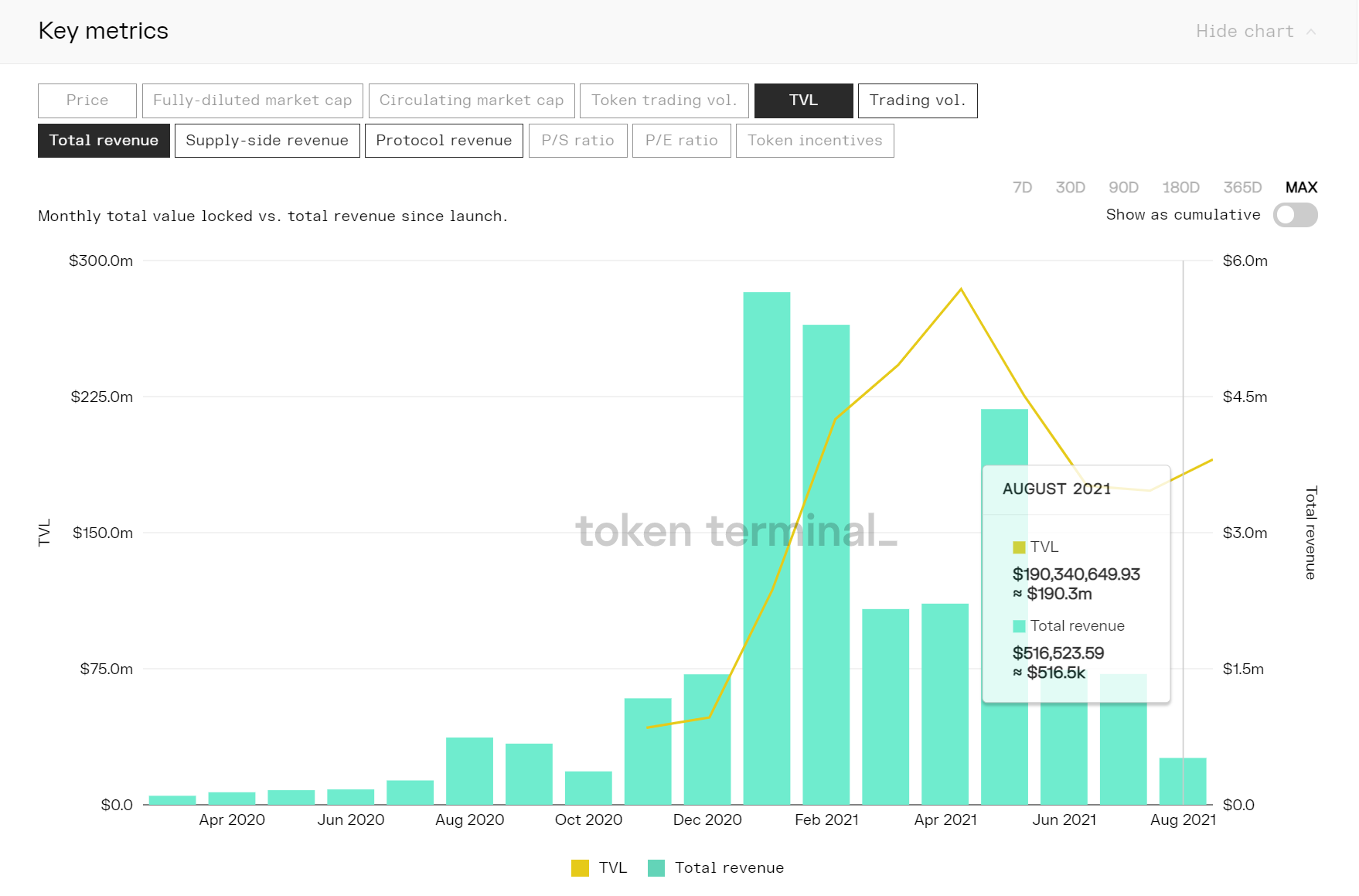
As a decentralized derivatives trading platform, the agreement shows on Debank that the number of dydx user addresses has reached 79,000, and 1,876 24-hour active trading addresses. These users contribute an average of $56,000 to the agreement every day.
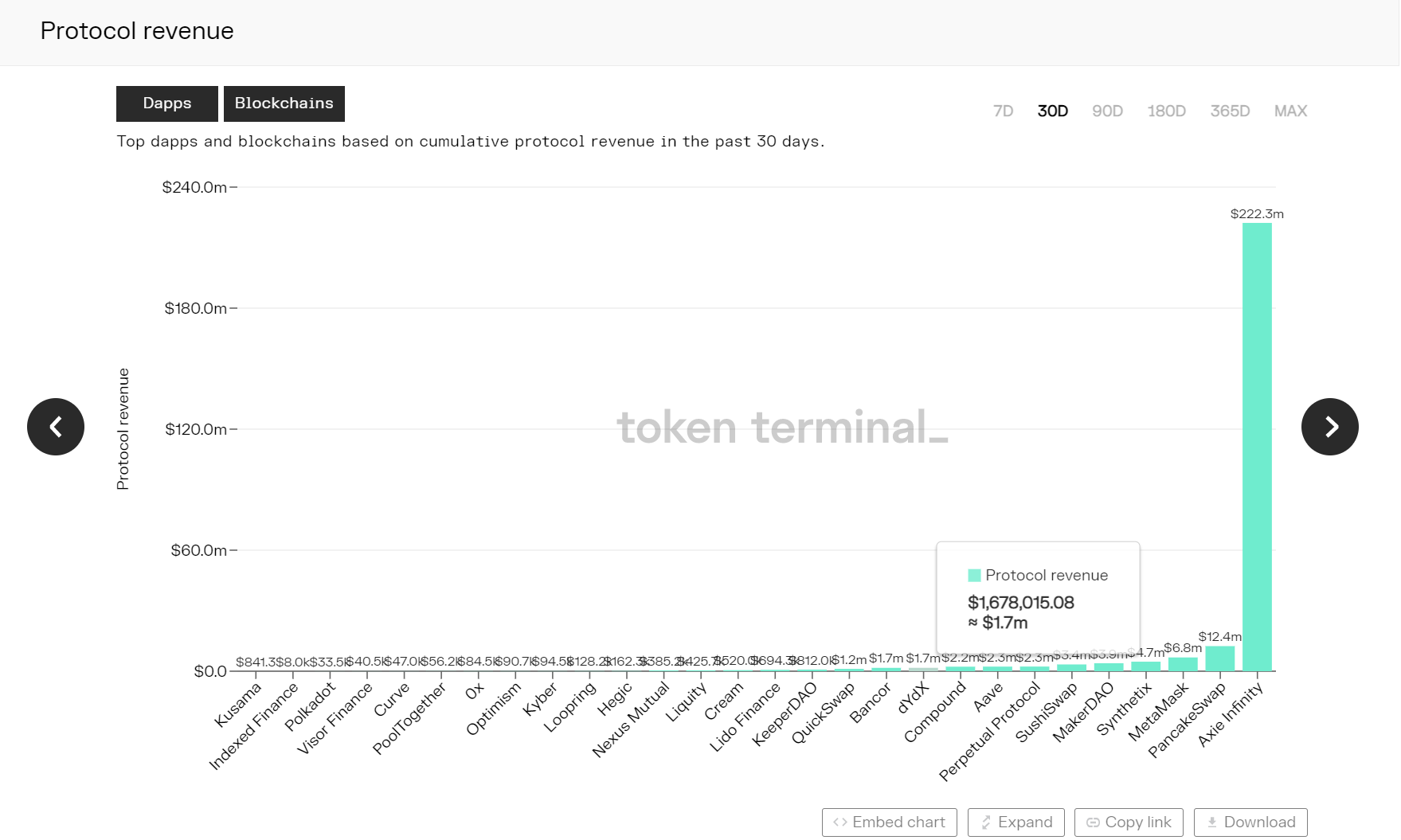
According to the monthly data of Token terminal, the revenue of dydx protocol ranks around 10th in the DeFi field. After the market returns, I believe that this set of data will undergo wonderful changes in the near future.
Summary of DeFi Perpetual Derivatives Agreement
Perpetual Protocol has officially launched the perpetual contract agreement since December last year. During the transaction period, users can also get rewards of governance tokens, which stimulates user transactions. Guided the transaction volume of Perpetual Protocol to continue to break through new highs. In the past 9 months, the protocol revenue has reached 22 million US dollars, with an average monthly income of 2.44 million US dollars. dydx has an average monthly protocol revenue of only 1.7 million US dollars. Perpetual Protocol In terms of monthly average agreement revenue, it surpassed dydx. Due to the relatively long operating time of dydx, in terms of the total income of the agreement, dydx was even better with 36 million US dollars.
dydx, which has always been proud, was quickly overtaken because they did not have governance token rewards before, while Perpetual Protocol has always had governance tokens to stimulate user transactions.
dydx quickly discovered why it was lagging behind, and launched its governance token on August 3, which will be distributed to all dYdX ecological participants within five years, including community users, investors and the dYdX team, 50 of which will be allocated to the community. Perpetual Protocol, which had maintained an 80% share in the past 6 months, until the transaction data after dydx released the governance token surpassed Perpetual Protocol within 24 hours.
Layer 2 expansion solution
Layer 2 expansion solution
Layer 2 pursues the ultimate performance. As a "layer 2 network", it can undertake most of the computing work for Layer 1, such as separating Ethereum transactions from the main chain, reducing the burden on the layer 1 network, improving transaction processing efficiency, and achieving expansion. Layer2 can only achieve partial consensus, but it can meet the needs of various scenarios.
In the previous articles of the Block unicorn public account, we explained the "Ethereum Layer 2 Summary", which mentioned the Layer 2 expansion plans of the four camps, including:
1. ZK Rollup
Aztecnetwork
Hermez Network
Loopringorg
StarkWareLtd
ZKSync
2. Optimistic Rollup
Arbitrum
Cartesi
OptimismRollup
OMG Network
Fuel Labs
3. Plasma
GluonNetwork
OMG Network
Polygon(Matic)
4. Hybri
Celer Network
Unicorn Polygon (Matic)
Among the many Layer 2 expansion solutions, Polygon (Matic) is currently the most valuable embodiment. Polygon is an expansion side chain and infrastructure development based on Ethereum. Developers can use the Polygon software development kit (SDK) to quickly deploy and be compatible with Ethereum EVM (virtual machine).
For more information about Polygon, you can review the previous articles on the Block unicorn public account "Matic releases future multi-chain development kit SDK" and "Behind Polygon's mission to become "Ethereum"". The following is the Polygon data for everyone.
Polygon data performance
In the fierce expansion competition, Polygon rose rapidly and became a superstar in the expansion plan. It gradually gained a firm foothold in Ethereum and embarked on a further journey.
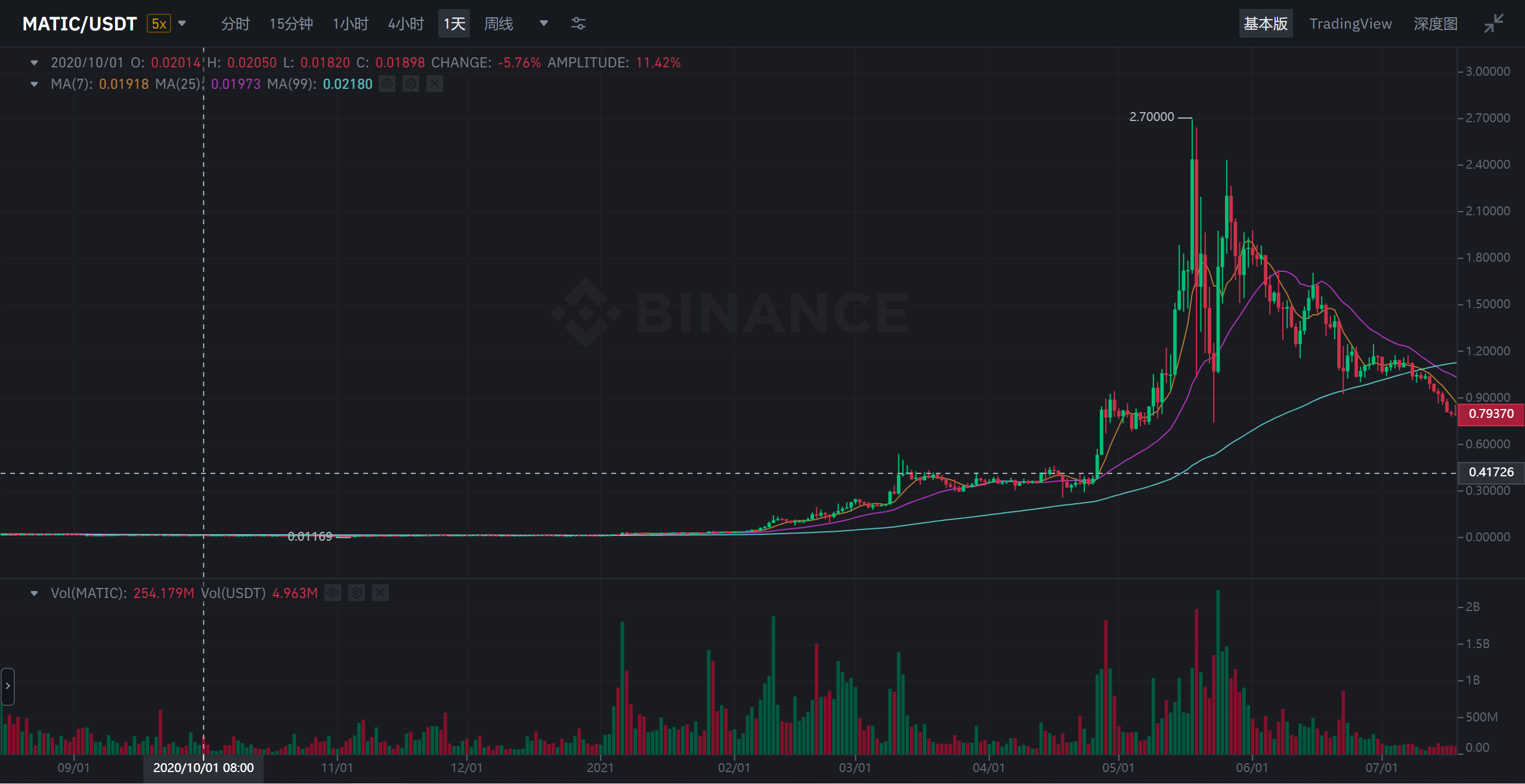
Since its launch in October 2020, Binance shows that Polygon’s governance token was $0.01898 until it rose to a maximum of $2.7 in May this year. It took 8 months, and the increase reached 142 times. Such an astonishing increase cannot be separated from the important support behind the data.
After a large cycle of decline, the Polygon governance token fell from a peak of 2.7 US dollars to 1 US dollar, and its market value also fell from 16 billion US dollars to the current 6.9 billion US dollars.
Today, Polygon Twitter has 570,000 followers, attracting not only followers, but also their DAPP developers Aave, SushiSwap, Curve, Balancer, 1inch, BadgerDAO, DODO and other well-known decentralized applications vying to join the Polygon ecosystem .
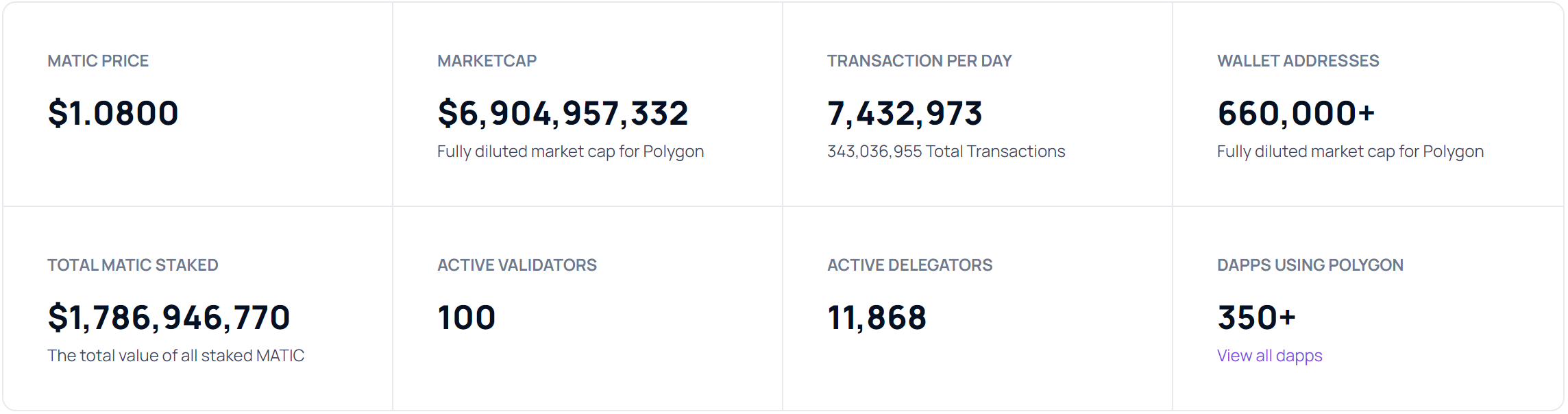
According to statistics from its official website, there are already 350+ applications running in the ecosystem, and the number is still increasing. The ecology includes 7 major sectors, DEFI, NTFT, games, DAO, and B2B.

The figure below shows. The number of wallet addresses in the Polygon ecosystem exceeds 660,000, 150,000 currency-holding addresses, pledged MATIC worth 1.78 billion US dollars, and 11868 active transaction addresses. According to L2bea's statistics, the daily trading volume of Polygon ecology alone based on QuickswapDEX has reached 738,266,850,000 US dollars.
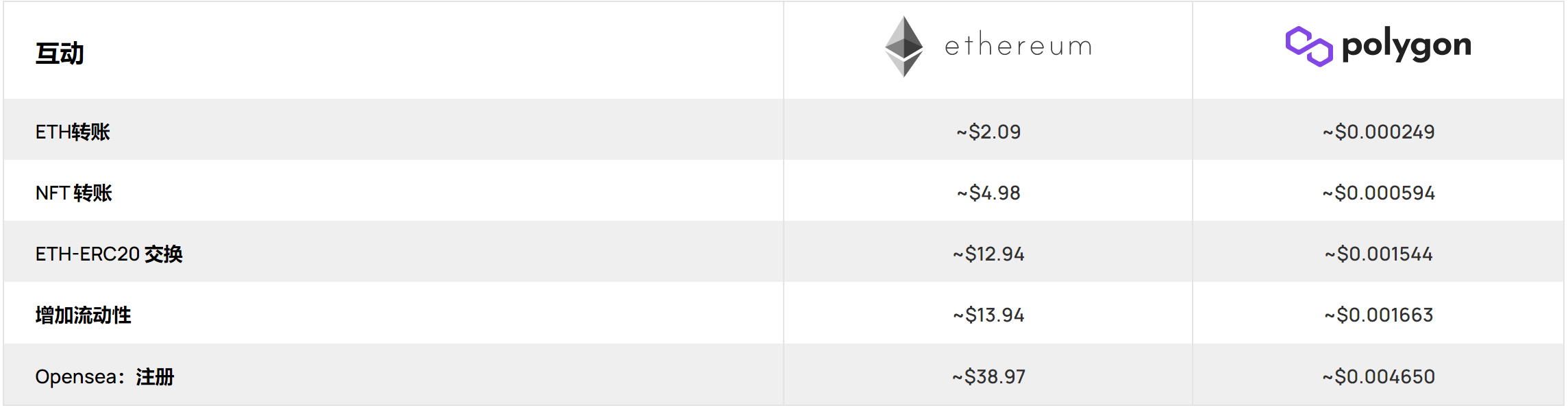
Comparison of Ethereum L1 and Polygon transaction fees
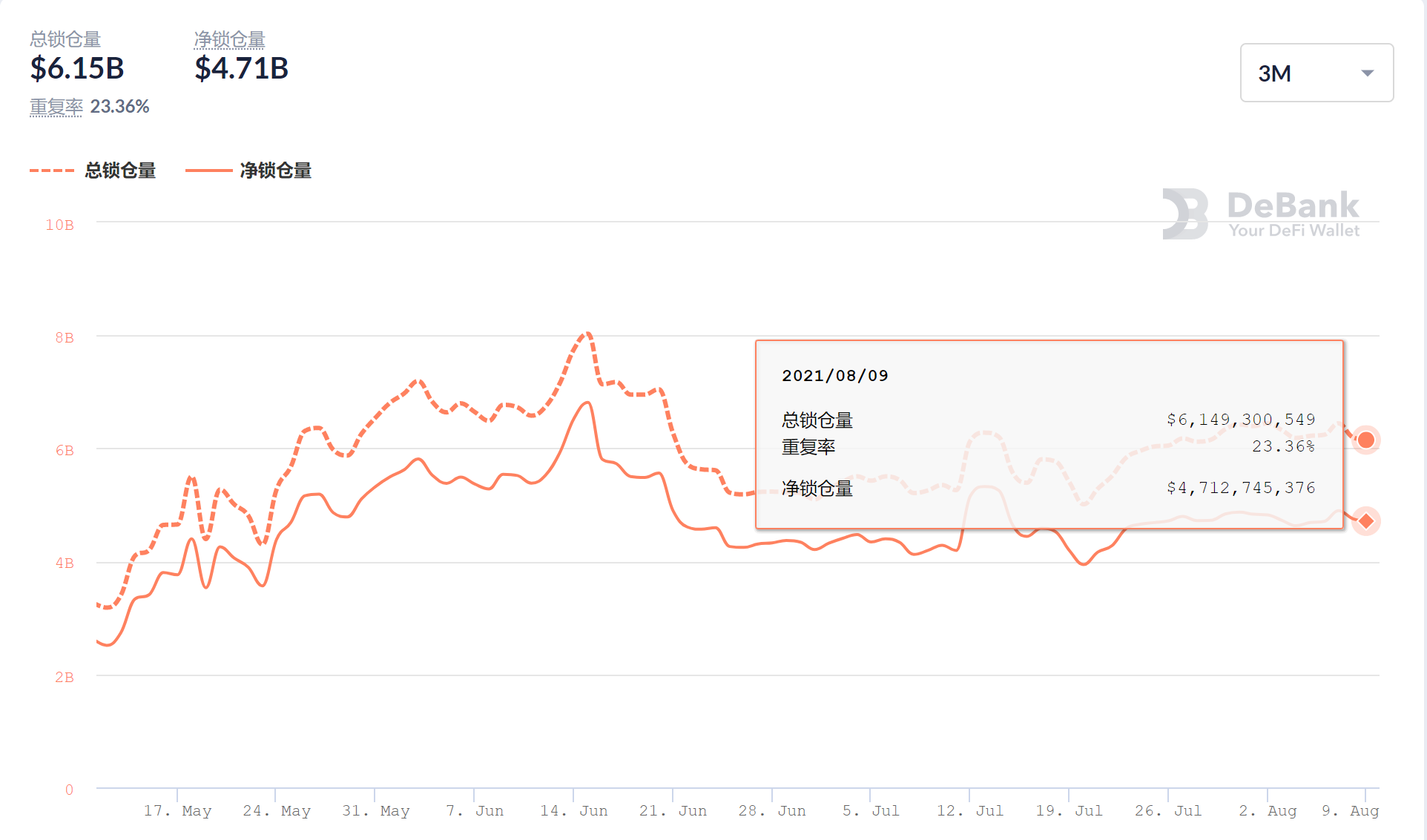
With the support of many applications, Polygon’s capital volume is also increasing. From the lock-up amount of US$5 million in October 2020 to the current lock-up amount of US$4.7 billion, the lock-up amount has increased by nearly 1,000 times. The astonishing growth allowed Polygon to win perfectly in the first stage of expansion, crushing all opponents.
In the expansion competition, according to L2bea statistics, the sum of locked positions of 17 expansion solutions is only 522 million US dollars. Optimism, ZKSync, and Arbitrum used to be in the development path of L2, and the media publicity for them can be described as powerful, but unfortunately it only made waves. The calm Polygon has set off a stormy sea, and no opponent that can match it has yet really appeared.
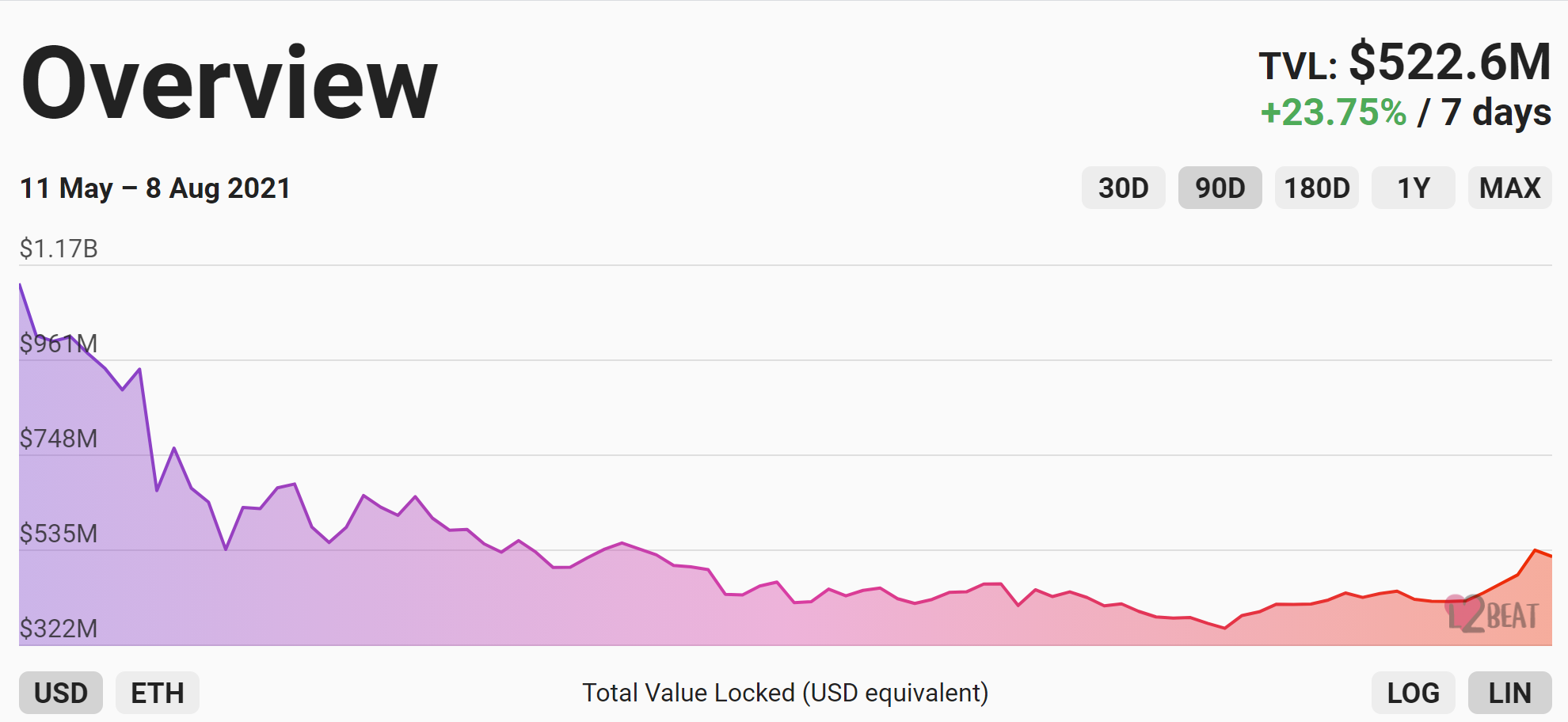
Summary of Polygon expansion plan
Although Polygon is powerful, it also has flaws and is not born perfect. Thousands of users are willing to accept its advantages and disadvantages.
Disadvantages: Polygon currently only has 100 nodes to ensure the security and verification of the network. The security and verification of the network does not depend on Ethereum, but on Polygon's own nodes to maintain network security. 3 months ago, the Reddit community discussed the problem of the network. The first 3 addresses of the 100 verification nodes controlled 54% of MATIC, and Binance held more than half of the 54%. If this centralized address It will be a breeze to launch a 51% attack.
It is possible to launch a 51% attack, and users believe that they will not do such a stupid thing, because it will destroy the reputation they have accumulated throughout their lives, as well as their promising and long-term business in the future.
Advantages: Since Ethereum has been in a state of high transaction fees for a long time, Polygon has provided a good solution to solve the demands of users. In the comparison of transaction fees above, the picture shows that Polygon's transaction and transfer fees are also quite low. It can process 1,000~9,000 transactions per second. Polygon claims that after Ethereum 2.0 goes online, it can process up to 65,000 transactions per second.
If partners want to join the ecology, they can directly deploy and run in the ecology through the SDK, saving more development costs and time for partners. 350+ partners, with a huge volume of more than 1 million users, is enough to continue to promote the development of Polygon.
The road ahead:
A few quarters ago, when various data skyrocketed, the team renamed the original MATIC to "Polygon". In future update iterations, Polygon will support all Layer2 network connections, such as Optimistic Rollups, zk-Rollups, Plasma and other Ethereum expansion technologies, which the team calls "Poca on Ethereum", In addition, linking Polygon to other blockchains can be understood in profound Chinese:Integrate the world。
DeFi Algorithm Stablecoin
In June 2020, AMPL, known as the originator of the algorithmic stablecoin, was born, creating the concept of the algorithmic stablecoin and being hyped to the sky. In the following months, the sudden imitation disk ESD, Basis, Mith, ONS, they came and went in a hurry, leaving only the sad and collapsed K-line.
AMPL, which has been silent for a long time, issued their governance tokens on April 22. As long as users who have traded AMPL, they can get FORTH governance tokens worth about 100,000. It was as if AMPL had returned to spring, and the feeling didn't last long before it disappeared.
Strictly speaking, AMPL is not a real algorithmic stablecoin. The meaning of algorithmic stablecoin is to keep the target stable in a certain price range through algorithms.
The official definition of AMPL is: the AMPL protocol will automatically adjust supply according to demand. When the price is high, the wallet balance increases. When the price is low, the wallet balance decreases. This is a deflation and inflation algorithm. This algorithm is easy to generate circular arbitrage by arbitrageurs. When inflation occurs, tokens are sold, and when deflation occurs, tokens are bought, and the cycle continues in this way.
If you need to go to the supermarket to buy 1 yuan of daily necessities, when you pay at the cashier, your wallet only has 1 AMPL. At this time, you encounter deflation and your AMPL will decrease. At this time, there must be insufficient funds. Pay for purchases, and the goods will not deflate or inflate with AMPL. Of course, AMPL will not be used in life.
AMPL is the prelude to algorithmic stablecoins.
A more noteworthy algorithmic stablecoin protocol Fei Protocol
Fei Protocol is a completely decentralized algorithmic stable currency. First of all, we know that the existing USDT, USDC, and PAI are controlled by the central bank. These are not decentralized and face great review and regulatory risks.
Secondly, DAI, a popular DeFi stablecoin on the market, takes Ethereum as an example. The mortgage rate of Ethereum in DAI’s vault is 150%, and at least 10,000 DAI needs to be generated to use its vault, which means that users need to mortgage more than $10,000 worth of Ethereum. The way of DAI has severely reduced the utilization rate of funds. Fei Protocol can also use ETH 1:1 to generate FEI (stable currency) while improving the efficiency of funds.
Fei Protocol capital injection
On March 9, Fei Labs raised $19 million from Andreessen Horowitz (a16z), Framework Ventures, Coinbase Ventures, and AngelList founder Naval Ravikant, among others.
With the support of top venture capital institutions, it has received a lot of attention. Fei Protocol ended its genesis on April 3rd and lasted for 3 days, raising a total of 639,000ETH. Within 3 days of fundraising, Ethereum was raised, and the ETH/FEI trading pair added $2.5 billion in liquidity to Uniswap, which became a moment in DeFi history.
Although Fei Protocol has received huge financial support, FEI has not stabilized FEI at $1 as envisioned by the team. Due to algorithm loopholes and arbitrage attacks, the lowest price fell to $0.6. Until June 19, FEI returned to a relatively stable price of 0.99~1.001.
How FEI keeps its value stable
First of all, the market behavior, when the FEI is lower than $1, everyone can buy to bring the value back to a healthy state, and if the price is higher than $1, they can sell to generate arbitrage. The same is true for today's OTC merchants, who withdraw USDT at a low price and then sell it at a high price, earning the middle price difference and making a profit.
Protocol Controller (PCV) Behavior
When the price of FEI is lower than $1 and there is no buy order in the market, PCV will trigger the action of repurchasing FEI. Users who sell FEI below $1 will be punished with a 4% loss, and users who buy can get a 2% reward.
To learn more about Fei Protocol, please check the following link: https://medium.com/fei-protocol/introducing-fei-protocol-2db79bd7a82b
Governance token distribution: https://medium.com/fei-protocol/the-tribe-token-distribution-887f26169e44
Fei Protocol data performance
Among the many algorithmic stablecoins, Fei Protocol has the best data at present. Stablecoins need to be adopted and accepted by more people to be valuable.
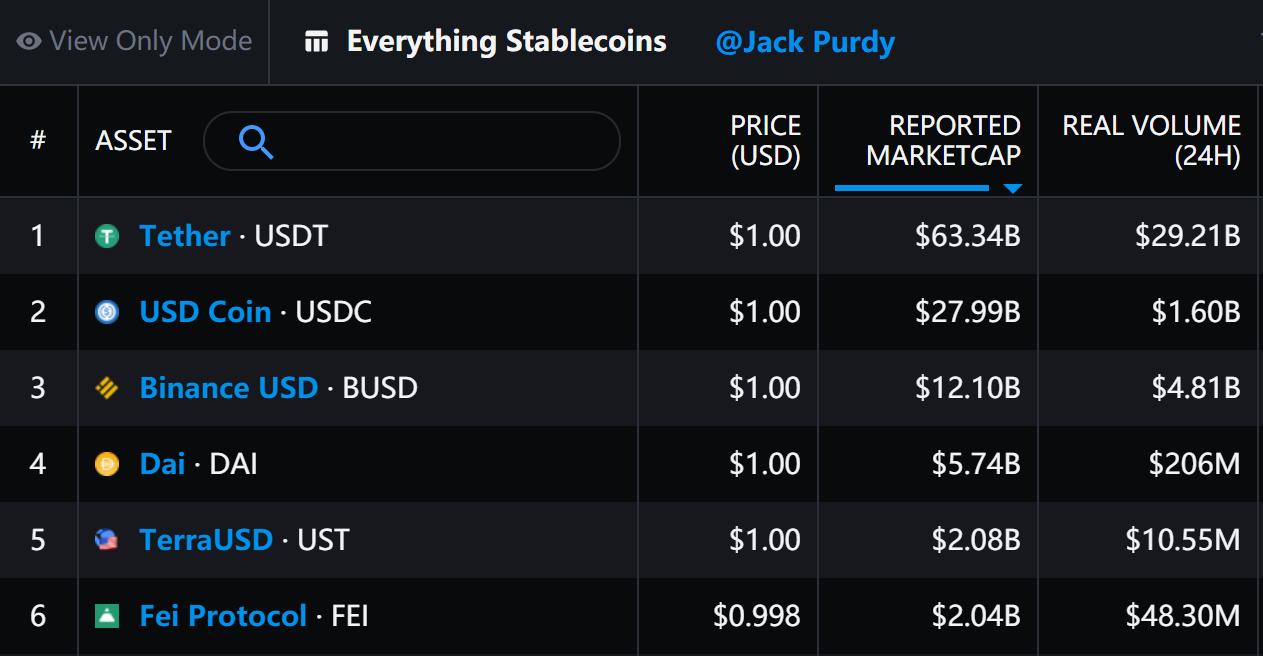
The Messari stablecoin section shows that the current price of FEI is stable at 0.998, with a total market value of $2 billion and a 24-hour trading volume of $48.3 million.
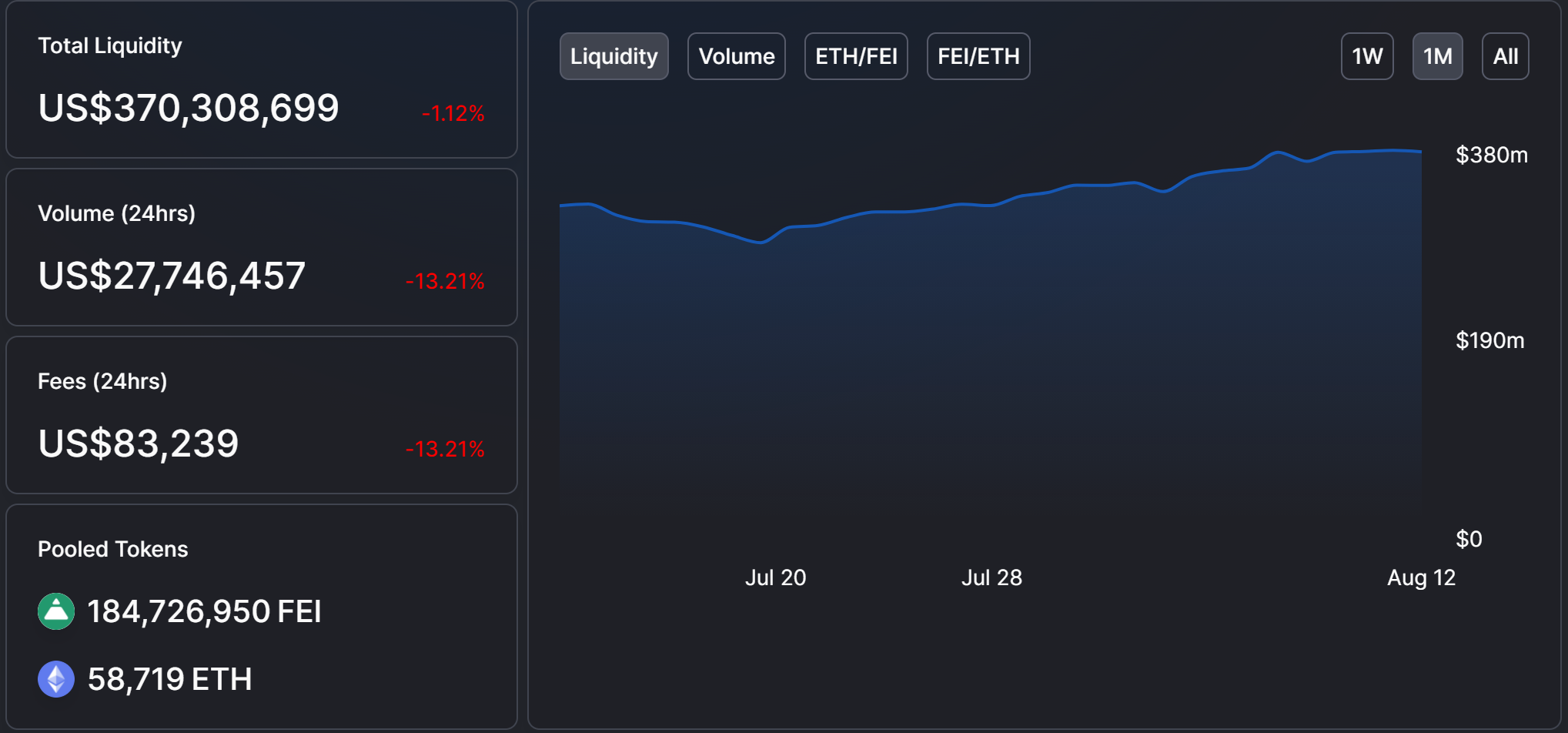
The value of ETH/FEI locked in Uniswap is 370 million US dollars, and the 24-hour trading volume is 27.74 million US dollars, creating a fee income of 83,239 US dollars.
The utilization rate of stablecoins needs to be accumulated slowly to allow them to be launched on more platforms. FEI is currently launched on 14 exchanges, and FEI has more than 20,000 token addresses. The more people use it, the more stable it will be.
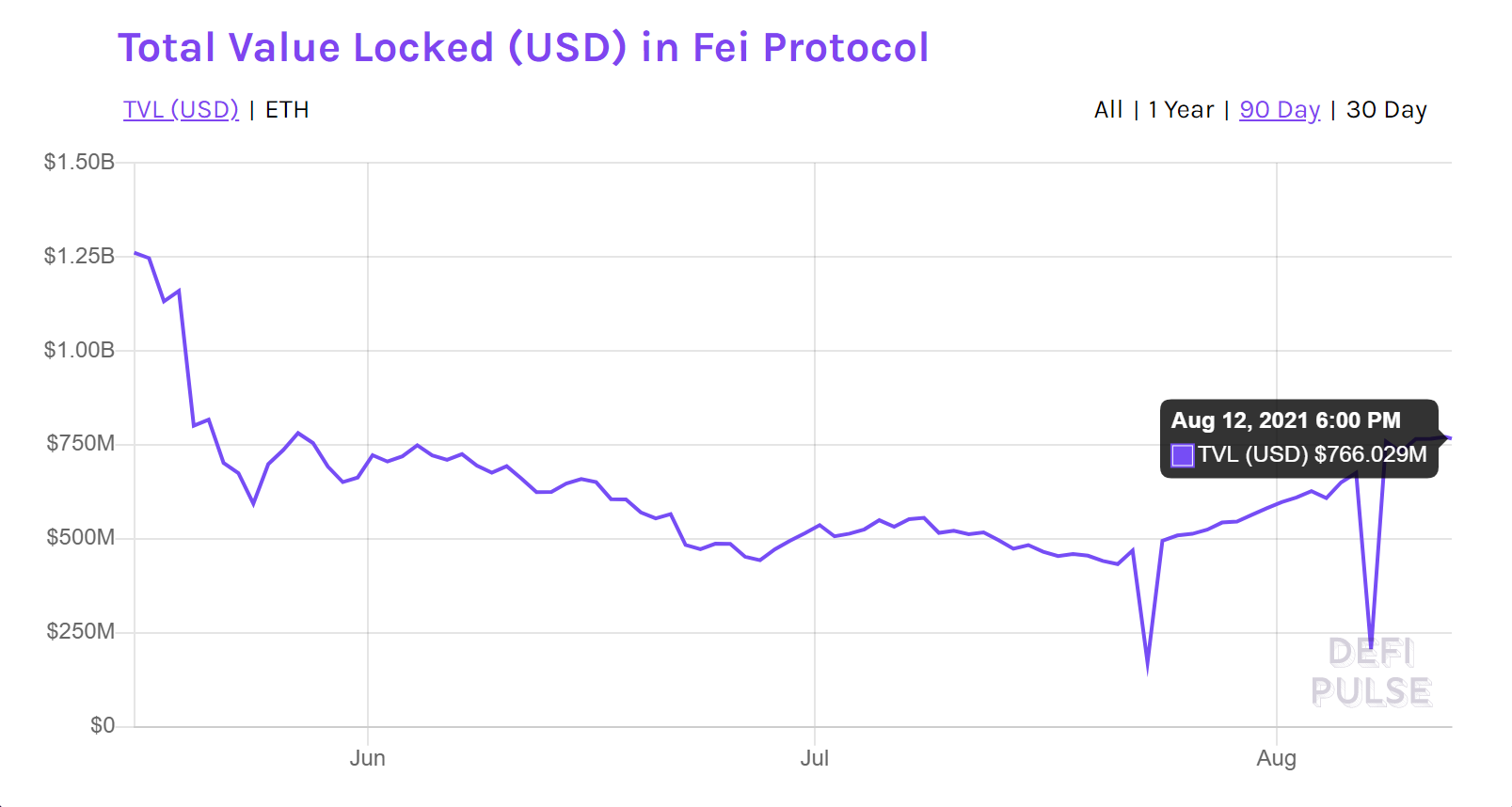
Just before Coinbase announced the launch of Fei Protocol’s governance token TRIBE, the locked position increased from $200 million to $7.76, and the locked position instantly increased by 2.5 times. On August 12, Coinbase officially announced the listing of TRIBE.
Competitors of Fei Protocol
Once known as the three heroes of stablecoins: Fei, Float, and Reflexer.
Whether FLOAT and Reflexer are really heroes of stable coins, we can find out from the data performance.
The first is the Float Protocol
Unlike Fei Protocol, Float does not have any financing, an anonymous team is established, and the distribution of governance tokens is completely community-based.
Float Protocol is a completely different kind of stablecoin. Rather than having a fixed value, it can be designed to "float" as the demand for itself and the cryptocurrency changes. Its goal is to reduce short-term volatility. In the long run, its value will increase with the growth of the cryptocurrency to protect the purchasing power of users.
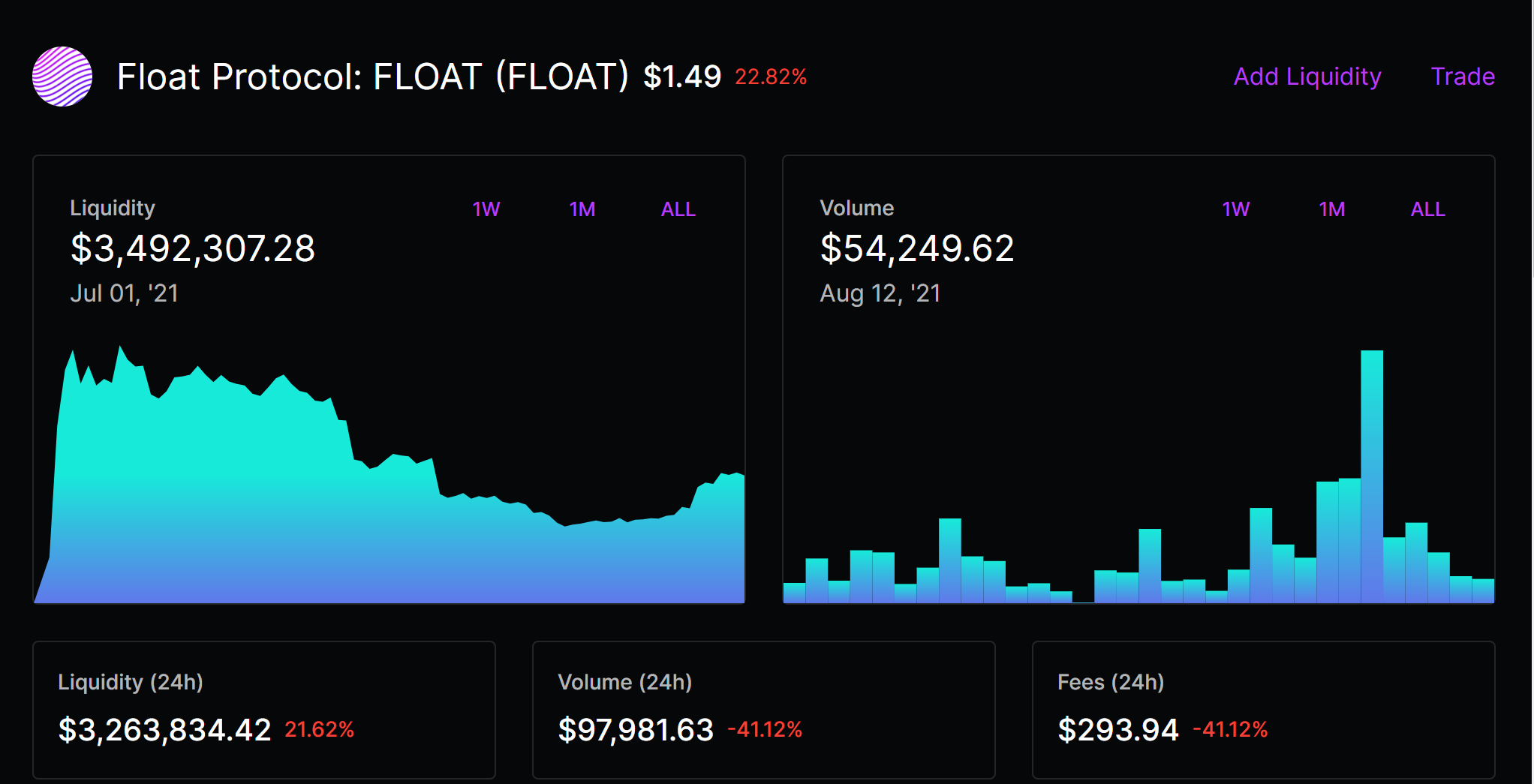
The 24-hour lock-up volume of FLOAT in Sushiswap is 3.26 million US dollars, and the 24-hour trading volume is only 97,981 US dollars, creating a service fee income of 293 US dollars. Only one decentralized exchange of Sushiswap is launched. This method obviously cannot make the public use it frequently. .
Reflexer
Reflexer is also an algorithmic stablecoin that has attracted many venture capital companies. Institutions such as Pantera Capital, Lemniscap, Paradigm, MetaCartel Ventures, Divergence Ventures, Standard Crypto, The LAO, and team members from Compound, a16z, Synthetix, and Aave all participated Reflexer's investment.
Its stable RAI is relatively close to DAI, and it is also an over-collateralized algorithmic stable currency. Unlike other stable coins, RAI is anchored at $3 for a long time. Due to the use of over-collateralization, it is more stable than FEI.
 8
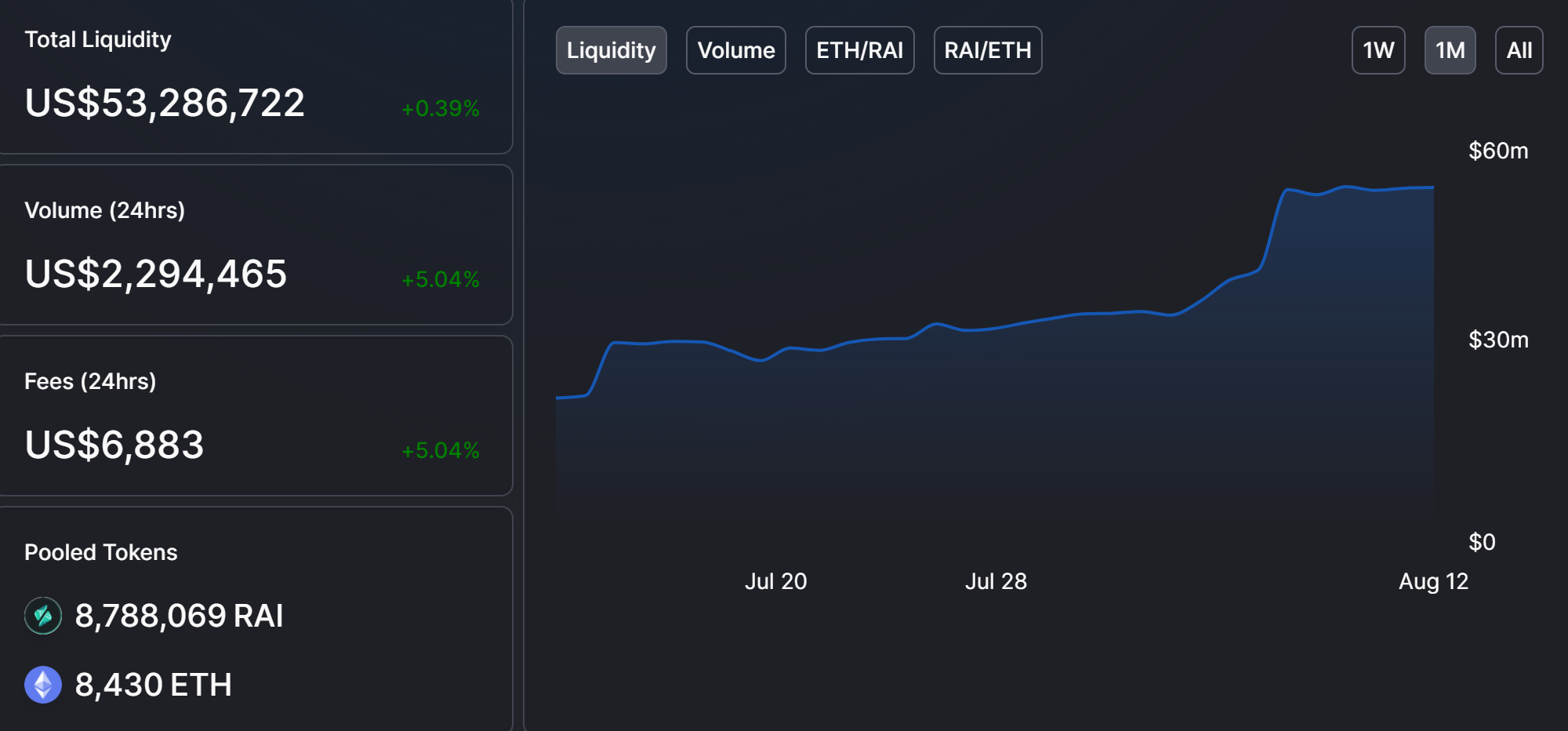
RAI's Uniswap shows that the total lock-up volume is 53.2 million US dollars, and the 24-hour trading volume is 2.29 million US dollars, creating a fee income of 6883 US dollars.
With the help of many institutions, RAI has launched 5 exchanges, but the trading volume is not satisfactory, and it is slightly inferior to FLOAT.
Link for more details about RAI: https://ameensol.medium.com/a-money-god-raises-rai-is-live-on-ethereum-mainnet-f9aff2b1d331
https://medium.com/reflexer-labs/rai-is-live-f151490b1b02
Algorithmic Stablecoin Protocol Summary
For centralized stablecoins, the current algorithmic stablecoins are not stable.
Algorithmic Stablecoin Judging from the data, Fei Protocol is most likely to become an algorithmic stablecoin accepted by the public in the future. Stability is like the renminbi we usually use. The more people use a certain stable currency or reserve a certain stable currency, and expand more financial use cases, it will be stable and valuable.
For example, the U.S. dollar, a global currency, is used as a global reserve currency and can be circulated in every corner of the world. The purchase of oil in the Middle East needs to be settled in U.S. dollars. Owning U.S. dollars can make more financial investment choices around the world. This is what stablecoins need to do, use it to do more things, and let more people accept it.
Among the many algorithmic stablecoins, it seems that Fei Protocol knows how to make others use FEI more frequently. Its community also strongly recommends the FEI team to interview more exchanges to launch its stablecoins and expand the frequency of use. This approach is very reasonable. This approach has indeed increased FEI transaction volume. Objective data shows that the total volume of all algorithmic stablecoin transactions is now less than FEI.





