


How should we pledge without 32 Ethereum?


Original title: "How do we pledge without 32 Ethereum?" "
In the ever-changing encrypted world, it is a bit of a fantasy to seek a relatively stable income. If you have to find one, it should be a pledge. But Ethereum 2,0 needs 32 Ethereum to become a validator, so how should ordinary people without 32 Ethereum pledge?
This article introduces the pledge method in the state of not running nodes in the environment of Ethereum 2.0 without 32 ETH.
Late last year, on December 1st, a long-awaited new version of the Ethereum network was released. Now anyone familiar with cryptocurrencies and ETH can potentially become a validator on this network. This means that new opportunities for passive income have emerged.
The pledge of Ethereum 2.0 is to lock ETH in the smart contract to participate in the network as a validator and get rewards for confirming blocks. Staking became possible after the launch of a new version of the network based on the Proof-of-Stake (PoS) consensus algorithm. This consensus algorithm is similar to the well-known mining, but instead of using computing resources validators lock coins in wallets to run a special node.
To become an Ethereum 2.0 validator, you need to lock up at least 32 ETH for investment, which is quite a lot for an ordinary crypto investor. The current price of 32 ETH is roughly over $70,000. So, how can ordinary investors stake ETH 2.0?
Some important things before starting:
Not a regular APY. The more ETH staked, the lower the APY.
Users cannot withdraw their stake until a future upgrade is deployed (this may take 1-2 years). Withdrawals will be available in a minor upgrade after the mainnet merges with the beacon chain.
Staking pool
Staking pool
The pool provides an intermediary for those who have less than 32 ETH, which will pool the user's ETH for joint mortgages. Staking rewards are distributed among pool members in proportion to their ETH shares. Storage is decentralized, transparent, and secured by smart contracts. Pools charge staking fees, and some services have limits on the minimum amount of ETH deposited. Most staking pools issue tokenized versions of staked locked ETH, such as rETH. These ERC-20 tokens represent not only ETH, but also staking income. Tokens can have the same symbol or name. But if they are not issued by the same pool, then they are different assets with different liquidity.
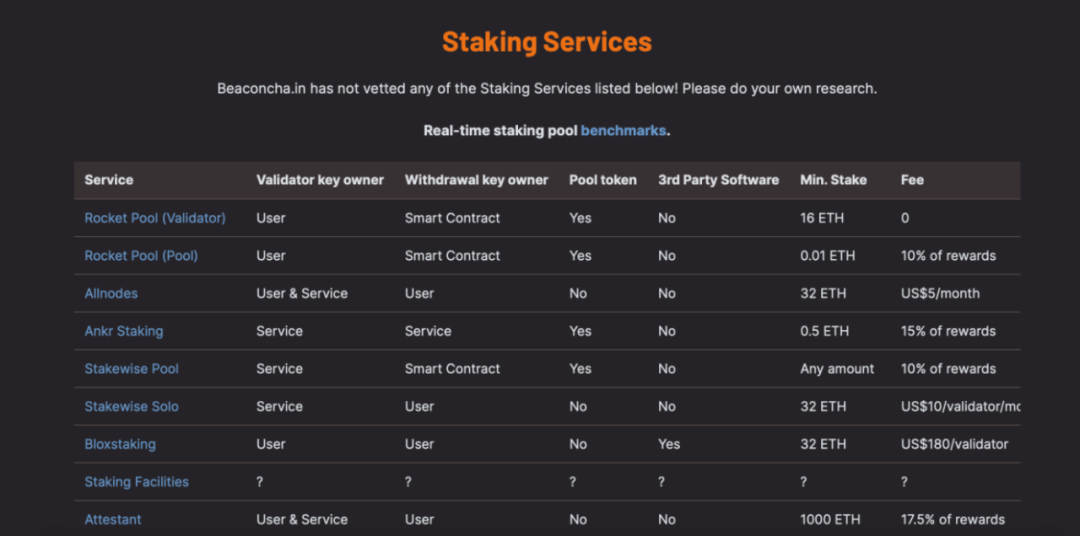
Give a few examples. For example, let's look at two top providers, Ankr and Rocket Pool.
Staking via Ankr is quite comfortable, but there is still a minimum amount of ETH that needs to be staked. Users will hold at least 0.5 ETH, which equates to about $1150 today. The APY of staking via Ankr is 9.64%. But it's important to know that Ankr charges a 15% fee on all rewards. For this fee, Ankr provides user-friendly infrastructure and a synthetic asset, aETH, which can be sold immediately if the owner decides to stop staking ETH. So, if an investor wants to stake 1 ETH through Ankr, the daily return will be $0.331.
Rocket Pool has a low minimum amount of ETH required to start staking — just 0.01 ETH, which is currently around $23. Like Ankr, Rocket Pool offers stakers a tradable synthetic asset called rETH. Right now, Rocket Pool's APY is 9.8%. Rocket Pool charges a 10% commission (or 0 commission if the user holds at least 16 ETH), so if an investor holds 1 ETH, the return would currently be $0.42 per day.
Pledge on the exchange
One of the easiest options is to transfer the ETH to a wallet on an exchange or other custodial service that offers dividend rewards. However, there is a typical risk of dealing with centralized exchanges: users do not control the private keys.
Currently, staking ETH through an exchange is definitely the easiest way. Investors only need to register or use an existing trading account, deposit or buy ETH and stake through a clear interface. It is now available on many exchanges, but due to the high risk of staking through exchanges, it is recommended to only use the most reputable exchanges. For example, Binance, Huobi, Coinbase, Kraken, and OKEx can be considered relatively safe staking platforms.
So, how much money can you earn by staking ETH through exchanges? For example, Binance offers convenient ETH 2.0 staking with just a few requirements. Staked assets cannot be redeemed until the shard chain is launched, which may take 2 years. Binance provides BETH tokenized assets to users at a ratio of 1:1, which proves that users have provided ETH for pledge. Binance has no minimum ETH staking limit, so basically, anyone can start doing it. Also, Binance charges 0% fees for its services, which is very unique. Right now, the APY is around 9.32%. Therefore, by staking 1 ETH, the user will be rewarded approximately $0.447 per day. It is important to emphasize that the APY used for staking changes over time.
Another example is the Kraken exchange, which offers the same service but with one different condition. The exchange charges a 15% fee on all staking rewards. Additionally, Kraken has a so-called onboarding process for staked ETH. Rewards will start generating 20 days after the user presses the button. So, if the APY doesn't change much after the 20-day onboarding period, staking on Kraken will net the user about $0.38 per day live.
ETH lending platform
A balanced choice between staking and the ability to borrow tokens with ETH locked for staking. Suitable for risk traders and investors seeking to maximize profits. For example, LiquidStake allows ETH stakers to use pledged ETH as collateral to borrow USDC.
Investors holding LiquidStake will earn 9.86% APY and pay 14.91% commission on returns. In addition, the USDC loans obtained by investors are equivalent to the value of pledged ETH. Now, by staking 1 ETH, users can get 0.4 USD per day.
How profitable is it?
Finally, it is also important to note that validator rewards are affected by the total amount of ETH locked. Based on this figure, the maximum annual return for a validator can be anywhere from 2 to 20%. Therefore, the profit investors get from the investment is not high, but it is relatively stable and the risk is low.
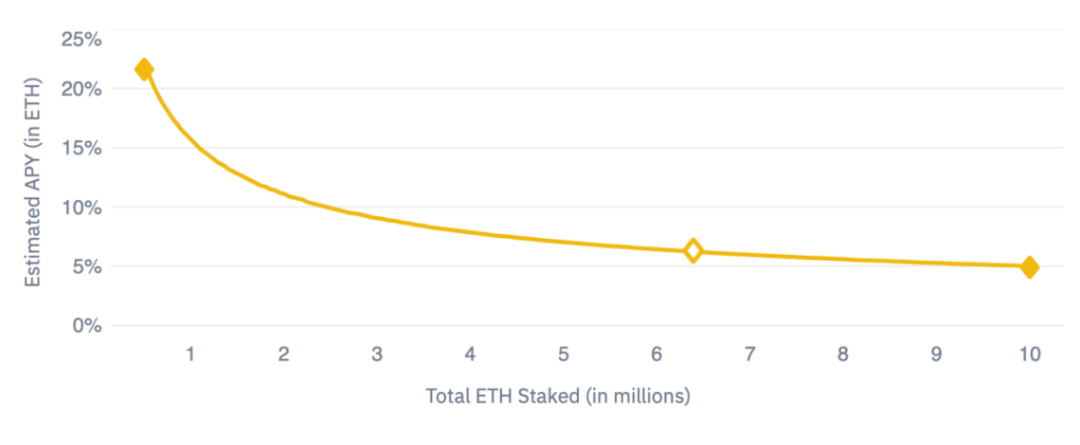
However, this profit is greater than the average interest you can earn by depositing fiat currency in a bank account, so ETH staking could be an interesting option. However, it is important to analyze the risks of the chosen staking method and remember that the price of ETH is quite volatile. Therefore, despite the investment profit, investors can get some extra profit or loss according to the ETH price in the market.
Source:https://hackernoon.com/how-to-stake-eth-2-0-without-running-a-node-and-32-eth





