


Ethereum is ushering in the most critical upgrade, and 5 community proposals will be realized


If nothing else, when the Ethereum network block height reaches 12,965,000, around 20:00 on August 5, Beijing time, we will usher in the Ethereum London hard fork upgrade.
Since the Ethereum secondary market soared to thousands of dollars, many top capitals, KOLs, and even securities have written research reports to discuss and imagine whether the value of Ethereum can exceed Bitcoin. Among the arguments they list, the August 5th London escalation must be among them.
first level title
Revisiting EIP-1559
In the Ethereum network, the transaction initiated by the user needs to be packaged by the miner to complete, and when multiple transactions appear in front of the miner together, the miner follows the bidding logic, that is, which user gives the miner more money (Gas fee), the first package whose deal. This has not changed in the 6 years of Ethereum.
But the problem is that when the number of users increases, the more transactions on the Ethereum network, the higher the Gas fee that users need to pay. In order for the transactions to be successfully entered into the block, the users started the Gas War.
EIP-1559 is a proposal to improve the Ethereum transaction fee mechanism jointly proposed by Ethereum co-founder Vitalik Buterin and ethhub_io founder Eric Conner. In August 2018, Vitalik published a paper Blockchain Resource Pricing, which explained the problems of the existing transaction fee mechanism from an economic point of view, and proposed a solution prototype. Since then, in the ZCash community, Vitalik has further refined the scheme. At the Ethereum Core Devs Eth1x/Istanbul Planning Meeting held in 2019, Vitalik introduced the research background, goals and mechanism of EIP1559. Since the adjustment of the transaction fee mechanism will affect the main stakeholder groups of Ethereum (users, developers, miners, wallets, etc.), the EIP-1559 proposal will not be realized until the 2021 London upgrade three years later. Since the research background involves more complex economics, Rhythm BlockBeats sorted out the main mechanism of the proposal and its impact on the Ethereum network.
In essence, EIP-1559 divides the Gas fee into two parts, one part is the "Base fee" (Base fee) that must be paid for each transaction, calculated according to the base fee of the previous block and the resource utilization of the block, and the other part is It is the "Priority fee" that is paid by the user optionally.
For the basic fee rate, when the utilization rate of the previous block is higher than 50%, the basic fee rate will increase; when the utilization rate is lower than 50%, the basic fee rate will be reduced, and the user cannot adjust the basic fee rate. The base fee will be permanently destroyed by the network.
In addition to paying the basic fee when initiating a transaction, the user also needs to pay a priority fee to the miners. The role of the priority fee is to compensate miners for the increased risk of uncle blocks caused by including transactions into blocks. At the same time, for users who want transactions to be included in the block as soon as possible, they can set a high priority fee to ensure that the transaction is included immediately.
In most people's point of view, the implementation of EIP-1559 is beneficial to the Ethereum network economy and user experience.
From an economic point of view, since a portion of ETH needs to be destroyed for each transaction, this means that the more economic activities occur in the economy, the greater the amount of ETH destroyed will be. In other words, when the burning rate is greater than the block reward issuance rate, Ethereum will enter a deflationary state.
As the head ecology of DeFi and NFT, Ethereum has unparalleled network activity, which also ensures that ETH will be continuously destroyed, thereby increasing the relative scarcity of assets, which is important for the value storage properties of assets. It is very beneficial to say. At the same time, when people continue to use the network, most users need to buy ETH from the open market, which ensures a steady stream of demand for ETH. On the other hand, the selling order, since the basic fee will be destroyed, the miners only get the priority fee and block rewards, which means that the natural selling pressure from the miners is greatly reduced.
From the perspective of user experience, users do not need to have a deep understanding of the transaction fee mechanism. They only need to pay according to the wallet's estimate, and they can get the optimal rate and expected results, which undoubtedly improves the user experience of Ethereum.
Of course, not everyone in the community agrees with the implementation of EIP-1559. Rhythm once counted the attitude of mining pools to this proposal, and the proportion of computing power opposed to it exceeded 62%. Because in the long run, EIP-1559 deprives miners, as a group, of the opportunity to benefit from Ethereum's success.
However, the implementation of the proposal will not be affected by the opposition of the mining pool, and the code will still be embedded according to the plan, so there is also a view that "Ethereum will fork".
first level title
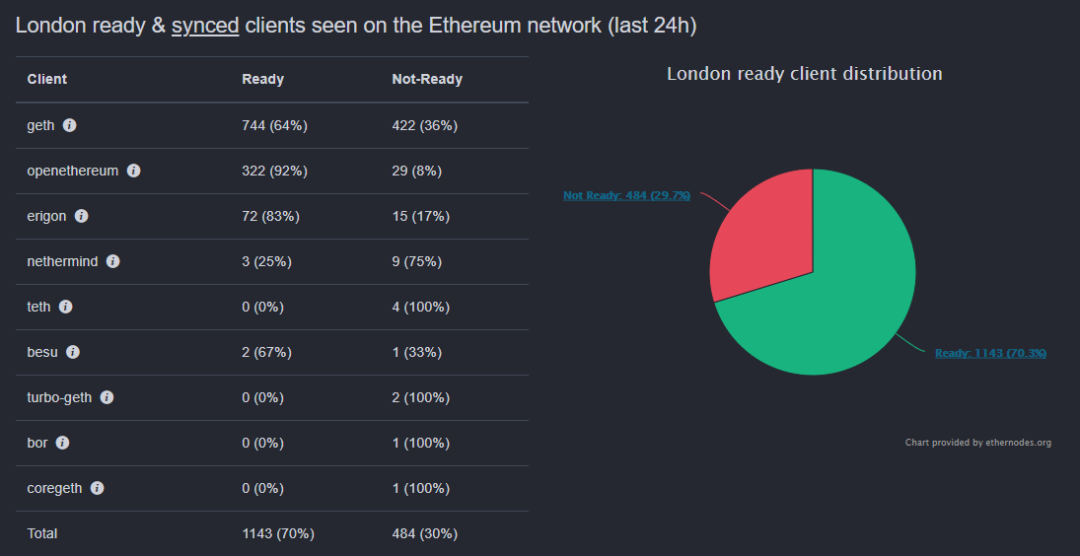
Other proposals that will be implemented in this upgrade
In addition to the much-watched EIP-1559, there are four other proposals that will be implemented in this upgrade. They are EIP-3198, EIP-3529, EIP-3541, and EIP-3554.
First, let's take a look at EIP-3198. EIP-3198 aims to optimize the user experience of smart contracts and enhance the security of the second-tier network (State channels, Plasma, Optimistic Rollups, etc.) that implement "fraud proof". By adding an opcode, the EVM can know the current The base fee rate for the block.
EIP-3529 solves the attack caused by the current gas return mechanism by removing the return Gas of the contract SELFDESTRUCT and reducing the return Gas of SSTORE, thereby releasing more available block resources. At the same time, this proposal also makes the once popular Gas Token no longer useful.
EIP-3541 facilitates further future updates of Ethereum by prohibiting the deployment of code starting with 0xEF bytes, while EIP-3554 helps developers better transition to Ethereum by delaying the difficulty bomb until December 2021 2.0.
After the upgrade in London, the entire focus of the Ethereum community will be on the upgrade of Ethereum 2.0. Looking at it more subdivided, the merger of Ethereum 1.0 and the beacon chain will be the next highest priority operation, and it is also a process that may last for many years. The most critical first step in upgrading.
Reference:
《What impact will the Ethereum London Hard Fork have? 》
https://swissborg.com/blog/eth-london-fork
《Ethereum London Hard Fork to Make Some Tokens Worthless》
https://decrypt.co/77345/ethereum-london-hard-fork-make-some-tokens-worthless





