


Going forward 7 years, why did the stablecoin come to the forefront again?


Original title: "Why stablecoins are on the cusp again? ", by rance Yue & Eli Tan
What are stablecoins?
What are stablecoins?
A stablecoin is a cryptocurrency whose value is usually pegged to another asset, whether it’s a government-issued currency like the U.S. dollar, a precious metal like gold, or even another cryptocurrency.
Issuers of stablecoins have been experimenting with different methods to achieve and maintain a stablecoin peg to the price of its underlying asset. Some stablecoins are pegged to the U.S. dollar, such as USDT, USDC, BUSD, and GUSD, and the dollar value of the reserves backing them should match their circulating supply; others are backed by physical commodities, such as each Tether Gold ( XAUT) value tokens representing 1 ounce of London Good Delivery gold.
first level title
How are stablecoins used?
Before the rise of stablecoins, most people used cryptocurrencies to transact with fiat and other cryptocurrencies. “Starting in 2017, spot trading for stablecoins started to take a larger share of trading activity,” noted Pankaj Balani, CEO of crypto derivatives exchange Delta exchange.
Stablecoins offer a faster and cheaper option than trading cryptocurrencies for fiat currencies, allowing for more liquidity. They are also theoretically less susceptible to market price fluctuations of other cryptocurrencies.
Stablecoins are also being used for cryptocurrency lending. For example, you can deposit USDC into a savings account with Coinbase, one of the companies behind the stablecoin, for a 4% annual interest rate. Depending on the platform, the interest rate for depositing USDT is between 1.66% and 13.5%.
secondary title
1. Tether is questioned
image description
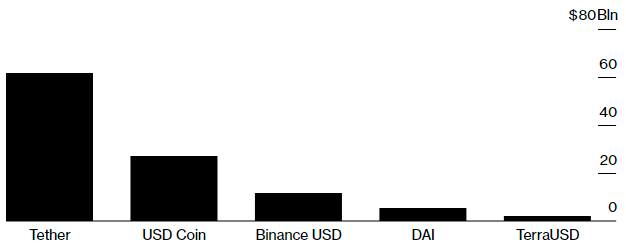
Above: the market capitalization of several mainstream stablecoins. Source: CoinMarketCap
However, Tether, the company behind USDT, has been plagued by regulatory issues.
On Monday, Bloomberg reported that,DOJ is probing whether Tether hid early cryptocurrency-related transactions from banks. A peculiarity of Tether (USDT) is that its issuing company claims that each USDT token is backed by one dollar worth of assets, either actual currency or assets including commercial paper, corporate bonds, and precious metals. assets. This has raised concerns that if many traders sell USDT at the same time, there could be a run on the asset backing the token.
Tether posted a response on its website, saying the Bloomberg article was based on “allegations made years ago, apparently to generate hits.” The company did not explicitly deny the allegations, though.
Tether (USDT) was first released in 2014 to solve a problem plaguing the cryptocurrency market at the time: Banks didn't want to open accounts for virtual currency exchanges because they feared access to funds linked to drug smuggling, cyberattacks and terrorism. By accepting Tether (USDT), exchanges are able to allow traders to hold assets independent of Bitcoin price fluctuations, and funds can be transferred from one exchange to another in an instant.
However, as previously mentioned, some investors are uneasy about the reserves underpinning Tether’s (USDT) issuance, doubting the company’s ability to redeem tokens in the event of a worst-case scenario. In May, the company disclosed a breakdown of its reserves as part of a settlement with the New York Attorney General's office. According to Tether's disclosure, about 50% of its reserves are invested in "commercial paper" (usually short-term corporate bonds), 13% are invested in secured loans, and 10% are invested in corporate bonds and precious metals.
secondary title
2. Regulatory pressure
According to data from CoinMarketCap,As of July 26, the total market capitalization of stablecoins was $116 billion, a nearly 4-fold increase since the beginning of the year.Along with this growth comes increased attention from U.S. and other regulators to stablecoins.
Alex Svanevik, CEO of crypto analytics firm Nansen, said: “Regulators focus on stablecoins because,They are closer to the existing banking system than other types of cryptocurrencies.Stablecoins have the potential to disrupt traditional finance. "
A month ago, Federal Reserve Bank of Boston President Eric Rosengren viewed Tether and other stablecoins of value as a financial system risk and expressed concern that short-term credit markets could be disrupted.
In addition, U.S. Treasury Secretary Janet Yellen said that regulators must "act quickly" to consider new regulations for stablecoins, and she will study the regulation and risks of stablecoins as part of the President's Advisory Group. Shortly thereafter, officials from the Treasury Department, the Federal Reserve, the U.S. Securities and Exchange Commission (SEC), the Commodity Futures Trading Commission (CFTC), the Office of the Comptroller of the Currency, and the FDIC met to discuss the issue “in light of the rapid growth of digital assets.”
Separately, SEC Chairman Gary Gensler suggested last week that some stablecoins should be considered securities and be regulated by the SEC.
secondary title
3. Circle plans to go public, other stablecoin issuers disclose more information
Circle, the issuer of the second largest stablecoin USDC, has also received attention. Circle plans to go public through a merger with a special purpose acquisition company (SPAC), Concord Acquisition. The deal values the crypto financial services company at $4.5 billion.
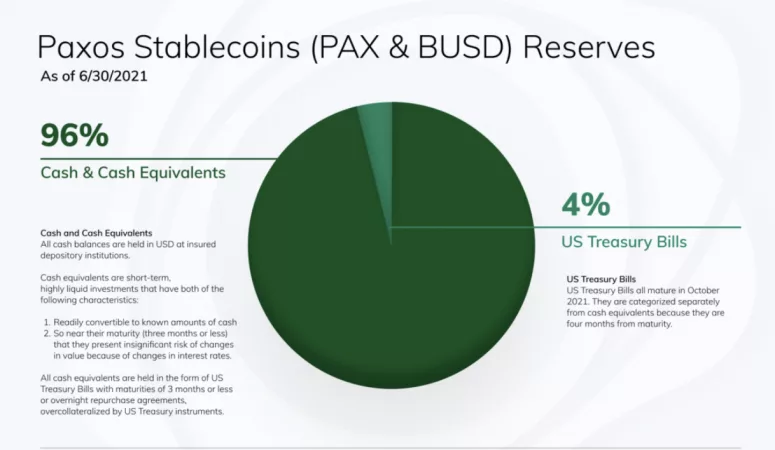
The asset class underpinning USDC was first revealed by Circle in its latest certification on July 16, following Circle CEO Jeremy Allaire's pledge to increase the company's transparency. The company reports that about 61% of its USDC tokens are backed by “cash and cash equivalents,” or cash and money market funds; Yankee certificates of deposit (that is, certificates of deposit issued by foreign (non-US) banks) account for 13%, and U.S. Treasury bonds 12 percent, commercial paper 9 percent, and the remaining tokens backed by municipal and corporate bonds.
image description
first level title
The Systemic Role and Risks of Stablecoins
The systemic role that stablecoins play in cryptocurrency trading and lending has some investors fearing some worst-case scenarios, such asWhat happens if stablecoin issuers face mass redemption requests.
This risk could also spill over into traditional markets. Credit ratings firm Fitch Ratings said in a report earlier this month that the risks to stablecoins could be “contagious.” According to Fitch, as of March 31, Tether’s holdings of commercial paper (CP) totaled $20.3 billion, meaningIts CP holdings probably exceed most good money market funds in the US, EMEA.
The ratings firm stated: "If a sudden mass redemption of USDT occurs during a period of broader selling pressure in the CP market, especially if it is related to broader redemptions of other stablecoins with similar asset reserves, it may affect short-term credit. market stability."
Stablecoins may also affect the money supply, said David Grider, head of digital asset research at Fundstrat Global Advisors. The actual reserves of dollars (that is, the dollars in the reserves backing the stablecoin) can be lent out in the real economy to earn interest, and the issued stablecoins may be loaned out again in the encrypted economy, also earning interest. As Grider wrote in an analysis, this is "effectively lending the same dollar twice."





