






Data Observation: Bitcoin consumes more energy than most of Africa combined


From Musk's release of mining waste of energy to Ethereum's switch to a proof-of-stake mechanism, from China's ban on mining to CNBC, can a Bitcoin network really consume such a large amount of resources?
You’ve likely seen Elon Musk’s tweet announcing that Tesla is suspending Bitcoin as a payment method due to environmental concerns, which is understandable since Tesla is a green company. Musk said in May: “We are concerned about the rapidly increasing use of fossil fuels in Bitcoin mining and transactions, especially coal, which has the worst emissions of any fuel.” Most of Africa’s energy resources are still very large. Relying on natural gas, coal and oil, the cost of these projects is out of reach for many on the continent, especially with the amount of energy required to produce electricity to mine Bitcoin.
How Much Energy Does Bitcoin Use Compared to Africa?
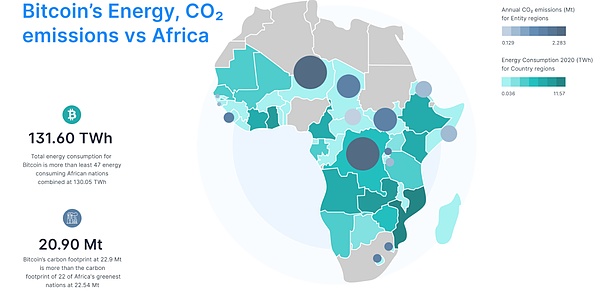
Image credit: Kash
Bitcoin's mining network ranks among the top 30 in the world in terms of energy usage. According to Digiconomist's Bitcoin Energy Consumption Index, Bitcoin's energy consumption can provide 131.16 TWh of electricity for a country with a population of tens of millions, which is more than the total consumption of 130.05 TWh for the 47 countries with the least energy consumption in Africa. According to a 2019 study published in the journal Joule Science, it produces 22.9 megatons of carbon dioxide per year, which is nearly as much as Sao Tome and Principe, the Comoros, the Central African Republic, Guinea-Bissau, Djibouti, Burundi, Gambia, Seychelles, Cape Verde, Somalia, Eritrea, Eswatini, Sierra Leone, Chad, Rwanda, Liberia, Malawi, South Sudan, Niger, Lesotho, Democratic Republic of the Congo and Guinea produced the same amount of carbon dioxide The combined output of these countries is 23.5 megatons of carbon dioxide. This won’t remain the case forever, though, as the price of Bitcoin rises and incentives for miners increase, leading to increased energy consumption. Another problem is that most of the mines are located in China and rely heavily on coal. China has been shutting down cryptocurrency mining operations due to concerns over energy consumption.
From the data, we can see that Bitcoin can indeed cause great pollution to the environment, and it is just one of thousands of ever-growing cryptocurrencies. At this rate, can our environment really tolerate all this? The answer is no. We are already fighting climate change. The cryptocurrency revolution must be more sustainable for itself and our Odaily.
Bitcoin's PoW consensus mechanism and its relationship with energy consumption
As the French mathematician Gaspard-Gustave de Corioli put it, work is energy directed at an action, and energy is "work done". Finished work can be stored in a currency such as Bitcoin for future spending. The Bitcoin consensus mechanism is based on Proof of Work (PoW), where energy is used to keep the blockchain running securely.
In the process of generating a new block, miners solve a guessing game in which pooled transactions plus a "nonce" are inserted into a SHA-256 hash function over an average time frame of 10 minutes, until the results meet the predetermined criteria defined by the protocol. In more detail, miners retrieve unconfirmed transactions from the mempool and bundle them into a new block. This block has several pieces of information in the block header. Miners then take the block headers, add a random number called a "nonce" and put it into a hash function, resulting in a 256-bit number. The network only accepts results smaller than a certain limit, again predetermined by the blockchain protocol and called a "goal" (e.g. the first 32 bits of a returned result must be zero [simplified]).
Miners repeatedly insert combinations of transactions bundled into blocks into a hash function until the result meets the criteria. The number of such trials per second is called the "hash rate". The first miner to receive a result that meets predetermined criteria broadcasts the result to the network and receives a block reward, which also includes transaction fees for the transactions included in the block. Due to the similar properties of Bitcoin and precious metals, the process is called "mining". The fictional name of Bitcoin's inventor, Satoshi Nakomoto, backed up this claim in one of his posts.
“In that sense, [Bitcoin] is more like a precious metal. The supply is predetermined and the value changes, rather than changing the supply to keep the value constant.” — Satoshi Nakamoto
The number of bitcoins issued per block is predetermined by the protocol. As a result, Bitcoin's supply is mathematically controlled and limited — in stark contrast to central bank-issued money. Over time, the number of new bitcoins issued per block has decreased by 50%. This "halving" happens every 210,000 blocks or roughly every 4 years. Currently, 12.5 bitcoins are issued for each mined block.
Bitcoin's proof-of-work mechanism is set to adjust the difficulty of finding a new block every 2016 blocks, and the average time to find a new block is about 10 minutes. The difficulty is affected by the computing power provided by the network (the higher the computing power, the higher the difficulty).
This means that there is a mining market with a fixed supply of bitcoins, as defined by the protocol, and a variable demand for computing power based on the difficulty determined by the overall hash rate. Due to the laws of supply and demand, the predetermined bitcoin reward per block, the current bitcoin price, and the cost of mining determine the number of cost-effective miners who can contribute to securing the network. In an efficient market, the premium is zero, which means that the marginal return to burning 1 kWh of energy via proof of work is equal to the marginal mining cost. The formula for block rewards including transaction fees is:

The automatic adjustment of Bitcoin mining difficulty results in a dynamic, self-correcting system. Assume that Bitcoin price and block rewards remain constant while mining costs increase. In order for the above equation to hold, fewer people will mine, which ultimately reduces the difficulty of mining. The reverse is also true: mining costs decrease, assuming the left side of the equation remains the same. More bitcoin miners will come online, which increases the difficulty.
In practice, however, perfect equilibrium does not occur because miners do not immediately shut down their equipment when it becomes unprofitable. Additionally, the increase in hash rate lags due to manufacturing and delivery time requirements. This gives existing hash rate owners an arbitrary advantage when the price of Bitcoin increases.
A conclusion can be drawn:
The energy consumption to keep the Bitcoin blockchain running depends on the hashrate of the network and the energy consumption of each miner.
Bitcoin rewards are predetermined by the protocol.
The overall cost-effective mining power is defined by the market (Bitcoin reward per block and Bitcoin price).
An Environmentally Sustainable Crypto Revolution
Fortunately, among the top cryptocurrencies, Bitcoin is the only one that consumes this much energy - Ethereum is currently moving to a completely different process, and other top coins such as Cardano require a lot less energy times.
There are two solutions to the environmental crisis brought on by the cryptocurrency revolution. Bitcoin and most other cryptocurrencies have been using a concept called "Proof of Work" (PoW) to verify each transaction. The proof-of-work mechanism ensures that attacks on the network are prohibitively expensive, and the mechanism allows conflict resolution in the event of a chain split. Additionally, proof-of-work minimizes trust because the valid chain—the one with the most accumulated work—can be easily attested to by everyone.
But this concept has a fundamental flaw, and that is the problem of scalability. Bitcoin's supply is finite, and as the supply dwindles, it takes longer to verify transactions, which in turn causes more energy to be used than ever to create a block, making the path less time-consuming. Not feasible. In fact, there are many mining warehouses around the world competing to solve the task at hand as quickly as possible, as only the fastest computer can prove a transaction and get rewarded among hundreds of computers competing to solve the same mathematical problem. This means that 99% of all energy that goes into a transaction is basically wasted energy.
One solution is partial centralization. All the trouble a proof system has is being able to verify transactions in a decentralized manner. Some believe that a central authority that algorithmically produces coins will reduce energy waste. For example, some cryptocurrencies have introduced a concept called pre-mining, which requires a central authority to create a certain number of blockchain-based tokens before releasing them to the public. In the long run, many are opposed to the idea of partial centralization, wanting to keep blockchain technology fully decentralized.
Another solution is to move to proof-of-stake (PoS) mining and use renewable energy. The Proof Of Stake system essentially eliminates the competitive computation process of the Proof Of Work system, while still keeping everything decentralized (even more decentralized than PoW). It lets each computer in the system handle one task at a time. Proof-of-stake systems require validators/miners to stake a certain amount of cryptocurrency as collateral, called "stake." In return, the algorithm periodically has one of the validators create the next block in the blockchain. This significantly reduces energy usage compared to proof-of-work systems, as there is no need to race to solve complex mathematical problems.
Additionally, there are several developments that make the Bitcoin blockchain more efficient. These developments include optimizations such as transaction batching and advanced cryptography, as well as additional layers on top of Bitcoin, such as exchanges, Bitcoin banks, sidechains, and the Lightning Network.
It is particularly interesting that the Lightning Network scales Bitcoin transaction volume by reducing the average amount of energy required to secure a Bitcoin transaction. As a decentralized peer-to-peer payment system that uses the consensus of the Bitcoin blockchain as the settlement layer to inherit its unique trust properties, the Lightning Network does not rely on entries in a shared ledger called the blockchain, and can theoretically Processing billions of transactions per second.
Transactions executed on a centralized second layer (exchanges like Coinbase) are also not placed on the blockchain and do not directly consume energy. In this case, the trust comes from the entity recording bitcoin transactions for its customers and maintaining a closed ledger of who owns how much bitcoin. These developments lead to more (if not unlimited) payments without putting them on the blockchain. This is why the increase in Bitcoin transactions will ensure that the average energy required per Bitcoin transaction is reduced to almost zero.





