


Ark Fund (ARK)'s rebuttal to traditional media's criticism of the top 5 cryptocurrencies


Original title "Debunking Common Bitcoin Myths"
Compile | Baize Research Institute
Compile | Baize Research Institute
Note: This article was originally published on June 28. The translator believes that the article is a promotion for The B World online summit some time ago.
More than 12 years after its birth, Bitcoin is still struggling to gain broad institutional acceptance. While constructive criticism is helpful, ARK believes that some influential financial research houses are dismissing Bitcoin based on stale information, incoherent arguments, and flawed analysis.
In light of Goldman Sachs' recent stance on Bitcoin, Ark is revisiting the most common misconceptions affecting its acceptance. We look forward to participating in the health and education debate about Bitcoin and the important role we believe it should have in a diversified investment portfolio.
Critics claim: Bitcoin is too volatile to be a store of value.
ARK counterclaims: Bitcoin’s volatility highlights the credibility of its monetary policy.
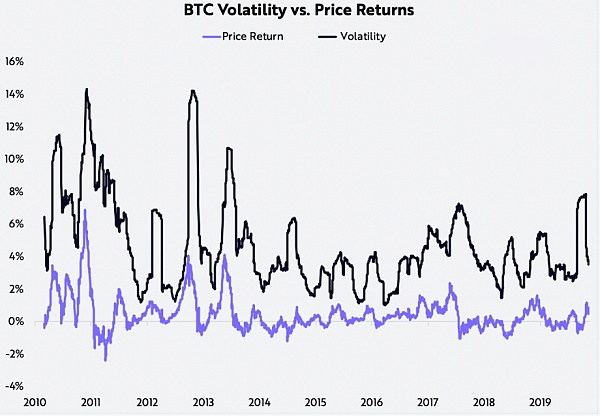
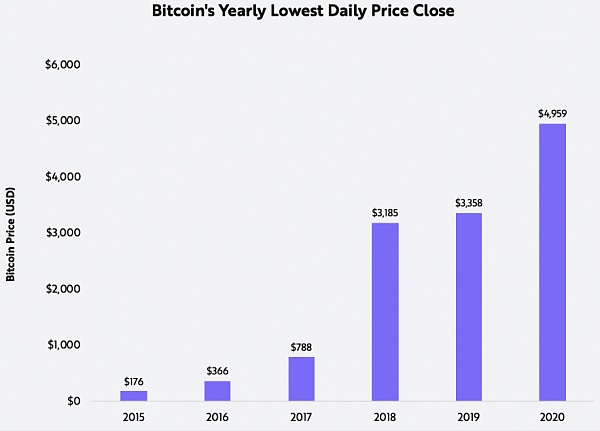
Critics often refer to Bitcoin’s volatility as a “store of value deal breaker.” Why would anyone want to store value in an asset whose daily price fluctuates so wildly?
In our opinion, these critics do not understand why Bitcoin is volatile and why its volatility might be less.
image description
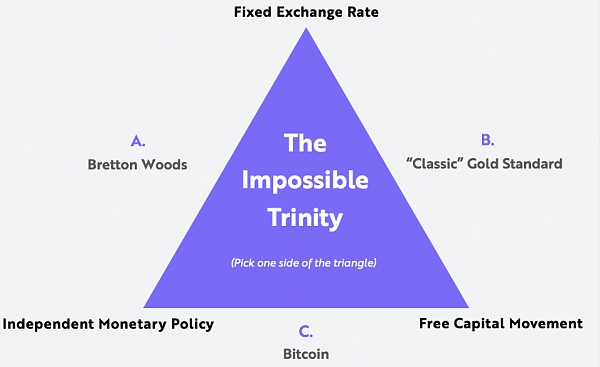
Source: Ark Investment Management LLC, 2020
Each side of the trilemma is mutually exclusive. For example, a monetary authority that chooses to fix the exchange rate and allow free movement of capital cannot control the growth of the money supply. Similarly, a monetary authority that chooses to fix the exchange rate and control the currency cannot adapt to the free flow of capital, and a monetary authority that chooses to adapt to the free flow of capital and control the money supply cannot fix the exchange rate.
Based on the trilemma, we can understand why volatility is a natural consequence of Bitcoin’s monetary policy. Compared with modern central banks, it does not prioritize exchange rate stability. Instead, based on the quantity of money rule, Bitcoin limits the growth of the money supply and allows free capital movement, forgoing a stable exchange rate. Therefore, the price of Bitcoin is a function of demand relative to its supply. Its volatility should come as no surprise.
image description
Source: Ark Investment Management LLC, 2020. Data source: Coinmetrics
image description
Source: Ark Investment Management LLC, 2020. Data source: Coinmetrics
Critics claim: Bitcoin is in a bubble.
ARK counterclaims: Bitcoin is a contender for the role of global currency.
Some economists, such as Nouriel Roubini, believe that Bitcoin is in a bubble that will burst. The line of reasoning is that Bitcoin has no intrinsic value and its appreciation depends on speculation like hot potatoes or tulips and "big fools" willing to pay more. In their view, Bitcoin is not an investable asset.
We think this argument refutes why Bitcoin has value over time. Indeed, Bitcoin does not behave like a traditional investable asset. Equity value is determined by discounting expected cash flows. Given higher future cash flows based on growth and/or return on invested capital, a stock appreciates independently of its shareholder base.
However, a monetary asset like Bitcoin is unproductive and its appreciation depends on its effectiveness in maintaining or increasing its value over time. In a way, the value proposition is circular: a monetary asset appreciates as more people demand it, and if it is an efficient monetary asset, more people will demand it. In other words, "money is a common delusion" and "money has value because other people think it has value".
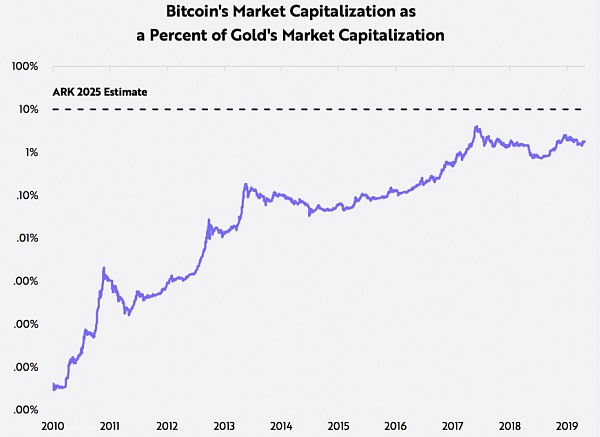
However, the claim that the value of money rests entirely on a common illusion suggests that its form is arbitrary. In fact, based on monetary history, the most common and sustainable currencies have qualities that sustain their demand. For example, for thousands of years, economists have considered gold to be the most successful form of money due to its scarcity, fungibility, and durability.
Often referred to as digital gold, we believe Bitcoin not only shares many of gold's characteristics, but also improves upon it. While scarce and durable, Bitcoin also has a divisible, verifiable, portable, and transferable set of monetary characteristics that confer superior utility and may drive demand and deem it suitable (if not superior) The role of global digital currencies.
image description
Data source: Ark Investment Management LLC, 2020. Data source: Coinmetrics
Critics claim: Bitcoin will lose the value of "forks" and digital copies.
ARK counterclaims: Software alone cannot replicate Bitcoin's value.
In the digital realm, goods are intangible and can be easily reproduced without destroying the original. For example, an individual can e-mail a Word document widely while retaining the original copy. Likewise, the ability for millions of people to listen to a song on repeat at the same time actually increases the value of the original, especially when other songwriters emulate its differentiated sound.
Bitcoin's software is no exception. It's free and open source. Individuals can copy the software, "fork the network" and create their own versions. However, skeptics still ask, if Bitcoin is based on open-source software that can be copied infinitely, how can it become scarce?
First, forking the Bitcoin network will not create new Bitcoin units, any more than exaggerating the Venezuelan bolivar will add dollars to the U.S. monetary base. Instead, forking Bitcoin creates a new network with new units or coins. While existing bitcoin holders own the rights to the new coins, forked networks operate under an independent set of rules backed by unique stakeholders. Instead of diluting the original network's money supply, open-source software encourages not only cheap experimentation and new networks, but new coins and a competitive market.
image description
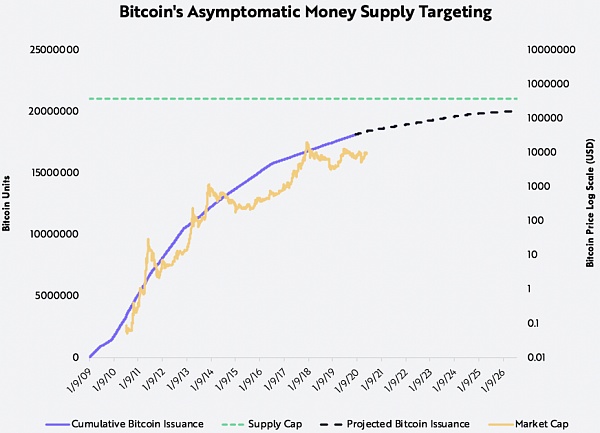
Source: Ark Investment Management LLC, 2020. Data source: Coinmetrics
So, at the time of the fork, what makes the 21 million units in the Bitcoin network more valuable than the 21 million units in a Bitcoin (BTC) fork such as Bitcoin Cash (BCH)? To equate the value of Bitcoin Cash to the value of Bitcoin is like assuming that Facebook's source code can be "forked" and automatically replicate the value of its 2.6 billion users and 50,000 employees. Their value stems from the network effects of Bitcoin and Facebook, not just their existence.
image description

Source: Ark Investment Management LLC, 2020. Data source: Coinmetrics
Critics claim: Bitcoin is for criminals.
ARK counterclaims: Bitcoin is censorship resistant.
Critics still accuse bitcoin of facilitating crime during its nefarious early days. For the first few years, Bitcoin funded Silk Road, an online black market platform known for selling illegal drugs.
We believe that to criticize Bitcoin for facilitating criminal activity is to criticize one of its fundamental value propositions: censorship resistance. As a neutral technology, Bitcoin allows anyone to transact, and "criminals" cannot be identified. Instead of relying on a central authority to identify participants by name or IP address, it distinguishes them by encrypting digital keys and addresses, giving Bitcoin strong censorship resistance. Anyone can transact anytime, anywhere as long as the participants pay the miners a fee. Once secured, the transaction cannot be easily reversed.
If criminal activity can be censored on the Bitcoin network, then all activity can be censored. In contrast, Bitcoin enables anyone to exchange value globally without permission. That doesn't make it an inherently criminal tool. Phones, cars, and the internet are no less banned than Bitcoin in facilitating criminal activity.
image description
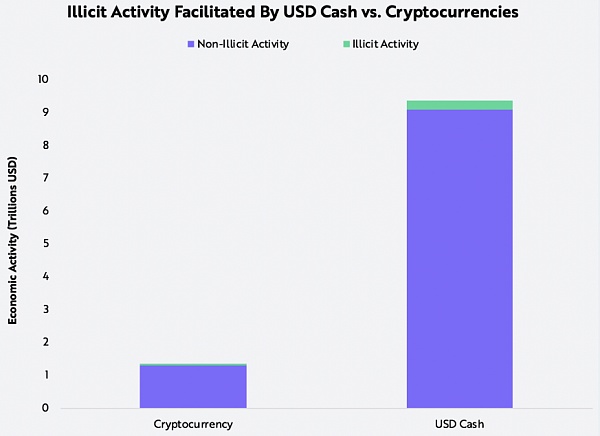
Source: Ark Investment Management LLC, 2020.
Critics claim: Bitcoin wastes too much energy.
ARK counterclaims: Bitcoin is more energy efficient than gold and traditional banks.
Bitcoin critics often assert that mining consumes more resources, especially energy, than it generates. Whereas critics consider computationally inefficient and non-scalable, advocates consider not only the expected trade-offs, but a fundamental characteristic. As Bit Gold founder and Bitcoin pioneer Nick Szabo has emphasized, “massive resource consumption and poor computational scalability unlock the security needed for independent, seamless global and automated integrity.”
ARK believes that Bitcoin has the unique ability to provide settlement assurance in a decentralized or trust-minimized manner, because specialized specialized hardware can transparently prove that the computer performed an expensive calculation.
Bitcoin makes the trade-off explicit: by allocating significant real-world resources to mining, we trust the network to guarantee settlement as well as anyone else. In Anatomy of a Proof-of-Work, Chaincode Labs resident Hugo Nguyen explains: "Behind the scenes, Proof-of-Work mining converts kinetic energy (electricity) into blocks of the ledger. By attaching energy to a block, one gives it 'form ’, giving it real weight and consequences in the physical world.”
image description
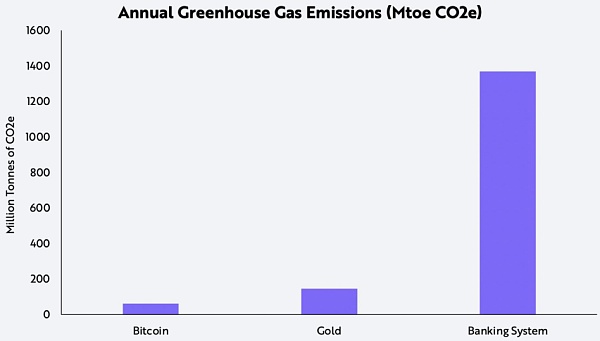
image description
Source: ARK Investment Management LLC, 2021. Data source: Hass McCook
in conclusion
in conclusion
The complexity of Bitcoin should not prevent financial institutions from conducting in-depth analysis of it. In this article, we discuss some of the most common objections to Bitcoin, hoping to spark conversation and debate within the institutional investment community. As the Bitcoin network continues to mature, we believe it will solidify Bitcoin as an emerging monetary asset that financial institutions will seriously consider.





