


Decentralized Stablecoins: An Unfulfilled Promise


Odaily Translator |
Odaily Translator |
introduction

introduction
While many pundits see cryptocurrencies as an independent monetary system capable of replacing traditional finance, stablecoins — a cryptocurrency pegged to the U.S. dollar — are still widely circulated on blockchains. According to data from Coingecko, stablecoins currently account for more than 50% of the daily trading volume of cryptocurrencies. However, less than 10% of the total cryptocurrency market cap consists of stablecoins, so stablecoins are likely to be used more as a medium of exchange between assets than as a store of value.
Today, most stablecoins are issued by a single legal entity, so they have certain centralization risks. From this perspective, stablecoins do not actually meet the expectations of DeFi users to "avoid centralization risks". But what if we could decentralize the stablecoin itself?Frankly speaking, the ideal is full and the reality is very skinny-many protocols have proposed various mechanisms for creating decentralized stablecoins, but only a handful of them have succeeded in the end.
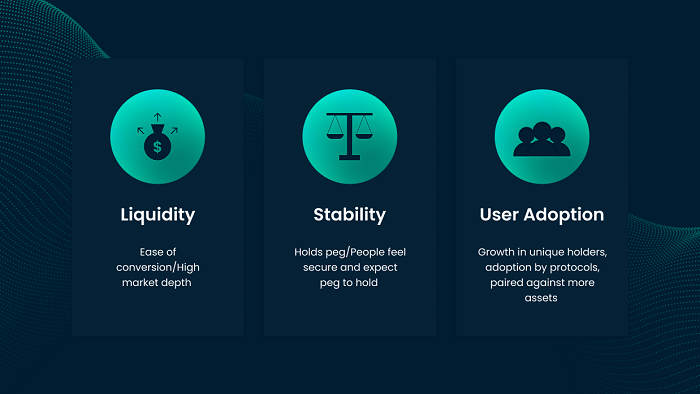
Even if it survives, the odds of eventual success are low, as price stability is only one of the pillars of the protocol’s growth. In fact, to be truly successful, a stablecoin protocol must achieve three main goals:
1. Liquidity
2. Stability
3. User Adoption Rate
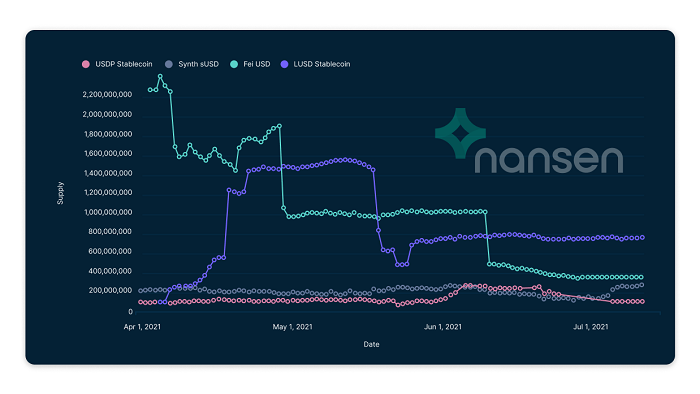
The graph above shows the supply of stablecoins with relatively stable pegs as of now, including USDP Stablecoin, Synth sUSD, Fei USD and LUSD Stablecoin.
secondary title
Different Stablecoin Models
While many stablecoin protocols have gone through many iterations, most stablecoins on the market share some similar characteristics. The diagram below shows a commonly used taxonomy framework for thinking about decentralized stablecoins more broadly. It should be noted that even in the same category of stablecoin protocols, some technical parameters and mechanisms will be different.
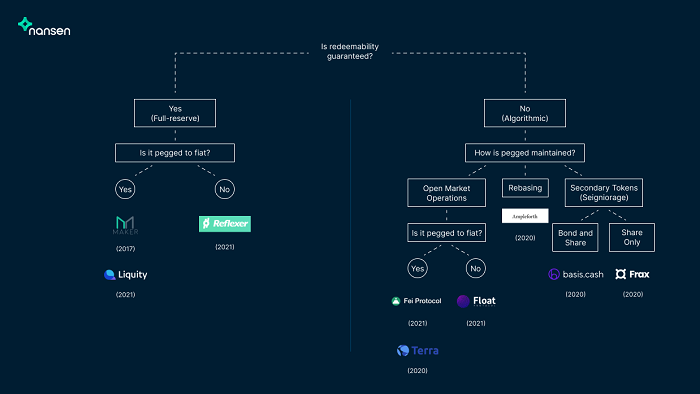
redeemability, which means that users have the ability to exchange stablecoins for equivalent assets.
MakerDAO is a fully-reserved, fiat-pegged stablecoin protocol. People can deposit reserve assets (such as ETH) into Maker, and then they can mint DAI based on the asset's USD valuation. Most cryptoassets are volatile, so Maker only allows DAI to be issued as a percentage of the asset's value and in this way ensures that DAI is always pegged to the corresponding asset at $1.
Because of this, Maker is like a traditional bank with full reserves, which allows depositors to withdraw money at any time without a run, and DAI users can also redeem their collateral at any time. Maker can have this "guarantee" because its full-reserve stablecoin is over-collateralized, but this over-collateralization model will lead to capital inefficiency. Maker typically has lower loan-to-value ratios and higher interest rates than other lending protocols, meaning people minting DAI can often borrow USD cheaper elsewhere.
In addition, the full-reserve stablecoin protocol also has a "natural flaw", namely: limiting growth, because the supply of stablecoins will be limited by the leverage demand of encrypted assets such as ETH. Imagine if all USDT users in the world today wanted to convert to DAI, but no one wanted to deposit ETH to mint DAI (e.g. ETH could be locked in staking), then there simply wouldn't be enough DAI available in the market .
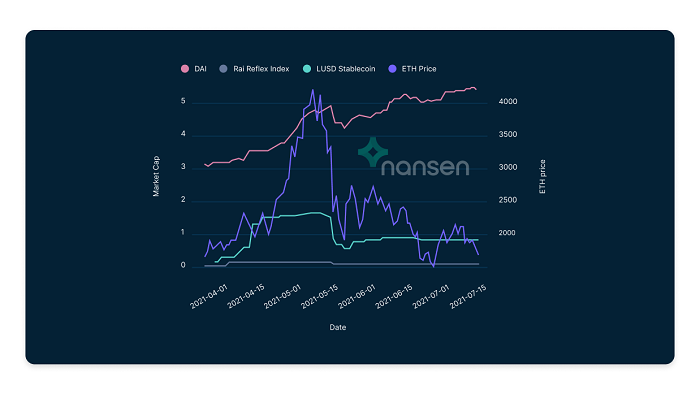
Above: As ETH price falls, so does the full reserve stablecoin supply
Algorithmic stablecoin protocols are designed to circumvent the problem of full-reserve stablecoin protocols—by definition, algorithmic stablecoin protocols do not guarantee that users can exchange their stablecoins for underlying assets of equal market value at any time.
Algorithmic stablecoins typically maintain their peg in three ways:
1. Open market operations.In the open market, algorithmic stablecoin protocols ensure the peg through smart contracts in exchange for reserve assets for the stablecoin itself, and vice versa. For example, Fei Protocol achieves this by directly conducting buy and sell transactions on its Uniswap liquidity pool, while Float Protocol uses Dutch auctions to ensure price anchoring.
2、Rebasing。Taking Ampleforth as an example, the token supply of the stablecoin protocol will be destroyed and issued in proportion to the number owned by the wallet. Suppose you have 10 $AMPL, the total circulating supply of $AMPL is 100, and the price of $AMPL is $1. If the $AMPL price drops to $0.90, then after Rebasing, you will find only 9 $AMPL in your wallet, and the total circulating supply will also drop to 90 $AMPL. (The mechanism will be more precise in actual implementation).
3. Secondary pass.In the secondary token model, the risk of “unanchoring” of stablecoins will be continuously absorbed by secondary token holders. Let's take Basis Cash as an example, when the stablecoin is trading below the anchor price, users can exchange the stablecoin for a bond at a discount, say a $0.70 bond. Once the anchor price is restored, bondholders can redeem their bonds at face value ($1). When stablecoins trade above the anchor price, new stablecoins are minted and issued to holders of bond tokens, rewarding shareholders for taking such risks.
However, after entering 2021, a brand new vertical stablecoin has appeared on the market: these stablecoins are not linked to any legal currency price at all. So how do such stablecoins work?
These protocols set a variable target price for the stablecoin, which is less volatile and updated regularly. The question is, how is this target price determined? Take Reflexer, an encrypted native stablecoin specially built for DeFi, as an example. In fact, as the protocol's demand for ETH leverage increases and decreases, the target price of Reflexer will (gradually) increase and decrease. From the perspective of the redemption mechanism, Relexer essentially faces the same problem as the early full-reserve stablecoin model, namely: low capital efficiency.
The Float protocol can be categorized as an algorithmic stablecoin using a secondary token model. At a high level, Float's target price rises and falls (gradually) as the overall price of its collateral rises and falls.
secondary title
Designing a stablecoin protocol is extremely difficult
Currency is a tricky thing - stablecoin protocols are usually only proven in theory, and in practice, we don't see many working examples.
Due to the complexity of how users interact with stablecoin protocols, what works on a smaller scale may not work on a large scale, and vice versa. One of the reasons why this is problematic is that as user adoption increases, so does the number/proportion of participants who do not understand the protocol mechanics. As Vance from VC firm Framework Ventures points out, once participants panic sell, the likelihood of a stablecoin protocol death spiral increases.
In addition, the growth of a stablecoin protocol also depends on the path: once the stablecoin protocol cannot effectively support the anchor, it may completely destroy people's confidence in the stablecoin model; once the issued governance tokens cannot be magically redistributed to the right people , users will also lose trust. Generally speaking, in the early stages of stablecoin protocol development, the most important thing is to cultivate a strong user community. The more people who hope that the stablecoin protocol will maintain operation for a long time, the more people who are willing to "bet" that the stablecoin will remain anchored. more. Huge user community This is an irreplaceable community "moat", but it takes a lot of time to build.
in conclusion
in conclusion
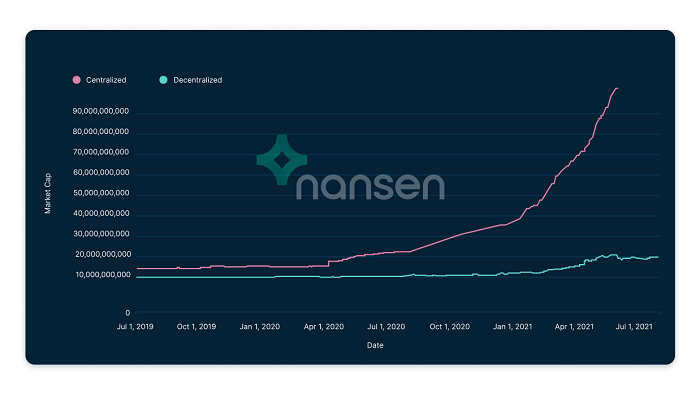
Today, the total circulation of centralized stablecoins is more than ten times the market capitalization of decentralized stablecoins. Why is this so? In fact, for many people, the security of a stablecoin issued by a centralized custodian far outweighs the risks involved in a decentralized stablecoin.
On the other hand, it is also questionable whether user adoption has grown, as many people are only using decentralized stablecoins as a temporary source of income. Except for DAI, no decentralized stablecoin has more than 3,000 unique active users since July! In 2021, as the New York Attorney General's Office reached a settlement with Tether, concerns surrounding USDT's lack of sufficient reserve support have dissipated to some extent. As consumers continue to explore DeFi using centralized exchanges like Coinbase, centralized stablecoins remain the first choice for most.
Still, the quest for decentralized stablecoins continues.





