


Glassnode 2021 Q2 Report: Stablecoins Undertake Hedging Demand, DeFi Income Plummets


This article comes fromGlassnode, by Luke Posey
Odaily Translator |

Odaily Translator |
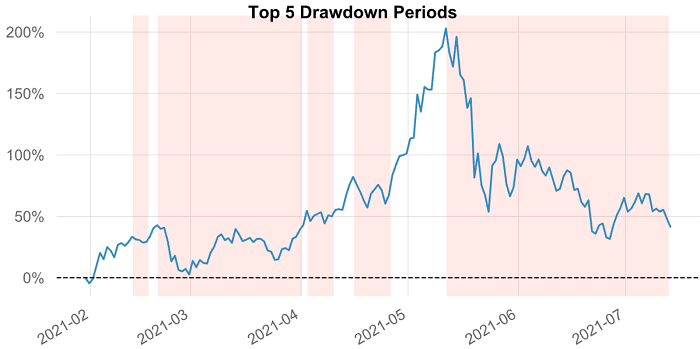
As far as the current stage is concerned, the digital currency market seems to have entered a period of sideways adjustment, and traders and investors have to look for more opportunities and explore new sources of income under low volatility market conditions. If the market resumes upward, there is still a lot of room for the ETH price to make up for the current "loss" of income. On the contrary, if the shock goes down, then the remaining gains in 2021 are likely to be completely wiped out.
In this article, we will focus on the following aspects:
1. The state of DeFi on Ethereum during market fluctuations
2. The recent market attention on synthetic assets Synthetix and potential driving factors
4. Finding alternative revenue source templates in DeFi
secondary title
lower volatility
Ethereum prices fell again after a brief rally, while some DeFi tokens experienced "isolated breakouts" despite little change in fundamentals.
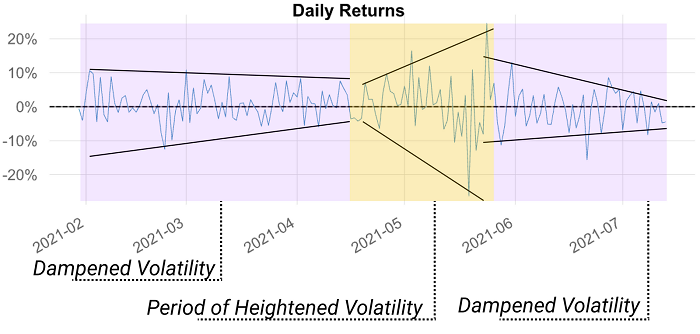 If the market resumes upward, there is still a lot of room for the ETH price to make up for the current "loss" of income. On the contrary, if the shock goes down, then the remaining gains in 2021 are likely to be completely wiped out.
secondary title
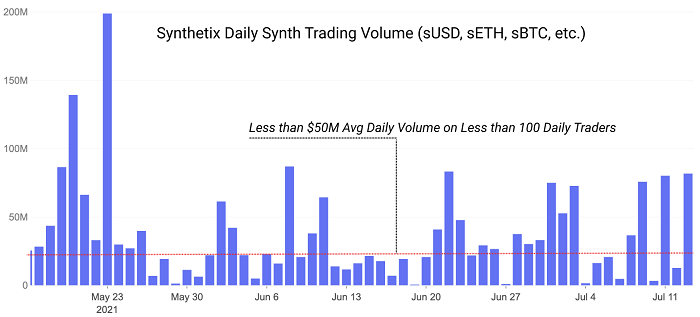
Synthetix looks for a "new way out"
At this stage, Ethereum is still in the sideways stage, and as a result, many DeFi tokens began to seek other "return paths", Synthetix is one of them, especially in the process of founder Kain Warwick's return to the project. greater resilience.
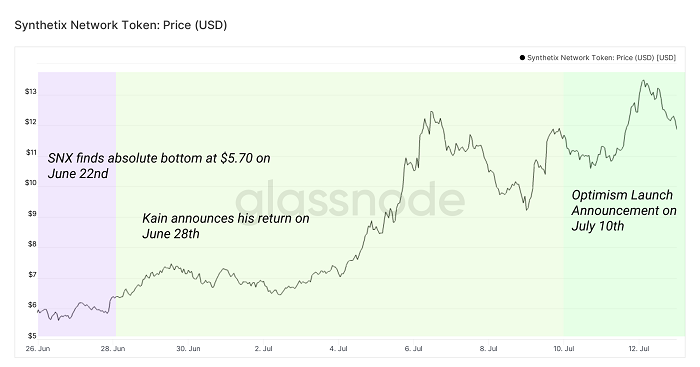
On July 10, Synthetix announced that it will launch Optimistic Ethereum (OΞ), the second-layer expansion plan of Ethereum, in the week of July 26. The final deployment date is subject to approval by the Spartan Council. According to the regulations in SIP-121, the initially supported synthetic assets are sETH, sBTC and sLINK. Additionally, the SNX price feed is also deployed by ChainLink. In preparation for the transition to Optimistic Ethereum, some additional SIPs will be released over the next few weeks. These include changes to the debt pool caching mechanism, the deprecation of iSynths, and a reduction in the number of Synths (synthetic assets) on L1.
Returns for Optimism stakers hit an absolute nadir of about 15% in July, and L1 staking is still profitable (relatively speaking), but with liquidity transitioning to L2, Optimism stakers can now earn The annual investment rate of return can reach about 50%. It is expected that sUSD/sETH, sUSD/sBTC and other trading pairs will be launched in July/August.
More importantly, as a mature project, Synthetix has demonstrated a typical research case of L2 migration to the entire digital currency industry.
secondary title
New goal of DeFi "blue chip" funds: hedging
Here are some of the three main categories that are gaining in the form of fees and liquidity mining incentives in the DeFi industry:
1. Earn fees by providing liquidity on decentralized exchanges
2. Income from loan assets in the loan pool
3. Earn governance tokens from liquidity mining rewards
As the market's demand for safe-haven capital (stable currency) increases, the valuation of DeFi tokens has become increasingly depressed recently, and the risk capital invested in this field is also decreasing-all of which have led to the benefits of the entire DeFi industry rate has shrunk significantly. So, how will stablecoins affect the DeFi industry? In fact, when stablecoin capital starts to increase, it means that "stable" capital flows start to compete for the same share of market value. As more and more capital enters yield-generating DeFi protocols, the dollar earnings of all participants will be diluted.
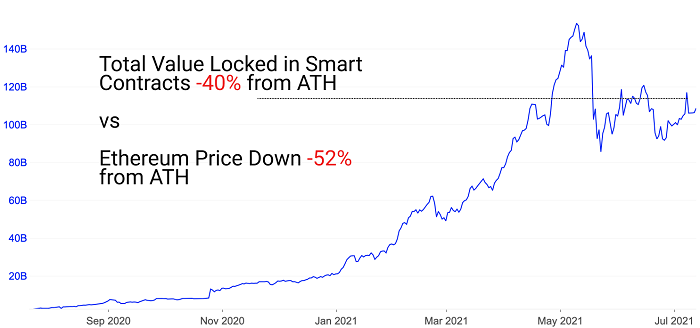
We see this clearly being the case as USD equivalents in DeFi are outpacing market cap growth in Ethereum and token valuations. As more and more capital begins to flow around, they also have a clear demand for the high yield of DeFi. But the problem is that these capitals are not used to buy spot ETH or governance tokens, and their main purpose of entering the DeFi market is actually hedging.
With the increase of capital, everyone will get a share, and the competition will become more and more fierce.
* Decreased on-chain activity: If available fees from user activity (e.g. transaction volume) start to decrease, but the capital trying to absorb these fees is static or increasing, it will cause liquidity providers to Opportunities for high returns are reduced.
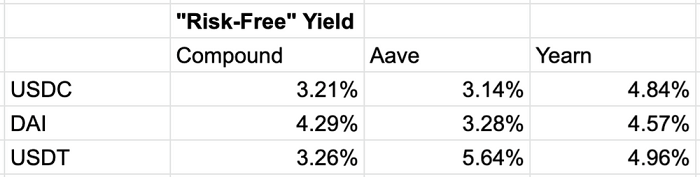
DEX usage on all blockchains declined in Q2, with indicators such as lending demand, speculative demand, and utilization all suppressed. Overall, while the market’s investment in DeFi remains strong, the actual usage indicators of DeFi are starting to weaken. As a result, the "risk-off" annualized rate of return of well-known DeFi protocols such as Aave, Compound, and Yearn has dropped below 5%. Even if Aave and Compound have introduced liquidity incentives, the annualized rate of return is still only 3-5%.
* Depressed token prices: If the rewards (in U.S. dollar equivalents) used to subsidize liquidity in DeFi protocols depreciate, then overall yields will also fall. As more and more funds flow into these DeFi tokens, the value of the tokens will continue to decline, because the dollar value of these tokens is on a downward trend.
The correlation between a few DeFi tokens and ETH began to weaken. When the price of ETH fell, the price of some DeFi tokens rose instead. But overall, compared to historical highs, the price of DeFi tokens is still severely undervalued. In the second quarter, governance token pledgers have lost more than 60% of their pledge capital, and DeFi tokens that provide yield farming are usually in the same situation as pledged tokens, so the value of "mining" rewards has also lost more than 60%.* Summarize:
Yields across the DeFi industry have been slashed due to a combination of reduced usage and fees, depressed token prices (and reward values), and increased participation in stablecoin capital.
Today's market environment is a bit "weird" - capital is very abundant but most tokens can't find fringe buyers, so in this environment, how can traders find new sources of income?
Frankly speaking, it is difficult to find high-yield alternatives now, and in many cases, investors and traders need to strengthen risk management and in-depth understanding of the underlying mechanism of DeFi tokens. There are indeed some high-yield DeFi projects in the market, and their transactions are not crowded (because they are not well-known), but it should be noted that these DeFi protocols may be more risky.
In fact, there are three main factors that "drag" traders to obtain high yields:
1. Large number of participants/liquidity
2. Low utilization rate/low transaction volume
3. Token price drops
So, how to solve the above problems? We also have three ways to deal with it:
1. Look for early mining pools with low participation
secondary title
Derivatives
Derivatives
secondary title
options
secondary title
Perpetual contracts
Perpetual contracts
As user activity in the DeFi field continues to decrease, it means that the returns that liquidity providers can obtain will also shrink. However, perpetual contracts have always been a bright spot in DeFi derivatives. In the past few months, this "pie" has grown bigger and bigger. Among them, the trading volume of Perpetual Protocol and dYdX has been very strong and growing month by month.
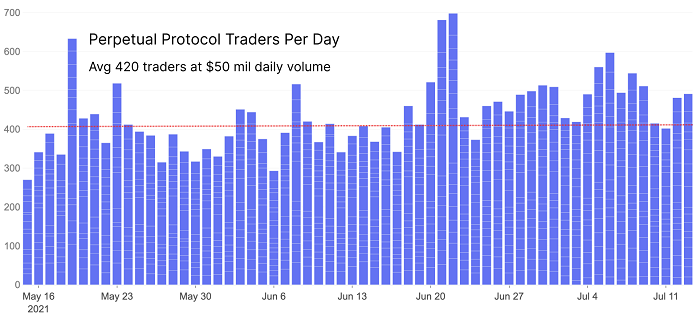
Every token holder wants to get a share of transaction fees and liquidity mining rewards, at least for now, Perpetual Protocol (PERP) stakers can get about 40% annualized rate of return, it is reported that Perpetual Protocol is about to release the V2 version, and the annualized rate of return may increase.





