


Messari's second quarter DeFi report: DeFi is making great strides towards a global open financial system


Odaily Translator |
Odaily Translator |
"DeFi is the Tower of Babel for humanity. We've rebuilt money as a language...a computer language, accessible to all cultures in the land. Now, all our brilliance, greed, and The ideal can be unified into one system, and the growth of DeFi will be unparalleled. The next 1-2 years will be very critical, and will affect the next decades or even hundreds of years.” ——Redphonecrypto
 A year ago, Compound launched the COMP liquidity mining program, which revolutionized the DeFi industry. With a new mechanism for channeling liquidity in DeFi protocols, the decentralized finance industry has achieved exponential growth in almost every metric. In the process, DeFi not only attracted the attention of investors, users, and regulators, but also showed the world how to achieve product/market fit.
In the second quarter of 2021, the DeFi market continued this momentum, with most indicators hitting new all-time highs. However, as the digital currency market began to weaken in the latter part of the second quarter, DeFi was not immune. In many cases, activity on DeFi protocols also declined in the second half of the quarter as market speculation waned.
However, is that all there is to the story?
Decentralized Exchange (DEX)
Decentralized Exchange (DEX)
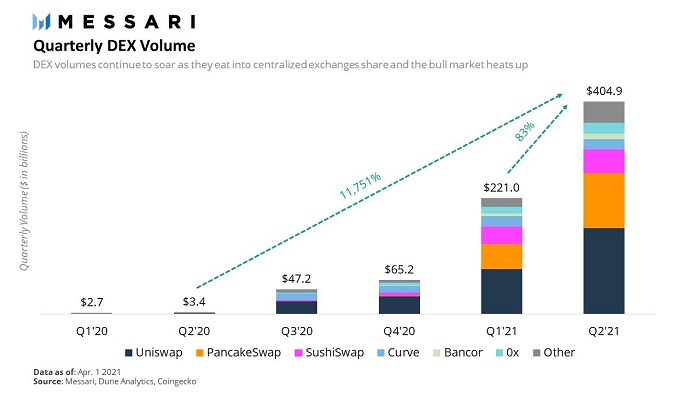
 DEX trading volumes continued to explode in Q2, reaching $405 billion in the quarter—a 117x year-over-year increase and 83% growth since Q1. May alone accounted for more than half of the transaction volume for the quarter, which is not surprising since the digital currency market also peaked in May.
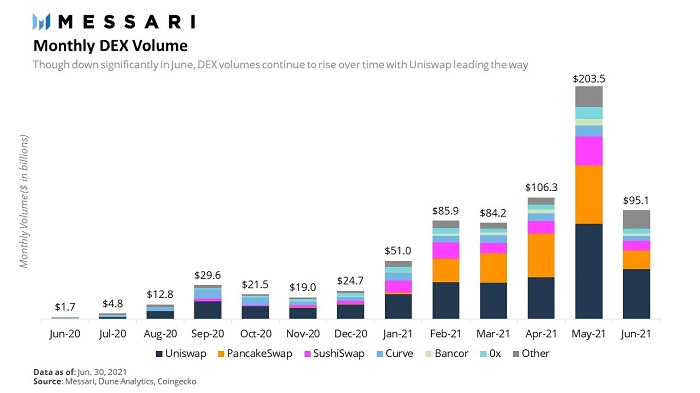
DEX trading volume has halved since May, dropping to $95 billion in June. Despite the drop in the metric, June still saw the third-highest DEX volume ever recorded.
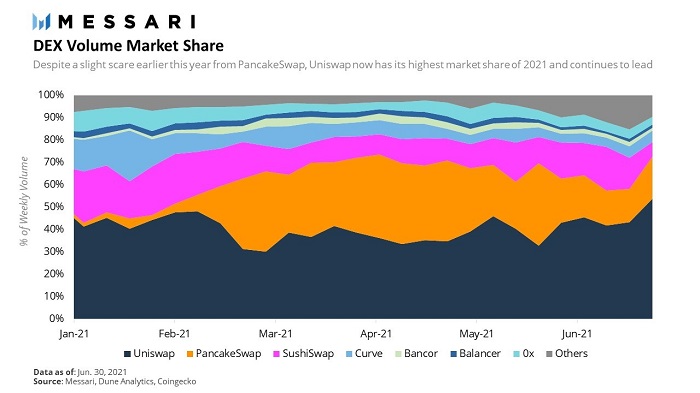
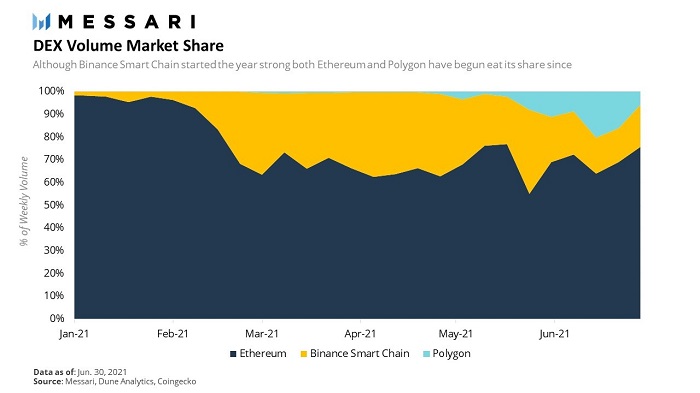
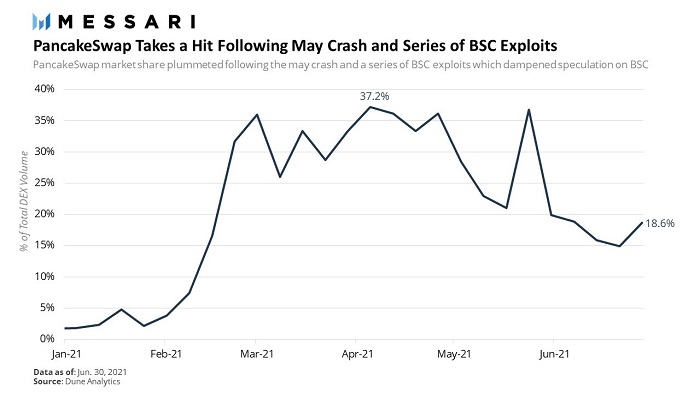
Looking at the evolution of the competitive landscape throughout the quarter, we see a considerable shift in PancakeSwap's position. Although the "breakfast"-themed DEX overturned Uniswap in terms of quantity in a short period of time in April, since then, due to the rise of Uniswap V3 and many problems in the Binance Smart Chain ecosystem after May, As a result, PancakeSwap's market share plummeted. By the end of the quarter, Uniswap’s weekly trading volume had accounted for 54% of total DEX transactions, the highest level since November 2020.
The rise of Polygon is also eroding the market share of Binance Smart Chain (BSC) in the decentralized trading volume. As more and more projects turn to Polygon, with new tokens for income farming, Binance Smart Chain is being squeezed out of the market. This situation is a good illustration of the ongoing liquidity "war" between public chains, showing that when token incentives are the main reason for capital to enter the blockchain ecosystem, once incentives decline or incentives elsewhere are more attractive When the force is applied, the mobility will be transferred.
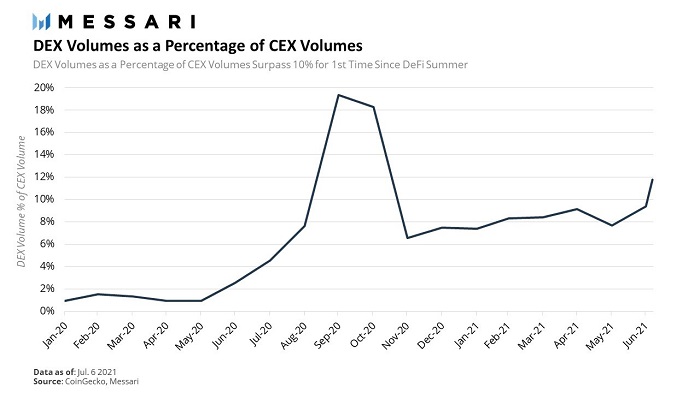
Finally, looking at the entire DEX market, we see that for the first time since October 2020, DEX volumes accounted for more than 10% of centralized exchange (CEX) volumes. The data shows that over time, decentralized exchanges are cannibalizing the trading volume of centralized exchanges.
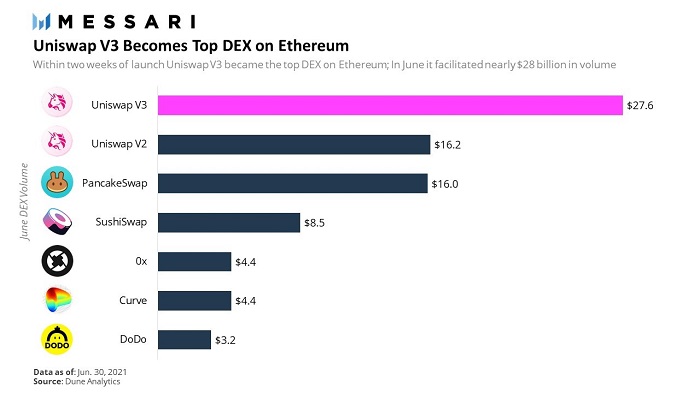
Uniswap V3 becomes the top DEX
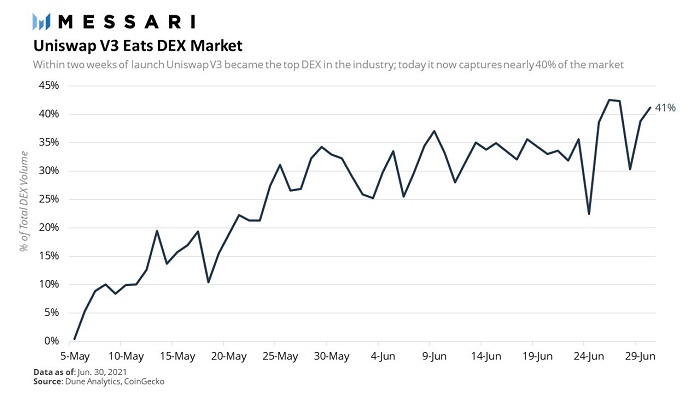
In May, Uniswap finally launched the highly anticipated Uniswap V3 protocol, whose biggest feature is the centralization of liquidity - allowing liquidity providers (LP) to make markets within a customized price range, and in the process create individual price curve. The design promises to increase the capital efficiency of liquidity providers by a factor of 4,000 by enabling them to provide the same depth of liquidity as V2 within a specified price range, while keeping less idle capital. In just a few weeks, Uniswap V3 became the largest DEX in the industry and achieved a trading volume of nearly $28 billion in June.
Uniswap V3 has accounted for more than 40% of all DEX trading volumes, and it continues to eat into the DEX market without any signs of slowing down.
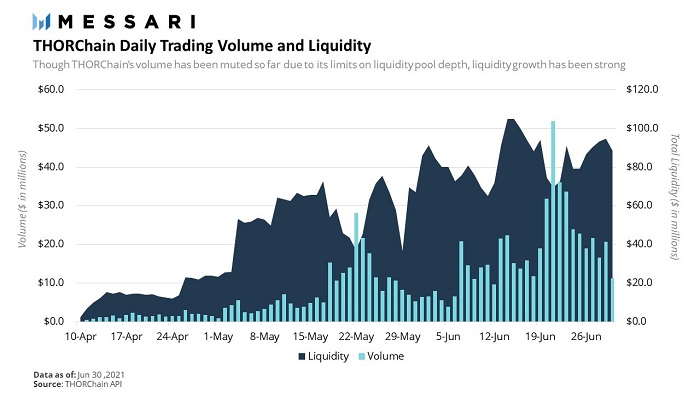
THORChain launches multi-chain Chaosnet
After more than two years of development and multiple delays, the cross-chain liquidity protocol THORChain finally went live in the first week of 2021 Q2. Currently rolling out in a protected manner, the community will gradually increase the cap on the liquidity pool as the network develops, proving its security and addressing bugs. THORChain currently supports five chains, including Bitcoin, Ethereum, Binance Chain, Bitcoin Cash and Litecoin, and plans to connect more blockchains in the coming months. Although the transaction volume of THORChain remains sluggish at present, the liquidity is growing synchronously with the increase of the upper limit, which also shows that the market demand for cross-chain liquidity is increasing. We are entering a multi-chain future blockchain where infrastructure like THORChain can transfer value between public chains without a trusted third party.
PancakeSwap meets Waterloo
After the cryptocurrency market crashed in May, the Binance Smart Chain ecosystem was also hit hard, with lockup volume dropping by more than 50% from its peak in just a few days. While locked-up volume shrank on all smart contract platforms, Binance Smart Chain suffered even more because most of the value locked in its applications is employed capital and is made up of assets that have little use other than to incentivize users to speculate. asset composition. Unlike Ethereum, which mixes a large number of stablecoins, the composition of Binance Smart Chain’s locked positions is relatively risky, making it extremely sensitive to market fluctuations. Coupled with a series of hacks and vulnerabilities on the Binance Smart Chain that have resulted in losses of hundreds of millions of dollars. Additionally, speculative activity on Binance Smart Chain dried up dramatically in June, causing PancakeSwap volume to drop by 69% in June. Its market share also declined simultaneously.
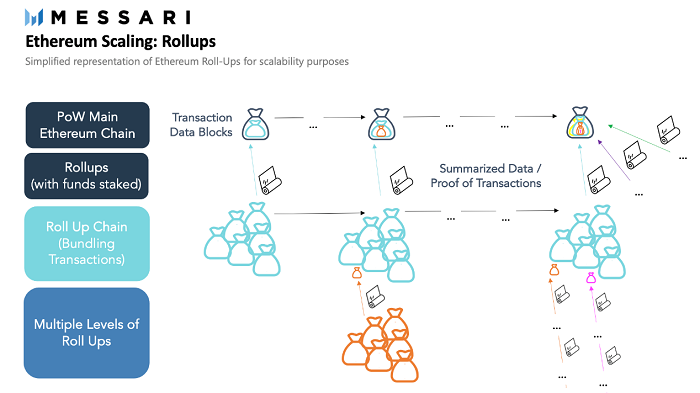
The DeFi industry is moving forward, and one of the common themes is the launch of Layer 2 scaling solutions on Ethereum, aiming to scale DeFi performance by orders of magnitude without compromising security. The most anticipated launch of these solutions is Optimistic Rollups, which allows the bundling of thousands of transactions into a single Rollup block, with leading solutions Arbitrum and Optimism expected to launch in Q3.
secondary title
lending platform
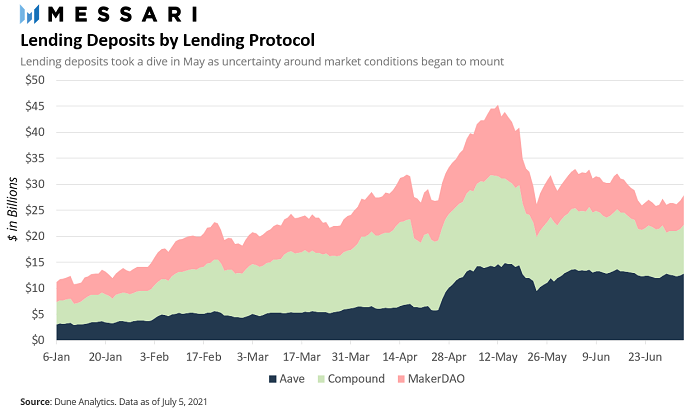
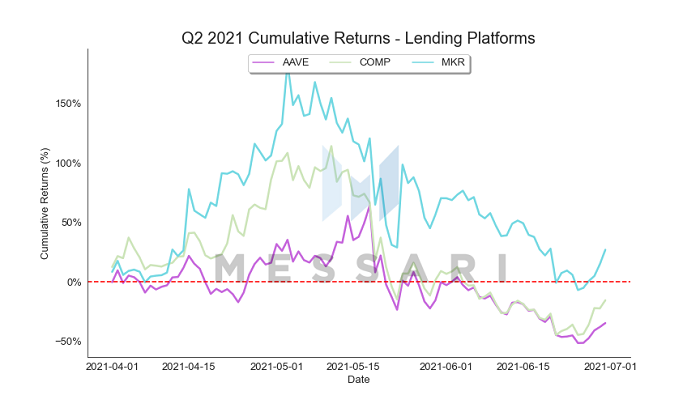 After a boom in the first quarter, DeFi lending started to cool off in the second quarter. However, the second quarter of 2021 continued the momentum of the previous quarter. From March to May, total borrowing surged from $25 billion to a peak of $45 billion (an 81% increase in just six weeks), largely as investors sought to capture the high loan yields in DeFi lending protocols . However, this uptrend came to an abrupt halt as the market turned better. The total amount of assets locked by major lending platforms rose by only 15% quarter-on-quarter as investors flocked to safer assets under the influence of heightened market turmoil, leading to a slump in the amount of loan deposits.
Unsurprisingly, the number of outstanding loans followed a similar pattern. During the first six weeks of the second quarter, total loans outstanding rose 62%. Over the next 10 days, total loans outstanding totaled just $4 billion, down only 21% from the peak. At the end of the quarter, total outstanding loans increased approximately 44% from the previous quarter.
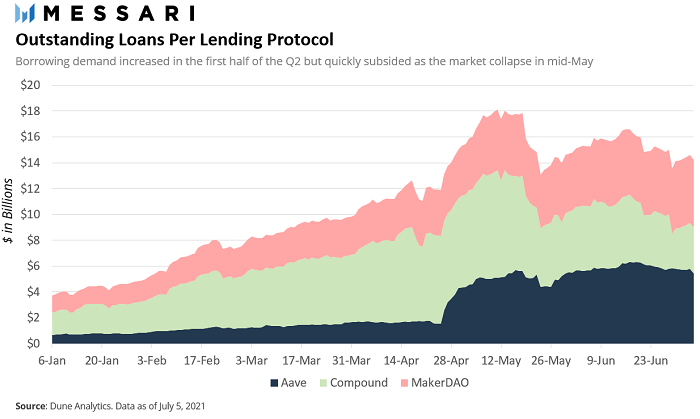
image description
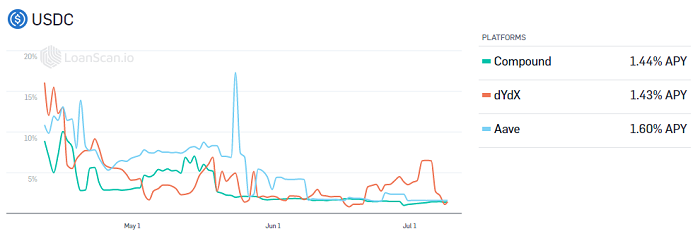
Above image source: LoanScan
Aave joins the multi-chain world
At the end of the first quarter of 2021, Aave announced the launch of Polygon, aiming to get rid of the high fee environment of Ethereum. Later, Polygon and Aave teamed up to provide liquidity mining rewards to early users. The project proved to be a huge success, causing Aave's lockup to increase from $6 billion to $12 billion in just two weeks.
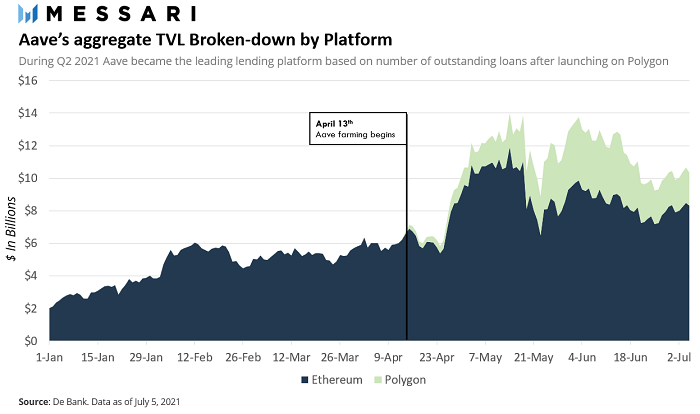
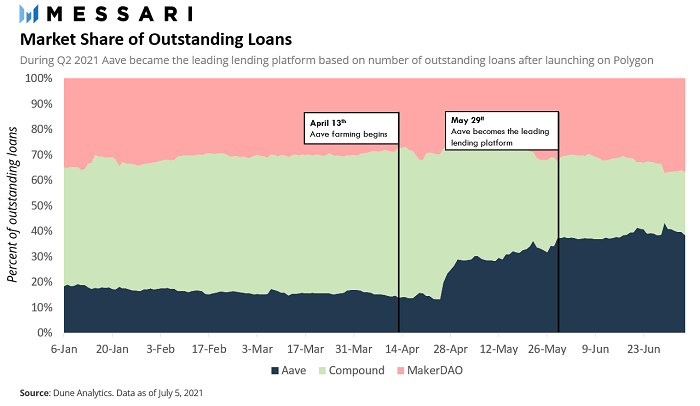
Aave’s market share of total outstanding loans soared in April, fueled by Polygon’s launch and massive token incentives, putting Compound into competition. By the end of May, Aave overtook Compound as the leading lending platform, capturing over 37% of the total DeFi lending market.
Bridging the Gap Between Cryptocurrencies and Traditional Banking - Compound TreasuryLate in the quarter, Compound Labs partnered with Fireblocks and Circle to launch Compound Treasury, a product designed for non-crypto businesses and financial institutions looking to enter the crypto interest rate market, which allows organizations to access USDC-based products without having to worry about crypto-related complexities, such as private key management and crypto-to-fiat conversions, and a guaranteed fixed interest rate of 4% per annum on deposits - astronomical compared to the average U.S. savings account number.
Laying the Foundation for Lending in a Multi-Chain World- Compound Gateway
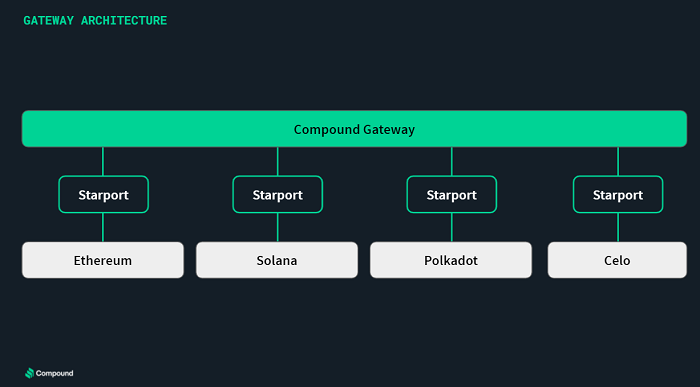
As a multi-chain future becomes more apparent, existing lending protocols have begun to explore solutions to accommodate this new way of operating. As a way to embrace this emerging paradigm, Compound has launched Compound Gateway, a Substrate-based blockchain designed to serve as the infrastructure for a cross-chain interest rate market. Similar to THORChain's THORFi lending feature (coming later this year), Gateway aims to enable users to use assets native to one blockchain (such as Ethereum) as collateral on another blockchain (such as Solana).
image description
secondary title
The new field of DeFi - the fixed income market
While the fixed income space is still an emerging niche market in DeFi, it is huge in the traditional financial industry. Fixed income products in this context are any instruments that generate steady and predictable cash flows, such as corporate bonds, treasury bills, and fixed income mutual funds. The concept of fixed interest rates is a relatively new and unexplored field in DeFi, where variable rates offered by protocols like Aave and Compound will become the norm.
As of now, the fixed income space can be broadly divided into three distinct categories:
1. Securitization and spin-off;
2. Fixed-rate loans;
stable currency
stable currency
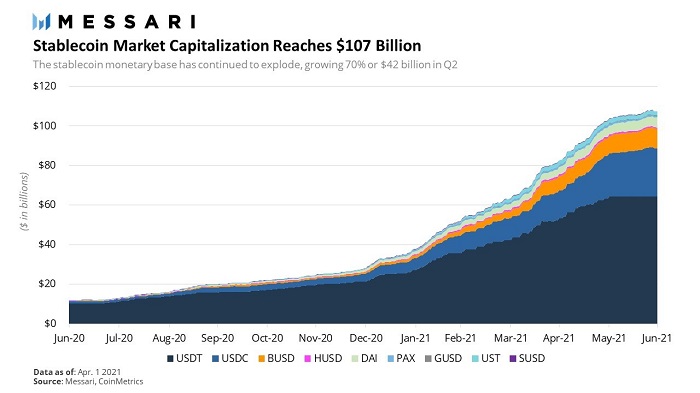
In the second quarter of 2021, the total issuance of stablecoins exceeded $107 billion, an increase of 70% since the first quarter and an increase of 803% year-on-year.
Stablecoins are widely adopted for a number of reasons:
• Stablecoins are easily accepted as payment because you only need an address on the public chain;
• Stablecoins run on a global public infrastructure and run 24/7/365, which makes them very usable and reliable;
• Stablecoins offer users greater autonomy, privacy and interoperability compared to existing payment solutions that require KYC and often restrict access;
• Stablecoins are programmable, allowing developers to use them to easily build and deploy applications with global distribution and instant access to funds.
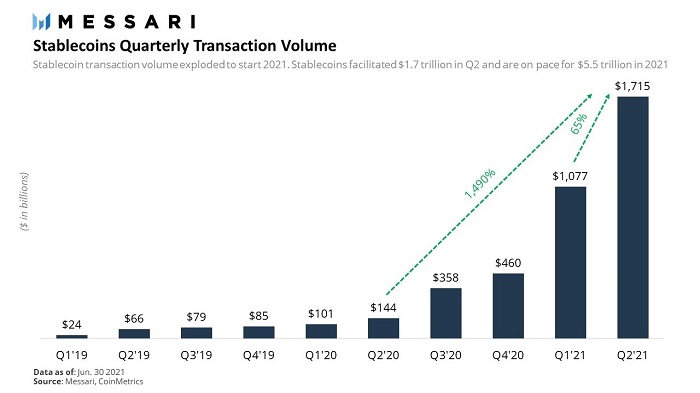
During the quarter, stablecoin trading volumes topped $1.7 trillion, up 1,090% year-over-year and an impressive 59% since Q1.
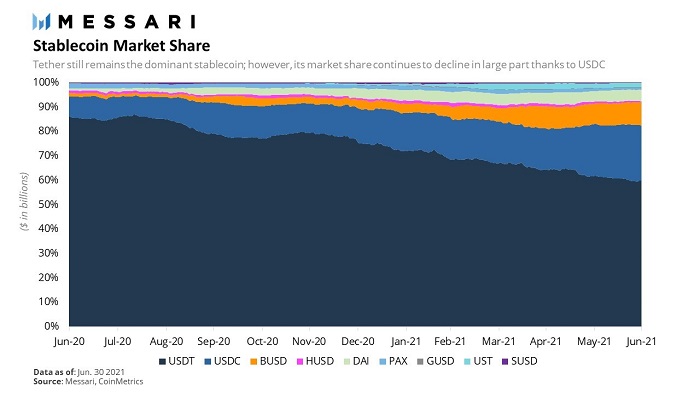
The biggest winners this quarter were USDC, BUSD, and DAI, whose shares grew to 23%, 9%, and 5%, respectively. While USDT is still king, its dominance is fading over time.
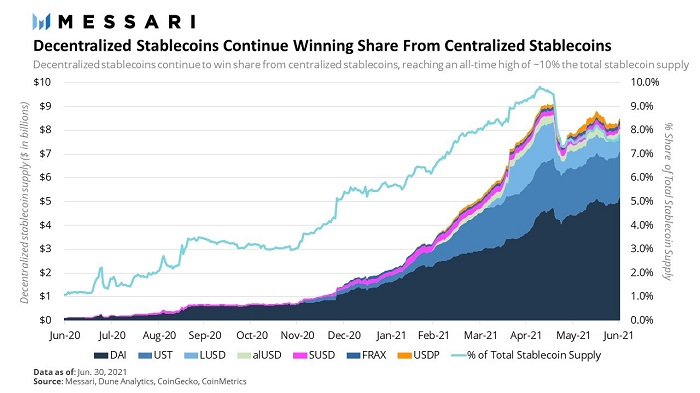
Finally, let’s take a look at the decentralized stablecoin market. In fact, decentralized stablecoins continued to gain share from centralized stablecoins in the second quarter. Decentralized stablecoins have accounted for about 10% of the total supply of stablecoins, hitting a record high.
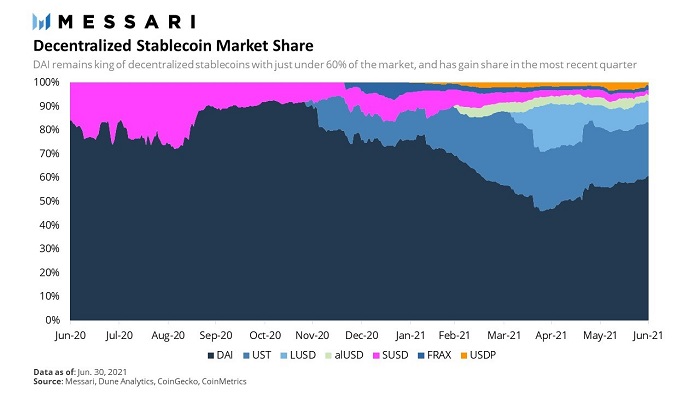
DAI's market share fell largely in Q1 due to the rise of Terra's UST, but it still leads the market by a wide margin at 61%. In Q2, DAI regained some share, while Terra stagnated.
USDC rises and becomes DeFi's stablecoin of choice
Perhaps no stablecoin has had a better quarter than Circle's USDC. Circle not only completed a financing of US$440 million, but also plans to go public through a SPAC at a valuation of US$4.5 billion, and has made great progress in Ethereum's booming DeFi ecosystem. It is expected that USDC will soon overtake USDT as the main stablecoin on Ethereum.
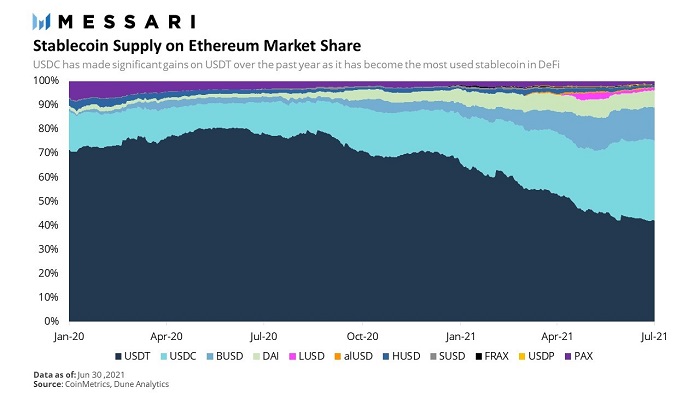
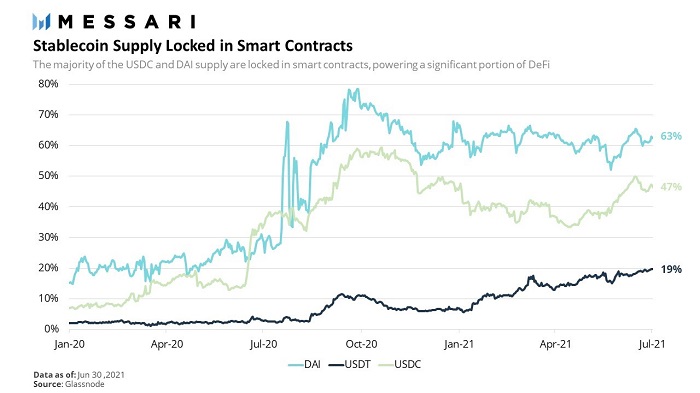
Over 50% of the USDC supply is now sitting in smart contracts - equivalent to about $12.5 billion. While this percentage is not as high as DAI, USDC is still ahead in dollar terms.
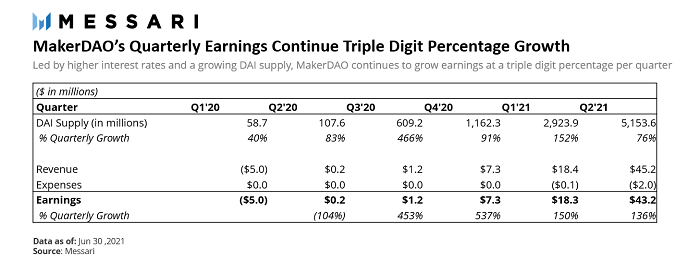
DAI Continues Incredible Growth While Centralization Risk Increases
MakerDAO had another incredible quarter, with a 76% increase in DAI supply and a 136% increase in earnings. As of the end of Q2, the DAI supply reached an impressive $5 billion, while MakerDAO generated $43 million in gains during the quarter.
The rise of non-pegged stablecoins
When Bitcoin was born, it sparked imaginations about the potential of non-sovereign digital currencies. But as Bitcoin began to trade, it quickly became apparent that it was not stable enough to be used as money anytime soon. At some point in the future, once Bitcoin becomes a large enough asset size and sufficient liquidity is established, it will eventually become less volatile. However, given that Bitcoin is a fixed-supply asset and cannot adjust its supply relative to demand, it could end up being forever volatile, like gold.
In an effort to bridge the gap between the present and the future, the digital currency industry has created dollar-pegged stablecoins that both address volatility and facilitate widespread adoption of many blockchain applications. However, the problem with these dollar-pegged stablecoins is that they dollarize Ethereum, which is controlled by the Federal Reserve, which in turn limits Ethereum from building a non-sovereign currency system. Additionally, stablecoins expose Ethereum to systemic regulatory risk due to its reliance on gray market USD-pegged stablecoins (although this risk is decreasing as USDC and USDT gain market share).
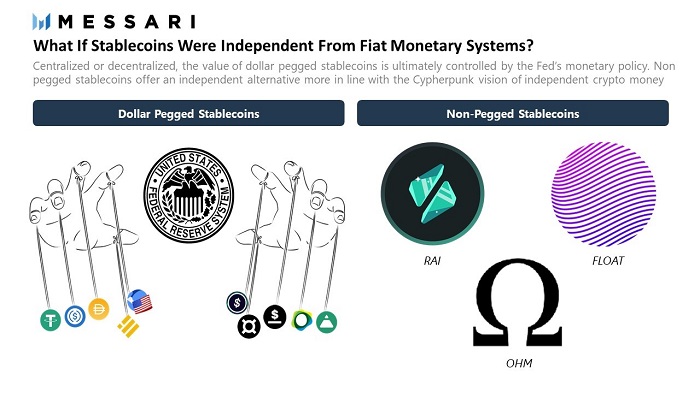
Fortunately, the digital currency industry has taken notice and recently launched a number of projects aimed at creating stablecoins that are not pegged to fiat currencies. Dubbed “non-pegged stablecoins,” these projects provide Ethereum’s monetary system with additional opportunities to achieve stability while removing its reliance on fiat currencies. In the process, "non-pegged stablecoins" will not only liberate Ethereum's monetary system from the central bank's fiat currency influence, but also introduce stablecoins suitable for the entire Ethereum economy.
secondary title
asset Management
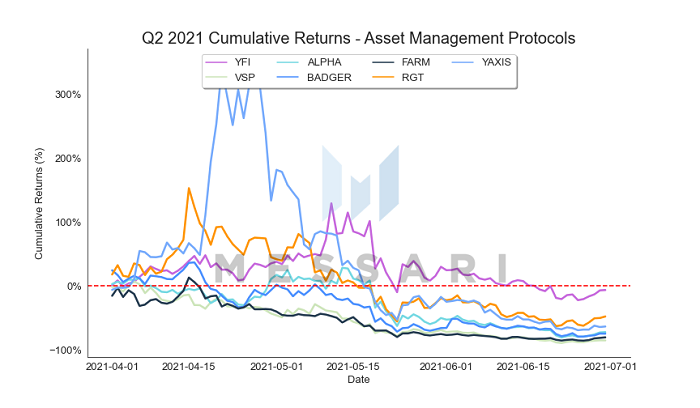
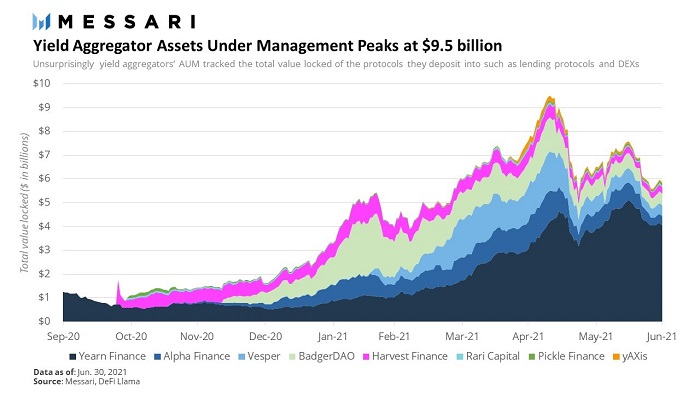
Unsurprisingly, as DeFi protocol liquidity soared during the quarter, so did the total value locked by yield aggregators that pump liquidity into DeFi, with AUM falling after peaking at $9.5 billion at the end of Q2 2%.
In the yield aggregator market, the second quarter to watch was Yearn's comeback and ascent, with its market share surging from 29% to 69% during the quarter.
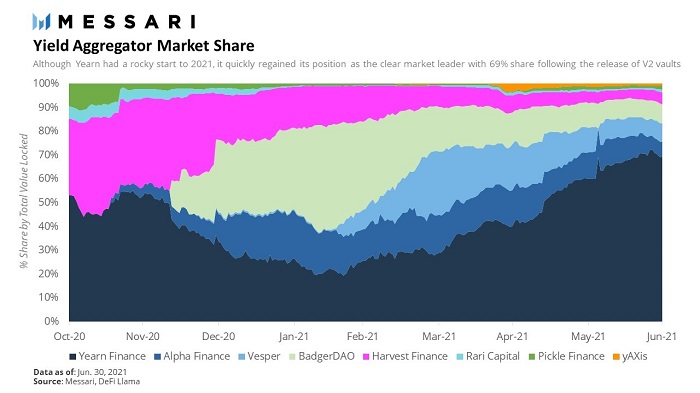
Yearn market dominance is growing
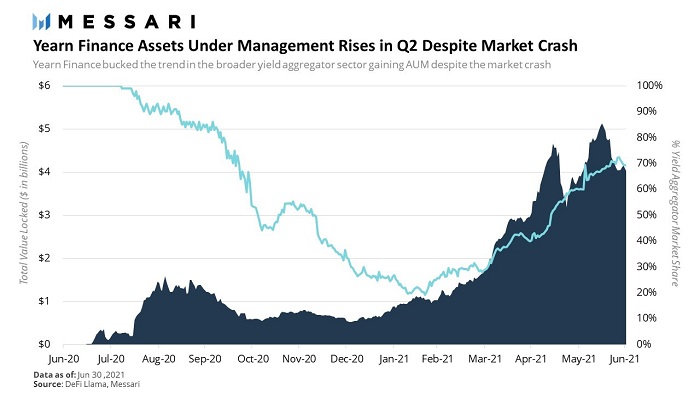
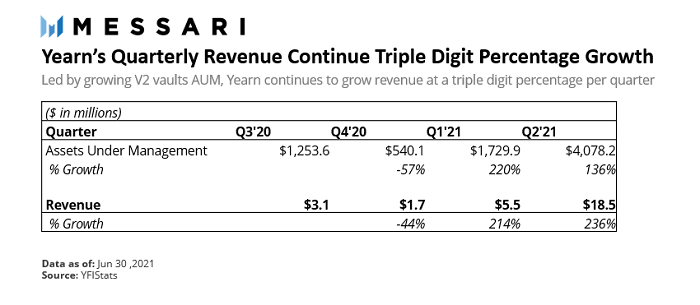
The most noteworthy thing in the field of asset management in the second quarter is the recovery of Yearn and the growing market dominance. With Yearn's incentive adjustment issues resolved in Q1, the current market focus has shifted to Yearn's new V2 vault. Yearn V2 has been a huge success, increasing Yearn assets under management from $540 million at the beginning of the year to $4.1 billion at the end of the second quarter.
secondary title
Derivatives
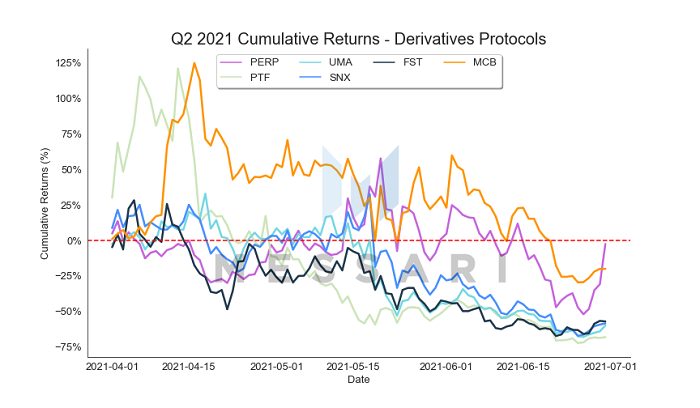
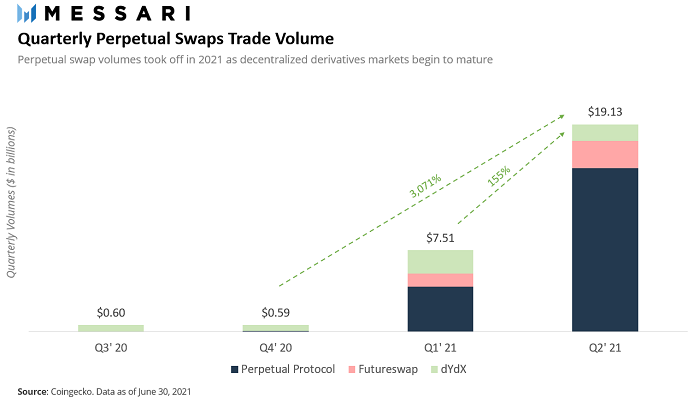
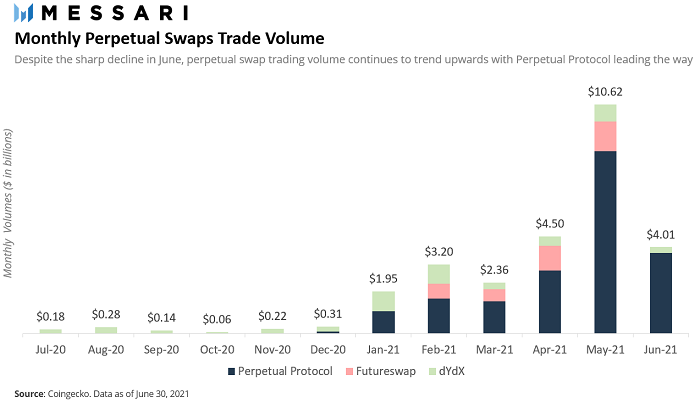
Decentralized derivatives trading volumes continued to grow significantly in Q2 2021, and while still only a fraction of decentralized spot trading volumes, perpetual swap contract volumes reached nearly $20 billion this quarter, up from 2020 This is a 3,000% increase in the fourth quarter and a 155% increase over the first quarter of 2021. Despite current scaling hurdles, decentralized derivative protocols have begun to gain traction among DeFi users.
secondary title
The next stop of DeFi
Obviously, in the second quarter of 2021, DeFi activities were negatively affected by the decline in market sentiment and low asset prices, but compared with the beginning of the year, the scale of the industry continued to expand. In the next few months, with the emergence of Layer 2 scaling solutions, more institutions are bound to start getting involved in the DeFi protocol, and the DeFi ecosystem will continue to mature, providing users with higher security, DeFi may usher in a moment of further growth.
DeFi will continue to march forward, each step toward a new, open global financial system.





