






Towards ETH 2.0: From "Olympic" to "London", look at the evolution of the protocol in the previous upgrades of ETH


herehere. There are few changes, and the information of the last few hard forks has been added.
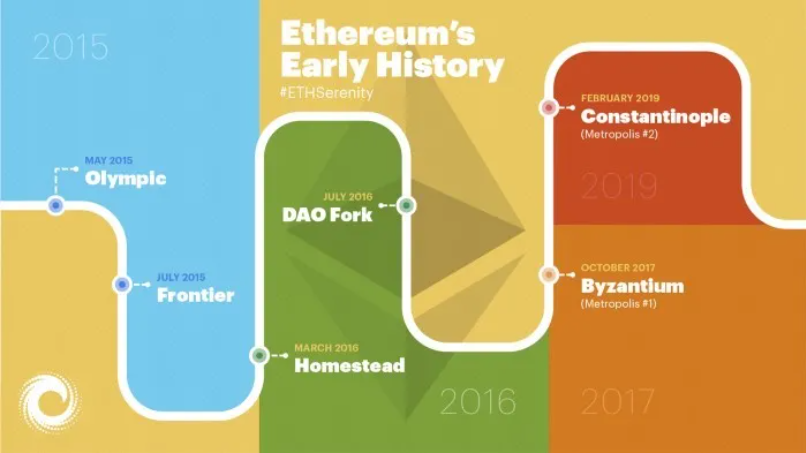
Looking at the overall situation, the emergence of blockchain technology is not long. Although the basic concepts related to blockchain (cryptography, decentralization, peer-to-peer networking, and transactions) have been studied for decades, it was not until the birth of Bitcoin in 2008 that people believed that these concepts could indeed be combined to create available products. Especially Ethereum, it was not until 2015 that it appeared in people's field of vision with a public and usable appearance. Although the expected development timeline and specific details have changed, Ethereum is still sticking to the plan and constantly upgrading the protocol to ensure improved usability, security, functionality and decentralization.
first level title
Olympic | May 9, 2015
text
Frontier | July 30, 2015
After months of stress testing, the Ethereum network is ready for the official mainnet launch. On July 20, the creation block of Ethereum was dug out, and the community began to gradually expand. A few months before the Frontier launch, Vinay Gupta published a note explaining the Ethereum launch process. There is no shortage of warnings to potential users of Ethereum in the impassioned statement. Gupta said that Frontier is the "most primitive form" of Ethereum, and developers should proceed with caution. Just a few days before the release of Frontier, Stephen Taul also reminded developers like Gupta: "Like those brave pioneers during the American pioneer wave, participants in the Ethereum community will find great opportunities and at the same time There will be many challenges."
The Frontier protocol includes the following key features:
Block Reward: When miners successfully mine a block on the Ethereum blockchain, they will receive a reward in ETH. In the Frontier phase, the block reward for miners is 5 ETH per block.
Gas: In the early days after Frontier was released, the gas limit for each block was hard-coded to 5000 gas. To put it bluntly, this means that there will be no big moves on the Internet. This allows a buffer period for miners to start working on ethereum and for early users to install the client. After a few days, the gas cap is automatically lifted and the network can start processing transactions and smart contracts as planned.
Canary contracts: Canary contracts are incorporated into Frontier to inform users which chains have been or are vulnerable to attacks. Canary contracts are assigned a value of 0 or 1. If the contract is assigned a value of 1, the client can recognize that this is a faulty chain and avoid this invalid chain when mining. Essentially, these functions of the Canary contract allow the Ethereum core development team to suspend the operation of the network when there is a problem with the network. In the early stages of Ethereum, the Canary contract was an extremely centralized but indispensable protection mechanism.
first level title
Homestead | March 14, 2016
The Homestead upgrade, the first hard fork of the Ethereum network, was implemented on March 14, 2016 at block 1,150,000. In general, the Homestead upgrade mainly includes three important improvements to Ethereum. First, it removes the canary contract, removing the centralized part of the network. Second, it introduces new code in Solidity, Ethereum's contract programming language. Finally, it introduces the Mist wallet, which allows users to hold/trade ETH and write/deploy smart contracts.
The Homestead upgrade was one of the first Ethereum Improvement Proposals (EIPs) to be implemented. EIPs refer to recommendations made to the community, and once they are endorsed, they are incorporated into network upgrades.
text
EIP-2: Homestead Core Upgrade
EIP 2.1: Increase the cost of creating a smart contract through a transaction from 21,000 Gas to 53,000 Gas. Previously, it was more expensive to create a contract by contract (the recommended approach) than to create a contract by transaction. Due to the increased gas cost of creating contracts through transactions, EIP 2.1 incentivizes users to revert to creating contracts through contracts.
text
text
text
EIP-7
text
EIP-8: Future-Proof Upgrades
first level title

DAO Fork | July 20, 2016
In addition to the planned Ethereum upgrade and hard fork, there was an unplanned DAO event worth remembering. In 2016, a decentralized autonomous organization called The DAO raised $150 million in a token sale.
In June, The DAO was hacked and $50 million worth of ETH was stolen by an unknown hacker. Most of the participants in the Ethereum community decided to perform a hard fork to restore the stolen ETH in the wallet and patch the vulnerability.
first level title
Metropolis: The Byzantine Fork | October 16, 2017
text
EIP 100
text
EIP 658
text
EIP 649
text
first level title
text
text
EIP 145: Bitwise Move Instructions
text
EIP 1052: Smart Contract Verification
text
EIP 1014:CREATE2
text
EIP 1283:SSTORE
text
text
text
text
text
text
first level title
Prospects: Istanbul and Serenity
textEditor's note:text
first level title
text
text
text
text
text
text
text
text
text
text
text
text
text
text
text
first level title
text
text
text
EIP 2384
text
first level title
"Berlin" upgrade
text
text
EIP-2565:ModExp Gas Cost
text
text
text
text
text
text
text
first level title
Upcoming "London" upgrades
text
text
text
EIP-3198: BASEFEE opcode
text
EIP-3554: Difficulty bomb postponed to December 1, 2021
text





