


How does Rollup win over Polygon and BSC in the long run?


, the following is the full text compilation.Dragonfly Research, the following is the full text compilation.
image description
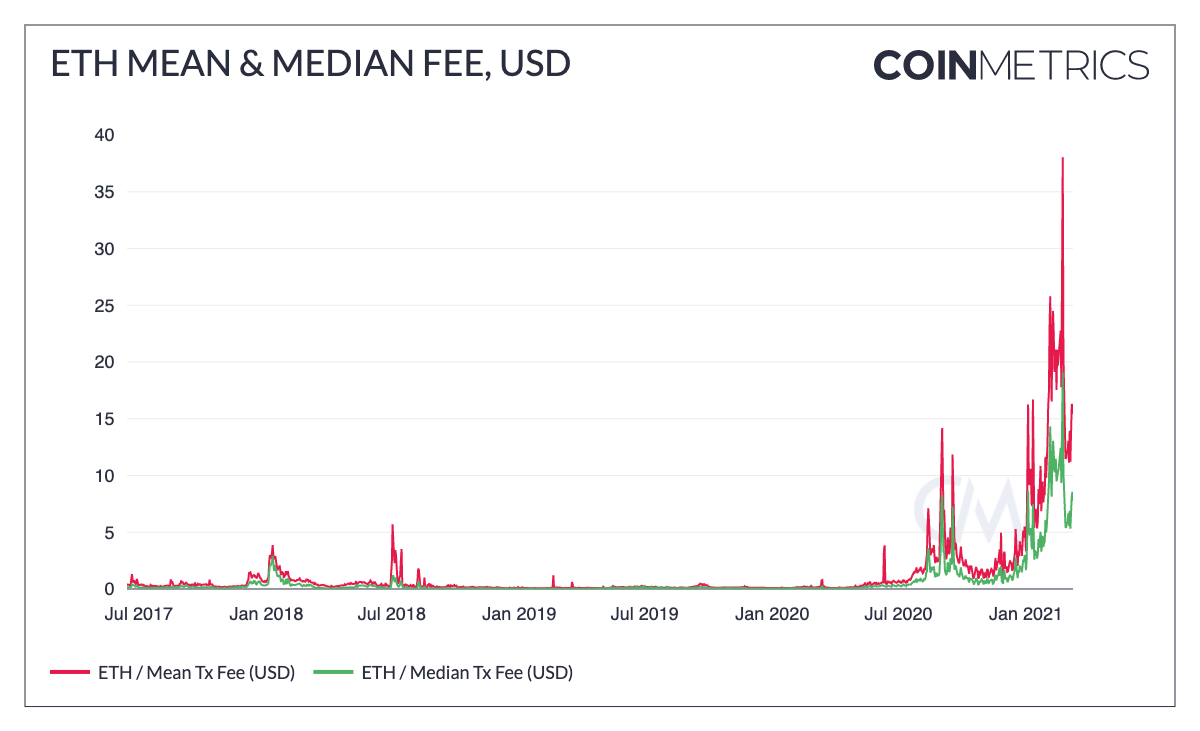
ETH fees (USD); Source: Coinmetrics
But don't worry, the "savior" has appeared.
Of course, I'm talking about Rollup. Vitalik already sees Rollup as the future of Ethereum scaling. Among them, some leading Rollups have received more than $100 million in venture capital. And every major DeFi protocol has also picked a side, promising to choose one of these upcoming Rollups as their future home.
If you don't know what a Rollup is, or need a refresher, here's a one-paragraph summary. Rollup is a mini-blockchain that inherits the security properties of the underlying blockchain. Even if Rollup validators/operators are not trustworthy, they cannot steal your funds (assuming Rollup is implemented correctly). Currently, there are two basic types of Rollup: Optimistic Rollup and Zero Knowledge Rollup (ZK Rollup). Among them, Optimistic Rollup is guaranteed by fraud proof, and anyone can freely prove whether the calculation is wrong, while Zero-knowledge Rollup is guaranteed by cryptography, and mathematics proves that the calculation is correct. A fuller exposition of Rollup is beyond the scope here, but if you want to dig deeper, check outArticles by Vitalik。
The beauty of Rollups is that they are completely trustless. If you believe in Ethereum, then you should believe in Rollup. This is an irreproachable scaling solution, and it has been correspondingly embraced by the Ethereum leadership.
image description
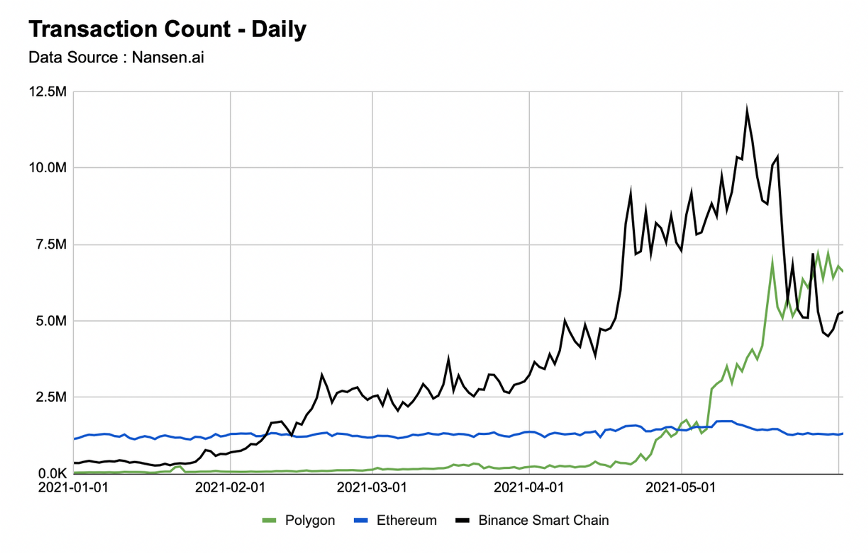
Transactions between Polygon (green) and Binance Smart Chain (black) and Ethereum (blue); Source: Dragonfly
Both chains took off like a blast and now each have more transaction volume than Ethereum itself. And other blockchains, such as Avalanche and NEAR, are also stepping up to roll out their own EVM-compatible systems connected to Ethereum.
The current situation is basically as shown in the following diagram:
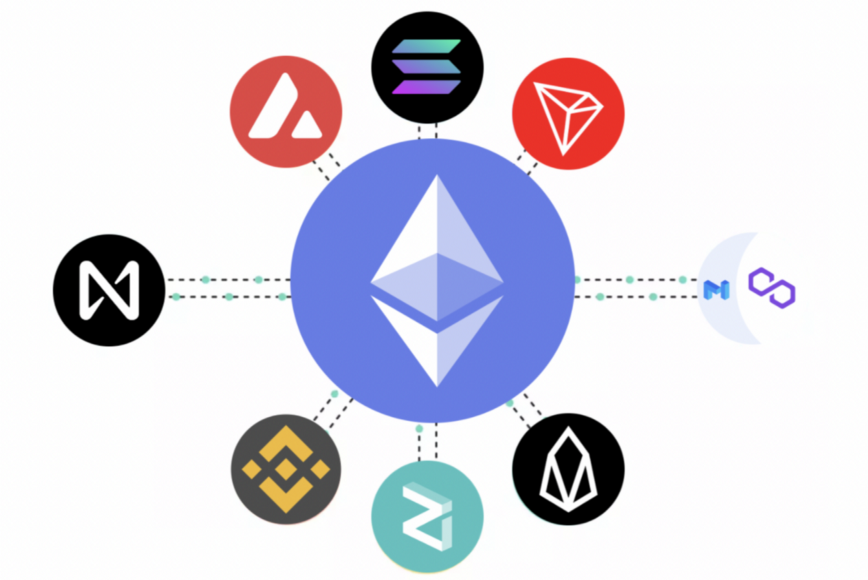
beacon chain"beacon chain". Cross-chain transfers and information are facilitated by multisig, temporary bridges, and some trusted parties. I call this architecture the poor man's sharding, and this is how DeFi actually scales today.
but! This sad state of affairs will soon end. Because, Rollup will be ready soon.
I'm excited about Rollup. I'm really excited, they're disruptive, elegant and brilliantly designed.
first level title
Layer 2's Savior Complex
Let me tell you an old story.
There used to be a blockchain that didn't scale. But then some very smart people invented trustless layer 2 technology that scales blockchain. Users are excited. Then, after years of hard work, these smart people finally built Layer 2. And when users can start using it, nobody cares because they are already using some other simpler but rubbish solution.
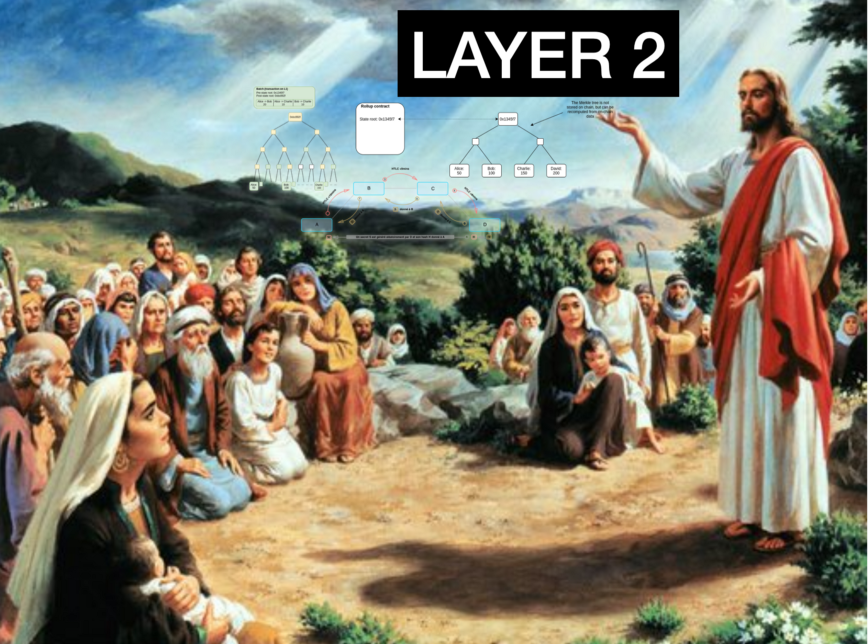
Any impression of this story?
lightning network"lightning network"? People only used WBTC. Remember Plasma? People just used xDai. Now, here we are, people didn't wait for Rollup, they went straight to Polygon and BSC.
Great narratives solve everyone's problems. And this narrative, this Ropplup expanded story, has something for everyone. Decentralized maximalists can tell a grand story of scaling Ethereum without trade-offs. Traders can draw lines on the chart, explaining how a Rollup will take ETH to $10,000. Ordinary people can nod their heads in awe while farming AAVE-MATIC feverishly and placing bets on digital racehorses.
I'm not kidding! There is a real class element to this. Rollup has overwhelming support from ethereum intellectuals - those twitterati who love to pump things up because they're not decentralized enough. I understand this because I am one of them.
But it’s hard to ignore that Polygon and Binance Smart Chain have been adopted by the masses, but not a single VC thought leader has seen it. A large number of users from developing countries like India, Indonesia, Thailand, Philippines, etc. are embracing these platforms, and many of them seem to have never used Ethereum before (they can't afford it!). still remember"Banking the Unbanked"Is this sentence? Well, these platforms actually have a global reach and appeal to what users really care about.
I often say that cryptocurrency users are driven by three motivations these days:
1. to make money
2. Have fun
3. Ideology
Of these three motives, ideology is the weakest. And I worry that ideology will end up being the main driving force behind Rollup adoption.
first level title
Rollup's Sweet Pain
Simple Uniswap-style transactions now cost as little as $0.0001 on Polygon. On Binance Smart Chain, it costs $0.20. On Ethereum, it costs about $7. And on Optimism Rollup, it costs about $0.68.
So, why is Rollup more expensive than these sidechains? This is because each Rollup must eventually publish calldata on Ethereum; this makes their fees pegged to Ethereum's fees. Each Rollup can only scale Ethereum by a constant factor. So the fees won't be too low compared to what many users are already used to.
Moreover, no rollup is fully compatible with EVM, and there are subtle differences between each virtual machine and EVM of these rollups. For Arbitrum they use AVM, for Optimism they use OVM, each subtly breaking some contracts and EVM-compatible tools. And for ZK-rollup, it's a completely different world. ZKRs will compile Solidity into an equivalent zero-knowledge circuit and execute it in a ZK virtual machine.
Now compare this to Polygon where you just copy and paste your contract and everything works as it is.
Then consider the issue of funds entering and exiting Rollup.
For Optimistic Rollups, when you want to withdraw funds, there is a challenge period of approximately 1 week during which your withdrawals are blocked. This is bad. Therefore, in order to promote"quick withdrawal", market makers will be ready to move your assets across borders quickly and for a fee. What they charge you will depend on their inventory and the liquidity of their assets. If you're transferring ETH, it might cost 0.2% or more, but if you're transferring a random dogecoin, it might cost more, maybe 1% or more. Some assets may simply not be possible to withdraw quickly without sufficient liquidity.
As a user, you will need to consider all of these when planning your Rollup DeFi portfolio. That said, if you invest in Rollup using a traditional multisig-based bridge, then you can avoid this withdrawal problem. But if you take the custody risk with multisig bridging, what exactly is Rollup an improvement over Polygon?
(Note that ZK Rollups don't have this problem because their withdrawals are virtually instant).
My concern is that with all this overhead, Rollup won't be able to meet the needs of users on either end. If you are a super whale who cares about security very much, it is ok to pay mainnet fees. But if you're an out-and-out public, then well, you use Polygon. And after that, who is left?
When can I become a representative?
Before this all started, I thought layer-2 would be the result.
Every DeFi protocol on Ethereum will be committed to Layer 2, some will choose Optimism, some will choose Starkware, and whoever collects the most protocols will eventually become the dominant Rollup.
It is now clear that this is not the correct mental model. In most cases, DeFi protocols are deployed on multiple chains. Currently, AAVE, Sushi, and Curve have launched on Polygon, pushing their TVL to over $8 billion. Among them, Sushi is deployed on 5 chains, and Curve is deployed on 4 chains. For a long time, Uniswap was only allied with Optimism, but with the upcoming launch of Arbitrum, Uniswap has changed its tune and will also implement multi-chain deployment.
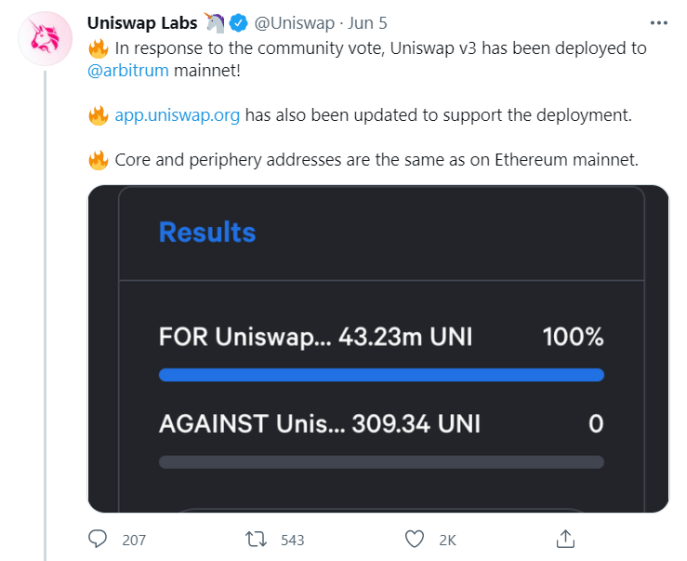
And Binance Smart Chain has taught everyone: If you don’t launch here, we will directly launch your fork and take away your original income. Going forward, I expect every major DeFi protocol to preemptively launch on every significant chain.
So, is it really up to the protocol to decide where the user goes? Or will it be up to users to decide where the agreement goes?
Now, the lesson from Polygon and BSC seems to be the latter, that protocols are coming after users, and they are being handsomely rewarded for it.
I can tell you, as an investor, the consensus right now is that Rollup will win. V God loves Rollup, everyone does. Rollup is a good thing, invest in Rollup.
But I'm still worried. I worry that no one will care. People already have what Rollup originally promised: a fast, cheap, EVM-compatible blockchain that integrates smoothly with the Ethereum ecosystem.
So, how can Rollup win in the long run?
In my opinion, there are two ways: one, non-Rollup sidechains fail catastrophically, and the industry learns, just like Mt. Gox. Catastrophic failure doesn't just mean"Node can't sync". it means"or"or"The chain stopped working completely". It's possible, but also probably unlikely.
So this leaves us with another path: Rollup has to actually become much better than the alternatives, decentralized signaling alone is not enough. For this, I personally only see one path forward, and that is the promise of cryptography and zero-knowledge proofs.
Over the past few years, the cryptography on which zero-knowledge proofs are based has undergone a Moore's Law-like trajectory, and it shows no signs of slowing down. EVM-like calculations in ZK Rollup were previously considered infeasible, but now zkSync and Starkware are on the verge of being launched, proving arbitrarily long calculation chains by recursively combining ZK-SNARKs. Over time, I predict we'll see a lot more than Rollup's constant-factor scaling today: massive computational compression, privacy-preserving smart contracts, provable MEV resistance, and more.
In ZK Rollup, the growth of the volume will not be a big problem, because no matter how large the volume is, users can always verify the correctness of the SNARKs by simply verifying the sequence.
In the long run, ZK technology will only get better.
image description
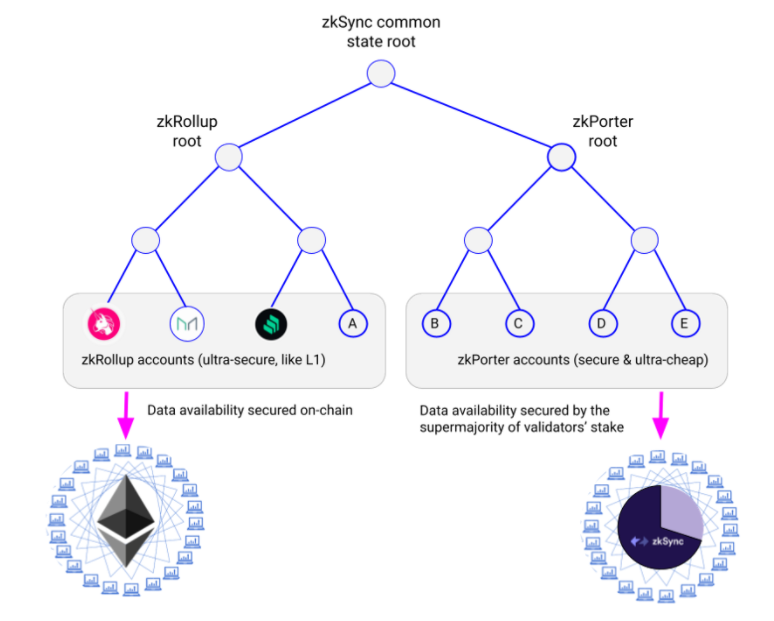
zkPorter Architecture; Source: Matter Labs
In my opinion, this is where the future is headed. We can't just say:"No, stupid user, your choice is wrong, I don't care if the fee is lower over there. But we shouldn't close the door to further innovation at scale, either."
As for Rollup, this is where I place my bets. But who knows? I've been wrong more times than I've been right, and if users embrace Rollups in the first place, it's good for them, and good for Ethereum.
<This post was written on a plane, so pardon any oversights. Dragonfly has a position in pretty much everything mentioned in this post. Thanks to Ivan and Celia for their short comments. >





