


Stablecoins under scrutiny: USDT encounters another crisis of trust


This article comes fromcointelegraph, Original Author: Andrew Singer
Odaily Translator |

This article comes from
, Original Author: Andrew Singer
Odaily Translator |
Are stablecoins really stable? With the start of a new round of debate over stablecoin reserves, the issue of Tether’s (USDT) basket of reserve assets has once again drawn attention.
The stablecoin market is growing exponentially — Boston Fed President Eric Rosengren seemed to be the first to raise the warning flag at the end of June, emphasizing in an appearance at the Official Monetary and Financial Institutions Symposium explain:
“There are many reasons to think that stablecoins — at least, many stablecoins — are not actually particularly stable, are prone to financial crises in the future, and unless we start regulating stablecoins, they will play a larger role in financial markets (creating a more serious danger)."
In the leaked speech materials, Eric Rosengren mentioned Tether (USDT), which currently dominates the stablecoin market, and pointed out that Tether (USDT)'s basket of reserve assets looks very much like a "very risky large fund." ", more importantly, this "fund" encountered a lot of trouble last year, and there have been two recessions. But even so, we still have many questions. Eric Rosengren "named" Tether (USDT) based on this issue, and raised the following important concerns:
1. We know that Tether’s reserve assets include commercial paper, and the cash ratio is very low. Is it really reasonable to deploy reserves like this?
3. Will stricter reserves and audits help serve the entire stablecoin industry?
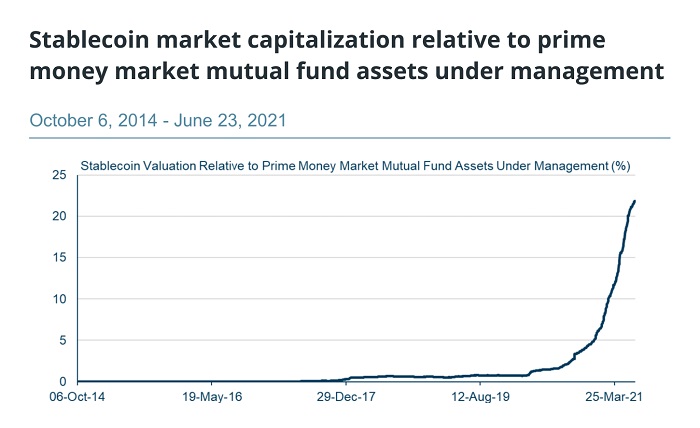
Moreover, given that Tether (USDT) is still by far the dominant player in the global stablecoin market, if it runs into "trouble," the consequences could be more serious than many imagine, and many fear that if Tether (USDT) shows signs of "trouble" , it will pull down the larger digital currency market. As the chart below shows (from), stablecoin market capitalization growth rates are at least 20% higher relative to the growth of better-managed money market mutual funds in traditional markets, and thus may also be more volatile.
Francine McKenna, an adjunct professor at American University's Kogod School of Business, understands Eric Rosengren's concerns very well. She believes that, in a sense, these new stablecoin funds are the traditional short-term credit market. "Intruders," the president of the Boston Fed and his peers may realize -- "how come we suddenly lose control of leveraged trading in the market?!"
secondary title
The Key to Crypto Market Liquidity Are Stablecoins?
Stablecoins are now influencing short-term credit prices, and unlike the traditional financial industry, these instruments can be exited quickly. For example, in mid-June, Iron Finance, a "partially collateralized" stablecoin project, suffered a "historic bank run", resulting in the decoupling of the IRON stablecoin price, triggering the price of TITAN, Iron Finance's native token, from an all-time high of $64.04 in two days. It plummeted to almost zero. As a result, investors such as the owner of the NBA Dallas Mavericks and billionaire Mark Cuban were severely affected.
Rohan Gray, an assistant professor at the Willamette University School of Law, warned that a collapse of Tether (USDT) could have dire consequences for the digital currency world, explaining:
“Tether (USDT) is still the most widely used asset trading pair for trading relative to (nearly) all other cryptocurrencies, and provides a lot of liquidity for the digital currency industry. So, yes, Tether (USDT) The collapse of cryptocurrencies would have major knock-on effects for the rest of the digital currency ecosystem."
Rohan Gray added:
“However, now that Circle and some other stablecoins have started to take market share from Tether, there is certainly a possibility that some other stablecoins will break Tether (USDT). That said, even without Tether, the rest of the cryptocurrency industry should It could also be allowed on top of other stablecoins that have been built.”
In fact, controversy has plagued Tether (USDT) throughout its short history - in February, Tether (USDT) and its issuer, cryptocurrency trading platform Bitfinex, reached a settlement with New York that required Tether (USDT ) and Bitfinex paid an $18.5 million fine to the state of New York and must submit mandatory quarterly reports on Tether (USDT) reserves to regulators. Not only that, U.S. Attorney General Letitia James of New York also asked cryptocurrency trading platforms Bitfinex and Tether (USDT) to stop trading activities in New York State to protect investors from fraudulent virtual or cryptocurrency trading platforms.
It’s worth mentioning that when announcing the settlement, Letitia James also emphasized that Tether’s (USDT) claim that its stablecoin is fully backed by U.S. dollars at all times is a lie.
However, not everyone is reassured by Tether's (USDT) quarterly report. According to the latest disclosed report data, "commercial paper" (commercial paper) has accounted for half of its total assets, such as 49.6%. is a particularly striking fact.
Rohan Gray explained:
“It is an indisputable fact that Tether (USDT) holds so many corporate notes and corporate bonds, and it is a huge problem that no one knows what these notes and debts are, which is different from their claim for years that they only invest in cash or Assets like cash."
Francine McKenna, an adjunct professor at American University's Kogod School of Business, explained that cash equivalents "must be particularly" liquid and not subject to market uncertainty, while commercial paper is not universal and the market is flooded with various types of paper. Various commercial papers. Maybe in the past, GE's commercial paper was "as good as gold", but now, who would use GE's commercial paper-in fact, commercial paper depends on who the issuer of the paper is.
However, not everyone has an issue with Tether (USDT) pegging its token to a basket containing commercial paper, Sean Stein Smith, an assistant professor in the Department of Business Economics at Lehman College, is one of them, stating:
“In my view, there is nothing inherently wrong with stablecoins — whether Tether (USDT) or not — being held or backed by commercial paper, rather than being 100% backed by a specific fiat currency.”
However, Sean Stein Smith acknowledged that there could be potential “complications” once stablecoins hold commercial paper — for example, the “operation” of stablecoins could destabilize specific segments of the commercial paper market. Correspondingly, if the commercial paper market "stands still", it may also disrupt the redemption mechanism of specific stablecoins.
secondary title
Do stablecoins need stricter audits?
If the Big Four audited Tether (USDT) reserves on a regular basis, would that improve their credibility on the issue of “reserve backing”? In Sean Stein Smith's view, stricter audits can help stablecoins improve their credibility, explaining:
“Regular audits will definitely help, as solid audits both increase confidence that Tether (USDT) is reserve-backed, and create specific cryptographic standards that can be adopted by other stablecoin issuers.”
However, others may disagree. As an example, the second largest stablecoin, USD Coin (USDC), has had Grant Thornton LLP confirm that it has sufficient USD reserves every month, which is generally considered a better approach, but in Francine McKenna’s view , there are serious limitations to even regular "confirmation" of reserves, he explained that what audits do now—that is, verify monthly bank balances of issuers—is not "reliable" because when auditors After checking the bank statement, the stablecoin issuer can immediately transfer the funds elsewhere.
So, is there any other way to solve the "reserve backing" problem of stablecoins? According to Francine McKenna, yes! The answer is custodial accounts, that is - requiring stablecoin issuers to set up separate customer fund accounts like brokers/dealers. In the words of Francine McKenna:
"In any case, there are many ways to tie up funds so that they cannot move."
Let's go back to Tether (USDT). According to Tether's own data, only 2.9% of USDT's reserves are currently in cash, which has led some to think that Tether behaves like a bank - but is not affected by it. Banks are strictly regulated.
“It’s clear from the makeup of the reserves – Tether (USDT) has only a very small percentage of reserves that are cash in bank accounts – that they operate like a bank, but without the normal disclosures,”
At the same time, all the questions about reserves may not help stablecoins attract new users. According to CoinMarketCap, USDT’s market capitalization has barely budged over the past month, which is a good proxy for total supply for dollar-backed stablecoins since each is pegged to $1.00. Meanwhile, Tether’s closest competitors, USD Coin and Binance USD (BUSD), have both seen substantial increases in market capitalization over the period — up 10% and 12%, respectively, since early June.
Judging from the data, Tether/Bitfinex seems to have lost to their competitors, but so far, they have not responded on the matter.
secondary title
What will the digital currency industry do if Tether (USDT) really "crashes"?
For now, at least, there aren’t any signs of an imminent collapse for Tether (USDT), but given its continued market dominance, such an event is usually a topic of conversation — or, rather, speculation.
“Bitcoin/crypto pairs are here to stay, but there’s still potential for a ‘massacre’, and if something goes wrong with Tether (USDT), I believe the market will lose 10% to 15% of its value – because, currently, Tether ( USDT) has a circulating supply of 64 billion U.S. dollars per month, assuming it really collapses completely, it may cause a short-term plunge of up to 35%, and it will also trigger panic in the entire digital currency market.”
However, Sean Stein Smith, an assistant professor in the Department of Business Economics at Lehman College, doesn’t think stablecoins — especially Tether (USDT) — pose much of a threat to financial stability or the crypto ecosystem, explaining:
“If stablecoins do pose a global systemic risk, then why are so many central banks experimenting with and deploying central bank digital currencies — which are essentially a grassroots, government-issued stablecoin. If Tether (USDT) crashes, There will definitely be some volatility and headlines heralding the 'end of crypto,' but it won't bring the industry down."
secondary title
Do we need a stablecoin bill?
In some jurisdictions, stablecoin regulation could be on the horizon, at least if some regulatory initiatives prove to be successful.
Sidharth Sogani analyzed:
“It’s important that when fiat-pegged stablecoins are issued, they are regulated, otherwise it’s like creating value out of thin air, allowing people to keep buying more cryptocurrencies, especially Bitcoin. In most cases, Since stablecoins are centralized, strict regulations must be in place due to the lack of transparency.”
The stablecoin market is also fragmented globally as different organizations issue their own stablecoins and many stablecoins can be used on different blockchains, for example Tether (USDT) can be used as an ERC-20 token on Ethereum , TRC-20 tokens on Tron, and BEP-20 tokens on Binance Smart Chain, can also be used through the Omni layer on the Bitcoin blockchain, which will make regulatory audits more difficult.
Gary Gorton, professor of finance at Yale University, recently made his point:
"Essentially, stablecoins are 'deposits unregulated' free banking, yet free banking never seems to work even when governments need support, and stablecoins need to be backed by reliable reserves because they Now you can run without any entity overseeing them."
Rohan Gray, an assistant professor at the Willamette University School of Law, believes that the stablecoin industry can actually benefit from more regulation. In December 2020, Rohan Gray helped draft the Stablecoin Network Sharing and Banking License Enforcement Act (STABLE ACT), which was introduced to the U.S. House of Representatives. Among other things, the stablecoin bill would require U.S. stablecoin issuers to obtain a banking license and prior approval, consistent with the Federal Reserve, FDIC and appropriate banking institutions within their jurisdiction.





