


ECB executive pledges digital euro will protect consumer privacy


This article comes fromThis article comes from, original author: Martin Arnold
Odaily Translator | Nian Yin Si Tang

Odaily Translator | Nian Yin Si Tang
The launch of a digital euro would boost consumer privacy and protect the eurozone from the "threat" of competing cryptocurrencies that could compromise its monetary sovereignty, according to the central bank's executive board, which oversees the development of a digital euro.
Fabio Panetta, a member of the European Central Bank's (ECB) executive board, told the Financial Times that one of the main goals of the digital euro project is to "counteract" the spread of digital currencies developed by other countries and companies.
"If the (European) central bank is involved in digital payments, privacy will be better protected ... because we are not like private companies," Panetta said. "We have no commercial interest in storing, managing and misusing user data."
"Of course there is a potential threat from other institutions that issue digital means of payment ... If people really want to pay digitally and we don't provide them with digital means of payment, someone else will 'do it'."He contrasted the digital euro, an electronic version of central bank-issued cash, with “(non-)stablecoins” such as Diem. Diem isDigital currency in Facebook's plans
, users can send cash as easily as sending text messages.The European Central Bank's recent talks on a digital euroconsultationfound that people were most concerned that this wouldinvade their privacy
. But Panetta said the central bank has tested ways to separate people's identities from payment details. "The payment goes through, but no one in the payment chain has all the information," he said.
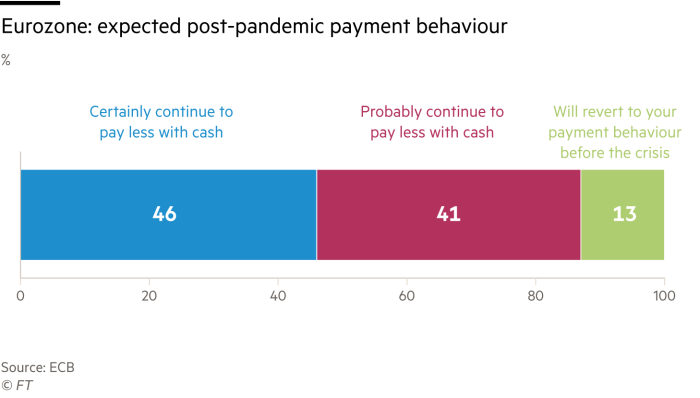
The central bank has also tested "small offline payments, that is, no data is recorded outside the wallets of the payer and recipient," Panetta added, adding that transfers of up to 70 euros or 100 euros can be done via a Bluetooth connection between the devices .
“For very small amounts, we can allow for truly anonymous payments, but in general, secrecy and privacy are different than anonymous payments.” Panetta added that most transactions require some checks to avoid money laundering, terrorist financing or tax evasion.
Bank for International Settlements (BIS)Data DisplayData Display
, nearly two-thirds of the world's central banks are conducting practical experiments on whether to launch digital currencies.But commercial banks are worried,Central bank digital currencies could eat into their deposits
, especially in a crisis. Morgan Stanley estimates that as much as 837 billion euros, or 8% of euro zone bank deposits, could switch to a digital euro.
Some critics argue that it could also crowd out cash; more than half of German households recently surveyed by the Bundesbank were skeptical of a digital euro, with those who regularly use cash the most skeptical.
Panetta believes that a digital euro will lead to "fundamental changes in the way payments are made, the financial system and how society as a whole works", such as through "programmability" to enable automatic payments, such as road tolls or cinema tolls.
But he also said the ECB was determined to ensure that a digital euro would not disrupt the commercial banking system, replace cash, crowd out innovation or become a shadow currency for small countries.
To achieve this, the ECB plans to either cap the amount of digital euros anyone can hold at £3,000 or impose a “disincentivising remuneration” above that threshold, Panetta said.The ECB Governing Council will meet next month,decide whether to proceed with these preparations
. Panetta said that if all goes well, a digital euro could be operational in about five years.
The central bank will also finalize a new regulatory framework for private digital currency and encrypted asset providers by the end of the year, he said.
Panetta also warned that crypto-assets such as bitcoin are "very dangerous 'animals'" that are "mainly used in criminal activities" and consume "a lot of energy."
So-called stablecoins like Diem are supposedly safer because they are backed by reserves of fiat currency, but Panetta said the potential volatility of those reserves creates “an inherent instability in the function of these so-called stablecoins — so they remain insecure. stable currency".
Regulating and supervising cryptoassets is very difficult “because there is no legal entity responsible for that,” he said. “Cryptoassets are decentralized. They could be in China, they could be in Switzerland, or South America … Institutions are involved in the supply of these encrypted assets, then we have the corresponding regulation and supervision.”
The digital euro should be available to tourists traveling to Europe in limited quantities, Panetta continued, but the ECB "has to consider very carefully the access rights of foreign users and the caps offered".





