


Analyzing the Stability Principles of Algorithmic Stablecoins


With the innovation of cryptocurrency technology and the continuous extension of its application fields, some new technologies and products have emerged as the times require, and algorithmic stablecoins have entered our field of vision.
Know Chuangyu Blockchain Security LabKnow Chuangyu Blockchain Security LabAnalyze the principles of single-currency algorithmic stablecoin (AMPL) and multi-currency algorithmic stablecoin (BAC).

The algorithmic stablecoin of the single-currency type controls the total supply of tokens through the rebase mechanism to achieve additional issuance and deflation, thereby controlling the price of the stablecoin to stabilize it at $1.
For example: when the current currency price is higher than $1, the contract manager will increase the total supply of tokens through rebase to increase the number of tokens in all holder addresses; on the contrary, when the current currency price is lower than $1 , the contract manager will reduce the total supply of tokens through rebase, reducing the number of tokens in all currency-holding addresses. The rebase of general projects is carried out at a fixed time every day, and the rise and fall of prices during this period will form a certain arbitrage space.
figure 1
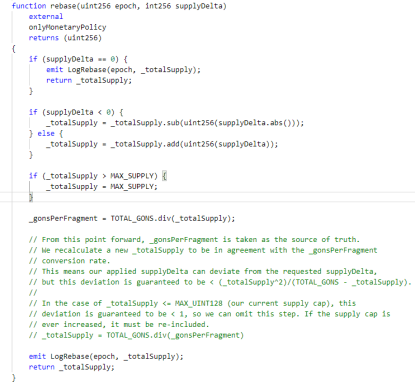
figure 1
Multi-currency algorithmic stablecoins Take Basis Cash as an example, there are 3 token contracts, namely Basic Cash, Basis Share and Basis Bond. Basic Cash is a stable currency, Basis Share can be understood as a stock, and Basis Bond can be understood as a bond. The price of Basis Cash is maintained at around US$1 through the purchase of bonds and additional issuance.
For example: when the BAC price is less than $1, the user can reduce the circulation of BAC by purchasing bonds, because the BAC purchased from the bond will be destroyed. At this time, the purchase price of the bond is the square of the current BAC price, and the price will be lower , the bond can be exchanged for BAC 1:1 in the future to stabilize the price of BAC by reducing the current circulation; when the price of BAC is greater than 1 USD, users can exchange BAC tokens by selling bonds, and the bonds will be exchanged after exchange. Destroy and continue to cast BAC to users who exchange bonds. If the price is still higher than 1 US dollar after the exchange, BAC tokens will continue to be minted to distribute dividends to users who hold BAS (stock), so as to achieve BAC price stability in the form of additional issuance .
The core code is as follows:
image description
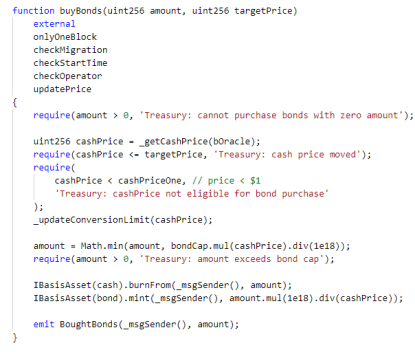
figure 2
image description
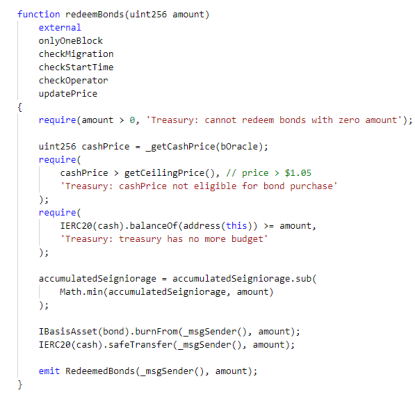
image 3
Figure 4
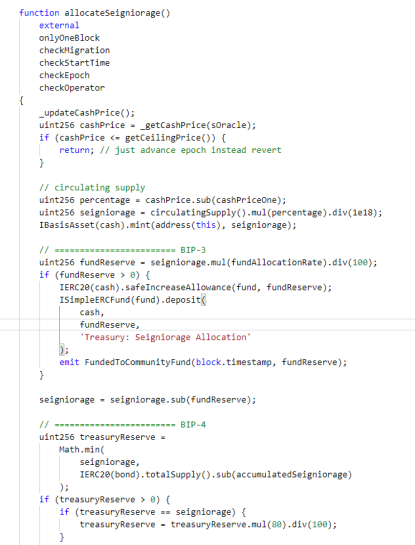
Figure 4
Regardless of whether it is a single-currency stable currency or a multi-currency stable currency, in essence, it is to maintain price stability by adjusting the total supply of tokens. Compared with the single-currency algorithmic stable currency (AMPL), the multi-currency stable currency (BAC) relies on the mechanism of mutual conversion between the three tokens to achieve price stability by encouraging users to purchase bonds and issue additional issues, which improves the project stability.
But as far as the current situation is concerned, algorithmic stablecoins have some defects, such as small early circulation, large price fluctuations, inability to maintain price stability in real time, and single adjustment methods. However, technology is always innovating and developing, and I believe there will be A more complete new stable currency was born.





