


V God's own handwriting: Uniswap after V3 why not "part-time" oracle machine


It has been almost a week since Uniswap V3 was officially launched.
In recent days, you should have seen a lot of evaluation articles about V3. Although praise and controversy coexist, it is undeniable that, as the absolute leader in the DeFi world, Uniswap has passed a key stage of its own development and is about to move towards A new goal to move forward.

How will the next road go? The benevolent sees the benevolence, and the wise see the wisdom. Today (May 12) morning, Vitalik Buterin, co-founder of Ethereum, appeared at the Uniswap Governance Forum and published an article entitled "UNI Should Become an Oracle Token (UNI should become an oracle token)”, gave his own insights on a potential future development path of Uniswap. Why did God V say that? Are existing oracle solutions not good enough? What are the inherent advantages of UNI? Everyone is welcome to read and understand below.
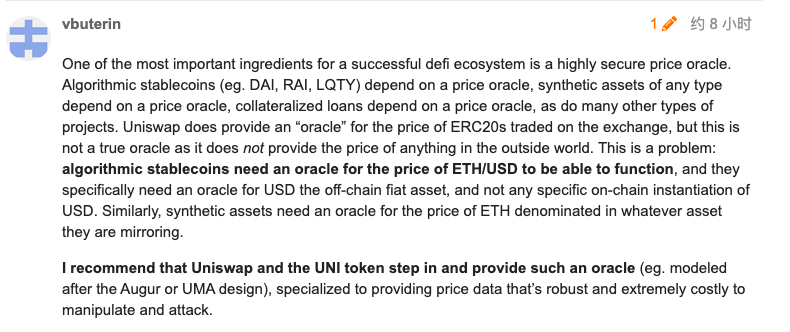
The following is the entire content of V God’s article, compiled by Odaily:
A secure price oracle system is a key factor for the success of DeFi. Algorithmic stablecoins (DAI, RAI, LQTY) need to rely on oracles, synthetic assets need oracles, mortgage loans also need oracles, and many other types of projects also need to rely on oracles. Same.
Uniswap does provide an "oracle" for the price of ERC-20 tokens on the exchange, but this is not a real oracle, because it does not provide any price relationship with off-chain assets. Here's the catch: Algorithmic stablecoins need an oracle that provides an ETH/USD price to work, and specifically an oracle that provides a price relationship between itself and an off-chain fiat asset (i.e., USD), not with some Similar to the price relationship between on-chain USD-pegged coins (such as USDT, USDC), synthetic assets also need an oracle that can provide the true price of any asset it reflects.
secondary title
Workarounds like ETH/USDC are not perfect
The goal of algorithmic stablecoins is to maximize censorship resistance by breaking away from the fiat world. If this goal is not so important for stablecoin users, then they can indeed directly use anchor currencies such as USDC to avoid the technical risks of algorithmic stablecoins, but if this goal is important, it is not only to avoid Direct dependence on the legal currency market, but also avoid indirect dependence. Using the ETH/USDC price as a surrogate for the ETH/USD price does not achieve this goal, as the system ultimately still depends on the survival and free circulation of USDC.
secondary title
Chainlink is great, but for high-value, non-timely scenarios maybe a complementary solution could be introduced
Currently, most “governance-minimized” stablecoins are using Chainlink as their oracle service. Chainlink can play a big role in many oracle adoption scenarios, but Chainlink is also a complex system with many specific features, its incentives are not as clean as Augur, and it lacks automatic penalties for wrong quote submissions.
secondary title
As an oracle token, UNI has great advantages
A decentralized oracle system needs a Sybil-resistant token (if one wants to avoid reliance on an identity layer). Those who hold tokens are asked what the price is, and usually an economic mechanism is introduced where those who provide a majority answer are rewarded and those who provide a minority answer are penalized.
If the holders of most tokens choose to do evil, then they can forcibly submit a wrong answer. At this time, if they want to restore the effectiveness of the system, the holders of a few tokens need to create a fork system. There, the perpetrator's tokens are removed and the community is persuaded to accept the new forked version. In this case, the cost of the real-time quotation attack will be half of the total market value of the token, and the actual situation may need to subtract some, because there will always be some lazy token holders who will not vote on the chain, even if In extreme emergencies where tokens may be lost.
Due to this reason,A robust oracle system must first be based on a token with a sufficiently large market cap.The efficiency of the oracle is not important. Some designs can be used to improve efficiency. For example, when one party thinks it is a certain price, the oracle will only be called if the other party disagrees; on the other hand, the attack cost The maximization of Ethereum is absolutely necessary, so the market value is the key. The two Ethereum ecological project tokens with the highest market value are LINK and UNI.
For Uniswap, supporting oracles is not just an altruistic act. In fact,Uniswap could benefit from a more robust token ecosystem.secondary title
Ethereum L1 needs to maintain minimal governance, but L2 should be more ambitious
The Ethereum ecosystem aims to be a much broader base layer of applications than previous blockchain platforms have attempted to cover. Its goal is not only to support the holding and transfer of underlying assets, but also to build a decentralized financial ecosystem (DeFi) and a decentralized governance ecosystem (DeGov). In the Ethereum ecosystem, a large amount of public welfare funds are also required.
Supporting this broader vision requires something broader than "just make one blockchain". This requires continued steps towards the vision of a "crypto nation",Expand the services provided by the blockchain ecosystem, including security, oracles, arbitration, public goods funding, identification, and more.But in order for Ethereum to become a more stable platform, Layer 1 needs to keep governance to a minimum. The minimalism of governance can reassure users that the applications they care about will not be disturbed, and Layer 1 will not be controversial because of adding characteristics that lead to consensus conflicts.
Therefore, these services need to be provided at Layer 2 somehow. The MEV that Optimism is implementing is an example, and Uniswap, as a decentralized exchange, is the core of the Ethereum ecosystem and will also take on more responsibilities (including price oracle services), which is its direction in this direction. Another potential reason to move forward.





