


Read all kinds of stablecoins in one article: full analysis of USDT, DAI, FEI, Basis Cash, ESD visualization


Editor's Note: Original text fromMedium, author Haseeb Qureshi, managing partner of Dragonfly Capital; this article is compiled by Odaily Qin Xiaofeng.
Another: Because Dragonfly, the author's fund, holds multiple asset positions mentioned in the article, relevant analysis is not recommended as investment guidance.
 Over the past year, the circulation of stablecoins has exploded. However, very little is known about how these stablecoins actually work.
For some reason, stablecoin creators are obsessed with making these designs seem elusively complex. Almost every white paper gets bogged down in equations and newly invented jargon, as if their authors are trying to convince you: trust me, you're not smart enough to understand this.
But I don't agree with that. In my opinion, the underlying design of all stablecoins is very simple. I will show you a visual to understand how all stablecoins work.
We can imagine each stablecoin protocol as a bank. They each hold assets and owe debts; they all try to somehow capture value and distribute that value to "equity" holders.
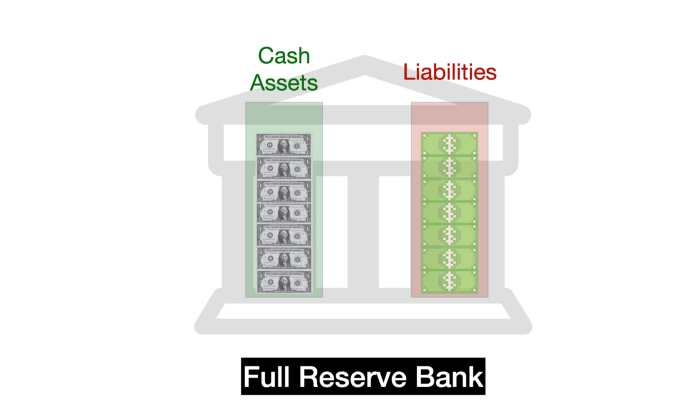
digital dollar"digital dollar"), that is, claims on reserve assets.
In a full-reserve bank, every liability is pegged 1:1 to the assets of the reserve. If a holder of a digital dollar requests cash back, the holder is given physical dollars and the corresponding digital liability is destroyed. This is how Tether, USDC, BUSD, and every other fiat-backed stablecoin works.
 The equity in the bank belongs to the shareholders (investors in the bank) who make money from the fees charged by the bank. In the case of Tether, the owners of Tether Corporation are the shareholders whose profits come from Tether’sMinting and redemption fees。
Every liability of a full-reserve bank should remain tightly pegged to the dollar, since it is always redeemable for $1 of reserves. As long as banks ensure convertibility, arbitrageurs have no trouble maintaining their exchange rates.
secondary title
Fully Reserved Crypto Stablecoin
Let’s start with a question, how do you create a crypto-full-reserve bank with a stable dollar as its liability?
Given that cryptocurrencies are just redefining money, the first thing you need to do is swap your dollar holdings for crypto assets. But cryptocurrencies are volatile, so 1:1 backing won't work if your liabilities are in dollars. If the value of cryptocurrencies falls, banks will run out of collateral.
Therefore, you need to "overcollateralize", that is, increase the value of collateral to give you a cushion when the cryptocurrency falls.
This is basically how MakerDAO works.
 The current exchange rate of the stablecoin DAI is basically stable. Because reserve assets are significantly greater than total liabilities (DAI), this ensures the safety of the entire system. I won’t go into details about other details about MakerDAO. Interested readers can click to read this article"What is MakerDAO?" ".
Now let's look at Synthetix.
Synthetix has takena different approach: Instead of holding a diverse basket of crypto assets, Synthetix issues its sUSD stablecoin against a bunch of its own SNX tokens. This SNX is also"equity token", in other words, the only asset Synthetix allows as a deposit is its own equity. Due to the high volatility of SNX, Synthetix requires a 600% overcollateralization of every sUSD in circulation.

The sUSD exchange rate is also currently stable.
secondary title
Algorithmic central bank
There is also a stablecoin, commonly referred to as"Algorithmic Central Bank"。
Algorithmic central bank stablecoins are not redeemable at all and have no depositors (depositors) in the traditional sense. This makes them less like traditional banks and more like central banks. (Note: Central banks tend to use methods other than callability to maintain price stability).
Each algorithmic central bank works slightly differently. To analyze algorithmic central banking, we try to understand how it works and functions in two important situations: when the stablecoin is above the peg, and when the stablecoin is below the peg.
Structurally, the simplest algorithmic central bank is probably Fei.
Fei got a lot of attention when it launched recently, but it broke the hook as soon as it went live. In simple terms, Fei can use the relationship between supply and demand to push the price to stabilize around the anchor target. The working principle of Fei is shown in the figure below:
 Currently, FEI's peg is broken.
Note that Fei is not over-collateralized and most of its assets are in cryptocurrencies. This means that in a black swan event, Fei's assets could be significantly lower than its liabilities, making it impossible to guarantee the exchange rate peg.
Although the above animation gives everyone a more intuitive feeling, the real mechanism of Fei is actually quite complicated. Fei uses Uniswap for all trading activities, and uses a method called"reweight"technology to conduct actual transactions. It also uses"direct incentive"(actually a capital control).
But the net effect is the same: the protocol participates in the open market, pushing the actual price towards the pegged price.
Another central bank with a similar algorithm is the Celo Protocol, which has produced a stablecoin called the Celo Dollar (cUSD). The Celo Dollar uses CELO as its reserve collateral (the native token of the Celo blockchain), along with a diversified mix of other cryptocurrencies.
Like FEI, Celo also uses products like Uniswap to continuously buy and sell Celo Dollars on the market. Celo starts with a large reserve of assets, and the purpose of the reserve is to remain overcollateralized at all times. If Celo's assets fall below 200% of its liabilities, the system attempts to regain the asset reserve by charging transaction fees for CELO transfers.
Therefore, the main difference between Celo and Fei (besides its transaction mechanism) is the assets it holds and the rules around staking.
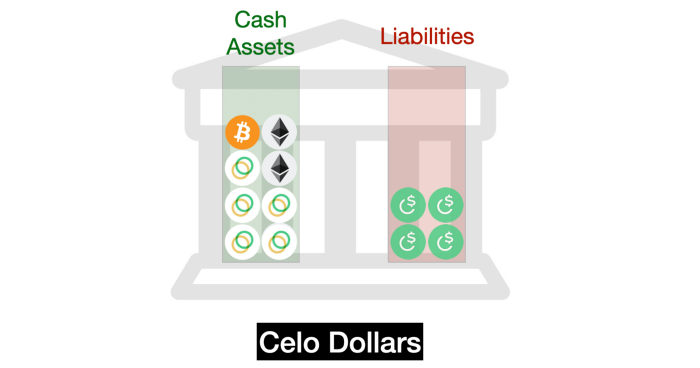
The Celo Dollar peg is currently stable.
Another algorithmic stablecoin is Terra’s UST, whose collateral is Luna (the native token of the Terra blockchain). Like FEI and Celo, the Terra protocol acts as a market maker for stablecoins; if the stablecoin system runs out of assets, it restocks it by increasing the LUNA supply.
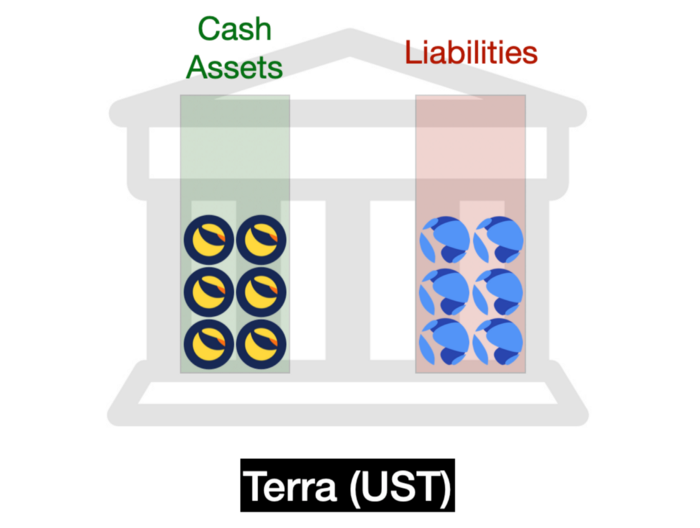
The UST peg is currently stable.
FEI, Celo and Terra do not allow redemptions. Instead, they create their own currency on the open market (that is, they are willing to buy and sell the difference).
On the surface, this might seem quite different from callability, but it's actually a closer continuation. Economically, a credible commitment to a market maker is the same as allowing minting and redemption.
Imagine a stablecoin, backed by ETH, call it a STBL token. The protocol is always willing to make an ETH/STBL pair in the market, which means the protocol is willing to sell 1 STBL for $1.01 of ETH and buy 1 STBL for $0.99 of ETH. If STBL is below the peg rate, it will keep trading STBL until its ETH is used up.
If the STBL instead used minting and redemption, it could potentially allow anyone to mint 1 STBL for $1.01 ETH and redeem 1 STBL for $0.99 ETH. If STBL falls below the peg rate, it will continue to redeem STBL for ETH until its ETH is exhausted.
The end result of the above two methods is the same.
In a traditional central bank, being a market maker rather than allowing redemptions gives the central bank more discretion. But algorithmic market making is different because smart contracts can make firm, self-enforcing commitments. From this perspective, market makers and callables are two paths to the same goal: providing liquidity and securing the peg.
Now, we have understood"central bank"type of stable currency. But there is also a fancy algorithmic stablecoin: Seigniorage Shares (seigniorage stablecoin).
secondary title
Seigniorage Stablecoins
the most classic"Seigniorage Shares "An example of a stablecoin is Basis Cash. It also became the quintessential algorithmic stablecoin from which many other designs were derived later.
The following is a video introduction of how Basis Cash works, you can alsoClick to read the article。
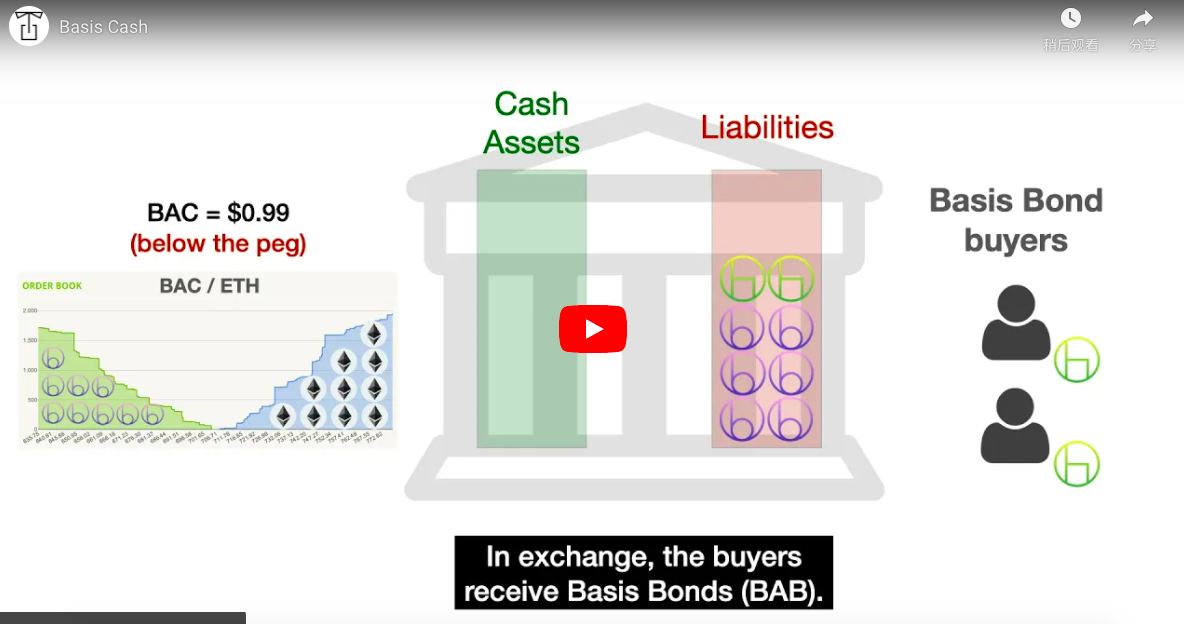 The Basis Cash peg has currently failed.
You can think of Basis Cash working in two phases: Basis Cash is in a contraction cycle when there are outstanding bonds, and the money supply is not growing fast enough to pay off all system debt. However, if demand continues to increase, eventually all bonds will be repaid, the system will enter an expansion cycle, and shareholders will again be rewarded with freshly minted Basis Cash.
The newly minted Basis Cash is"Seigniorage", that is, the central bank's profit from issuing new currency.
A normal central bank would keep this money on its own balance sheet for a rainy day. But Basis Cash pays all taxes to its shareholders the moment the cash is received.
You can intuitively see that Basis "mortgaging is very efficient". Having no assets on its balance sheet allows it to back a very large stablecoin supply on zero asset reserves, but it also makes it vulnerable to"death spiral"Or the impact of a crisis of confidence. In fact, Basis Cash encountered the latter situation.
It is important to understand how Basis Cash works. Most subsequent algorithmic stablecoins are descendants of the Basis design, including the last stablecoin we'll examine: ESD.
Empty Set Dollar (ESD) is an absolutely fair stablecoin launched by an anonymous team. The original version of ESD (now called ESD v1) was based on Basis Cash design.
 The peg for ESD v1 has been broken and they have since moved to a new design.
shares"shares"stable currency"stable currency"Token Fusion. This means that stablecoins will generate more stablecoins if they are collateralized. As you can probably guess, this has caused the stablecoin to become very volatile and move away from the peg, sometimes as high as $2.00 and sometimes dipping below $0.20.
write at the end
write at the end
In the early days of DeFi development, many believed that decentralized stablecoins were fundamentally untenable. It now appears that this conclusion is too hasty. Some of the designs do look good, and there's a lot of room for improvement.
But one thing is for sure: you shouldn’t insist that a decentralized stablecoin is stronger just because of a white paper. You have to think about it for yourself, what kind of stable currency should be considered stable. If you get confused, try to tease out the principle and draw a diagram, at least for me, this is very helpful.





