


Smoothy, a stable currency platform, allows users to easily hold coins and earn interest


Smoothy is a novel liquidity protocol. On the basis of supporting multiple stablecoins, it has the characteristics of single pool, low fee, zero slippage and high pledge return. That is, in a stable coin pool, the exchange of multiple stable coins can be realized.
Want to know the stories behind the Smoothy team?
Focusing on stablecoins, how does Smoothy maximize LP revenue? How will currency holders gain benefits?
Michael Li, the core engineer of Smoothy who used to work for Baidu, visited the Odaily Chaohua community to explain in detail how Smoothy realizes the exchange of multiple stable coins.
The following is a record of the community dialogue, organized by Odaily
1. Since many users are not familiar with Smoothy, please introduce the positioning and purpose of Smoothy first.
Michael Li: Smoothy is a novel liquidity protocol. It is not a fork of any existing project on the market. On the basis of supporting multiple stable coins, it has the characteristics of a single pool, low fees, zero slippage and high pledge returns . That is, in a stable coin pool, the exchange of multiple stable coins can be realized.
At present, Smoothy has logged into two networks of ETH and BSC. The BSC version of Smoothy supports 6 stable coins, and the ETH version supports 8 stable coins. You can choose to deposit any one or several of the supported stable coins to provide liquidity. Now the daily transaction volume has exceeded 15 million US dollars, and the total TVL has exceeded 120 million US dollars. In the future, Smoothy will log on to more platforms such as HECO, Fantom Polkadot QuarkChain, and support more stable coins (the design can support more than 100 stable coins) .
At the same time, it has been integrated into the aggregator 1inch openocean matcha by 0x, and paraswap is under planning.
2. There are many landing directions in the DeFi field. Why did Smoothy choose to focus on stable currency exchange? How do you see the development prospects of this field?
Michael Li: The birth of our project is mainly due to the explosive development of the DeFi field, which has allowed many assets to be introduced into Ethereum, BSC, HECO and other networks by anchoring coins, such as anchoring to BTC, US dollars or Gold, there are more than 20 such anchor coins in the market, and it is expected that more tokens of this type will be introduced into the network in the future. At present, the USDT market size has exceeded 48 billion US dollars, while other asset-anchored stablecoins are still being introduced, and it is very likely to become a market with a scale of 100 billion US dollars in the future. It can be said that this segment has great potential.
And this kind of asset anchors the exchange demand between tokens. Since the same asset is anchored, the exchange between such tokens should theoretically be 1:1 exchange. However, in the current DEX, because the current functional design does not fully consider For such exchange needs, the transaction slippage will make users bear deadweight costs, so a product for the same asset-anchor currency exchange is needed.
Curve.fi and mStable are two well-known representatives of the same asset-backed coins, including stablecoins. Curve has an $8 billion valuation, and mstable has a $240 million valuation. However, they do not provide a perfect solution to transaction slippage, and both designs are only a trade-off between lower transaction fees and earning interest through staking.
And our original design allows the exchange to guarantee the 1:1 exchange of the same asset-anchor currency most of the time, and at the same time that the handling fee is lower than 80% of the current projects, it can bring maximum benefits to the liquidity provider Interest.
3. At present, there are many stable currency exchange agreements in the market, including Curve, Depth and so on. Compared with these competing products, what are the differentiating advantages of Smoothy?
Michael Li: As a brand new project, the entire design of Smoothy has the following four characteristics:
1 Greatly reduce gas costs through algorithm optimization
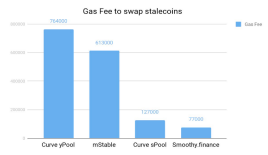
Even if it is deployed on Ethereum, the gas fee required for stablecoin exchange on Smoothy after algorithm optimization is 90% lower than that through Curve's Y pool and mStable. Achieve lower gas fees without using layer2.
2 A single pool can support many different types of stable coins, with better liquidity
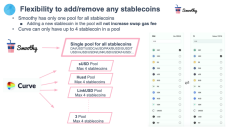
Unlike Curve, a fund pool supports up to 4 stablecoins, Smoothy's fund pool can support multiple stablecoins for pledge, and can add/remove currencies flexibly. In theory, hundreds of different types of stablecoins (even algorithmic stablecoins) can be accommodated in a fund pool, so that Smoothy will not be dispersed by too many pools, allowing the entire pool to have better liquidity.
3 Maximize LP income
curve Different pools have different effects
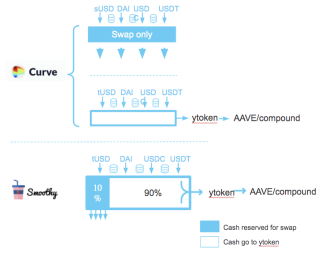
The service fee of the s pool is relatively low, but at the same time the rate of return is also low, and it is mainly used for SWAP. The annualized rate of return of the Y pool will be higher, but because the funds have to be brought to a higher place to earn interest, the gas difference is not high. On the basis of a single pool, Smoothy has designed a unique dynamic cash reserve algorithm (Dynamic Cash Reserve Algorithm) with reference to the bank's reserve system. Funds (currently 90% tentatively) are used to deposit coins to earn interest, and the rest of the funds are used to meet daily exchange (10%). In addition to income, liquidity providers can not only obtain exchange fees, but also enjoy deposit coins to earn interest income.
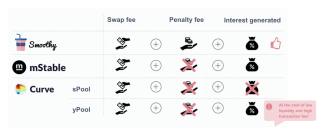
lp income = Swap Fee + fee generated by slippage + machine gun pool interest + SMTY income
4 Zero slippage trading algorithm
Michael Li: Smoothy’s original SmoothSwap new algorithm divides transactions into range transactions and out-of-range transactions. Basically, all transactions will be carried out within the range. In this part, we can provide 1:1 exchange. For occasional out-of-range transactions, that is, extreme transaction situations, we allow transaction losses to occur. In this way, we can not only provide 1:1 exchange in most cases, but also in extreme cases, we do not restrict transactions, ensuring liquidity.
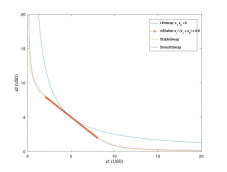
The blue curve is the old bonding curve of Uniswap
The red curve is the bonding curve of Curve: it can be seen that the slippage is lower than that of Uniswap, and it is more suitable for stablecoins
The red straight line is the conversion formula of mStable, which supports 1:1 conversion within a given range, and does not support conversion beyond this range
The red straight line + purple curve is smoothy's exchange formula: 1:1 exchange is supported in a given range, and it can still be exchanged beyond this range, and the slippage is smoother than Curve
4. Many users may be curious, if liquidity is provided for stablecoins on Smoothy, how high is the stablecoin LP income? Which pool is more reliable to choose?
First of all, we are a single pool, that is, all the currencies used are in the same pool, so there is no need to make trade-offs, and we can guarantee the maximum profit of LP. This is one of our most prominent features.
lp income = Swap Fee + fee generated by slippage + machine gun pool interest + SMTY income
This is a simple comparison between us and other competing products. It can be seen that mstable and curve have no income from slippage fees, and the low-gas s pool has no interest income from investment.
5. Can you introduce SMTY, the Smoothy governance token, and its economic model? What is the application scenario and value embodiment of SMTY in the project ecology?
Michael Li: SMTY is Smoothy's governance token, which is mainly used for the following basic functions:
1. Vote to determine the exchange fee (initial setting is 0.04%) and cash withdrawal fee (will be used to repurchase SMTY, initial setting is 0.04%) that LP can charge
2. Provide liquidity rewards
3. Other functions will be added in the future
besides:
SMTY can be used as collateral for adding new stable coins (or anchor coins) into the exchange pool
Token Economics
Token Economics
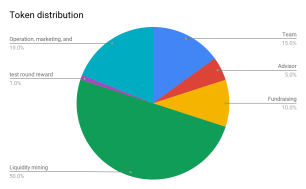
Total amount: 100,000,000 SMTY
Team 15% (4-year period, gradually released after 6 months)
Advisor 5% (2-year period, gradually released after 3 months)
Test round reward 1% (1 year period, 20% released online)
10% for sale (8% for private placement, 2% for public placement)
19% for operation, marketing and ecological construction (8% will be unlocked soon to provide initial liquidity)
Liquidity mining reward 50% (including pre-mining and genesis mining)
6. As a DeFi product, the security of DeFi is also of great concern to everyone. What measures does Smoothy take to ensure or maximize the security of funds on the platform? That is to say, how to prevent a coin from being exchanged for other coins in the pool after a problem occurs?
Michael Li: First of all, our code has gone through two rounds of audits, one by Peckshield and the second by SlowMist. In addition, a 48-hour time lock has been added, so that all operations of the team will take effect after 48 hours, thereby improving credibility.
The current eight coins (there are six on the BSC) are selected stable coins with a relatively high safety factor. Even so, the maximum proportion of the pool that can be accounted for (the red line in the liquidity pool) is stipulated in turn, from 2% to 100% No wait, the newly added stablecoins will have a stricter hard cap, which is the maximum size of the total pool (red line), and will strictly control risks.
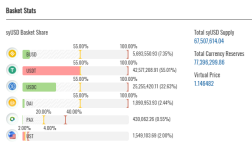
The yellow line in the liquidity pool represents the allowable range for 1:1 exchange. If the exchange exceeds the yellow range, there will be slippage (according to the price of the token at this time), so even if the price of a stablecoin suddenly drops after being attacked, it can be allowed to do so. The scope of 1:1 exchange is also very limited. The 1:1 exchange range allowed by the newly added stable currency will be even smaller.
In addition to the current 8 stablecoins, the newly added stablecoins need to be mortgaged with SMTY and this part of the mortgage still needs to be locked after voting. Once the tokens are at risk, this part of the collateral will be used to compensate users for losses.
7. Recently, SMTY is conducting public offerings on multiple platforms. Can you introduce the relevant plans? Which centralized trading platforms will SMTY launch in the future?
Michael Li: We joined 4 platforms BSCPad, Ignition by Paid, Paddle.finance and DAO Pad
Currently in progress are the following two
04 / 25-04 / 27Paddle(BSC)
Starting price for sale: $0.5 (from $50 million valuation)
Sales: 1,100,000 SMTY
Twitter:
Twitter:https://twitter.com/PaddleFinance
04/27 Paid's Ignition (Ethereum)
Price: $0.50 ($50 million valuation)
Sales: 300,000 SMTY
Twitter:
Twitter:https://twitter.com/paid_network
Participation takes two forms:
1) Fixed price: BSCPad, Ignition by Paid and DAO Pad ($0.5 fixed price). Each platform has different whitelist and investment cap rules, and needs to hold platform currency. For details, please refer to its Twitter.
2) Multi-price hyperfunding pool: Paddle.finance (starting at $0.5, starting at $50M valuation). There is no whitelist, no platform currency holding requirements, no upper limit, and it is open to everyone. To put it simply, there are several pools, and each pool is different. You can choose a reasonable investment, and finally calculate the transaction according to the price from high to low. Over-raising will be allocated according to the investment ratio. Too soon a higher price order will be established until the hard cap.
Selling price: $0.5 for 1 pool, $1 for 2 pools, $2 for 3 pools (each pool is a super-raised pool)
Time: 04/25 8am UTC to 04/27 8am UTC (48 hours)
At present, Paddle is very popular, and the $1 order pool is almost full, but because it is an auction, so the price is right, regardless of the order of input.
Detailed participation tutorials can be found here:https://www.jianshu.com/p/aabe69e40dfa
We have already talked about the above exchange, and we will announce the situation of the exchange in the near future, please pay attention.
8. Is Smoothy blind mining over? What is the next step after the end? Is there any way to get SMTY now?
Michael Li: In theory, blind mining will end on 4/20. However, due to the public offering on 22-27, we will also provide the same proportion to lp during the week of 21-27. Previously, the 8 weeks of blind mining were 1-2% rewards, and the public offering week was 0.16-0.32% rewards. LPs that provide liquidity will receive exchange fees, slippage fees, interest-earning benefits and SMTY rewards for deposits. SMTY token rewards will be distributed gradually after the public sale ends and the token goes online.
Meanwhile, we recently successfully completed a $2.4 million private placement round. Strategic investors include Hashkey, DeFiance Capital, AscendEX, Spark Digital Capital, BTC12, Signum, Morningstar Ventures, X21, Exnetwork Capital, BTX, IDC Capital, QuarkChain, and SECBIT.
We will launch a public sale in the near future, and the Smoothy governance token SMTY will be held on BSCPad, DAOmaker, Paddle and Ignition from 04/22 to 04/27.
All SMTY tokens will be released and traded at the same time after the sale is over, please refer to each platform for details.
At the same time, we will also log into more platforms. Now we have logged into ETH and BSC, and we will also log into HECO, Fantom, etc. in the future. And it is evaluating adding more currencies to the pool and inviting experts to improve the proportion of stable coins in the fund pool.
9. If someone is still willing to become an LP, how to participate in providing liquidity?
Michael Li: smoothy's page is very intuitive. Deposit any supported stablecoin to get syUSD. For details, please refer to
https://bihu.com/article/1140513157
https://smoothy-finance.medium.com/smoothy-finance-mining-tutorial-725296969447
If you only have large funds in a single currency, you should pay attention to the current range that allows zero slippage. At present, there are relatively few usdts and it is recommended to deposit more usdts. If you have large funds in multiple currencies, it doesn't matter if you choose the security mode (click multi-deposit without price impact) and deposit at the same time. The higher the TVL, the more funds you can deposit with 0 slippage.
Please note that you should bet less, don’t bet too much, there will be slippage when you cross the yellow line, and take more when you withdraw, so that slippage can be effectively avoided.
In addition, I need to introduce syUSD. This is not a stable currency but an lp token. Other income on Smoothy except SMTY is reflected in the price increase of syUSD, including: currency exchange fees, slippage fees and interest. According to the design, unless yfi has unpredictable risks (such as project shutdown, attack, negative interest rate), syUSD will keep rising.
10. At present, Smoothy has been implemented on the two chains of Ethereum and BSC. Will it be expanded to other public chains in the future? What is Smoothy's criteria for selecting a public chain? Can you briefly introduce our cross-chain solution?
Community question:
Community question:
Q1: May I ask the initial motivation and ultimate goal of creating Smoothy? Is there a user incentive plan to allow more new user investors to participate? If users still want to participate in the Smoothy ecosystem, besides buying coins in the secondary market for mining, are there other ways and means that are more favorable?
Michael Li: The background has been introduced just now. This is a huge market, and someone needs to provide lossless exchange services. There are many things that can be done now, and with the launch of our governance tokens, we will provide more possibilities for new users. At present, the most direct way to participate is to become an LP. First of all, we are a single pool, and we can participate with a single currency. In addition, our return to LP is the most generous, 50% of governance tokens will be used for LP rewards.
The background has been introduced just now, this is a huge market, and someone needs to provide lossless exchange services. There are many things that can be done now, and with the launch of our governance tokens, we will provide more possibilities for new users. At present, the most direct way to participate is to become an LP. First of all, we are a single pool, and we can participate with a single currency. In addition, our return to LP is the most generous, 50% of governance tokens will be used for LP rewards.





