






Will Ethereum be the next "value reserve asset" for listed companies?


This article comes fromYahoo Finance, the original author:
Odaily Translator |

This article comes from
, the original author:
Odaily Translator |
MicroStrategy, Tesla, Square, these industry giants have added Bitcoin to the company’s balance sheet. Although the market seems to be calm, there is an undercurrent under the water. More and more companies are beginning to try to allocate part of their assets to cryptocurrencies. .
What followed was a rush by consulting firms and cryptocurrency firms to launch crypto services for businesses to help them navigate the cryptocurrency transaction process, a trend that also gained media attention. Today, however, the vast majority of businesses are still focused on Bitcoin and rarely dabble in other cryptocurrencies, and while every investment decision is made by the corporate treasurer, we're starting to hear a voice: When is it Ethereum's turn? (ETH)?
Will ETH, the native token of the Ethereum blockchain, become a premium reserve asset for businesses?
To answer this question, let's first look at why businesses add Bitcoin to their balance sheets. There are several reasons:
1. Risk-return asymmetry;
2. Part of the company's "future first" strategy;
3. Prepare to accept Bitcoin as a means of payment;
This last point is actually very important because the primary role of the corporate treasury function is "asset/capital preservation" and Bitcoin's value proposition - the "store of value" - comes into play first. Of course, some critics point out that Bitcoin is too volatile to be a true store of value, but this kind of thinking is actually somewhat short-sighted. Yes, in the next week, month, or even a year, the price volatility of bitcoin may indeed be higher than that of legal tender, but in the long run, in the market environment where the Federal Reserve is frantically "sprinkling coins" to increase the money supply In this case, an "anonymous and fixed-supply" asset such as Bitcoin will actually increase in value relative to an asset without a fixed supply (such as the U.S. dollar). As investment guru Paul Tudor Jones pointed out, even a 2% inflation rate can depreciate the value of your cash and make it a "waste asset."
So, can the same argument support Ethereum?
From the current point of view, it seems that the support is not enough, but this does not mean that Ethereum will not appear in the balance sheet of the enterprise. Let Odaily Jun (ID: o-daily) analyze it with everyone:
secondary title
Is ETH a good store of value?
First of all, there is no limit to the supply of ETH, however, the growth rate of ETH token supply is very moderate (the current growth rate is about 4%, and it is expected to gradually decline over time), which may be far below the market demand in the future. growth, so ETH can actually still be considered a store of value.
But for now, the value narrative is not the main driving force for companies to invest in ETH, especially in the eyes of institutional investors, Ethereum is more regarded as a "technical game". More importantly, Ethereum is more like one of the experimental technologies for investors chasing stronger liquidity. Rather than building faster rockets or optimizing dental technology, Ethereum aims to re-invent a way to automate running applications, with the ultimate goal of building the underlying layer of a global digital economy. As noted macro analyst Jim Bianco said earlier this week, decentralized finance “is reshaping the entire financial system.” Ethereum-based applications could also impact markets, with changes in governance, energy, public services, and possibly even how personal identities are managed.
Bitcoin itself is actually a "technical bet". In fact, one of the greatest significances of Bitcoin is that it has released a brand-new value transmission method to the world. However, many basic parameters were developed when Bitcoin was conceived. Added, upgrade iterations of Bitcoin itself can take years to complete.
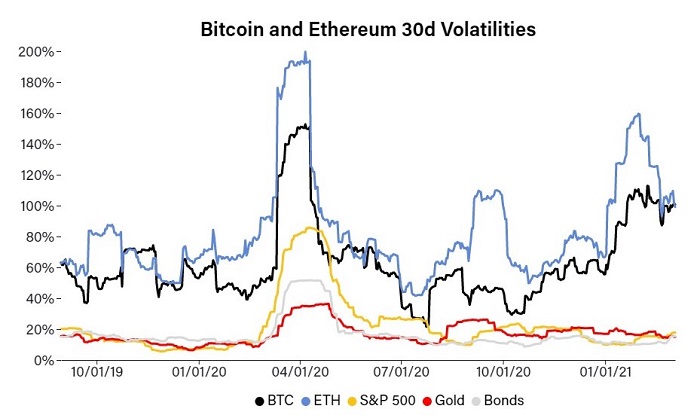
For Ethereum, it not only "bets" on the growth of the decentralized economy, but also "bets" on new connectivity and innovation, but the relevant technologies are not yet fully formed. We can see that Ethereum represents a radical innovation, and the risk of "early betting" is even higher than that of Bitcoin. This situation can actually be seen in the volatility of ETH price (as shown in the figure below):
If bitcoin’s volatility makes corporate finance leaders feel riskier, ethereum is arguably more so.
secondary title
Rather than as a corporate reserve asset, it is better to treat ETH as liquidity
Although ETH seems to have "a lot of problems", this does not mean that it will not appear on the company's balance sheet-rather than treating ETH as a corporate reserve asset, it should be regarded as liquidity.
In fact, businesses are already accumulating ETH and using it as liquidity. On March 8, according to the Hong Kong Economic Daily, Meitu, a software and social media application company listed on the Hong Kong Stock Exchange, has purchased 15,000 units of Ethereum in open market transactions on March 5, 2021. and 379.12 units of bitcoin, for a total consideration of approximately $22.1 million and $17.9 million for the two cryptocurrencies, respectively. These purchases were made pursuant to a cryptocurrency investment plan previously approved by the Board of Directors, whereby the Group may purchase cryptocurrencies up to a net amount of $100 million, funded from the Company’s existing cash reserves (but not the Company’s IPO the remainder of the proceeds). According to the announcement, the board of directors believes that cryptocurrencies have sufficient room for appreciation, and by allocating part of its cash reserves to cryptocurrencies at this time, it can be used to diversify the risk of holding cash in fund management.
Summarize
Although it is currently in the early stages of development, outside of the crypto industry, the number of enterprises integrating Ethereum applications is not large. However, there are signs that more and more companies are beginning to be interested in Ethereum. For example, last Wednesday (March 3), Aon, the world's second largest insurance intermediary company, entered the DeFi industry. At present, the company has launched a pilot project with the insurance technology platform Nayms , to provide decentralized insurance services for cryptocurrency holders against losses caused by hackers and virus software.
secondary title
Summarize





