For defi mining, even in the bull market trend, defi and some mining projects will collapse, especially many speculative replicas, so we should be more cautious.
Hello everyone, I’m Pepe. I don’t know if it’s affected by the drum market next door. The market on Monday is a bit confusing, but recently mining has become popular again, especially on Ethereum. A BDP was issued through liquidity mining last weekend. Tokens have attracted more than 6 billion US dollars into the pool within 2 days, known as the "God Mine", including the recent increase in the total lock-up volume (TVL) of Ethereum defi, which is now around 40 billion US dollars: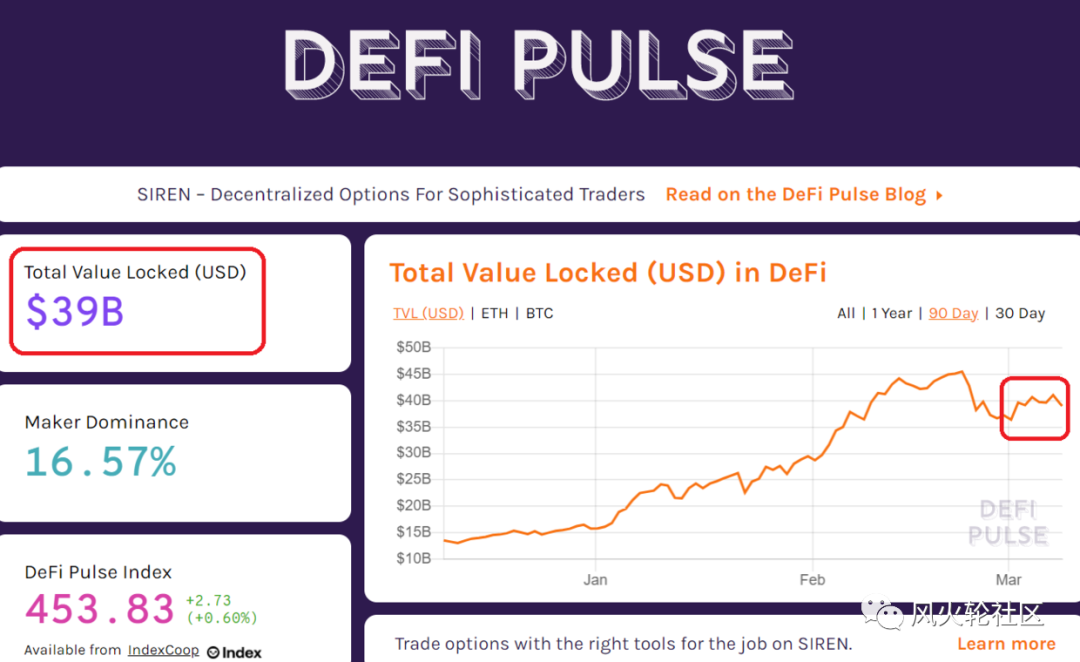
It can be seen that even under the background of high gas and attractive ecosystems of various competitive chains, the fundamentals of DeFi on Ethereum have not deteriorated. In view of the fact that some new and old friends have recently begun to pay attention to the field of mining, and in view of the following third law of defi mining:
So let’s talk about liquidity mining again today, which is more entry-level content, and those who are familiar with it can skip to the end of the article.If there is a difference between the current bull market and the currency circle in the previous bull market, many people may see decentralized finance and lending, but I think the bottom and core innovation lies in the liquidity pool (Liquidity Pools).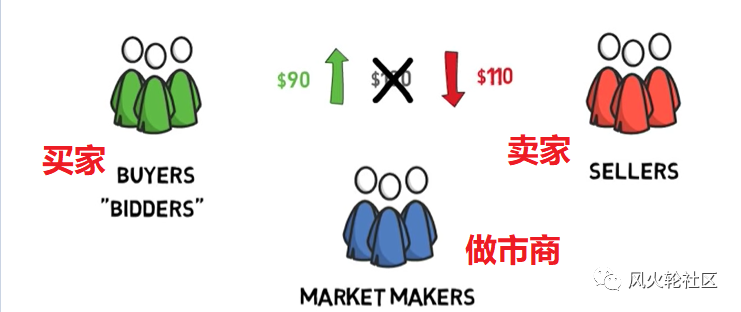
There is a role in a traditional transaction called a market maker. Its function is to improve transaction efficiency and user experience. For example, a seller wants to sell 10,000 coins in 10U, but there are not so many buyers at a time, and a market maker may buy first. , Waiting for new buyers or will increase the price before selling, the specific process may not be like this, I roughly understand what it means.The transaction is transferred to the chain, the pending order mode is limited by performance, and compared with CEX, it has no advantage in promoting user migration, so a liquidity pool mode has been developed: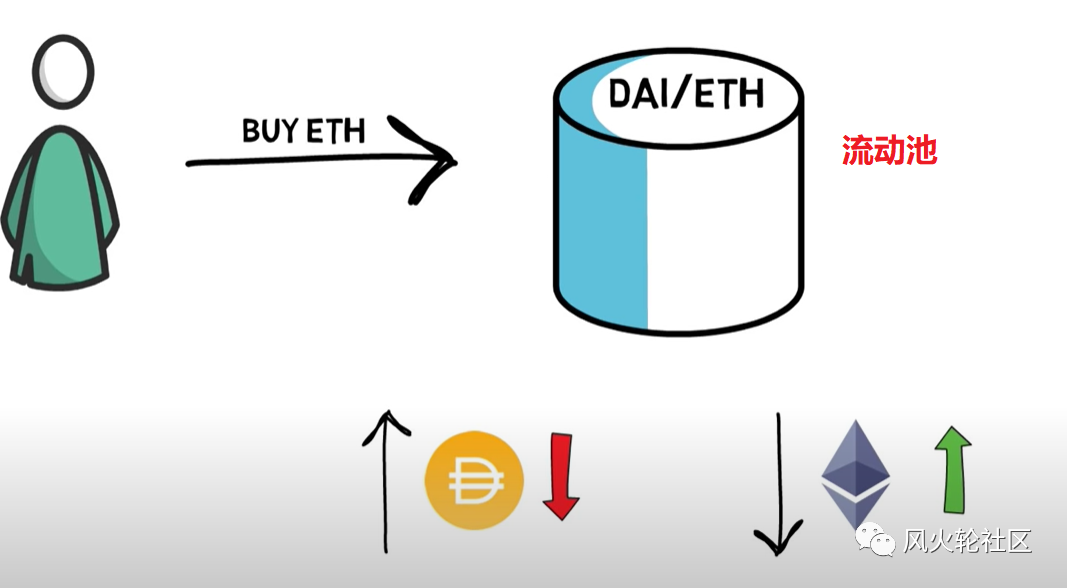
Each trading pair becomes a pool of funds locked in the contract behind it, and the market maker has also changed from a specific team to an unlimited one, as long as the two tokens pointed to by the trading pair are deposited into The contract address corresponding to the liquidity pool, you become an on-chain liquidity market maker.It is also a market maker, so the bottom layer is the same as that of traditional market makers. From a certain point of view, what a market maker does is the "counterpart" of all traders of the transaction pair, assuming that the transaction pair is A/B. , if in a certain period of time, more people bring in A to exchange for B, then for the liquid market maker, the proportion of A in his locked position will increase, and the tokens of B will decrease. If the price of A decreases at this time, During this period of time, the market maker may suffer certain losses, but pay attention to the certain period of time I mentioned here. Maybe when the price of A recovers, the market value of the market maker’s holdings will increase even more. This is why everyone calls it An impermanent loss, because it is not fixed and may turn around as time goes by.Now a lot of funds are willing to go to various liquidity pools to make markets. One is that most DEX platforms have a mechanism for sharing the commissions of market makers. For example, the annualization of several main trading pairs on the universe-level platform uniswap can now be achieved. Do forty or fifty points: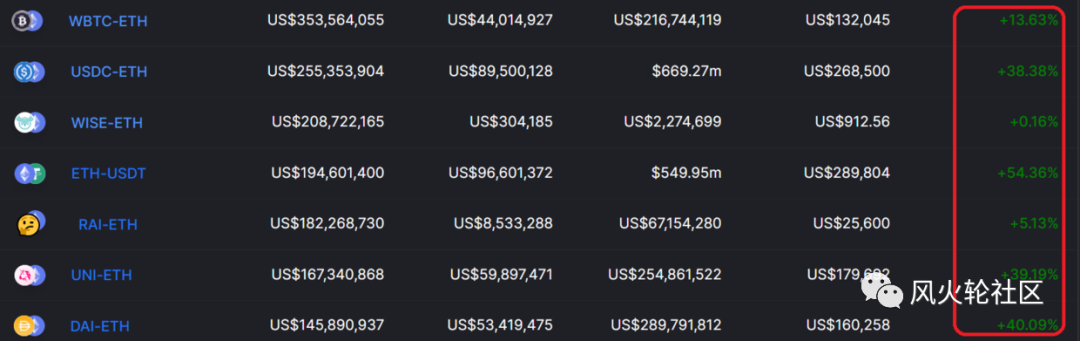
The other is the various liquidity mining that is being played now, that is, as long as you deposit money to provide liquidity in the past, also known as doing LP, you can get a certain token incentive.At first, a new DEX trading platform was opened, so there must be several transactions, right? The project party will distribute the platform currency to each liquidity provider. The price of the platform currency will allow mining to have a rate of return. When the rate of return increases , to promote more people to enter the market to do LP, and the liquidity of the platform will be better, which also means that the price fluctuation will be more stable. For example, the slippage loss of trading 100 eth will be small, and it will also attract many real traders. If you use it, this platform will become, and how to measure the liquidity of these platforms, because behind each transaction pair mentioned above is a token lock-up pool, so the higher the lock-up value in this platform, the higher the TVL , especially the long-term TVL growth trend, also represents the better the quality of this trading platform.Like the sushi and curve that came out before, they all belong to the above-mentioned category, as well as the wave of food farming tokens in defi before September last year.Later, it gradually evolved into the issuance of some new tokens. The project itself is not necessarily a dex or a loan, but it is issued by making several liquidity pools. Usually, this kind of liquidity will be done in the relatively large DEX on the ecological chain. For example, choose uniswap for ether, and pancake for bsc chain.For example, if you open an R-ETH trading pair for the new currency R, investors can get an LP token by depositing equal proportions of R and ETH into the contract address on uniswap:Then deposit this LP token into the place set by the project party, and you can issue new R coins in proportion.For this type of new project, some project parties will do IDO in advance (IDO is also very popular recently) to obtain some eth as a bottom position for project development or initial market making, so that early investors can get coins before the project goes online , but there are also some that all coins are issued by market making, which will also trigger an initial game. It is possible that everyone will see a short-term soaring currency price and explosive yield.Here is another concept in liquidity mining: 1 pool and 2 pools.Pool 1 is divided into three levels according to risk. The lowest level is stable currency. For example, as long as you mortgage USDT, or LPs with minimal fluctuations such as USDT/USDC, you can participate in mining. This is usually called "white prostitution" in the community.Slightly higher risk is some mainstream currency and stable currency trading pairs, such as WETH/USDT, WBTC/USDT or single-currency deposit eth, that is, it is possible to mine coins with ether, but when eth falls later, your income cannot cover Floating losses, but the mainstream market will think that the volatility of mainstream currency mining is small, and at the same time there are many investors who hold the mainstream for a long time. For them, this cannot be called a risk. For example, BDP’s current market-making eth and btc mining annualized at 26 % and around 50%: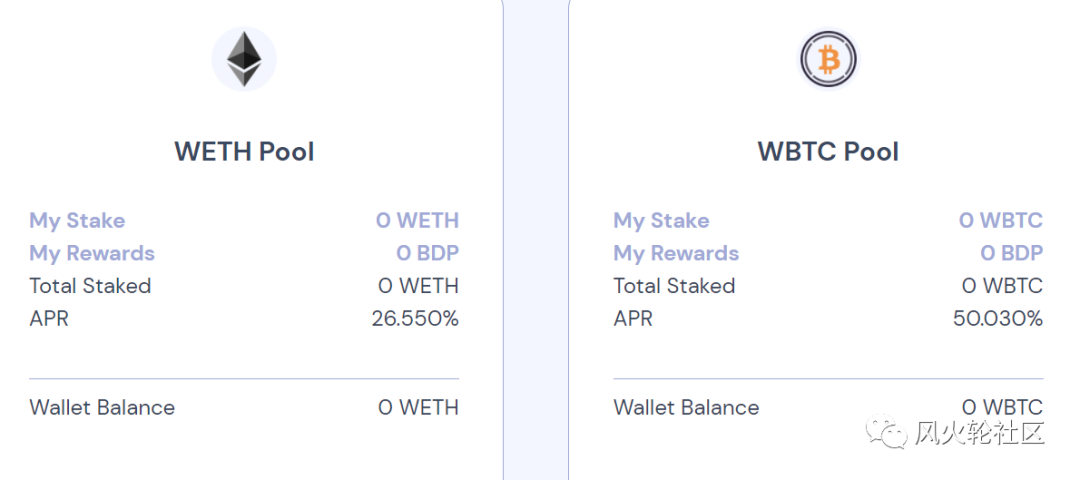
The risk is higher is to use mainstream defi coins and stable coins as LP tokens, such as aave, link, uni are frequent visitors here, the price fluctuates greatly, and the relative annualization rate is also higher: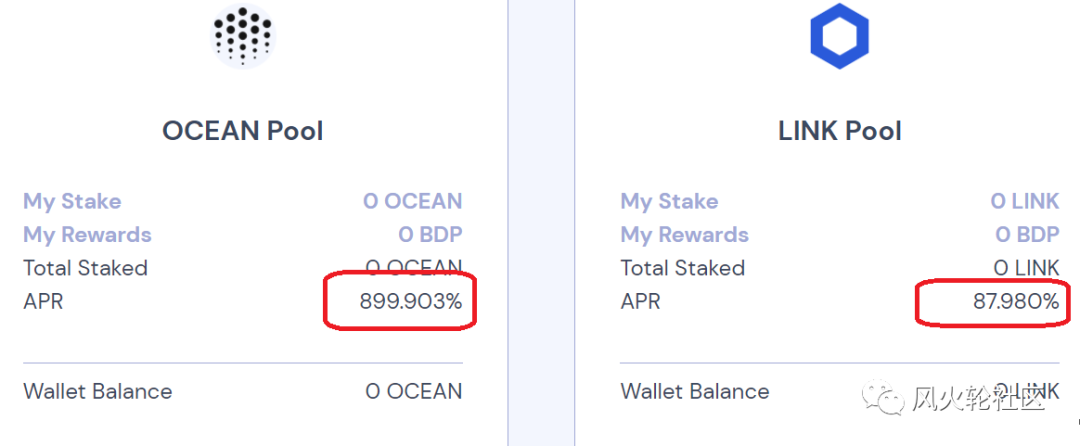
The 2 pool is to use the local currency as the liquidity pool, and its risk is the highest, such as BDP/WETH, both parties of the transaction pair are unstable, of course, generally speaking, its return is also the highest.The purpose of the 2 pool is to improve the liquidity of the new currency in the DEX, but for this kind of project that relies on mining to issue, it also plays the role of undertaking those unsentimental mining machines, because the initial maximum for the new currency is The demand for buying is to lock into the 2 pools to obtain a possibly better rate of return.Some 2 pools do not produce their own currency, and they dig new coins to promote more users to participate in 2 pools. For example, BDP2 pool also mines another bALPHA.For a project solely relying on liquidity mining, there is a certain amount of mining volume in pool 1 in the first hour of launch, and the number of pools that can participate in mining in pool 2 at the earliest is very small, but the annualized APY is calculated based on the rewards of the day It will be super high, and the first pool is usually dominated by big whales, and the coins they dig the earliest will be directly invested in the second pool, resulting in very few tokens for mining and selling. It is difficult to find a coin in the market. Although the amount of mining has increased over time, the APY is still maintained at an annualized rate of tens of thousands, which lures speculators to directly buy coins to participate in Pool 2.It really looks like a zj disk here. I also saw an article today about the calculation logic of the 1 and 2 pools. If you are interested, you can take a look:As for the so-called collapsed mines, some of them are the big whales inside. They maintain high profit margins, attracting various retail investors to follow suit, and then exchange their mining income from 2 pools for ETH, and the token price plummets instantly. The rate of return collapses, and the users of the first pool can pat their asses and leave for other mines, and the loss of the second pool is a bit like a "thunderstorm".Profit and loss thinking about liquidity market making
The above is about defi mining and sorting out some content, mainly for some new friends, and finally a few points:1. How to make money through liquidity miningOne is to participate in the first pool of some mainstream projects. Whether it is a mainstream or a newcomer is a god mine or a god pit. One consideration is TVL. However, for pool 1, if it is on the ether, there is still a capital threshold, preferably 50,000 to 100,000 U, so that the income will not be too affected by gas; the other is that most of pool 1 has a limited rate of return, relatively It will be suitable for long-term holding positions; another way is to borrow coins to mine, which also promotes the development of the lending industry on the one hand, of course, there is still an extra layer of risk in lending.2. Token holding or liquidity mining
For the targets born through liquidity mining, it still depends on its economic model, whether there is a market and other needs, not just relying on two pools to speculate and play a plate. Now most of the miscellaneous coins may end up collapsing and then like this It dissipates like fireworks, and those who want to speculate must do their homework.In fact, high-quality targets like uni did not have 2 pools for mining before. At that time, everyone complained, but now it seems that there is no problem.In addition, market making seems to have a daily handling fee, but it is not necessarily better than simple hold income. There is a website on Ethereum that can calculate the market making income of each address: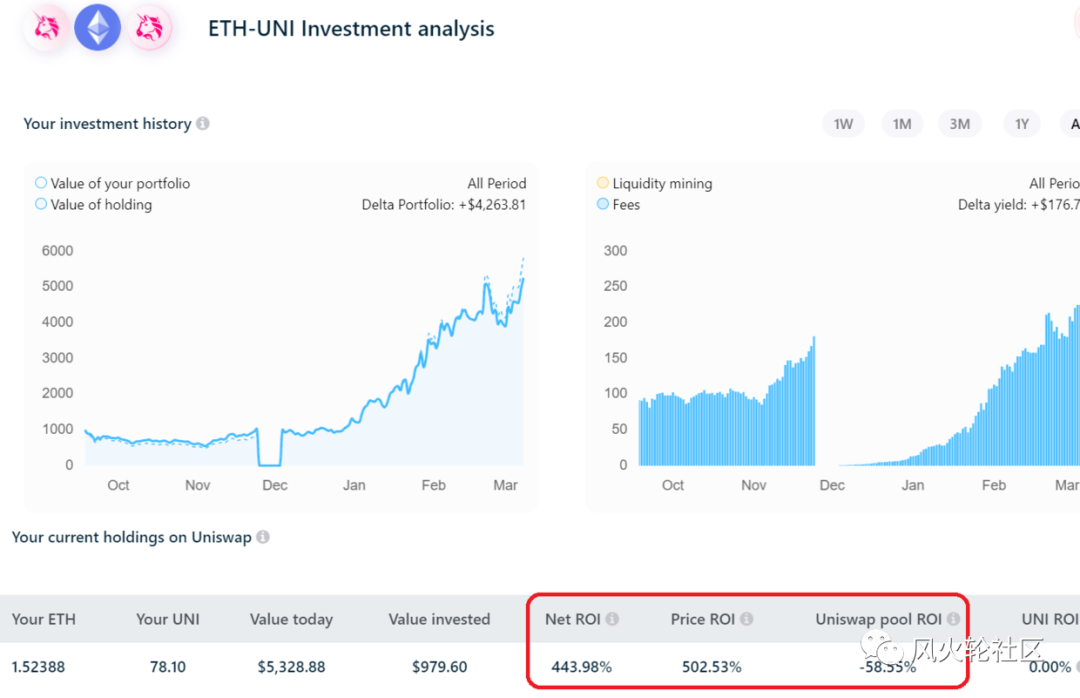
The calculation of impermanence loss in the market is mostly based on the currency standard, but if it is based on the market value, it may not be as good as simply holding currency in some periods of market making, which is also something investors need to consider.3. Bull market or bear market
I have said so much above today. What I want to say is that this wave of bull market also has the promotion effect of these liquidity pools. Think about so many Bitcoin DeFi coins locked in it for mining, and then new mines and new locks are constantly being produced. Warehouses, like the BDP mine we mentioned above, more than 10 million pieces of uni are locked, and it seems natural that the price will rise.It can be said that this wave is not like 2017, when the market value growth was purely driven by speculation. Naturally, it is not the kind of price that quickly touches the high and then collapses. I don’t know if you feel it. I want to wait for the price to collapse, but I feel that the market is After a rapid rise, it is difficult to really drop it. The fall is like scratching an itch. There may also be changes brought about by liquidity market making.Many times the market seems to be contradictory. One side sees $100,000, but there are also many negative signals on the other side. For example, the recent news that Meitu has bought cryptocurrency, it seems that they have always started to come out at the most lively time. There are new projects now. I see that many media are posting lists one by one, and each one is different. Think about how Isio used to be finished. When too many projects poured into the penny, Without enough incremental support, in the end it can only pierce the bubble.In fact, it is very similar to the wave of defi in August-September last year, and a whitelist will be opened for all kinds of mining, so for defi mining, even in the bull market trend, defi and some mining projects will collapse. Is it a lot of speculative replicas, or a little more cautious. 





