


ConsenSys releases DeFi report: 74% of stablecoins are deployed on Ethereum


Editor's Note: This article comes fromBabbitt Information (ID: bitcoin8btc)Editor's Note: This article comes from
Babbitt Information (ID: bitcoin8btc)
Babbitt Information (ID: bitcoin8btc)
, Author: Forkast.News, Compiler: Captain Hiro, published with authorization.
Three-quarters of stablecoins are now issued on the ethereum blockchain, up from 50% a year ago, according to a ConsenSys report on ethereum DeFi (decentralized finance) released today . The total value of stablecoin transactions currently on Ethereum also greatly exceeds that of Ethereum (ETH).
The Ethereum-related ecology has attracted the attention of many blockchain and cryptocurrency users, because the vast majority of DeFi protocols and stablecoins are now running on Ethereum. ConsenSys is a software development company based on the Ethereum blockchain.
The Rapid Rise of Stablecoins
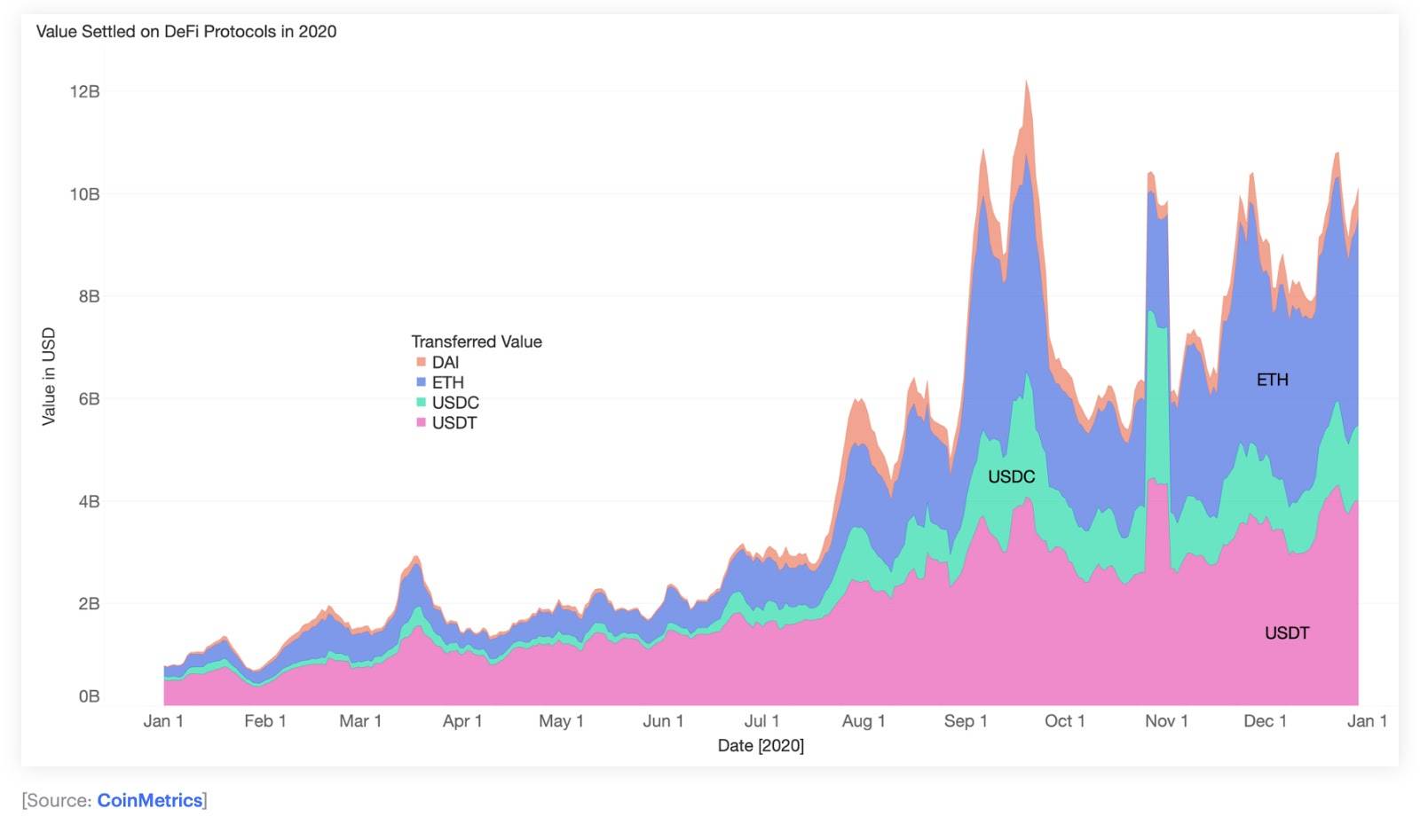
According to a ConsenSys report, the transaction volume of stablecoins on Ethereum exceeded $1 trillion last year. In 2020, Tether, the most popular stablecoin, settled $580 billion on Ethereum, while ETH’s transaction volume was only $385 billion.
According to the report, as of January 1 this year, 74% of stablecoins were issued on Ethereum, worth about $20 billion. Moreover, the types of these stablecoins have evolved from stablecoins (such as USDC, USDT) that were mainly backed by fiat currency in the past to many "new types" of stablecoins, such as stablecoins backed by cryptocurrencies, interest-bearing stablecoins (such as cUSDC, aUSDC , aUSDT), synthetic stablecoins (such as sUSD) and algorithmic stablecoins (such as AMPL, yUSDC).
image description
Figure: Trading volume of ETH, DAI, USDC, USDT on Ethereum. Source: ConsenSys
The report notes that as stablecoins have risen, they have also attracted more government regulation, most recently the controversial STABLE Act, and DeFi has also become the subject of regulatory discussions.
SEC Commissioner and “Crypto Mom” Hester Peirce told Forkast.News in an interview that regulating DeFi will be a challenge:
Because most of the way we regulate is done through intermediaries, and when you really build a decentralized thing, there are no intermediaries.
It was important to us to provide some help to those trying to understand 'how DeFi interacts with securities laws'.
Demand for DeFi Liquidity
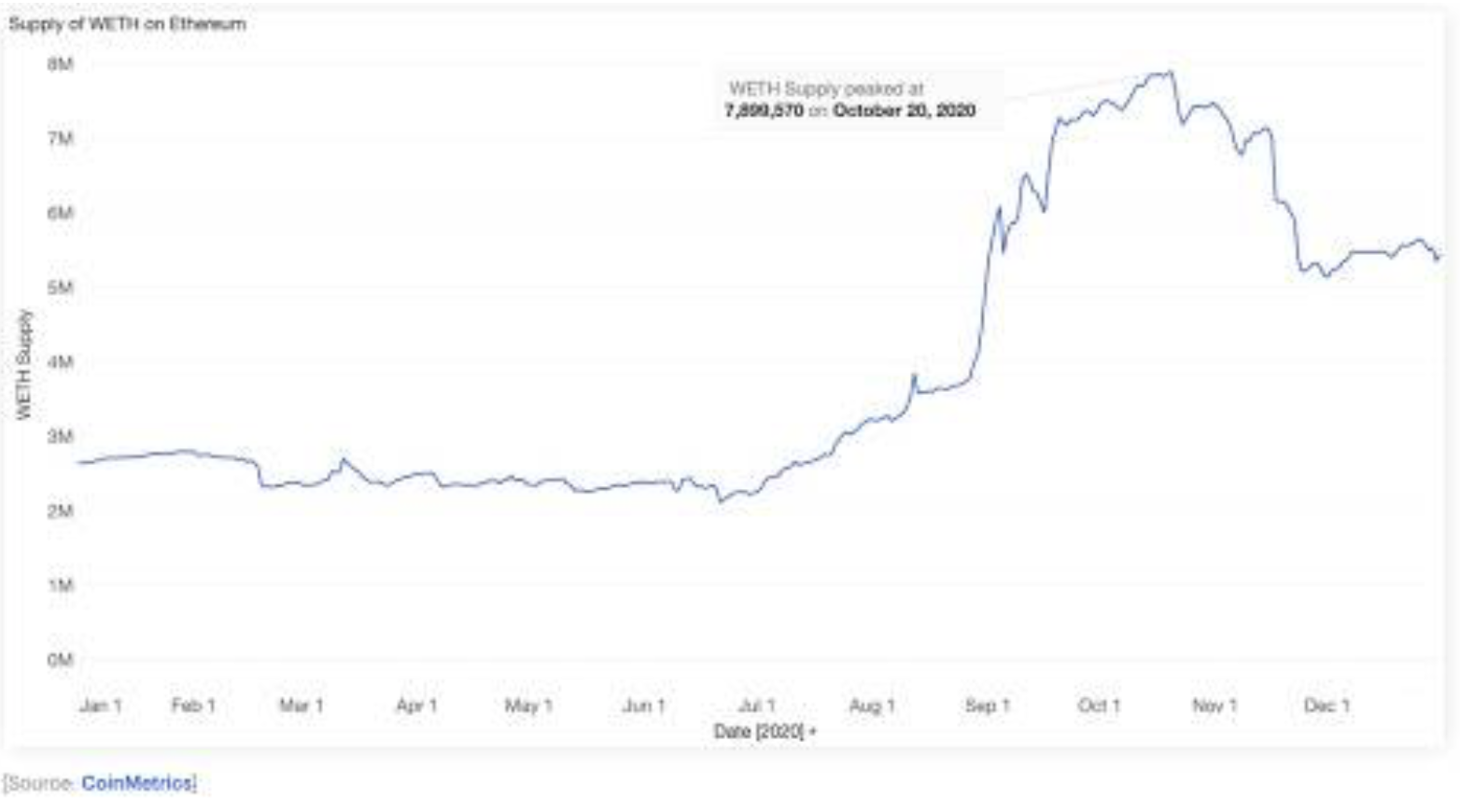
Other key trends in the DeFi space in 2020 include increased demand for asset-backed lending liquidity. Decentralized exchanges (DEX) like Uniswap proliferated in mid-2020, leading to an influx of value tokens on Ethereum, from WBTC, WETH and the decentralized storage network Filecoin, to institutional and other blockchain-based The demand for the agreement increases. The report predicts that this momentum will continue, with more protocols launching cryptocurrency-backed versions of their tokens on Ethereum in 2021.
image description
Figure: WETH on Ethereum, source: ConsenSys report
But the report shows that regulatory and technical challenges remain, and new types of standards, such as ConsenSys' proposed universal token for assets and payments, may be a way to bring traditional finance to decentralized finance.
LUKSO founder and chief blockchain architect and former Ethereum developer Fabian Vogelsteller said in an earlier interview with Forkast.News:
It's all about standards [like ERC-20 and ERC-725], it's all about how the infrastructure is defined.
Non-fungible token (NFT) design and market growth
According to the report, the design and market of NFT in the DeFi ecosystem has been successful in 2020 and will usher in greater growth. NFTs provide ownership of digital art, games, and other virtual assets. Digital artist Mike Winklemann, also known as "Beeple," sold a collection of NFTs for $777,777.777.
In addition to the explosive potential of NFTs, the market for NFTs has also flourished since the emergence of collectibles markets such as CryptoPunks and CryptoKitties. According to the report, there are currently at least 27 unique digital art marketplaces on Ethereum, of which SuperRare, MakersPlace, Async art and Known Origin have achieved sales of up to $8 million since their launch.
Community-based social tokens are also trending, with artists and creators experimenting with new ways to connect with fans and make money online amid the coronavirus pandemic. Celebrities such as Lil Yachty, Akon and Ja Rule are launching social tokens on the Roll platform, which allows users to instantly send social currency, or “fan coins,” to another user on the network. The size of the social token market is estimated at $81.2 million, according to the report.
DeFi loopholes
While DeFi has great potential, the report notes that the risks to smart contract security are real, as evidenced by hacking and exploitation.
Some DeFi protocols were attacked based on flash loans in the fourth quarter of 2020. According to the report, Harvest Finance lost $34 million, Cheese Bank lost $3.3 million, Akropolis lost $2 million, and Value DeFi lost $6 million.
According to the report:
As long as the Internet has value, there will be people bent on wresting value from it. DeFi is a truly novel invention like Aave's 'Flash Loans' or Uniswap's 'Flash Swaps' that have spawned arbitrage schemes at unprecedented scale and speed.
DeFi Trend Observation in 2021
According to the report, new fractional loan products and derivatives on Ethereum 2.0 are trends to watch in the first quarter of 2021. Some of the lending involves the use of derivatives, which allow users to mitigate their exposure to fluctuations in interest rates or market prices by depositing digital assets in pools.
With the successful launch of the Ethereum 2.0 Beacon chain, the Ethereum network is changing to a cheaper and more scalable direction. Ethereum 2.0 uses Layer 2 technologies such as Rollup to reduce the computational burden and mainly uses blockchain as security.
Due to Ethereum's ongoing transition from a "proof-of-work" protocol to a "proof-of-stake" protocol, and high gas fees, blockchain competitors known as "Ethereum killers" have emerged to challenge Ethereum's dominance and First mover advantage.
Charles Hoskinson, the founder of IOHK and Cardano, who was one of the co-founders of Ethereum but left a crack before Ethereum’s public launch in 2014, told Forkast in a recent interview:





