U.S. Office of the Comptroller of the Currency (OCC): U.S. Banks Can Use Stablecoins for Payments, and Even Issue Stablecoins


Editor's Note: This article comes fromBabbitt Information (ID: bitcoin8btc)Editor's Note: This article comes from
Babbitt Information (ID: bitcoin8btc)Babbitt Information (ID: bitcoin8btc), by Aislinn Keely, published with permission.
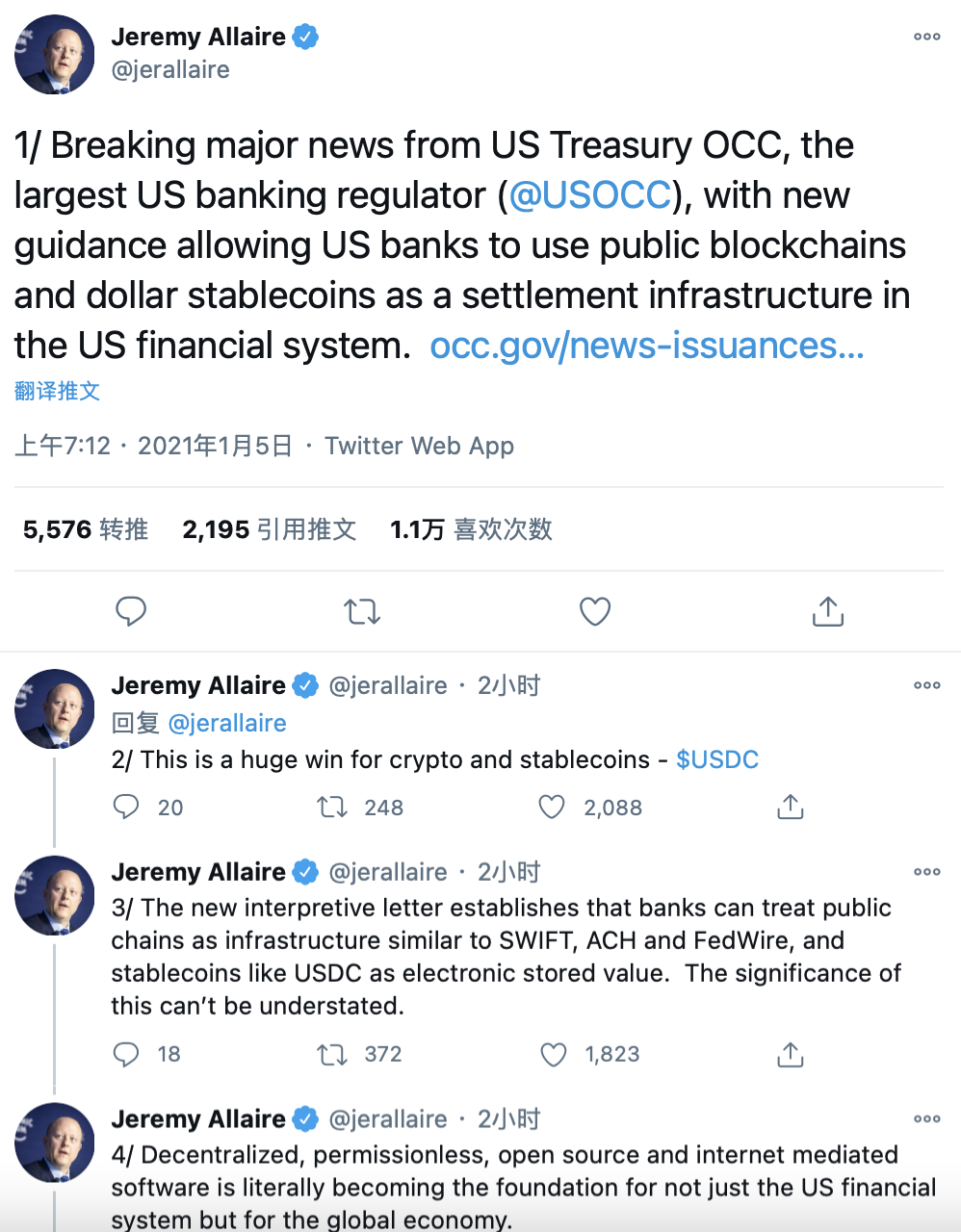
An explanatory letter issued by the U.S. Office of the Comptroller of the Currency (OCC) late Monday (
View full text
) said that the National Bank of the United States and the Federal Savings Association can use public blockchains and stable coins for settlement.
The letter indicates that banks and savings associations can now run cryptocurrency nodes and use the associated stablecoins for "permitted payment activities." This means that banks can use public blockchains to verify, store, record and settle payment transactions as long as they comply with existing laws.
The OCC also singled out the use of stablecoins for transactions, saying blockchain networks could serve as a "cheaper, faster, and more efficient" payment method to ease the cost of cross-border transactions. As such, it empowers banks to utilize the blockchain and its stablecoins to convert back and forth between fiat currencies during remittances, and even issue stablecoins if they choose.
The regulator noted:
“Similarly, banks could use stablecoins to facilitate customer payment transactions on a network of independent node verifications, including issuing stablecoins and exchanging that stablecoin for fiat currency.”
As stated elsewhere in the letter:
“Just as a bank can buy and sell ESV as a means of converting ESV into USD (and vice versa) to complete a customer payment transaction, a bank can buy, sell and issue stablecoins to facilitate payments. For example, an entity (payer) may wish to send payments in USD Remittance to a second entity (the payee), instead of using a centralized payment system, the payer converts USD into stablecoins, then transfers the stablecoins to the payee via INVN, and the payee then converts the stablecoins back. to U.S. dollars. In a common paradigm of this kind of situation, the payment is a cross-border remittance."
Brian Brooks, the OCC’s acting comptroller and former Coinbase legal head, said the letter was in response to a recent statement by the President’s Financial Markets Task Force on stablecoins. The statement had said regulators might consider limiting “multi-currency stablecoins,” and highlighted the potential risks of one-to-one tokens.
Brooks said:
"Our letter removes legal uncertainty regarding the legal mandate for banks to connect to blockchains as validator nodes, thereby representing customers who increasingly demand the speed, efficiency, interoperability and low cost associated with these products Make stablecoin payments."