


Will algorithmic stablecoins become the "currency" envisioned by Satoshi Nakamoto?



Satoshi Nakamoto introduced a peer-to-peer electronic cash payment system in the Bitcoin white paper, but Bitcoin has deviated from this original design of electronic currency; ETH exhibits certain transaction medium properties, but is essentially an application token , it is difficult to realize the design requirements of the currency in the blockchain. Although the central bank's digital currency has blockchain attributes, it is still a centralized currency with strong supervision.
secondary title
Bitcoin deviates from Satoshi Nakamoto's currency vision, and ETH has no intention of acting as a currency
In the context of the digital age, Bitcoin has deviated from the "currency" envisioned by Satoshi Nakamoto. The current transaction payment cost of Bitcoin is actually very expensive, which is far from the plan Satoshi Nakamoto envisioned. So far, Bitcoin block expansion has rarely been mentioned.
Bitcoin has given up the role of "currency" envisioned by Satoshi Nakamoto, but is heading towards the road of digital gold in the encrypted world, and it already has the property of hedging.The Great Transfer of Wealth Pushes BTC to Become a Mainstream Investment TargetThe Great Transfer of Wealth Pushes BTC to Become a Mainstream Investment Target"The report pointed out that Bitcoin seems to have some commonalities with safe-haven assets, such as: 1. Scarcity; 2. Verifiability; 3. Not much correlation with traditional financial markets and uncontrolled.
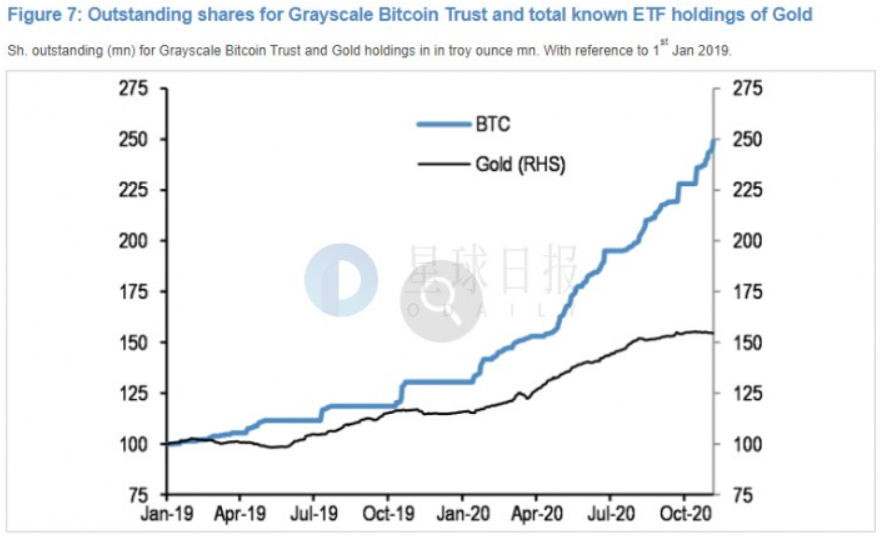
In the past, Bitcoin as digital gold was only in people's imagination, but now, traditional institutions have regarded BTC as digital gold.It pointed out that Bitcoin is cannibalizing the market's demand for gold ETF. Institutional investors such as family offices see Bitcoin as a digital alternative to gold, and demand for Grayscale's Bitcoin Trust exceeds the combined demand for all gold ETFs.JPMorgan Chase in a reportIt pointed out that Bitcoin is cannibalizing the market's demand for gold ETF. Institutional investors such as family offices see Bitcoin as a digital alternative to gold, and demand for Grayscale's Bitcoin Trust exceeds the combined demand for all gold ETFs.
In the future, with the maturity of anchor currency and cross-chain technology, Bitcoin will further realize the function of value storage in the blockchain network.After Ethereum solves the problems of slow transfer speed and high handling fees, Bitcoin is expected to achieve efficient circulation in the form of anchored tokens without being blocked in its own small block; if the cross-chain technology is mature, Bitcoin Then it can be further circulated in the blockchain world (although this circulation is still in the role of digital gold, not currency).
So, is Ethereum, the second largest encrypted asset, likely to become the "currency" envisioned by Satoshi Nakamoto? The positioning of Ethereum and Bitcoin has been very different from the beginning, and Ethereum did not intend to become a "currency" in the blockchain network from the beginning to the end. Although in the development of Ethereum, ETH did act as a trading medium in some scenarios, the value of Ethereum depends on the application value of its underlying network. The price of ETH has great uncertainty, and it is difficult to be a good "currency" Role. Take this year's 3.12 plunge event as an example. MakerDao uses ETH as collateral assets, but due to violent price fluctuations, it leads to asset liquidation. Under network congestion, chain liquidation ensues, forming a huge systemic risk. ETH is actually more like the "energy" of the Ethereum network, and it may be more appropriate to be regarded as a utility token.
secondary title
Evolution and Development of Stablecoins
The essence of the "currency" envisioned by Satoshi Nakamoto is a decentralized encrypted native token based on cryptography. Although the digital currency issued by commercial institutions or the central bank adopts blockchain technology, it has a strong centralization attribute; while the algorithmic stable currency is an encrypted native token that is more in line with Satoshi Nakamoto's vision. Before introducing the algorithmic stablecoin, let’s review the evolution and development of the stablecoin, so as to observe how the stablecoin realizes the form of “currency” envisioned by Satoshi Nakamoto step by step.
The representative of the first generation of stable currency is USDT, which tokenizes legal currency and builds an important bridge between legal currency and cryptocurrency.
The second-generation stablecoin attempts to build a decentralized stablecoin, the representative of which is MakerDAO's DAI. MakerDAO used ETH as collateral in the early days. Based on market risk considerations, it later introduced some centralized assets as collateral, such as USDC, wBTC, etc. After the introduction of centralized assets, although DAI has gained greater stability, it has also sacrificed some of its decentralized features.
The third-generation stablecoins try to build the native tokens of the cryptocurrency industry, represented by the elastic stablecoins of AMPL and YAM. These stablecoins do not need to use collateral, and are mainly regulated through algorithms and mechanisms. The third-generation stable currency is very close to the "currency" envisioned by Satoshi Nakamoto, and it will also become a strong competitor for the blockchain "currency" in the future, but we are more optimistic about the algorithmic stable currency.
secondary title
Advantages and disadvantages of the first and second generation stablecoins
Although the above-mentioned four generations of stablecoins can be said to be anchored to the US dollar, they are different in essence. They can be roughly divided into two categories: the first-generation and second-generation stablecoins are mortgage-anchored The price difference between these two types of stablecoins and the US dollar is kept within a small fluctuation range; in the third-generation and fourth-generation stablecoin systems, the price of the US dollar is actually only equivalent. Based on the reference price, stablecoins essentially use algorithms and market adjustments to find a price balance point, which currently makes their fluctuation range relatively large.
Although the first-generation and second-generation stablecoins are mortgage-anchored tokens, what is the difference between them? What are the advantages and disadvantages of this type of stable currency? Why are the third and fourth generation stablecoins more promising?
The first generation of stablecoins is a fully centralized mortgage-anchored model, and its issuing agency is centralized. It issues stablecoins 1:1 by reserving US dollars (equivalent to mortgaged US dollars). Although the second-generation stablecoin is also 1:1 anchored to the US dollar, its collateral assets are mainly encrypted assets, which maintain the anchor price through the automatic pricing mechanism built into the smart contract, rather than through the issuing body. In other words, the second-generation stablecoin transformed the centralized stablecoin into a decentralized mortgage-anchored model.
The stable currency of the mortgage-anchor model builds a bridge between traditional assets and encrypted assets; at the same time, it establishes its own stable currency unit for the highly volatile encrypted world. The role of this circulation medium temporarily plays the role of Nakamoto The "currency" function designed by Satoshi, but this is only temporary.
secondary title
Why are the fourth-generation stablecoins more advantageous?
Compared with the first-generation and second-generation stablecoins, the third-generation and fourth-generation stablecoins abandon the mortgage-anchor model, and instead establish a "currency" system through the relationship between market supply and demand.
Let’s first introduce the operating mechanism of the third-generation and fourth-generation stablecoins in detail.
The third-generation stablecoin is an elastic stablecoin. Take AMPL as an example to introduce its basic operating mechanism. AMPL is issued based on the Ethereum smart contract. The most important part of the AMPL protocol is the "token base readjustment" mechanism, which can automatically adjust the number of AMPL tokens on all user wallets according to market prices. This adjustment will not cause token dilution, but increase or decrease in the same proportion. The basis for its adjustment is mainly based on changes in the relationship between supply and demand in the market, and then through the transmission of price information, people are encouraged to game and arbitrage, thereby prompting AMPL to find a price balance point. The demand for people to buy AMPL is to hope that it will rise, so as to obtain more tokens for profit, which leads to a very strong speculative atmosphere in the AMPL market. The overall adjustment of AMPL is a bit rough, and once most people start panic selling, it is very easy to cause systemic risks. AMPL is very innovative, trying to find the native currency of the encrypted world through market supply and demand, which is worthy of recognition; but this attempt lacks experience, is highly speculative, and is not suitable as the "currency" envisioned by Satoshi Nakamoto.
The fourth-generation stablecoins are algorithmic stablecoins. The algorithmic stable currency refers to the previous design of Basecoin, and combines the experience of liquidity mining and elastic stable currency to form a relatively complete currency market adjustment mechanism. Unlike the third-generation stablecoins AMPL and YAM, the token adjustments of the fourth-generation stablecoins ESD and BASIS are not adjusted globally through smart contracts, but are done actively by users and stimulate user behavior with economic incentive mechanisms.
We take the algorithmic stablecoin BASIS as an example to introduce. There are three types of tokens in the Basis protocol: BAC (abbreviation for Basis Cash), BAS (abbreviation for Basis Share), and BAB (abbreviation for Basis Bond). Among them, the target price of BAC is 1 US dollar; the main function of BAS and BAB is to pull the price of BAC back to 1 US dollar. Holding BAS can obtain newly issued stable currency rewards, which is equivalent to enjoying seigniorage; BAB has the opportunity to obtain premium income.
Specifically, when the transaction price of Basis Cash is lower than $1, users can enjoy a certain discount to purchase Basis Bond. When users purchase Basis Bond (BAB), they will destroy Basis Cash (BAC) at the same time, thereby reducing the supply of BAC and lowering the price of BAC. Pull back $1. When the price of Basis Cash rises above $1, users holding Basis Bond can directly redeem Basis Cash at a 1:1 exchange rate. When Basis Cash is redeemed by users, Basis Bond will be destroyed. Basis Bonds have no interest charges and no maturity or expiration time.The general design of algorithmic stable coins is similar, but there are some subtle differences, such as the Coupon (similar to BAB) in ESD has an expiration date; in addition, there are also differences in epoch time and lock time. These will cause differences in the degree of price deviation, degree of market speculation, and flexibility of the market regulation mechanism, and eventually develop different trajectories. In the competition of many algorithmic stablecoins, the market will choose the best "currency".
The general design of algorithmic stable coins is similar, but there are some subtle differences, such as the Coupon (similar to BAB) in ESD has an expiration date; in addition, there are also differences in epoch time and lock time. These will cause differences in the degree of price deviation, degree of market speculation, and flexibility of the market regulation mechanism, and eventually develop different trajectories. In the competition of many algorithmic stablecoins, the market will choose the best "currency".
According to our observation, the fourth-generation algorithmic stablecoins are more "stable" than the third-generation elastic stablecoins.
First of all, the algorithmic stable currency draws on the design of Basecoin, which is very reasonable; at the same time, it also combines the experience of liquidity mining and elastic stable currency to form a relatively complete "currency" adjustment mechanism based on changes in market supply and demand. It will be more similar to the "currency" function envisioned by Satoshi Nakamoto.secondary title
How will algorithmic stablecoins develop in the future?
future
We believe that,futureAlgorithmic Stablecoin's Anchor Could Deviate from One Dollar. Avalanche Protocol founder Emin Gün Sirer tweeted yesterday: Algorithmic stablecoins may indeed have an anchor point, but this value is not necessarily $1. He also cited the example of DSD, which is currently trading at $0.38, and there are not enough DeFi participants to bring it up to $1. When DSD is above $0.38, these people think they have made enough money and sell when they think DSD is above everyone else's entry level.
This phenomenon is caused by the existence of a complete "currency" adjustment mechanism inside the algorithmic stablecoin, and this adjustment mechanism is essentially determined by market supply and demand. The US dollar price is more of a reference price in the algorithmic stablecoin system, so Algorithmic stablecoins don’t have to be pegged to USD prices. At present, the scale of algorithmic stablecoins is still small, and the volatility is relatively large; however, according to observations, as the volume of algorithmic stablecoins expands, the volatility of algorithmic stablecoins is also decreasing. After the algorithmic stability is more widely adopted, a more accurate anchor point will also appear. At this time, the volatility of the algorithmic stablecoin will also be greatly reduced, so that it is generally contacted by the encryption market. A complete set of "currency" "The system will also mature.At that time, algorithmic stablecoins, DeFi, Bitcoin and other encrypted assets will be combined to form a complete encrypted economy.
Additionally, we believe thatAlgorithmic stablecoins anchoring a basket of fiat currencies may also appear in the future. On the one hand, this is due to the decline of the U.S. dollar, the emergence of multiple competitions in the traditional financial market, and a basket of currencies can better reflect the currency value of assets; It must be anchored to the US dollar. If it can be more diversified, it can better adapt to the future diversified development of the encryption market.
Algorithmic stablecoins are still in the experimental stage. If they can usher in a long-term and stable development, they need a broad and long-term consensus.
From the user's point of view, although early participation can obtain high profits, it also faces high risks. For example, the tokens in the algorithmic stablecoin system generally have a high premium, which is likely to fall sharply in the future; in addition, the security and applicability of the contract also need to be tested by the market, and investors should participate cautiously.





