


Luo Kai, CEO of Hyperion Technology: The next stage may be ISO


On the afternoon of December 1st, the "Road to Evolution - Witnessing the Launch of Ethereum 2.0 Phase 0 Online Live Summit" hosted by Odaily, OKEx, Whale Exchange, Hyperion, and Hashquark was successfully held.
Luo Kai, CEO of Hyperion Technology, sorted out the development of Ethereum at the meeting. Luo Kai said that Ethereum 2.0 was not created for the large-scale explosion of applications. It puts more emphasis on the B2B2C model and the concept of mortgage (Staking). The next stage may be ISO, that is, based on Staking Some new ways of playing, this stage will generate some private domain traffic, which in turn will bring about a large-scale application system explosion.
The following is the full text of Luo Kai's speech, edited by Odaily.
First of all, thank you for watching today’s live broadcast. The theme of today’s live broadcast is Ethereum 2.0. Hyperion itself has a lot of communication with Ethereum. Our cooperation team in Silicon Valley has also maintained long-term communication with Ethereum.
We believe that the development of Ethereum to the 2.0 stage actually has contextual logic. Looking back at the development of the entire Internet in the past, the reason why the earliest Ali, Baidu, and Tencent can become the giants of the Internet world today is because they first discovered the Internet. Business logic - traffic + business. In the stage of Internet development, especially in the period from 2000 to 2010, and even until 2015, the traffic you talk about actually refers to public domain traffic. This is because all the traffic in the development stage at that time still belonged to the incremental market. , the three different monetization channels of advertising + traffic + finance have made the Internet pattern.
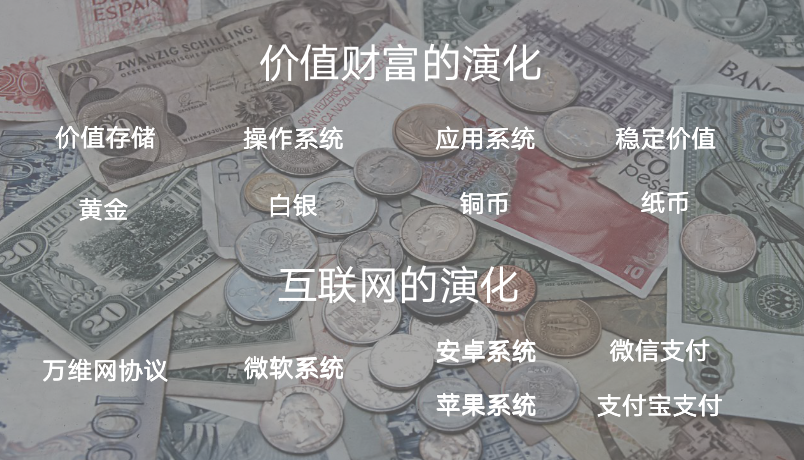
Conversely, we can also see that the evolution of the entire wealth field and currency field is actually in the same line as the evolution of the Internet in the past. A concept that Ethereum has not given up from 1.0 to 2.0 is "distributed computer", which is actually more similar to a Microsoft system in a blockchain world. The evolution of value wealth can be divided into four stages: value storage - operating system - application system - stable value, corresponding to different currency forms are gold, silver, copper coins and so-called credit currency (paper money). For the operating system, Ethereum is constantly strengthening its wealth attributes. During the evolution from 1.0 to 2.0, Ethereum is emphasizing more on Staking, that is, the value storage system. In fact, a similar evolution has also been experienced in the Internet world, that is, World Wide Web Protocol - Microsoft System - Android System and iOS System - WeChat Pay and Alipay, which also represent an evolution process of currency and assets.
In the process of the birth of the blockchain, that is to say, from the earliest stage of zero to one, we see that all projects (including Ethereum) are doing "credible time + asset on-chain" During the process, the wallet actually becomes the entrance of traffic, and this stage also opened up the imagination space of the entire blockchain world for the first time. What we saw later from wallets to distributed transactions actually appeared in the Bitcoin era.
The value of the currency itself actually comes from large-scale circulation. For example, in 2003, the prototype of Paypal actually appeared. What they were doing at first was to make money by depositing funds in the bank with interest, but later everyone found that the reason why people choose to use Paypal is because it The rapid transfer of currency value can be achieved, and eventually Paypal switched its business model to charge a fee for each transaction. In technology financial products, there is a thing called dependency barriers, which happens to be Ethereum’s recent emphasis on increasing network transfer fees in the future, which may reach 218 Gwei.
I personally tend to think that Ethereum 2.0 is gradually allowing users to develop the habit of saving through some very small details. Ethereum started the DeFi era-decentralized transactions, lending, derivatives, payments, and assets. These are actually the directions that Ethereum has been talking about in 2018. In 2020, due to the epidemic and the impact of the global economy With great changes, Ethereum has begun to move towards a complete DeFi era. Why is this happening? Why does Ethereum increase its own transfer fees? I remember that in August and September of this year, the gas fee soared particularly obviously. Due to the promotion of DeFi, especially Uniswap and Sushiswap, the transfer fee of the entire Ethereum network was very high, and the highest time was about 580 RMB per time. In it, we found that as an economic operating system, as a kind of digital silver, in the future, Ethereum will put more emphasis on its saving function, that is, the value part, rather than for large-scale applications. We believe that in Ethereum In the 2.0 stage, the concept and attributes of Staking will continue to be strengthened.
In the traditional world, the industrial attributes of silver are basically B2B. For Ethereum, from the ICO era in 2016 and 2017 to the current DeFi era, it has not deviated from its development direction - B2B2C, the earliest For the IC0, it is actually based on the project side to acquire new users. At present, the user group of Ethereum is stable enough, and it has become a large private domain traffic pool, and it has also become a place for other projects to collect traffic. But for the future development of Ethereum itself, I believe it should be more inclined to calls between organizations and institutions, rather than calls between ordinary users. Its more functions are not at the application level, but at the financial assets level. From the perspective of the development of the entire blockchain, from 2009 to 2019, it basically focused on financial assets, that is, wallet + DEX.
In 2020, we can see the context of the development of the entire blockchain world, that is, wallets become the entrance of private domain traffic; DEX, as an exchange channel for data assets, its future development direction must be to infinitely approach zero transaction costs; for For DeFi, it is only possible to form a large-scale turnover of currency and digital assets when transaction costs approach zero indefinitely, not to mention NFT, which is a trend of free exchange of game assets.
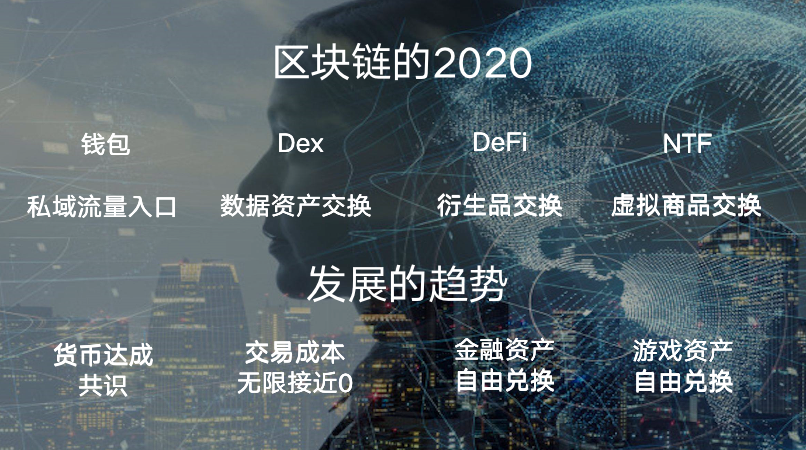
I think the 2.0 upgrade of Ethereum is very representative, because it is gradually creating some new ways of playing that are different from the past. There may be a very important point in these new ways of playing. Regarding the outbreak of the future blockchain, we tend to think that, Only when the application data is uploaded to the chain can it be possible to realize the explosion of various application scenarios, which means that the future will move towards "trusted time + trusted location", so the development of the entire blockchain we see actually has a A complete context, a complete blockchain economy must include several parts: distributed network, distributed database, distributed computing, distributed storage, distributed ledger, distributed governance, distributed application, distributed market. What will explode in the next stage may be related to the distributed market, which will be linked to application scenarios on a large scale.
From the past development, we can see that Ethereum is not a public chain born for large-scale applications. Although it is known as the "King of Public Chains", it emphasizes more on the B2B2C business model. Ethereum 2.0 emphasizes the concept of Staking, which may open up some new imagination space. We think that in the next stage, a new way of playing may emerge, replacing the original ICO, which may be ISO, that is, Staking Offering.
Based on the new gameplay, there will definitely be a new traffic model. The difference between the blockchain world and the Internet world in the past is that the Internet has been playing with public domain traffic in the past, but now in the Internet field, public domain traffic is disappearing. Start to enter a circle such as private domain traffic. Essentially, anything done in the blockchain field will eventually become private domain traffic, and private domain traffic is your users, and users can form a consensus on the project itself.
We believe that Ethereum has actually become an ocean, which has bred a large number of life ecology, but even based on this development, its future direction is not a large-scale application explosion. Because a large-scale application explosion must have several important factors, the first is that the transaction cost must approach zero indefinitely, and the second is that the transaction speed must be fast enough.
Today, all scenarios that are really linked to application data are linked to trusted locations. Such scenarios must not be purely peer-to-peer asset exchanges, but may involve structured transactions. Therefore, we will emphasize that a new underlying application system will be born in the future, which will combine trusted locations and structured transactions, but I don’t think this new system will replace Ethereum. On the contrary, it will become a complement to Ethereum. Because the real value of Ethereum is that it is the standard of the protocol, which will be the focus of Ethereum for a long time in the future. This is also an important purpose of why Ethereum needs to be upgraded to the 2.0 stage.
We have also carefully observed the mortgage situation of Ethereum 2.0. The initial mortgage time may be about two years. This kind of mortgage can be said to be very rare in the entire blockchain world. Most of the public chain projects have emphasized that their mortgage time will be relatively free, but we found that in fact, the real project must generate "silent costs". , if there is no silent cost, users will not stay in the project for a long time and finally reach a consensus. Taking Bitcoin as an example, the mining mechanism allocates the cost of silence to every user, especially the miners, which makes users and projects only interdependent for a long time.
I personally think that the decision of Ethereum to make a two-year pledge period may firstly be because its own ecology is large enough; the second point is because it is not for the direct realization of a large-scale application explosion, but for the organization, institution, Enterprises and various project parties are based on their networks to achieve the outbreak of certain specific vertical fields. This is why we believe that the new gameplay in the next stage is likely to be ISO. The new gameplay based on staking will also generate some private domain traffic, which in turn will lead to a large-scale application system explosion. This is what we think will happen in the future, be it Ethereum, Bitcoin, or the next underlying application system. Personally, we are very optimistic about the development of Ethereum. Relatively speaking, the entire underlying layer has gradually matured.
Of course, I think the technology of sharding is still under development. For example, our partner Harmony has made sharding very early, but the cost is still very high, and the whole consensus is relatively not so stable .
I think that now that Ethereum 2.0 is about to open the beacon chain, the door is about to be opened. In the future, there will be more and more public chains and more and more games and projects based on Ethereum or other new underlying layers. . We believe that next year will be a very important year for Bitcoin, Ethereum, and Hyperion. Many people in the traditional world may gradually start to pay attention to the development of the blockchain business next year, and traditional funds will also enter the blockchain. world.





