


Interview with Bitfinex CTO Paolo Ardoino: Demand for Tether is particularly strong in East Asia


Author | Qin Xiaofeng
Editor | Hao Fangzhou
Produced | Odaily
Author | Qin Xiaofeng
Editor | Hao Fangzhou
Produced | Odaily
In the encryption market, Tether's position has always been delicate.
Especially this year, with the overall recovery of the encryption market, Tether started the "money printing mode". In the past 9 months alone, it has issued more than 10 billion US dollars.
Behind the crazy growth, is it driven by demand or inflated assets? Paolo Ardoino, CTO of Bitfinex & Tether, accepted an exclusive interview with Odaily and responded to related questions.
Paolo Ardoino said that behind Tether is a 100% asset reserve; this year’s continuous issuance, in the final analysis, is the market that drives the demand for Tether. In addition, from the perspective of fund transfer trends, the demand for Tether in East Asia seems to be particularly strong.
Paolo Ardoino:first level title
The following is the Q&A transcript, organized by Odaily:
Odaily: From Realcoin in 2014 to USDT in 2017, Tether has experienced 6 years of ups and downs. First of all, would you please give us a detailed introduction to the process of Tether’s issuance and redemption of USDT?
 Tether Token (USDT) is a digital token built on various blockchain chains, including Omni, Ethereum, EOS, Tron, Algorand, Bitcoin Cash's Simple Ledger Protocol (SLP), and Liquid Network. These protocols consist of open-source software that interfaces with the blockchain, allowing the issuance and redemption of USDT.
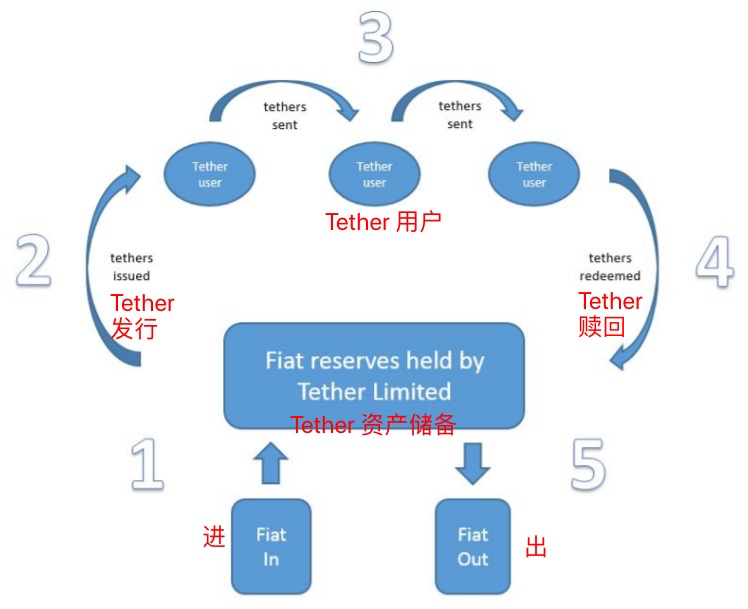
Paolo Ardoino:Tether will issue tokens according to market demand and put them into the market for trading. According to Tether's terms of service, USDT can be exchanged and traded at a ratio of 1 USDT: 1 USD.
At the time of issuance, USDT will be backed by 100% of Tether's assets; when customers redeem, USDT will be returned to Tether and the user's reserve will be refunded. As follows:
Paolo Ardoino:Odaily: At the beginning of this year, the total amount of Tether (USDT) was only 4.76 billion US dollars; in the past 9 months, the cumulative additional issuance exceeded 10 billion, reaching 15.2 billion US dollars, a cumulative increase of 220%. Many people will question whether the cryptocurrency market really needs so many stablecoins when the scale of the industry is limited, hot money is difficult to enter, and new users are scarce. Could you please tell us where the demand for additional issuance comes from?
Tether tokens play a key role and play a vital role in the trading of cryptocurrencies. In fact, we have seen a shift in recent years: from denomination of Bitcoin transactions to denomination of Tether. Additionally, USDT is increasingly being used for innovative projects in remittances and digital assets, including decentralized finance (DeFi). In general, it is the market that drives the demand for Tether.
Odaily: From the perspective of time distribution, March, April, July and August are the months with the fastest growth of USDT. Why does the amount of additional issuance fluctuate greatly over time? Many people try to summarize the relationship between the additional issuance of USDT and the price trend of the "big market", what do we think?
Paolo Ardoino:People are looking for efficient, liquid, reliable alternatives to antiquated banking and payment systems, and investors want a safe haven to reduce risk. In challenging and uncertain times, the utility, security and viability of digital currencies such as Tether have come to the fore and into the market spotlight.
As the largest, most liquid, and most technologically innovative stablecoin, Tether is a model of how global markets can use blockchain technology to operate more efficiently, and represents a payment channel built for the future of commerce and innovation.
Odaily: Does this year's additional issuance mainly come from individual users or institutional users? What is the maximum amount of a single additional issue? What are the changes in the number of users in different regions?
Paolo Ardoino:The growing demand for USDT is a good reflection of the development of the entire crypto ecosystem.
Nowhere is this more evident than in East Asia, where people trust USDT and like to use the most liquid, stable, and preeminent stablecoin among cryptocurrencies. According to Chainalysis, the USDT token is the largest and most popular stablecoin in East Asia.
Odaily: In the past few years, we have also seen that the cross-chain demand for USDT has become stronger and stronger. From the previous Omni, ETH, and Tron to EOS, Algorand, OMG, and Solana, there may be more public chains to undertake USDT in the future demand. What are the technical difficulties when different public chains undertake USDT conversion needs? What difficulties did Tether encounter when switching chains, and how did they solve them? (Illustrate with examples)
When we receive a chain-swapping request from an encrypted exchange, we need to coordinate with the exchange and manage the entire chain-swapping process until it is completed.
Paolo Ardoino:There have been instances when our clients requested funds for on-chain swaps that exceeded the amount of USDT tokens held in our inventory wallets on the target blockchain. If we want to continue the chain exchange, then we must authorize the issuance of additional USDT and transfer these tokens to the target blockchain.
After the transfer is complete, we either burn the same amount of USDT tokens on the initial blockchain (USDT on the target chain will be fully backed and issued), or keep these tokens in the treasury wallet on the initial blockchain Medium (unsecured), for future on-chain exchanges with customers.
Paolo Ardoino:Odaily: At present, ERC20-USDT is the largest in circulation, and TRC-20 is the lowest and fastest in handling fees, and is very popular. In your opinion, can the ERC20 and TRC20 versions of USDT maintain the first-mover advantage? Can other versions of USDT change the current situation?
Tether loves and is willing to support many blockchain innovations. For other blockchain versions of the USDT token to grow, more projects must be encouraged to adopt and use it.
Paolo Ardoino:Odaily: Although there are other different versions of USDT (such as the EOS version of USDT), centralized exchanges do not support it. For latecomers, what is the necessity and advantage of existence?
USDT makes it easy for exchanges to use fiat currencies on the blockchain. The exchange supports different versions of USDT tokens, which will be able to better serve various blockchain communities.
Paolo Ardoino:Odaily: In addition to USDT, Tether has also issued stablecoins anchored to the euro, offshore renminbi and gold, but the development status is not as good as that of USDT, only tens of millions. What are the obstacles? How to expand this part of the market?
USDT is currently more popular than Tether tokens backed by other fiat currencies, mainly because USDT is pegged to the US dollar, the global legal reserve currency, and the dominance of the US dollar determines the popularity of USDT. Also, time will tell if there will be more demand for Tether's non-USDT products; if so, Tether is ready.
Paolo Ardoino:Odaily: In the future, what other plans does Tether have? Will it issue stable coins based on more fiat currencies and physical objects?





