


Odaily Frontline | What should I do if the token is stuck in the contract address? Explain Tether's USDT recovery mechanism in detail


Odaily Translator |The Block, original author: Yogita Khatri
Odaily Translator |
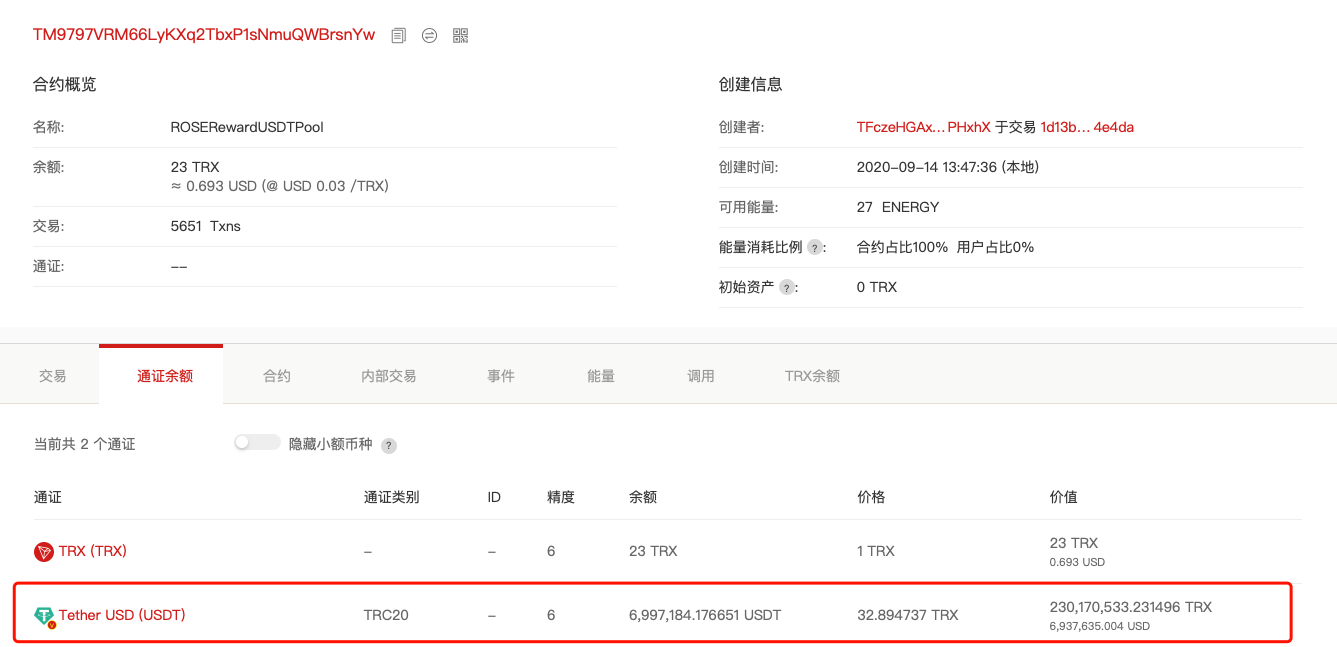
On the evening of September 14, users found that the tokens in the USDT pledge pool of Rose Finance, a liquidity mining project on the TRON chain, could not be unstaked normally. The Rose Finance official later stated that it had contacted the auditing company Zhichuangyu and the Tether official, hoping to solve this problem.
Data DisplayData Display, there are still nearly 7 million USDT stuck in the contract address.
Whether this fund can be unfrozen normally, Tether's "USDT recovery mechanism" may give the answer.
There is a precedent
In fact, Tether just handled a somewhat similar incident for a Swerve Finance (Curve fork project) user last week. After transferring 1 million USDT to Swerve's contract address by mistake, the user found that he could not withdraw it, and once thought that he would never get these funds back. Subsequently, this incident caught the attention of Paolo Ardoino, Tether's chief technology officer. Under his leadership, Tether then successfully recovered and returned 1 million USDT to the user through the "recovery mechanism".
Before helping the user recover 1 million USDT, Tether officials contacted Mr. Fahrenheit, the host of the Discord channel of Swerve Finance. Mr. Fahrenheit released a message sent by the director of Tether as follows:
“Mr. Fahrenheit, I would like to contact you on behalf of Tether. We were recently contacted by a user who made a mistake and transferred 1 million USDT directly to Swerve’s contract address (0xb8baa0e4287890a5f79863ab62b7f175cecbd433). Before we take any remedial action , I want to confirm two things with you:1. The funds are not recoverable under any normal usage; 2. We will blacklist the address while recovering the funds, I want to confirm that this will not cause any damage to Swerve's operations Influence.」
Apparently, Tether decided to help the user recover their assets after getting a positive answer from Swerve. As for the contract address being blacklisted, Mr. Fahrenheit said: "This is just a technical blacklist. Our contract address can never transfer tokens out, so being blacklisted has no effect."
The "recovery mechanism" only supports two public chains
It is actually not uncommon for users to mistakenly send funds to the wrong address, resulting in those tokens being never accessible.
Tether Chief Technology Officer Paolo Ardoino said: "When users contact us about such incidents, we will start to investigate. If necessary, we may be able to help these customers recover their tokens. We will use various blockchain analysis tools to analyze The original sending address is investigated, and the user needs to prove the ownership of the sending address...Whether to help is completely at Tether’s discretion, we cannot guarantee success, but we will always abide by the rules and abide by the law.”
Ardoino further explained how the "recovery mechanism" works. Tether itself cannot transfer funds from stuck addresses, but there is a code in Tether's Ethereum (Ethereum) and Tron (Tron) smart contracts that allow issuing The party freezes the stuck tokens, then destroys the tokens, and then issues an equal amount of new tokens, and finally realizes the restoration of user funds, such as the Swerve Finance user case mentioned above.However, Tether cannot do this on the other six public chains that support USDT - Algorand, EOS, Liquid Network, Omni, OMG Network and Solana.
In fact, Tether regularly receives and resolves such requests. Ardoino revealed that Tether helped 12 different users recover their funds in a single day last week. So far this year, Tether has helped users restore about 5 million USDT, the smallest of which only restored 250 USDT.
Do other stablecoins also have "recovery mechanisms"?
Is Tether's "USDT recovery mechanism" unique? Josh Hawkins, Senior Vice President of Global Corporate Communications at Circle, revealed that USDC, the second-largest stablecoin by market value, does not have a similar mechanism, so there is no similar "reversibility".
Gemini said that there is no similar mechanism for GUSD.
As of the publication, Paxos has not yet responded to whether this mechanism exists for BUSD, PAX, and HUSD.





