


Odaily Frontline | Will Ethereum Become a Fee Market?


This article comes fromCrypto Briefingsecondary title
Odaily Translator |

Main points:
Main points:
- Ethereum transaction fees have become quite expensive;
- DEXs and derivatives exchanges that rely on on-chain settlement for transaction confirmation may experience reduced trading volume if high fees persist;
- The increase in transaction fees is related to the sale of Ethereum-based stablecoins.
The average transaction fee on Ethereum has grown by more than 160%. Miners earn higher revenues due to higher costs borne by users, but this may change in the near future.
secondary title
The cost of transacting on Ethereum has risen
Ethereum transaction fees have been rising in May, with the average transaction fee already approaching $0.3.
This is a case of concern as it makes using the Ethereum network more expensive.
According to Coin Metrics, the average transaction fee so far in 2020 is $0.15 or 0.00085 ETH. However, the average transaction fee in May alone reached $0.29 or 0.00143 ETH.
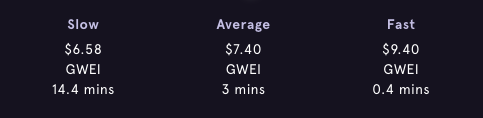
At a time when prices are generally trading higher, there are exceptions. Using Synthetix as an example, the average transaction fee to mint SNX is $7.4 at press time.
The core value proposition of Ethereum is the ability to conduct seamless transactions over the network.If user activity drops due to high fees, several projects built on the Ethereum network willFacing the problem of reduced transaction volume
. DEX (decentralized exchange) loses the most because transaction confirmation requires on-chain settlement.There are many reasons for high transaction fees, but one theory is that since Bitcoin's recent halving, all cryptocurrenciesbullish sentimentare on the rise. In previous bear markets, many investors have beenHoard Tether (USDT)
to wait for the market to switch.
The time may finally come to deploy this marginalized mobility.Stablecoins account for about $10.5 billion of the total cryptocurrency market capitalization,。
Since most stablecoins are based on the Ethereum blockchain, a massive shift of stablecoins to more speculative assets like BTC and ETH could explain the rise in transaction fees.
secondary title
Miners, PoS, and scalability
During 2020, miners earned an average of 631 ETH in transaction fees per day. But in May, that average has nearly doubled to 1216 ETH.
While users are burdened with high transaction fees, miners are excited about the increase in revenue.
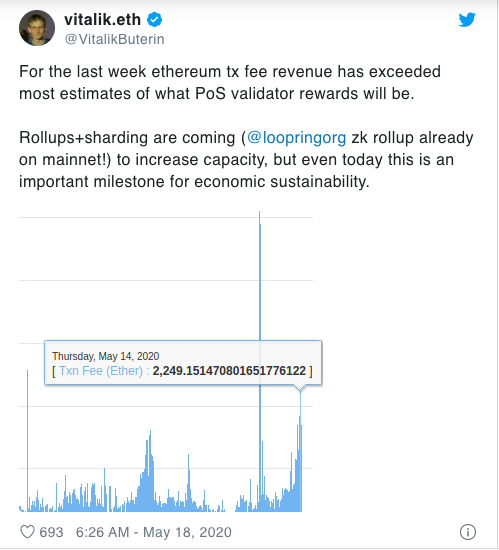
On May 18, V God, the founder of Ethereum,TweetTweet
Said: "In the past week, Ethereum transaction fee revenue has exceeded the reward (estimated) that most PoS validators will receive. ZK Rollups and sharding are coming to increase capacity, but even today, this is a realization. An important milestone for economic sustainability."
Note: ZK rollups are a hybrid scaling approach that combines on-chain security and second-layer networks through smart contracts and a zero-knowledge approach.Optimistic RollupsScalability innovations such as
) attempts to solve the problem of high transaction fees by allowing more transactions to be processed using the same amount of block space.
As scalability improves, miner revenue will bear the brunt of the impact.





