Long Baitao: From Slate Economy to Digital Economy


Ten years in a dream, the narrative of the blockchain industry is becoming more and more similar or even boring, and practitioners lack the guidance of inner shaping power-the reason is nothing more than the lack of narrative caused by the rudimentary thinking, and people urgently need to clarify the blockchain. The most critical, challenging, and controversial issues in the industry:
secondary title
Money did not originate in barter,The need of the country is the real origin
We come to the first topic, the origin of money.
The earliest human currency is credit currency, which originated in the palace and temple economy of Mesopotamia in 3000 BC. Mesopotamia is located in the current Mesopotamia, located in Iraq.
In August 2019, Wang Wei, chairman of the China Finance Museum, claimed in a public speech that the theory that currency originated from barter exchange is wrong, and the current mainstream consensus is that currency originated from government authority.
According to research, judging from the extensive historical and anthropological evidence that can be traced back thousands of years ago, barter is basically a myth. In primitive and ancient societies, barter trade almost did not exist.
I am not denying the existence of barter trade, but only saying that in ancient times, in an economy, large-scale barter trade did not actually exist. A large body of literature proves that the earliest commercial transactions were based on an elaborate credit system, whose origin was the needs of states, religions, temple institutions, and social rituals rather than the needs of private transactional relationships.

Some students may ask, there was no country in the modern sense in 3000 BC, why it is said that currency was first needed by the country. We define state authority a little more broadly here.
As long as it is a country or a religion, temple, institution or social ceremony, etc., we all consider it to be a national authority. This is a broader definition. Money originated here, rather than the need for private transactional relationships, let's take a look at what the monetary system of Bronze Age Mesopotamia looked like before 3000 BC.
The monetary system at that time, the entire economy, operated on the basis of credit, and created money as a means of repaying debts. Debts were owed primarily by residents to Mesopotamian palaces and temples. What is the so-called currency creation here? The payment tool is monetized food or silver, and the two are completely equivalent.
Then currency has two uses: the first is the accountant of the economy, who will use currency as a management tool. Everyone should pay attention to that it is a management tool for long-term planning and resource allocation, and it is related to the economy. Other departments transact, assigning standardized values to key commodities by creating a grid that manages prices.
Let's understand this sentence. It is an economy that requires long-term planning and resource allocation. What is long-term planning? For example, how much labor do I have and where do I need to use it, such as building city walls, raising livestock, making textiles, etc. Each kind of labor requires corresponding manpower and material resources. For an economy, it is necessary to calculate how many different kinds of goods and services need to be produced, and the human and material resources that each kind of goods and services may require.
This is the so-called long-term planning, and resources are allocated for the long-term planning, and the allocation is mainly rations and other things. The so-called price management price grid refers to the use of monetized grain or silver as a means of valuation, and the relative value or quantity of other goods or services.
For example, a day's ration of an adult male labor force is equivalent to how much volume of grain or equivalent to how much weight of silver. Create such a price grid. What I just talked about is labor, and it can also include other commodities, such as oil (can be divided into lard, ordinary oil and essential oil, etc.), salt and copper. This is the first use. The second use was as a means of paying taxes and fees to officials and financing trading enterprises. Note that it is not the currency used by trading companies for foreign trade and exchange. Not for this purpose. It is used to provide financing for trading enterprises.
From the point of view of the mathematical system, it is mainly a sexagesimal system divided by fractions. We are all familiar with this system now. For example, the standard month is 30 days, and then this hour is 60 minutes, all in base 60. The earliest use of the sexagesimal system in the entire economy to divide fractions in human history actually originated in Mesopotamia in the Bronze Age.
For example, the weight unit "carat" that modern people are very familiar with. Women like diamond rings of more than one carat. What does "carat" mean? It actually comes from the seeds of the carob tree, a plant in the meridian of Mesopotamia. In Bronze Age Mesopotamia, a "carat" was equal to 1/60 of a shekel, a unit of weight greater than a carat. This is the unit of weighing, let's look at the interest rate. There were already interest rates on commercial advances. 1/60 per month, double the principal in 60 months, equivalent to 20% annual interest rate. This rate applies to the entire Mesopotamian economy. Let's talk about debt again, because the economy itself is based on credit, and credit will naturally form debt. Debt includes two types, one is usury, and the other is the accumulation of debt. After a long time, excessive debt bondage will form in the economy.
How does the economy deal with these debts at this time? This is very different from modern society. The principle of the Mesopotamian economy at that time was to protect a landed citizen from being permanently dispossessed of the land and becoming a serf. At that time, the creditor was mainly the palace, so the palace simply adopted the method of "debt forgiveness or cancellation" to deal with the debt.
In this way, the debtor is protected and the individual debtor is relieved of his obligation to repay. Commercial debt is of course still retained, thus addressing the polarization caused by the accumulation of debt. This involves the slate economy. As you can see, the title of my new book is "Tradition and Innovation from Slate Economy to Digital Economy". What does slate economy mean?
First, let's understand the slate. The slate is actually the writing tool used in Mesopotamia in the Mesopotamia of the Bronze Age. The slate is the clay slab. When the clay slab is not dry, reed sticks are used to write on it. Their characters are called cuneiform.
so
soThe meaning of slate economy actually refers to the credit economy of Bronze Age Mesopotamia. Then their debt cancellation is actually to scrape off the surface of the slate, and the books are cleared, so it is called "cleaning the slate". This is where the term slate economy comes from.If you want to know the details of the content I talked about today, including papers and historical documents, you can read my book, which gives complete reference documents.
Let's look at Greece and Rome in classical times. Ancient Greece and Rome were the birthplaces of Western European civilization, the birthplace of European civilization, and Europe and the United States also believe that European civilization is essentially the birthplace of world civilization. A natural question, what is the relationship between Greece and Rome in the classical era and Mesopotamia?
According to sufficient historical evidence, at least around 2000 BC and 1000 BC, there was no currency phenomenon in Greece and Rome in the classical era. But around 800 BC the elites of Greece and Rome learned their monetary systems and weights and measures through trade with the Near East.
If you look at the map, you will know that the Near East refers to the Middle East, which is located to the east of Greece and Rome, and then goes west to the Mediterranean Sea. At that time, when merchants in the Mesopotamia expanded their trade westward, they would first pass on some civilizations here, including the currency system and weights and measures, to ancient Greece and Rome westward. Greece and Rome in the classical age, we divide it into early and late, because the early civilization is very close to Mesopotamia in some respects, which is Mesopotamia in the Bronze Age.
The late period of Greece and Rome in the classical era is more similar to what is mentioned in our history books, and we will talk about it later. The early currencies of ancient Greece were mainly for credit transactions and financing rather than goods transactions, and currencies were also used to pay taxes and fees. This is very close to the use of currency in Mesopotamia just mentioned, because in essence Greece learned from Mesopotamia.
In early ancient Greece, in 599 BC, the Greek consul Sauron implemented the "Sauron Reform". This reform was caused by the financial crisis caused by loan sharks, and Sauron's reform embodies the so-called financial-good society in modern society, a society with good finances. Many of its methods are very similar to the methods of dealing with financial crises in modern society.
For example, three points:First, debt cancellation cancels the debts of small farmers;
The second is the monetization of agricultural products, the so-called monetization means that small farmers can use their output to directly repay their debts. In this way, the price risk caused by the price fluctuation of agricultural products in different seasons is actually reduced.
In modern society, it is actually used a lot. Those who trade commodities must use futures to hedge the risk of price fluctuations. The monetization of agricultural products reformed by Sauron eliminated the risks brought to small farmers by seasonal fluctuations in the market prices of agricultural products.
The third is that the government issues non-debt currency. This reform was so successful that it became the basis of the ancient Roman monetary system.When talking about ancient Greece and Rome, we have to mention Aristotle, whose "Ethics" first put forward the theory of the state and system of money.
It says that money does not exist naturally, that money exists only because of law, and it completely rejects any concept of commodity-based money. Aristotle is a very great philosopher, scientist and philosopher. The theory of currency and system recorded in "Ethics" has had a huge impact on later generations of scholars, especially European scholars. .
In the early days of ancient Greece, the state-backed fiat currency, which was not a commodity currency, was based on base metals. Base metals are things like iron and copper, where the value of money is not based on the intrinsic value of the metal itself. Gold is a precious metal. We know that gold is very valuable, so many people believe that gold can be used as currency, and its value comes from the intrinsic value of gold. This is the classic commodity money theory.
The early currencies of ancient Rome were non-commodity currencies based on base metals, such as the Stass system, the Athens system, and the early Roman system, all of which were based on base metals. The monetary systems of early Greece and Rome, including the handling of debt, were very similar to those of Mesopotamia. Let's recall again that the debt accumulation in Mesopotamia was discussed earlier, which basically bought and sold directly, so it can eliminate polarization.
Let's look at the late classical period of Greece and Rome. Ancient Rome and Greece developed into an oligarchic economy in the late period. At the same time, the taxation of ancient Rome and Greece was actually underdeveloped, and there were no taxes collected in the country. They mainly relied on wars and conquests to plunder spoils of war. Its loot consists of gold bars, which are mostly loot obtained by conquering some of the surrounding places.
But when there is no more of this territory around to conquer, they have no source of gold bars. The oligarchy in the later period of ancient Rome introduced gold into the minting of currency. Recall that we just talked about the early days of ancient Rome, and its currency was based on base metals. In the early days of ancient Rome, gold or silver was not actually used as currency, and the use of gold was a later thing. But it does not have a good tax system. When there are no more territories to conquer to obtain gold bars, the oligarchs mainly import luxury goods to the East, which then leads to domestic currency deflation (lack of gold for minting currency) .
In late classical Greece and Rome, debt was handled very differently than in the early days. Because it developed into an oligarchy in the later period. Oligarchs are wealthy nobles who believe that debts cannot be canceled except to maintain the loyalty of the army in military or social emergencies. So at that point the creditor has the right to foreclose, so this (foreclosure) act is sanctified. Instead of directly writing off debts like the Mesopotamia in the Bronze Age, let the economy restore balance.
Therefore, the accumulation of usury or debt is handled in favor of the creditor. This history actually originated in the late period of Greece and Rome in the classical era, and this treatment has been written into the history books and has been affecting the present. Almost everyone in modern times takes it for granted that debt repayment is justified. But in essence, the debt handling of the economy has its own inherent laws, because the debt itself has its own uncertainties. Of course, I will not talk about it today.
Debt is bound to accumulate, and when it accumulates to a certain point, it creates systemic problems. Debt accumulations were dealt with either by writing off or, as in late ancient Rome, by foreclosing and dispossessing the debtors of their land.
In the late ancient Rome, the oligarchy monopolized the land and deprived the economy of currency. Why is it called the deprivation of the currency of the economy? Because they used most of the money to import some luxury goods to the East, resulting in a large flow of money to the East. Therefore, domestic gold and silver are getting less and less, leading to a lack of currency among the people, which is deflation according to the current situation.
Later, when the oligarchs collapsed in late ancient Rome, the people basically had no currency. The reason is that most of the gold and silver were sent to the East to be imported in exchange for luxury goods, so the folks became a self-sufficient barter economy. So remember, this is the beginning of the earliest large-scale barter exchange in human history, which is actually the late period of Rome and Greece in the classical era.
But later generations of economists did not recognize this, and believed that this kind of barter economy existed earlier. In fact, this is not the case. According to the description I just made, we know that credit economy existed in Mesopotamia in 3000 BC. In 800 BC, the early people of ancient Rome and Greece learned their monetary system and weights and measures from the Mesopotamia through trade.
secondary title
Currency Evolution in the Post-Classical Era
Let's look at the evolution of money in the post-classical era. Aristotle's "Ethics" had a very important influence on later generations of scholars, and it talked about the national and institutional theory of money. This influence lasted until before the Industrial Revolution.
Before the Industrial Revolution, Western currencies were generally still in the hands of governments or religions. After the collapse of Byzantium in 1204, private banking business appeared for the first time in human history, but even in this way, the right to mint currency is still in the hands of the state. The famous Bank of Amsterdam in the Netherlands is actually still owned by the government. The change occurred with the "Free Coinage Act" in England, probably in 1666, which handed over the control of the supply of money to private hands.
The privately controlled Bank of England was established in 1994. This is the first time in human history that a major sovereign state has delegated monetary control to private individuals. Since 1694, more and more currency dominance has been transferred from the royal family or religion to private hands. In the three hundred years from 1694 to the present, we have a wealth of historical facts to compare the results of government or private issuers controlling the issuance of currencies.
Because in history books or some fans including Bitcoin, when it comes to privately issued currency, "Hayek's Denationalization of Currency", etc., they all quote some very wrong historical facts to prove that the state controls the currency. The historical stage of the country is very poor, while the private control is very good, and said some very classic cases, including the inflation in Germany in 1923.
I will talk about it here, these are actually famous fallacies. Let's talk about the UK first. Historically, with one exception, kings have used their monetary privileges responsibly for the country. However, during the period of about 200 years of private control from 1694 to 1890, there were only 25 years without financial crises. Therefore, the result of government and private control of currency in British history is very obvious. The monetary experience of the United States is similar to that of the United Kingdom.
Let’s look at the most famous hyperinflation in Germany in 1923, which was allegedly caused by excessive government money printing, but in fact this is a big lie. In the 1920s, he was the central bank governor of Deutsche Bank. In the 1960s, he wrote a memoir called "The Magic of Money", which restored some truths about Deutsche Bank at that time.
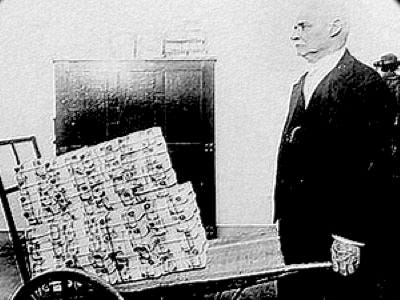
The truth is that Germany's hyperinflation is mainly due to two reasons: the first is excessive war reparations, we know that Germany is a defeated country in World War I. The second is the massive creation of money by private investors, financed and abetted by private central banks. Everyone must know that in the 1920s, the German central bank was controlled by private individuals. This was because the victorious United States demanded that the German central bank be controlled by private individuals. In essence, Germany’s hyperinflation was due to these two reasons.
In the same way, in modern times, many people talk about hyperinflation, and sometimes they talk about small countries such as Venezuela and Zimbabwe. This is a very boring comparison. When making comparisons, you can choose some normal economies, such as China and South Korea. Why did you choose Venezuela?
This kind of comparison is untenable from an academic level. The hyperinflation in Germany is indeed the result of private speculation. But Germany's hyperinflation has always been widely circulated as a classic example of the failure of the government to control the currency.
Let's look at the 2008 global financial crisis again. Who was to blame for the 2008 global financial crisis? fed. Is the Federal Reserve a private institution or does it represent sovereignty? It's all explainable here. Including the independence of the Federal Reserve and the independence of the modern central bank, why must the central bank talk about independence? The central bank is independent of government interference and does not receive instructions from the government or politicians, allowing the central bank's bankers to make judgments based entirely on their professional capabilities. Ask yourself, how many people are able to exercise their power in a way that is in the interests of the public without self-interest when they have the power of the governor of the central bank?
Do you believe that such a central banker exists in this world? Of course there is. For example, Paul Walker, who died not long ago. But the Fed chairmen other than him actually represent the interests of capital. Therefore, the so-called independence of the central bank is essentially a theory deliberately shaped by the actual control force behind the central bank, so that the central bank can be independent of political interference. Any organization, as long as there are people, must have actual controllers behind it, and it must represent the interests of a class.
If the central banks of capitalist countries are said to be independent of the government and political interference, whose interests do they represent? We have to think about these issues. So now the independence of the central bank, we must put a question mark, what does its independence mean? At present, among the major economies, we believe that the central bank may only exercise its power in such a way that is completely in line with the public interest.
Let's take a look, why are there two theories of the origin of money? What impact do they have on public policy?
To put it simply, the national currency theory means that the currency itself is a kind of claim, and the credit behind the debt is ultimately endorsed by the sovereign government. What it means for modern policy is that instead of borrowing from private banks or bondholders when the government runs a deficit, they can monetize their spending by issuing fiat currency, so-called monetized financing.
Let's look at this financial turmoil. Major economies have adopted large-scale fiscal stimulus policies. Where will the required funds come from? In essence, it is monetization financing. But monetized financing is a policy taboo in modern central banks. After the financial crisis in 2008, most central banks carried out continuous large-scale quantitative easing, and the Fed is already QE4.
And there is no sign of QE exiting. If there is no exit, it is basically equivalent to monetization financing. Then, in the theory of national currency, it reflects the flexibility of the modern monetary system. Elasticity means that the government can create a lot of legal currency when needed. For example, in the U.S. bailout, Trump happily signed what he considers to be the largest fiscal stimulus package in history, about $2.5 trillion. Where does the money always come from? right? This essentially embodies the flexibility of the modern currency system. As far as the theory of national currency is concerned, it corresponds to the theory of currency and commodities.
The premise of commodity currency theory is that money originated from barter, and barter is a transaction arrangement between private individuals, which does not involve government authority. So private banks support this assumption. Because for them, the currency itself originated from the arrangement of private transactions between people, so the currency should not be regulated by the government. The bank itself acts as an intermediary for money, between savers and lenders, so banks naturally support barter and commodity currency theory, because this provides them with a theoretical basis to evade supervision, which is the first point.
The second point, under the premise of the commodity currency theory, they believe that it is irresponsible for the government to create its own currency. That is to say, when the government is short of money, you have to borrow from rich people, such as banks or bondholders. Therefore, one of the richest groups in the world, including banks, supports the commodity currency theory in their bones.
Commodity currency theory itself has some flaws, but it is still written into textbooks and has become mainstream. In the macroeconomic textbook written by the well-known American Nobel Prize winner, Samuelson, the easy-to-acquire theory is regarded as the fact of the origin of physical currency.
By the time he was writing his textbook, the prehistory of money had become an arena for free-market economists and advocates of government regulation. They debated whether the private or public sector should dominate money, and whether governments should leave the responsibility for regulating credit and creating money to private institutions.
Therefore, some ideas of free market economists are in the interest of financial groups. Therefore, the theory of currency commodity theory and barter exchange has been written into textbooks. We need to know that textbooks, including the media, education and theoretical circles, are actually industries that are deeply influenced by interest groups.
What are the flaws of commodity money theory? The first flaw is that the theory of commodity money has no historical basis at all. Some of the most famous bases of the theory of commodity money are basically myths, such as Stone Coin Island.
When many people talk about the theory of commodity currency, they must mention Shibi Island, which I find very funny. Shibi Island is completely an independent and fragmented historical phenomenon. There is no link between the past and the future, and there is no historical document to prove it. There are only a few stones like currency standing there, and then a bunch of people used their imaginations to imagine that currency originated from that thing. Don't you think it's funny? Therefore, the theory of commodity currency basically has no empirical evidence of anthropology and archaeology, including the evidence of literature.
From the perspective of convenience, when they compare commodity currencies, they will think that paying with metal currency is simpler than barter exchange. But the question is if you compare barter to credit money, isn't credit money simpler? Credit currency does not require you to carry a lot of commodity currency and metal currency, it is the number on the ledger, isn't that simpler? But the problem is that when economists like Samuelson write their books, they don't compare barter to credit.
Because if you compare, you will not be able to write any more, because the logic is full of loopholes. In addition, in the theory of commodity currency, metal currency should be used as the medium of exchange. Who will control the weights, measures, weighing, and measurement of metal currency, as well as the purity of gold and silver? It is unreliable to rely on private individuals to grasp these weights, measures, and purity, and must rely on the authority of the government.
But these logics cannot be analyzed in depth, because once analyzed, the theory will die, and it is completely untenable logically. Because the theory of currency and commodity exchange and the theory of barter exchange conform to the interests of financial interest groups, under their academic lobbying, the theory of barter exchange and currency and commodity exchange has been written into textbooks and widely circulated.
What does it mean for us to understand these things?
I believe that students who have listened to this class today, or read my book, may feel a kind of shock. The shock of the system, it turns out that in 3000 BC, credit currency already existed in human history, and this is how the earliest human economy operated.
You may suspect that your previous understanding of the nature of money may have been biased. Because the so-called "mainstream" thought in the past was that currency is a commodity, and the value of currency comes from the intrinsic value of precious metals in the currency itself.
When you understand that the economies of the Mesopotamia in 3000 BC operated on the basis of credit, you may think more about currency, and it may really be that its essence is a debt, not a commodity. I think its greatest significance is that it may change our understanding of the nature of currency and your understanding of the currency properties of Bitcoin.
The second point is that we need to know that, judging from the history just mentioned, the competition for minting rights actually took place between the government and private banks. Between private and government banks, there is now a new force, the Satoshis.
The third point is that in history, there is a very clear line between government and private control of banks, but the line of modern central banks is becoming more and more blurred, just like how we feel about the Federal Reserve.
Let's do a little more understanding of the Federal Reserve. Behind it is actually a private institution, but it represents the US government's right to exercise currency management. But does it represent the government or private individuals? Combined with what I just said, if the central bank represents the government, but there is another theory of central bank independence.
Just now I also explained to you what is the real motivation behind the theory of central bank independence? Essentially speaking, in the major economies of modern society, outside of China, the boundary between the government/central bank or private banks controlling the banking industry is actually becoming more and more blurred. Basically, no serious monetary scholar would believe in the theory of central bank independence.
My book will tell you that in essence, modern central banks do not represent the interests of sovereign governments, but represent the interests of multinational capital groups. Transnational capital groups themselves do not represent any sovereign state, nor do they represent a nation. It's a bit like, some people say that there may be many Jews in the group of multinational capital groups.
But it's not that the Jews have complete control over this thing, it's not like that. It just means that in transnational capital, Jews are a very important component. But they do not represent the Jewish nation.
Why? If you study history, you will know. Where did Germany get its war financing during World War II? Germany's war financing mainly came from Wall Street. This is not a conspiracy theory. These are all historical facts. And many of the Wall Street bankers who provided war financing for Germany were Jews, do you believe it?
Jewish multinational capitalists provided war financing for Germany in World War II, and then the Germans went to kill the Jews. Therefore, transnational capital groups do not represent the interests of any sovereign state or nation.
The current debate between commercial banks and the state's control of currency is indeed becoming more and more blurred. Therefore, through the shaping of modern central bank theory, this kind of non-state power is mainly the independence of the central bank and the design of the global monetary top-level system, which affects and controls the creation and supply of most of the world's money and credit. What institutions are included in the design of the order of the top-level system of the global currency?
For example, the Federal Reserve and the European Central Bank are the two most typical monetary policy institutions, as well as the Bank for International Settlements, the Financial Stability Board, the International Monetary Fund, and the World Bank. The top-level system design of the global currency is mainly completed by the power elites of these institutions. China's financial elites are not in this group, and you can even understand that the RMB-based currency system is actually against this system. This is the fourth point.
Let’s talk about the fifth point. Modern currency and payment systems are essentially credit systems. I won’t expand on them, but they are essentially credit systems. The credit system has the dual characteristics of discipline and resilience. Discipline means that each market Participants have their own constraints every day. Simply put, income and expenditure must be balanced. If your income flow is less than your expenditure flow, you have to borrow money to complete your payment obligations. This reflects What matters is the discipline of the currency and payment system.
The money and payments system is resilient. They have the dual characteristics of discipline and resilience at the same time. These two characteristics actually correspond to the two theories of the origin of money, so they are the unity of opposites.
Some readers may not have read my book seriously, and then they may start to scold me after reading the first few pages, including leaving me a message in WeChat reading, scolding me for supporting academic ideas of centralization. But in fact, after reading my book, you will know that I do not deny the commodity currency theory.
Because of the operation of the current monetary system, it has two characteristics at the same time, and these two characteristics actually correspond to these two theories. Therefore, these two theories are the unity of opposites in the operation of the modern monetary system.
According to these two characteristics, if we look at Bitcoin in comparison, you will find that Bitcoin cannot actually become a currency. There are many reasons why Bitcoin cannot become a currency. One is that the value fluctuates too much, and the other reason is that what we are talking about today is the dual characteristics of discipline and resilience. The current monetary system has these two characteristics, but Bitcoin actually only has discipline and no resilience. I will not analyze it here. A monetary system without resilience is a big problem.
Many people criticize the government directly when they criticize the traditional currency system. Strictly speaking, they are actually targeting the wrong target, because Europe and the United States are the same, and the control of currency and credit is actually in the hands of multinational capital groups.
multinational capital group. Their front desks are mainly the Federal Reserve and the European Central Bank. These two have very high political independence, and even the independence of the European Central Bank has surpassed the Federal Reserve.
Therefore, in the real competition for minting rights, from the public's point of view, the biggest opponent is not the government, but these global monetary policy institutions and international currency standard institutions.
secondary title
Modern currency creation and circulation mechanismand the use of currency
There are two most basic questions to answer here. The first is how is money created? How did the second financial crisis come about? The currency we ordinary people talk about is mainly the currency in circulation.
Currency in circulation is mainly coins, banknotes and bank deposits. Therefore, the currency in circulation is mainly the cash issued by the central bank and the deposit currency of commercial banks.
These two currencies are completely equivalent to ordinary people. People don't think there is any difference between the two: they are both circulating currencies. In China, the proportion of cash may be about 8%, and 92% is deposit currency.
It is about 97% in the UK, 95% in the United States, and basically 100% of the deposit currency in countries such as Denmark and Sweden, and the banknotes of the central bank are close to zero. So we found that most of the real currency in circulation is actually a deposit currency.
How is deposit currency created? It is created by commercial banks through loans. To put it simply, you went to a bank to borrow 1 million. Where did this 1 million come from? We used to think that the 1 million should come from another bank account, whether it is the depositor's account or the bank's own account, but this is not the case. When a commercial bank lends money to you, it uses an "accounting method".
The bank created two items at both ends of its balance sheet: 1 million loan assets were created on the asset side. As a lender, you have to repay the loan to the bank according to the agreed time, cycle and interest rate. The loan is the property of the bank. Then the bank creates a savings account on the liability side of its balance sheet at the same time, and writes a figure of 1 million in it, and you can spend the money directly.
So we can see that the asset side and liability side of the bank's balance sheet have expanded at the same time. The asset side has increased by 1 million loan assets, and the liability side has increased by 1 million deposit liabilities. So its balance sheet is balanced, but you have to know that your 1 million number was created out of thin air.
Going back to the conclusion, commercial banks mainly create deposit currency through loans, and destroy deposit currency when repaying loans. Of course, commercial banks can also create money in other ways, such as purchasing financial assets, foreign exchange, gold, or bonds, just like the Federal Reserve buying various securities such as commercial paper, MBS or treasury bonds, and he creates money. Theoretically speaking, commercial banks can indeed create unlimited money out of nothing, but this is definitely not possible.
So the central bank has a way to restrict the ability of commercial banks to create money. The central bank generally constrains commercial banks through the indicators required by the Basel III agreement, such as capital adequacy ratio, leverage ratio, liquidity ratio, and net stable financing ratio. In China there is a reserve requirement ratio. For example, the central bank can "release" the base currency by lowering the RRR. Therefore, the central bank mainly restricts the ability of commercial banks to create money through these regulatory indicators. This is the mechanism by which money is truly created. Let me summarize again:
Commercial banks do not need pre-existing funds for lending. They create money out of thin air while lending. This is the first point;
The second point is that the central bank restricts the ability of commercial banks to create money through some regulatory indicators;
Please pay attention to it. Basically, when some macro reports talk about broad money, they often talk about loan balances, and the two are basically equal.
If you look at the broad renminbi statistics released by the central bank every month, you will find that the balance of all loans of commercial banks is very close to the current M2 (broad renminbi currency) in circulation, and it is for this reason. Because commercial banks create money mainly through lending, well, that's the creation of money.
Because the classic monetary and financial textbooks basically talk about the money multiplier, or that the bank is an intermediary, that is, the bank does not create money, and the bank is only an intermediary between depositors and lenders. It is only responsible for moving funds. These theories The description does not match the operation of modern banks and central banks at all. However, in the current textbooks of mainstream money banks, it is rarely mentioned that the creation of money is created through loans.
As long as you carefully read the working papers and white papers of major central banks around the world (the Federal Reserve, the European Central Bank, the Bank of England, and even the Central Bank of China), it is clearly written that commercial banks create money through loans.
Let's look at the use of money again. There are basically three uses of currency. The first is for productive investment, which is to lend money to productive enterprises. In China it is called physical investment. After the enterprise gets the loan, it invests in new products, new technologies, new processes, etc., which can generate cash flow in the future, and the cash flow can return the interest rate of the loan and generate some additional income. Therefore, productive investment has a real contribution to the increase of GDP. This is the 1st use of money;
The second use of money is consumption. Eating, drinking and having fun is consumption. We know that there is a limit to the number of goods and services an economy can produce without significant changes in its productivity. Therefore, if too much currency pours into the consumption field, it will push up the CPI index. Because there are more currencies, and more currencies are used to chase limited goods and services, the prices of natural goods and services will be higher, so the CPI index will be higher. This is the second use;
The third use is speculative investment, which is mainly to use currency to buy assets, the most typical ones are to buy real estate (such as second-hand housing transactions), and to buy financial assets, such as stocks, bonds, derivatives, and so on.
The characteristic of speculative investment is that financial transactions only involve the transfer of ownership. During this process, asset prices increased. It seems that value is generated, but in essence we know that it is actually the generation of no value. The increase in housing prices and financial asset prices is actually a kind of bubble, because it has no real value creation.
How are the three uses of money allocated?
10%, 10% and 80% are written on the PPT, which is very shocking. 80% of the newly added currency is used for speculative investment. The proportion is similar across countries. We now know these basic facts. In this new crown epidemic, the central bank said that it will cut the required reserve ratio and issue targeted loans, hoping that the loans can be invested in the real economy. In fact, most currencies will still enter the speculative investment side.
Under normal circumstances, only 10% of the currency will go into the field of productive investment. We cannot assume that during the financial crisis or financial shock, the newly added currency can more accurately and effectively enter the areas where it should go, such as productive investment. Because it is difficult for the central bank to control whether the money is used for productive investment or for stock market speculation.
At present, as long as the currency is created, the central bank has no practical means to effectively control the flow of currency. The central bank now controls the flow of money, mainly through post-event audits. For example, commercial banks will submit loan reports to the central bank every week or every month, reporting how many loans I have issued this month and which fields these loans have gone to. For example, to agriculture, rural areas, small and medium-sized enterprises, or to real estate. This is a post-event control, it is not an ex-ante/in-event control, and it is very easy to fake it.
In the past few years, it was popular in China to package shadow banks with wealth management products and move these funds from on-balance sheet to off-balance sheet. The central bank has no way to check. Therefore, under traditional circumstances, the central bank's control over currency injection is relatively weak. China is better because China is a top-down centralized system. For example, the People's Bank of China requires commercial banks not to credit more than 1 billion yuan to real estate this month. Commercial banks listen to this. The top-down authority in China is very strong, and commercial banks can at most cheat to circumvent restrictions, but commercial banks still listen in theory.
But Europe and the United States emphasize marketization, how can the central bank control the whereabouts of commercial bank currency? This is not in line with their free market philosophy. The control of currency flow is very strict in China. Students who are familiar with the operation of the Bank of China and the central bank may have heard of the so-called "credit window guidance".
What is "Credit Window Guidance"? It is the central bank guiding commercial banks. During this period, the direction of your credit extension and the amount of credit creation are administrative guidance, and the following banks will at least superficially follow them. This is actually an institutional advantage of Bank of China.
After the financial crisis in 2008, it was China's 4 trillion yuan of water that saved the Fed, which is the first;
Second, since the financial crisis in 2008, Europe and the United States have not completely emerged from the recession. The long-term negative interest rates in Europe and Japan have dropped to zero in the United States, but China still has considerable room for monetary policy. This shows that China's currency control is relatively successful, and everyone must realize this basic fact.
secondary title
Causes of the financial crisis
The cause of the financial crisis, simply put, is excess money, 80% of the money used for speculative investment is used to push up asset prices.
This push-up of asset prices creates a boom in asset prices. However, it is impossible for the asset price to rise all the time. At a certain point, it will collapse, and the collapse will cause the rupture of the asset price, thus forming the asset price cycle. The asset price cycle is the direct cause of the financial crisis. After the financial crisis, asset prices avalanche, but the debt and leverage formed during the boom stage of asset prices will not be eliminated automatically.
For example, if you buy a house with a loan from the bank during the housing market bubble, when the housing market bursts, you will owe the bank no less money. Therefore, after the financial crisis, leverage and debt will not be eliminated, so companies and households want to deleverage at this time. For households, deleveraging means reducing consumption, and for companies, deleveraging means reducing investment.
This is the current situation (after the epidemic) that every family and every small and medium-sized enterprise is facing. Do you have extra money to spend? No. So you reduce consumption and reduce expenditure, so the total demand in this economy is greatly reduced.
Aggregate demand is reduced and a prolonged recession will result. Recently, countries all over the world and local governments in China have been discussing the issue of universal red envelopes and consumer coupons. In fact, consumer vouchers need to make up for the spending capacity of enterprises and households, so as to ensure demand, because demand will drive production.
Then we briefly discuss the issue of monetary neutrality. In the past, currency neutrality was a popular theory. The reason why currency neutrality theory prevailed was to find a theoretical basis for commercial banks to control currency creation.
secondary title
Tokens: Most of them are deflationary models and scams, how can they be improved?
Now let’s look at tokens. Let’s recall that there has not been a single successful case since the token was proposed. We must know why. Guo Qiang, a leading figure in the practice of token economy, recently wrote a book review for me. He is actually very familiar with Yuan Dao, he used to work with Yuan Dao. We know Yuandao is the founder of Token. Guo Qiang himself is very idealistic. He believes in tokens, so he became one of the founders of the token practice alliance and released three versions of the token economy white paper. However, he admitted in his book review to me that he has practiced tokenization for more than three years, and now he has found that there is no successful case of tokenization. There must be an essential reason for this.
In fact, when I met Guo Qiang two years ago, I showed him my first article on tokenization, saying that the standard token economy is actually a deflationary model. We need to know that the capital market and the Ponzi scheme are both deflationary economic models, so you can easily understand.
So far, for all token-based projects, we will find that the final result is a fund or a Ponzi scheme. Because they are essentially deflationary economic models. I am not saying that the person who first proposed the concept of the token economy deliberately provided a theoretical basis for the capital market or the Ponzi scheme.
I think they had good intentions, but they didn't think through the issue. The standard token economy is essentially a deflationary model, and the token represents the user's right to use goods and services. This sentence, everyone, go back and think about it carefully. Its essential implicit premise is that the supply of products and services is limited. If it had an infinite supply, the value of the token would not go up.
So the subtext here is that tokens are deflationary economic models. Here, the token price is affected by market sentiment and market manipulators, in short, it is manipulated. In the long run, the price of the pass depends on the degree of consensus reached by the user group and the price level that users are willing to pay for the pass.
From this point of view, there is no pricing rule for the pass, and its pricing rule depends on the degree of user consensus. If the price of the pass is determined by the degree of user consensus, it will eventually be 100% of the fund, no matter how hype it is. When I was in July 2018, when Fcoin was in full swing, my thesis analyzed that it was a fund.
Deflation is actually not a healthy economic model. Ethereum is a typical example. It is not feasible from an economic point of view. If it is a deflationary economic model, we say that the public chain is an infrastructure. Can you imagine that the more people use an infrastructure, the more expensive it will be? This is a very inexplicable business logic. The more users we use Amazon and Alibaba Cloud, the cheaper the price will be. However, as a deflationary economic public chain, the more people you use, the more Bitcoin and Ethereum are like this, the higher the handling fee, which is a completely unreasonable business model.
Under this model, it is impossible for you to support large-scale economic activities. So we see that the applications that can really run on Ethereum are all gambling games except for issuing coins. It's all that kind of game, because it is determined by the deflationary economic characteristics of Ethereum, which cannot support large-scale commercial applications. But tokens are not useless. I personally believe in tokens, but the standard token design magnifies the evil of human nature.
I will not talk about it according to the PPT, but I will talk about some conceptual things. For example, Fcoin has the right to issue coins in his hands, and then distributes dividends with Fcoin's platform currency. When the project party has the right to issue coins, he uses the platform currency as a tool to pay dividends and rewards. For the project party, does it have the motivation to hype the price of its platform currency in the short term? high?
First of all, he has the ability to do this, and he can control the market; second, he has motivation, because after he inflates the price of the platform currency, he can distribute less currency to you when he distributes dividends. Once the platform currency is used to pay you dividends, then the price of the platform currency suddenly plummets, and a leek is harvested. So he actually has a strong motivation and the ability to do this.
Dividends and incentives are actually useful, we just need to change the rules a little bit. For example, every dividend is paid with hard currency (Bitcoin) or stable currency, and the project party finds that he has no ability to cheat.
Because every dividend must be given to Bitcoin or stable currency, he has no way to cheat, because he has no way, it is difficult for him to manipulate the price of stable currency/bitcoin, so the first part of the "improved token economic model" One rule is dividends and incentives. Hard currency or stable currency must be used. Its function is actually to cancel/weaken the possibility of cheating by the project party. This is the first and very important point.
In fact, for a token project, if the project party has no motive for subjective cheating, there is no essential difference between using platform currency or stable currency to distribute dividends. As long as he does not manipulate the price of his platform currency, it can turn its platform currency into bitcoin or stable currency for you when paying dividends. But if he has an incentive to cheat, that's another story. If he has the motivation to cheat, his motivation must be to inflate the platform currency first in the short term, because he can do this, so that it can give you less currency.
The second principle is that a token economy must have a source of value. Almost all token projects are not clear about their source of value, but they all have their own words, saying that when my community is large, Then users can generate consensus, and consensus can generate value. This is wrong. Go back and think about it carefully, can you convince yourself?
Any healthy economy must create and source value. Just like the analysis I gave you just now, there are three uses of currency: productive investment, consumption and speculation.
Therefore, the token economy must have a source of value creation. The token economy must be able to produce certain products and services, and then someone is willing to pay for such products and services, and the payment must be paid with stable currency or hard currency.
This shows that the project party cannot swipe orders and cheat, and the real business must be in motion. From this point of view, tokens are actually no different from traditional commercial enterprises, indeed.
There is actually no essential difference between tokens and traditional commercial enterprises. For example, when we talk about stocks, of course we know that there are also Ponzi schemes in stocks. For example, Luckin is a typical example. But we normally understand this kind of commercial enterprises to issue stocks and share dividends. This enterprise has its own business model, can produce certain products and services, and can find products and services to a group of consumers, and consumers can use currency to buy it.
Then after the company obtains economic income, after removing its own costs, there will be dividends, which are dividends for shareholders. The value source of the token economy is exactly the same as this. There is no difference. If someone says the difference is lying to you, there are two reasons:
The first one is that he deliberately fools you, and deliberately wants to play capital markets and Ponzi schemes; the second is that he has not thought clearly. But I think that 99% of the projects in the world that are currently operating the token economy are very clear that their projects are worthless, and they are very clear that they are playing a Ponzi scheme.
So I also remind these people that this bubble will definitely burst. There is definitely no market for playing this thing, especially ICO. Especially as a theorist with a strong root like me promotes this theory, more people will understand and correctly understand the economic nature and financial attributes of the token economy. So do something useful and valuable as early as possible. So when we talk about it here, we are actually clear. In essence, there is no essential difference between the token economy and the traditional economy, but what is the real difference?
The real differences I think are a few:
The first point is that he overlaps more and more groups of users and shareholders. It is both a shareholder and a user. Therefore, part of the value generated through consumption can be redistributed and redistributed to users. This is the problem of matching the risks and benefits of tokens. This is the first;
The second is tokenization. In essence, it has no essential difference from traditional stocks, but it is different from the technical level. Because after tokenization, at the technical level, it immediately has liquidity.
Token has liquidity from the moment of creation, and it is global liquidity, and it is irrevocable, just like Bitcoin. It will be sent to you after it is sent to you, and I cannot take it back. Therefore, these features actually give the token a lot of additional advantages compared to traditional stocks. For example, it has very good liquidity, it can be easily used as an incentive, and its incentive feedback loop is very short.
Let's understand the incentive feedback loop. In the traditional stock incentive feedback loop, the stock may be an option at the beginning, and then the option becomes a restricted stock, which cannot be sold within a certain period of time, and finally becomes a stock that can be traded freely, and the stock that is freely traded is subject to Restrictions on the opening hours of the exchanges. Stock incentives may also be canceled by unreliable management in the middle. Therefore, the tradability and liquidity of traditional stocks are actually subject to many restrictions.
But when you think of stocks as tokens, you will find that the liquidity is very good, it can be traded 24 hours a day, and it is irrevocable. Then the feedback loop is very short, which means that the economy can develop very flexible incentive strategies and quickly test their effectiveness.
Although from the perspective of value sources, there is essentially no difference between tokens and stocks. However, due to the tokenization of the technical form, the pass has many excellent attributes. One of its attributes: very flexible business models can be designed based on very short feedback loops. So tokens can bring a lot of extra imagination.
Well, let’s now distinguish between several types of tokens: payment tokens, security tokens, and utility tokens.
Payment tokens are actually stablecoins, so we won’t talk about them. The rest are security tokens and utility tokens. Security tokens are what I just mentioned, and they are not fundamentally different from traditional stocks. Utility tokens, in my opinion, are all empty. Because it is not clear what the source of value is for utility tokens.
The most typical utility tokens are Bitcoin and Ethereum. Moreover, most of the practical token projects mentioned before, to put it bluntly, are all excuses for themselves to issue coins without being responsible. If it is a security pass, periodic dividends are required after the currency is issued, because it is a stock itself. The utility token is issued by the community and the entire public chain/project is managed by the community, and the currency issuer does not care, so the utility token is basically a liar in my opinion, basically empty.
Bitcoin is actually air. But saying that Bitcoin is air does not mean that I deny the value of Bitcoin. As far as deflationary economic models are concerned, gold, bitcoin, precious metals, luxury goods, etc. are all deflationary economic models. The most important thing in a deflationary economy is to form a consensus. For example, after reaching a consensus on precious metals and luxury goods, users can pay a very high price for your things, a high price that he can tolerate.
Many people will think about it. When it comes to consensus, Bitcoin has consensus, and Ethereum has consensus. Let me say one more thing, bullshit. All consensus has only one kind, which is the consensus on value. A piece of renminbi is brand new on the ground, and it is very dirty when taken out of the hair pit. Do you think there is an essential difference between the two 100 yuan?
no difference. The human consensus on value is unanimous. Like the enemy and us, we can use the same currency because we have the same consensus on value. So from this perspective, the Bitcoin consensus is essentially a consensus on value, and all other consensuses are also value consensus, but you need to know that there is only one consensus on value. There is no need to form a second consensus on value, not to mention that there are different beliefs, there is no difference.
In my opinion, there is a glimmer of hope for Bitcoin, and it will finally come to fruition. But there is not enough consensus yet. Gold is actually the same, but it has formed the consensus of all mankind in the past thousands of years. So now Bitcoin fans, including myself, believe that Bitcoin can form a consensus, but this time the 3.12 incident is surprising, and the consensus of Bitcoin is still the consensus of some people in a small circle.
In the circle of digital currency, the consensus of Bitcoin is still a small circle consensus, but this small circle is still much larger than other consensuses. I think it is still possible for Bitcoin to form a wider consensus in the future, and then be able to make its atmosphere real. It is actually difficult for other practical tokens, including Ethereum. But Ethereum does find some unique scenarios, so I think Ethereum may be able to be as successful as half or a fraction of Bitcoin. All other utility tokens, I think, have no chance of success. This is my personal opinion.
secondary title
Encrypted asset exchanges: Nominal inventory depends on handling fees, essentially a commercial bank
Let’s talk about encrypted asset exchanges now, let’s talk about the conclusion first, almost all encrypted asset exchanges are essentially commercial banks.
Why do they make so much money? It seems that 50% of the income actually comes from transaction fees, but in essence, if encrypted asset exchanges cannot create currency, they will not be able to form such a large transaction volume, and it will be impossible to form such a large transaction fee income.
Therefore, the essential income of the encrypted asset exchange actually comes from the asset pool enlarged by the banking business, and then the enlarged transaction volume formed forms the handling fee.
Let’s explain why an encrypted asset exchange is a commercial bank. I believe that everyone here may have done transactions, and I have done transactions myself. What is the first step? It is recharge. For example, I have 10 Ethereum, and I charge it to an exchange account. After the 10 Ethereum is charged into the account, the 10 Ethereum will not stay in your account.
The exchange will definitely move your 10 Ethereum to one of his pools. Suppose this is its asset pool, so now your account number is just a number, and this number represents the debt that the exchange owes you 10 Ethereum. At this time, your exchange account is essentially a claim. The exchange owes you 10 Ethereum, which is actually the same as bank deposits.
For example, I deposited 10,000 yuan in China Merchants Bank, and the 10,000 yuan actually entered the fund pool of China Merchants Bank. In my deposit account, it is just a number of 10,000 yuan, which represents the debt China Merchants Bank owes me. The exchange is the same reason, so the number in our exchange account is no longer an asset, but a kind of debt.
So when we are trading, in essence, our claims are actually trading. If our transactions always occur within the exchange, that is to say, there will be no withdrawals.
We are completely unaware of the misappropriation of assets in the fund pool by the exchange. But we know that there are only a small number of people who really need to withdraw cash. If someone withdraws and the exchange’s spare assets are not enough, the exchange will go to the outside to find, for example, go to other exchanges or OTC to buy, and then take it back for temporary replenishment you.
Looking at the margin financing and securities lending business of the exchange, some people may have borrowed money and used leverage in the exchange. The exchange said that you use your assets to mortgage, and you can get up to 5 times leverage. Many exchanges are like this, but don't forget that the number in your account on the exchange is no longer an asset, it is actually a claim.
The creditor's right is the debt owed to you by the exchange, so in essence, your securities lending or financing business to the exchange is that you re-mortgage the IOU owed to you by the exchange, and then the exchange borrows a sum of money Here you go, what is the process? This process is actually the creation of currency by empty-handed wolves, which is essentially a process of currency creation.
This is how the Federal Reserve plays with the U.S. Treasury Department. The Treasury Department issues treasury bonds, and then the treasury bonds go around in the market. The Fed buys the treasury bonds back from the market and issues equivalent currency.
But you have to know that the Fed and the U.S. Treasury are playing this game because the credibility of the entire United States is behind it. We are not afraid of the US default, but why do exchanges play like this? Let’s talk about the leverage within the exchange. If you understand it as a bank, the bank has leverage, and the central bank will agree on those regulatory indicators through the Basel Agreement: capital adequacy ratio, leverage ratio, liquidity ratio, net stable financing ratio, etc. Supervision is carried out to restrain his behavior of creating money and putting leverage.
Who goes, who can exchange? The level of leverage within the exchange is in an industry without supervision and lack of industry self-discipline. At this time, the leverage inside the exchange is only limited by the founder's inner fear. Everyone's risk tolerance for leverage is different, so in the end it really depends on the founder's inner fear, not on others.
So the exchange is essentially a bank, but we know that traditional commercial banks have leverage, but they have a deposit insurance plan behind them, a central bank lender of last resort function, and even the central bank can use government funds to bail out commercial banks. But who is going to rescue it from the exchange? This thing has already happened.
No exchange, an exchange with a Chinese background, can withstand cash withdrawals, so many people say that the three major exchanges have already settled down. That is because no one uses nuclear weapons. What are nuclear weapons? run on. But what does it take to create a run? Need a hack? Not required. Here I don’t need to shut down the exchange, I just need to write soft articles and find trolls, and then create public opinion and panic, saying that a certain exchange is insolvent, and then everyone will withdraw coins one after another.
But why is no one using this weapon now? Because all exchanges are doing this now. It's a bit like when the United States and the Soviet Union were fighting for hegemony, everyone had nuclear weapons in their hands, but no one had the guts to throw nuclear weapons at each other's heads first.
But let’s change this story again. If a new exchange comes in now, and it decides not to use leverage, it operates like a traditional exchange, with full custody of assets and no internal leverage. At this time, the best competition strategy for it is What? The best competitive strategy for this later unleveraged exchange is to create a run and kill everyone else. Because everyone else is definitely insolvent, broke or gone, without exception.
Let's look at the future opportunities of encrypted asset exchanges, because many people say that the pattern is fixed, but it is not the case. First, all Chinese exchanges are flow-based, flow-based exchanges, another word is to cut leeks.
I believe no one denies this. Some exchanges want to launder. First of all, you want to clean up your crimes, you want to go to the government, and you want to get closer to the government. There is no such possibility. I will speak directly. We know that some big exchanges are actively moving closer to the government. There is also a lot of hype in the media. It seems that they have a good relationship with the government, but in fact they are not like this.
The Chinese government despises bandits the most. You think that what you have in your hands is necessary for the Chinese government, and what you can provide to him is actually very difficult. So the best way is to cut the leeks before, don’t cut the leeks again, and then really make an exchange for institutions. From a traffic type to an institutional-oriented exchange.
The second is technology and security. All exchanges are rubbish.
Some people may not be convinced, but there is nothing wrong with it. As the chief designer of the Shanghai Stock Exchange, I have enough confidence to say this. They go down every three days, and if the traffic is a bit larger, they will either go down, whether it is man-made or accidental.
There is also the relationship between exchanges and stablecoins, which I will not analyze here. Stablecoins are actually a very complicated thing and a currency system. From the perspective of business model, the exchange needs to be leveraged, or even unleveraged. In essence, you don’t want to do the fund pool business anymore, because the fund pool business is banking business.
secondary title
The surging digital tide will promote the change of currency competition paradigm and adjust the future competition pattern
Let's talk about how the digital tide will change the currency competition paradigm and the future pattern of currency competition. There is only one PPT page for digital currency, but in fact I can talk for two hours and three hours.
I will pick a few key points to talk about.
First, we must first understand how traditional currencies compete.
The triple role of traditional currency is unit of account, medium of exchange and store of value, but the importance of these three roles is different. Remember one sentence, there is only one standard that defines a currency: the unit of account. You use someone else's unit of account, and you are essentially asserting the monetary authority of that currency. For example, USDT is essentially maintaining the monetary authority of the US dollar.
why? Because only the central bank that created this unit of account can execute lender-of-last-resort schemes without restriction. Remember the Fed's "unlimited QE" move this time? In order to achieve the goal of bailing out the market, the creation of liquidity by the Federal Reserve is endless. Only the Federal Reserve has this ability, USDT does not. Moreover, the world will not doubt the Fed's use of this ability.
So the unit of account is the only role that defines a currency and is a manifestation of monetary sovereignty. Traditional currencies basically compete by mixing these three roles. Currency serves as a unit of account, a medium of exchange, and a store of value. Digital currency actually subverts this kind of competition, and it can split the three roles of currency.
Why do you say that? It is because first of all, the currency of the digital currency itself is tokenized, which is the first.
Second, the digital currency itself can carry smart contracts. So there is tokenization, smart contracts, which can support low-cost and fast exchange between two currencies. For example, it is possible to write a smart contract to automatically execute this currency conversion between USD tokens and RMB tokens. This conversion has no intermediaries and is executed quickly.
This is what blockchain and smart contracts bring us, it is code, there is no intermediary, and its execution speed can be very fast. Therefore, under the digital currency scenario, this conversion between different currencies can become very fast and low-cost.
Conversely, let's think about the traditional currency exchange, such as converting US dollars into RMB, or vice versa, is this conversion costly, whether it is financial cost or time cost? From this perspective, in the era of digital currency, it is not important whether the three roles of the currency itself are mixed together, because they can be converted to each other instantly and at low cost.
More importantly, the currency itself, its triple role can be completely disassembled. For example, some currencies are very stable as a unit of account, but they are not convenient as a store of value. Some are fine as a store of value, but not as a unit of account, such as Bitcoin.
Bitcoin is no good as a unit of account because it fluctuates too much. But we know that Bitcoin as a store of value does work. So under this model, we found that we can only use a certain attribute of a certain currency, instead of using all three roles together as in the past.
This feature is called the decomposition of currency roles, or decoupling. Digital currency can participate in currency competition with a single role. For example, Bitcoin, which is very typical, cannot be used as a unit of measurement, but Bitcoin looks good as a store of value. For many people, most of their assets are usually stored in Bitcoin. When they really want to make a payment, they go through a smart contract or OTC to exchange it into USDT and then make the payment.
So like this kind of behavior, if it is automated through smart contracts, this kind of application scenarios will become very extensive, so this is the first change in the competition model brought about by digital currency, which is the decoupling of currency functions. Second, with regard to the expansion of currency functions, or called enrich, why? You will find that digital currency is increasingly tied to the online platform on which it resides. For example, pay with Yu'ebao balance. Is this digital currency? Of course it is, but the People's Bank of China does not recognize it.
The balance of Yu'ebao is actually the equivalent of RMB, but have you ever thought about why you choose Alipay or Tencent Pay when you use Ant Financial or Tencent platforms? Much depends on what kind of online activity you're doing right now, whether it's e-commerce, social platforms, or something else. Then this event is only available on this platform.
<