


Take you to understand the difference between USDT "printing" and "issuing" in seconds


USDT, a stable currency issued by Tether, is pegged to the US dollar, and 1 USDT is approximately equal to 1 US dollar. The reason why it is called stable is because its price volatility is low. Tether Company stated that it will strictly abide by the 1:1 reserve guarantee. For every USDT issued, its bank account will deposit 1 USD.
USDT accounts for 90% of the transaction volume of stablecoins, and is currently the most popular stablecoin in the market. Tether has issued a total of 25.2 billion USDT on the three major public chains of Omni, ETH, and TRX. The USDT in circulation is less than 4.3 billion.
Knowing the above data, let's talk about what is "money printing". The act of printing money is called "Mint". If USDT newly prints 100 million banknotes, and we agree with Tether's 1:1 reserve, it means that 100 million US dollars have entered the encryption in the form of USDT at this time. currency market. However, it should be noted that this does not mean that all the 100 million US dollars have been circulated in the market. The total number of USDT that can be circulated in the market is the total number of USDT "issued" by Tether.
That is to say, how many USDT Tether prints does not mean how many USDT it will issue. This is the difference.
At this time, you may ask, why does Tether issue as many USDT as it does not print? This is because the USDT in circulation needs to be controlled within a reasonable range, and it is often adjusted according to changes in market demand. The adjustments here mainly include "additional issuance" (that is, new issuance), "repurchase" and "destruction ". Of course, when necessary, Tether will also choose to issue all newly printed USDT.
We look at a set of data.
In Stablecoin Explorerhttps://stablecoin.tokenview.com/You can view the USDT issuance and destruction records.
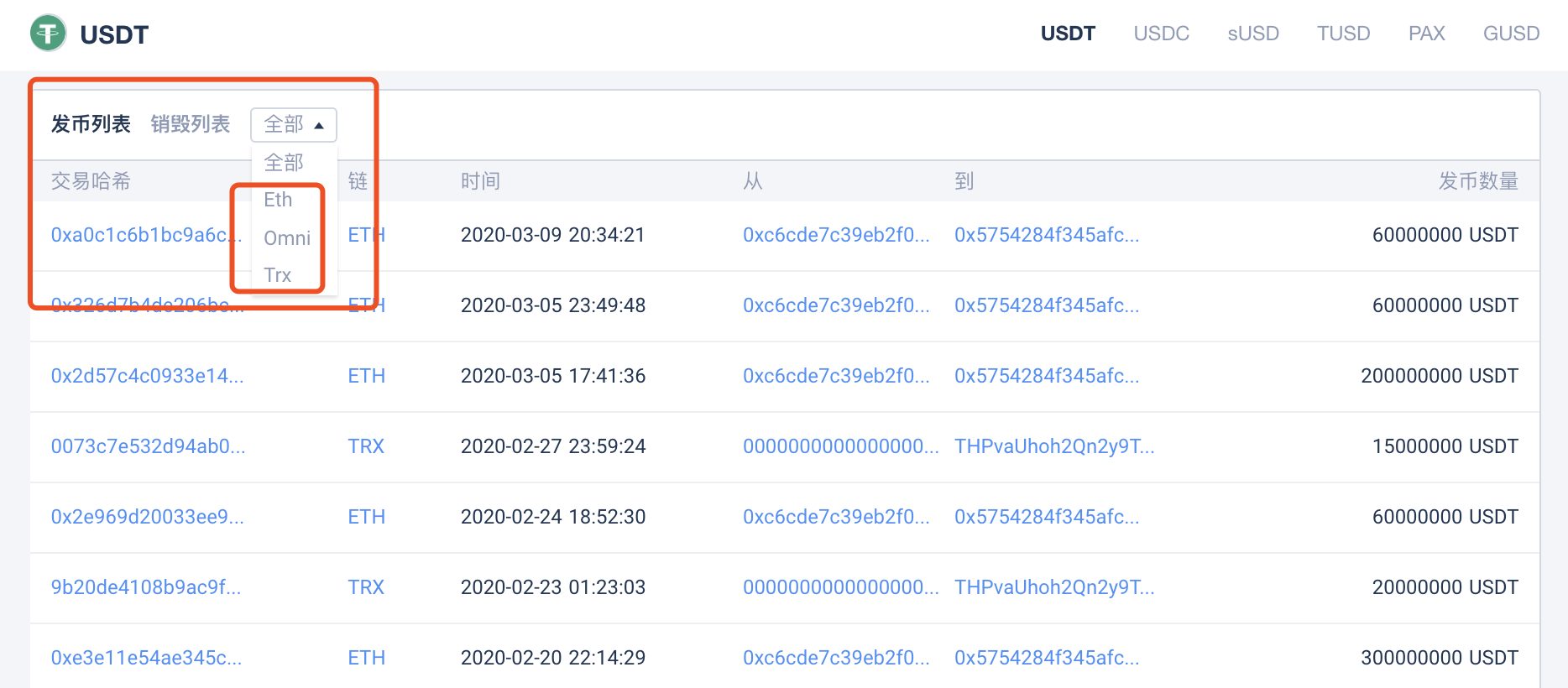 As of March 5, 2020, USDT has been issued a total of 212 times, including 83 times on Omini, 46 times on Ethereum, and 83 times on TRON. A total of 23 times were burned, 7 times on Omini, 7 times on Ethereum, and 9 times on Tron.
So why is it necessary to issue additional USDT? Issuing additional USDT means increasing the circulation of USDT. Generally, we think it is to meet the increasing demand for market transactions. The repurchase or destruction needs to reduce the circulation of USDT, generally to increase the market's confidence in USDT. Of course, such as the occurrence of "wrong decimal points", the additional USDT must be destroyed.
When repurchasing or destroying, you can repurchase or destroy USDT in circulation, or you can repurchase or destroy USDT that is not in circulation in the market. As mentioned earlier, the USDT in circulation is all issued USDT, while the uncirculated USDT is the USDT in Tether's own pocket.
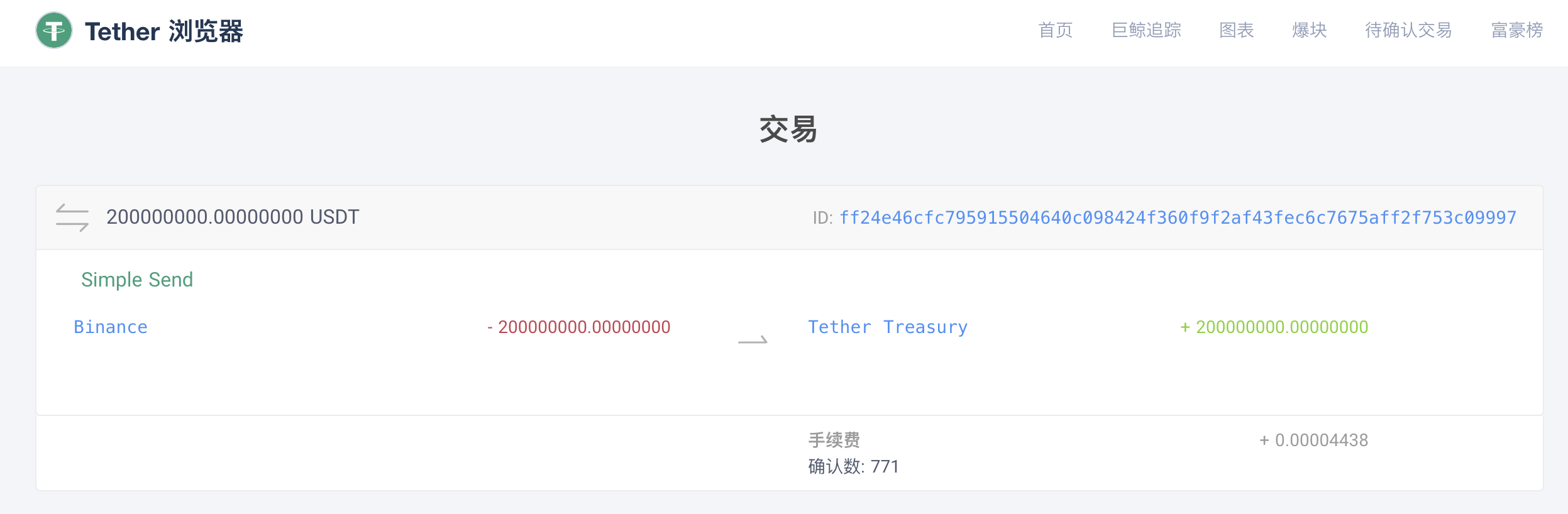
In addition, there is also a USDT chain swap operation. There are usually two operation methods for chain swapping, one is to issue a certain amount of USDT on a certain chain, and at the same time destroy the same amount of USDT on another chain. The other is to withdraw (not destroy) a certain amount of USDT on one chain, and then issue coins on another chain. For example, the following transaction is the operation of recovering USDT.
The additional issuance of USDT means injecting new funds into the cryptocurrency market, which often drives the market up. we can inhttps://stablecoin.tokenview.com/Always pay attention to the issuance and destruction of stablecoins such as USDT.





