






Storj Labs申請破產保護,代幣持有者能換到公司股權嗎?


- 核心觀點:去中心化雲端儲存平台 Storj 的母公司 Storj Labs 已申請第11章破產保護,並計劃在重組方案中開創性地為 STORJ 代幣持有者提供換取重組後公司股權的途徑。此舉旨在解決歷史債務並精簡業務,但面臨破產法優先級規則及無先例可循的法律挑戰。
- 關鍵要素:
- Storj Labs 於7月26日申請第11章破產保護,稱負債源於歷史營運與收購;業務已精簡,將剝離非核心資產(如GPU計算公司Valdi),重新聚焦去中心化儲存主業。
- Storj 管理層提議代幣持有者可參與重組後公司的股權分配,以對齊各方利益;該提議在加密行業破產案中尚無先例,僅處於意向階段,具體條款待法院批准。
- 核心障礙在於破產法優先級規則:代幣持有者處於清償序列末端,僅在債權人獲得全額清償後,剩餘價值才可能流向代幣持有者;此前WTT訴訟案認定代幣持有者不具成員身份。
- STORJ 代幣總供應量4.25億枚,其中約30%(1.3億枚)仍由公司自身持有;若這些代幣也參與轉換,可能引發管理層與外部持有者之間的利益衝突。
- Storj 在去中心化儲存賽道的規模遠小於Filecoin(市值約是其20倍)和Arweave,其核心優勢在於毫秒級檢索延遲;破產重組期間面臨節點運營者及客戶流失至競爭網路的風險。
Original Author: ChandlerZ, Foresight News
Storj Labs, the parent company of the decentralized cloud storage platform Storj, filed for Chapter 11 bankruptcy protection in the U.S. Bankruptcy Court for the Northern District of West Virginia on July 26.
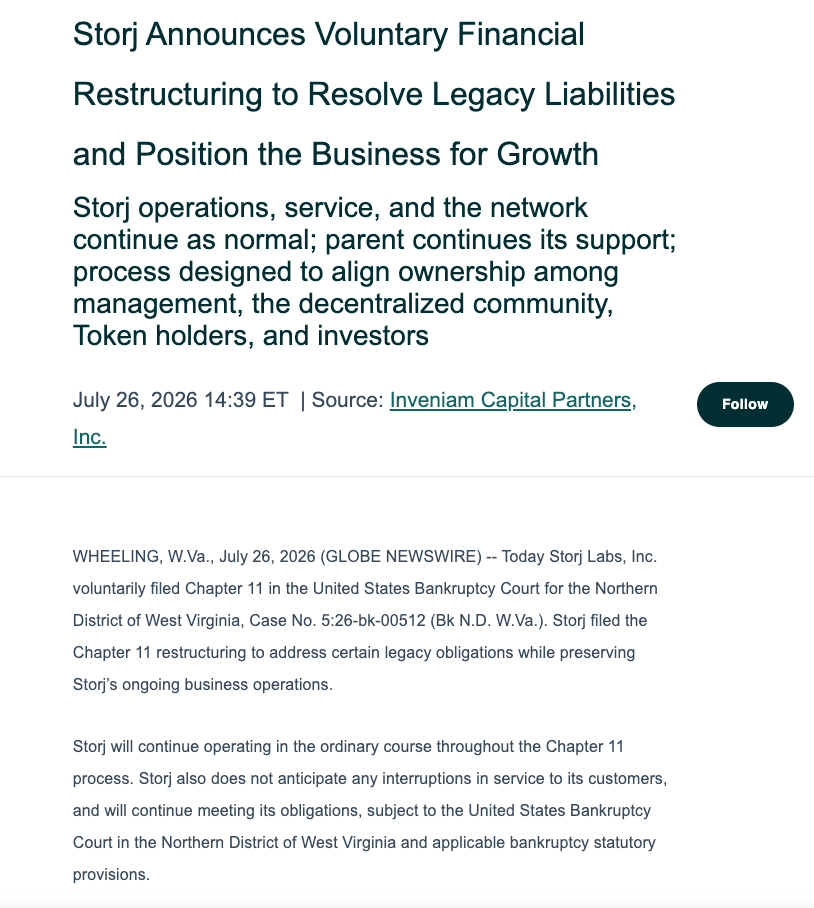
Storj stated that the network will operate normally and token functionality will remain unaffected. It also plans to offer STORJ token holders a path to acquire equity in the restructured company as part of the reorganization plan. This proposal of swapping tokens for equity has no precedent in the crypto industry, and its feasibility depends on whether there is residual value after satisfying creditor claims.
Bankruptcy Less Than a Year After Acquisition
Founded in 2014, Storj is one of the earliest decentralized infrastructure projects in the crypto industry. Its core business involves leveraging blockchain incentive mechanisms to allow global node operators to contribute idle hard drive space, building a distributed cloud storage network as an alternative to centralized services like Amazon S3. Users pay for storage and bandwidth fees with STORJ tokens, while node operators are compensated in STORJ tokens.
In its early stages, the project secured seed funding from Google Ventures, Qualcomm Ventures, and Techstars. In 2017, it raised approximately $30 million through a token sale. By 2024, Storj's annual recurring revenue (ARR) had grown 7x to about $30 million, with a team of 81 people. That same year, Storj also acquired GPU computing company Valdi, expanding its business from pure storage to computing power leasing.
In October 2025, Inveniam Capital Partners, a firm specializing in data assetization, acquired Storj through a reverse triangular merger. CEO Colby Winegar remained in his role, and Executive Chairman Ben Golub joined Inveniam's board. On the day the acquisition was announced, the STORJ token fell by 18%. Less than a year later, the merged entity entered bankruptcy proceedings.
In an open letter, Storj attributed the bankruptcy to legacy debts, stating that the liabilities primarily stemmed from past operations and acquisitions, predating the current business strategy and being too large to be naturally resolved through business growth. The company claimed its current operations are streamlined, but the past burdens could only be addressed through court-supervised reorganization. It also indicated plans to divest non-core businesses acquired in previous acquisitions during the reorganization, refocusing on its core decentralized storage business.
The GPU computing company Valdi, acquired in July 2024, is the most likely asset to be divested. Valdi brought Storj a global network of over 16,000 GPUs, which was originally a key part of Storj's expansion strategy into AI computing. However, from a bankruptcy reorganization perspective, this acquisition itself may have been a source of increased liabilities. Divesting Valdi would mean Storj returns to the pure storage track, abandoning its previous positioning as a full-stack decentralized cloud platform.
Tokens for Equity: Promise or Empty Check?
The most notable proposal in the official open letter is offering token holders a path to company equity. Storj's management stated they plan to propose a mechanism in the reorganization plan that allows token holders to participate in the equity distribution of the restructured company, realigning ownership among management, the decentralized community, token holders, and investors.
Storj's Director of Software Engineering, Kaloyan Raev, used quite restrained language in the open letter, indicating they would offer users a seat at the table and good faith intentions, not a guaranteed outcome. The company has not yet disclosed the qualification method (e.g., whether a token snapshot or lock-up is required), the percentage of equity to be distributed, or the specific participation mechanism. All terms need to be formulated during the reorganization process and approved by the court.
The core obstacle facing this proposal is the priority rules in bankruptcy law. In a Chapter 11 reorganization, creditors' claims take precedence over equity holders. Token holders are legally positioned closest to equity holders, at the end of the payout hierarchy. Only after creditors receive full or agreed-upon payment can residual value potentially flow to token holders.
There is no precedent in the crypto industry for a token-for-equity bankruptcy arrangement. In the WTT lawsuit case, where crypto mining company Giga Watt filed for bankruptcy after raising approximately $22 million through an ICO, the court ruled that utility token holders did not have membership status in the company. This means token holders cannot automatically claim equity status; rights must be separately created through the reorganization plan. While the FTX bankruptcy case set a precedent for crypto asset valuation, it dealt with creditor claims, which is entirely different from the token-for-equity path proposed by Storj.
Another notable variable is the concentration of token holdings. The total supply of STORJ is 425 million tokens, of which approximately 30% (about 130 million) is still held by Storj Labs. If the company's own tokens also participate in the equity conversion, there is a potential conflict of interest between management and external token holders.
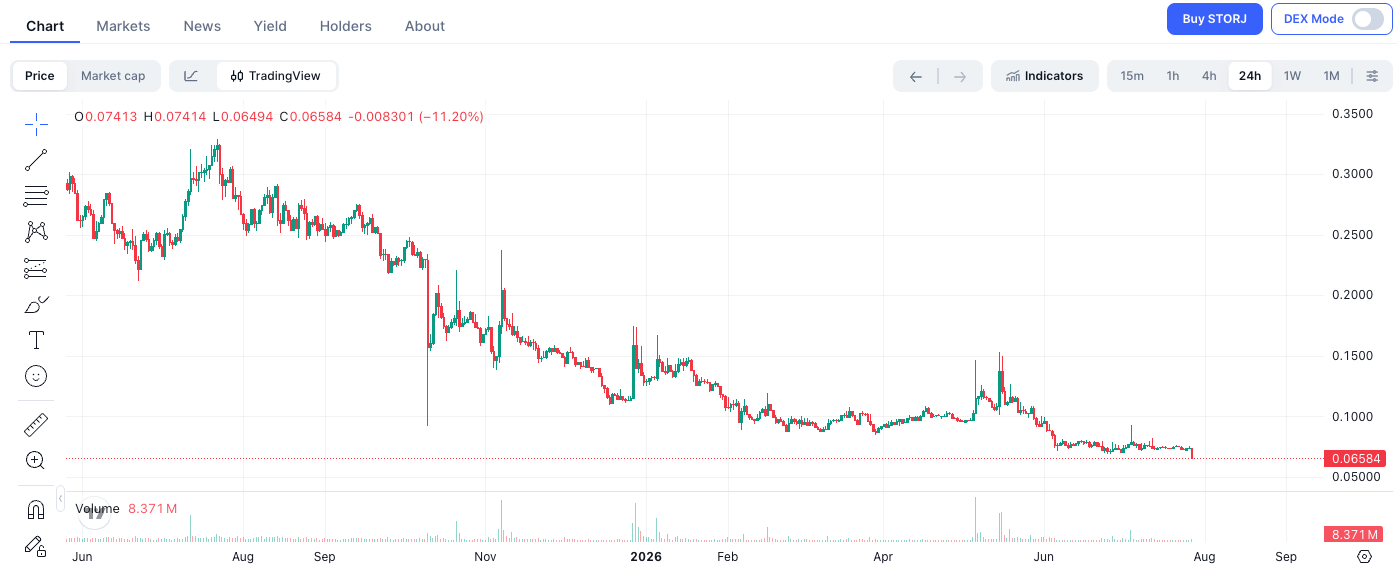
The STORJ token is currently trading at approximately $0.06584, with a total market cap of about $27.97 million. Following the announcement, the price fell 11.2% in 24 hours.
A Marginal Player in the Decentralized Storage Track
Storj's scale in the decentralized storage track is far smaller than leading competitors. Filecoin currently has a market cap of approximately $607 million, nearly 20 times that of STORJ, with a network storage capacity exceeding 1.8 EiB. In early 2026, Filecoin officially launched its Onchain Cloud roadmap, using the Filecoin Virtual Machine (FVM) to support automated data repair, perpetual contracts, and liquid staking of storage computing power, positioning itself as a decentralized alternative to AWS. Arweave takes a different approach, using a one-time fee, permanent storage model to capture the market for NFT metadata and blockchain historical state storage.
In comparison, Storj's advantage lies in retrieval speed. Storj uses Erasure Coding to split files into over 80 fragments distributed across global nodes, requiring only 29 fragments to reconstruct a file. Retrieval latency can reach the millisecond level, close to the performance of centralized cloud service providers. This gives Storj a certain competitive edge in hot data storage (e.g., video streaming, application data), but its market share is far behind Filecoin.
During the bankruptcy reorganization, a real risk for the Storj network is whether node operators and enterprise customers will migrate to Filecoin or Arweave due to uncertainty. For STORJ token holders, the key variables to monitor include the specific terms of the token-for-equity proposal in the reorganization plan and court approval progress, how the company's 30% token holdings will be handled, and whether the business post-Valdi divestiture is sufficient to support the valuation.


