《CLARITY法案》給2026中期選舉帶來了多大變數?


- 核心觀點:HarrisX民調顯示,美國選民跨黨派支持通過《CLARITY法案》,以確保美國在加密貨幣領域的領導地位,該議題已成為影響2026年中期選舉的關鍵政治變數,能為支持者帶來顯著的選舉優勢。
- 關鍵要素:
- 高支持率與選舉收益:52%選民支持《CLARITY法案》,僅11%反對。支持該法案可為參議員帶來20個百分點的淨選舉收益,37%的選民更傾向投票支持該法案的候選人。
- 跨黨派吸引力:47%的選民會因候選人支持該法案而考慮跨黨派投票,加密持有者中這一比例高達72%,表明該議題有能力打破黨派壁壘、爭取搖擺選民。
- 國家安全敘事驅動力:56%的選民認為,若境外建構數位支付系統會削弱美國國家安全,該理由被23%的選民警惕為支持法案的首要原因,將監管上升為國家競爭議題。
- 對現狀不滿與行動訴求:70%的選民認為美國本應早已通過加密立法,60%寧願接受不完美的聯邦監管,也不願繼續依賴SEC的「逐案執法」模式,反映強烈的立法緊迫性。
- 認知差距與政策偏好:僅33%的選民知悉全球十大交易所中八家位於海外,但被告知後46%認為這是個問題。更傾向明確規則而非執法監管的比例保持在近50%,顯示資訊增量可強化支持。
Original Title: National survey of voters shows bipartisan support for American leadership in cryptocurrencies and passing the CLARITY Act.
Original Author: HarrisX
Original Translation: Peggy, BlockBeats
Editor's Note: Crypto regulation is emerging as a new variable in the 2026 US midterm elections.
The HarrisX survey shows that national voters not only support, across party lines, American leadership in digital finance and cryptocurrencies but also broadly support the passage of the CLARITY Act.
Note: HarrisX conducted an online poll of 2,008 registered voters from May 1 to 4, 2026.
This bill was originally a regulatory framework legislation, aiming to clarify the regulatory boundaries of the SEC and CFTC over digital assets, establish registration rules for exchanges and custodians, and enhance consumer protection. However, based on the HarrisX survey results, its political significance extends beyond the crypto industry itself: 37% of voters said they would be more likely to support a senator if they voted for the bill; overall, supporting the CLARITY Act could yield a net electoral gain of 20 percentage points.
More noteworthy is the cross-party movement. The survey shows that 47% of voters said they would consider voting for a candidate outside their preferred party if that candidate supported the CLARITY Act while their preferred party did not. This percentage is even higher among cryptocurrency holders, voters familiar with digital assets, and those aware of the bill.
This means that the CLARITY Act is not just a legislative attempt by the crypto industry to seek regulatory clarity, but could also become a tool for candidates to attract young voters, crypto holders, and swing voters. For the US political landscape, the core question of crypto regulation is shifting from "should it be regulated" to "who can use it to mobilize votes."
Below is the original text:
Introduction
Digital assets and their federal regulatory framework are at a critical juncture.
The Digital Asset Market Clarity Act of 2025 (the CLARITY Act, H.R. 3633) under consideration in Congress will clarify three things: which types of digital assets are regulated by the SEC versus the CFTC, registration rules for cryptocurrency exchanges and custodians, and industry-wide consumer protection standards. This is one of the most significant digital asset legislations Congress has ever considered.
Building on its long track record in public opinion polling, HarrisX conducted a national survey of 2,008 registered voters to measure four things: voters' awareness and ownership of digital assets, their attitudes towards US leadership in digital finance, support for the CLARITY Act, and whether a candidate's stance on crypto regulation could influence the 2026 midterm elections.
Eight out of the top ten global cryptocurrency exchanges are headquartered outside the United States. As digital payment systems and stablecoin infrastructure accelerate globally, if the US fails to establish clear federal rules, it risks ceding the dominant position in a strategic financial technology to overseas jurisdictions – an outcome that would materially impact national security, the global standing of the US dollar, the retention of developers and businesses, and America's overall competitiveness in financial technology innovation.
Voters across party lines recognize this risk and want Congress to act quickly.
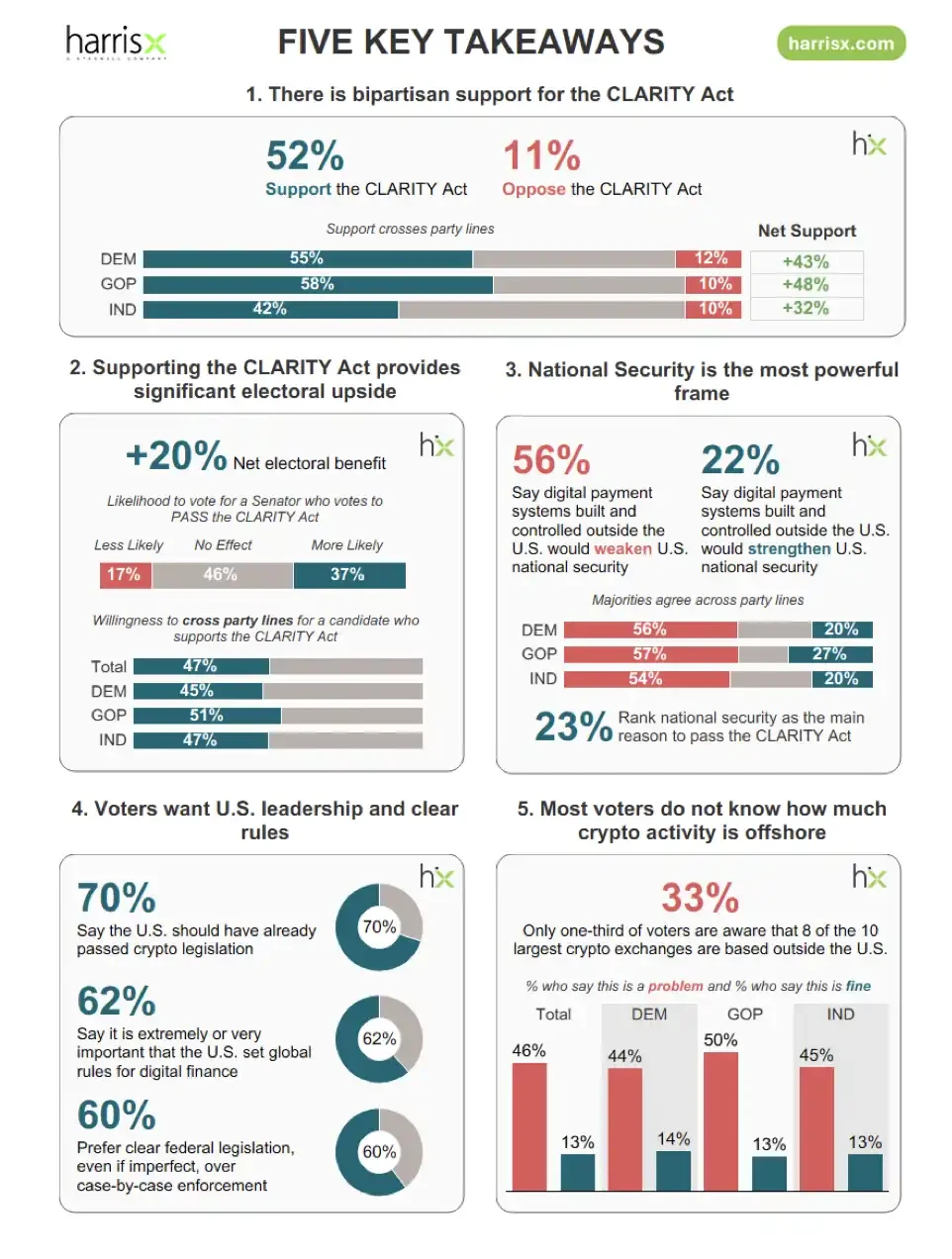
This is a voter poll conducted by HarrisX regarding the CLARITY Act (US cryptocurrency market structure legislation). The five charts present five core findings:
Chart 1 | The bill receives bipartisan support. 52% of respondents support the CLARITY Act, with only 11% opposing it; the net support rates among Democrats, Republicans, and Independents are +43%, +48%, and +32% respectively, with Republican voters showing the highest level of support.
Chart 2 | Supporting the legislation yields clear electoral gains. The net electoral benefit is +20% – 37% of voters said they would be more likely to vote for a senator who helped pass the CLARITY Act, while only 17% said they would be less likely; 47% of voters are willing to cross party lines to vote for this, with the highest proportion among Republican voters (51%).
Chart 3 | "National security" is the most compelling narrative framework. 56% of respondents believe that a digital payment system built and controlled outside the US would weaken US national security, while only 22% believe it would strengthen it; this view is a majority consensus across all three major parties (DEM 56%, GOP 57%, IND 54%). 23% of voters cite national security as the primary reason for passing the bill.
Chart 4 | Voters want the US to take the lead and establish clear rules. 70% believe the US should have already passed crypto legislation; 62% believe it is "extremely important" or "very important" for the US to set global rules for digital finance; 60% say they would prefer an imperfect but clear federal law over continuing with a "case-by-case enforcement" regulatory model.
Chart 5 | A majority of voters are unaware of the offshore status of the crypto industry. Only 33% of voters know that "eight out of the top ten global crypto exchanges are headquartered outside the US." After being informed, 46% consider this to be a problem, while only 13% think it's fine; this concern is most pronounced among Republican voters (50%).
American Leadership and the Need for Clear Federal Rules
Voter understanding of digital assets remains limited, but their opinions are clear and consistent: America should set the rules for digital finance, and it should do so quickly.
Awareness of digital assets is still low, but crypto holders constitute a significant voting bloc
· 39% of voters say they are familiar with digital assets and blockchain technology, while 61% say they are not.
· Two in five voters have purchased cryptocurrency, with 30% having done so in the past year.
· Familiarity and ownership rates are concentrated among men and voters under 35.
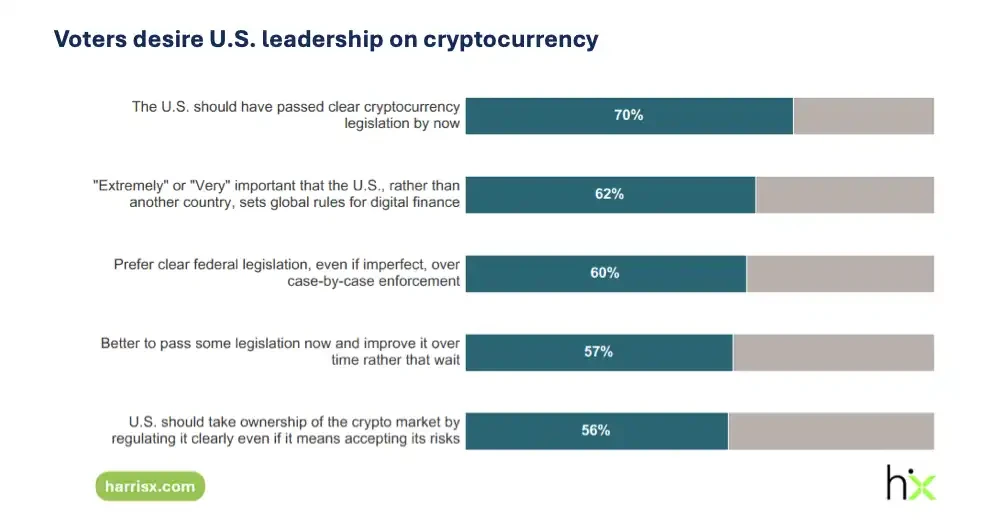
This chart focuses on a core issue – the strong expectation among US voters for their country to establish dominance in the cryptocurrency field. HarrisX uses five questions, covering "urgency, global standing, regulatory path, legislative pace, and risk tolerance," to depict a very clear public opinion trend:
70% | Legislation should have been in place long ago. Seven out of ten voters believe the US should have passed clear cryptocurrency legislation by now. This is a judgment about "timing" – voters are no longer discussing "whether to act," but expressing anxiety about "why hasn't it happened yet."
62% | Global rules should be written by the US. Regarding the power to set global rules for digital finance, 62% of voters consider it extremely or very important for the US, rather than other countries, to lead. This essentially elevates crypto regulation from a "financial issue" to a "national competition issue."
60% | Clear federal law, not case-by-case enforcement. Six out of ten voters explicitly state they would prefer an imperfect but clear federal law over continuing to operate in the gray area of case-by-case regulatory enforcement. This is a direct rejection of the SEC's "litigation instead of legislation" approach of recent years.
57% | Legislate first, iterate later. 57% of voters believe it's better to pass the current version of the bill and refine it over time rather than continue waiting for a perfect piece of legislation. This echoes the common legislative logic of "don't let perfect be the enemy of good" and also reduces political resistance during the bill's advancement.
56% | Willing to accept risk for leadership. Even if it means accepting the inherent risks of the crypto market itself, 56% of voters still believe the US should "take over" this market through clear regulation. In other words, voters' concern about "letting the market flow overseas" has surpassed their apprehension about "the trouble regulation itself might cause."
Voters Want the US to Maintain Leadership in Cryptocurrency
Although most voters are not familiar with the technical details of digital assets, they demonstrate a strong, broad, and stable demand for American leadership and clear federal rules.
A 70% majority of voters believe the US should have already passed clear cryptocurrency legislation; 62% of voters believe it is important for the US to set global rules for digital finance.
Voters also do not endorse continuing with case-by-case enforcement: 60% of voters prefer clear federal legislation, even if imperfect; 57% of voters believe it's better to pass some legislation now and refine it later, rather than waiting for a perfect law.
Even when explicitly acknowledging the trade-offs involved, voters still lean towards action. 56% of voters believe the US should assert dominance in the crypto market through clear regulation, even if it means accepting the associated risks.
Overall, these results indicate that voters are not asking Congress to continue debating "whether to act," but are demanding that Congress take decisive, clear, and federal action as soon as possible.
Offshore Concentration is an Important but Underappreciated Problem
Voters support US regulation. The high concentration of crypto exchanges overseas provides another concrete reason for voter support of federal crypto regulatory rules.
The survey shows that voters are generally unaware of how much digital asset market activity occurs outside US regulation; however, once informed of this fact, few find it acceptable.
· Only one-third of voters know that eight of the top ten global cryptocurrency exchanges are headquartered outside the US.
· After learning this fact, 46% of voters believe that most crypto trading occurring outside US regulation is at least somewhat of a problem; only 13% believe it is not a problem or is even a good thing.
National Security is a Key Factor Driving Voter Support for Federal Action
When this issue is framed within the context of national security, voters' concerns about foreign-controlled digital payment systems potentially weakening US security and the global status of the dollar are further amplified.
· 56% of voters believe that if future digital payment systems are built and controlled by countries other than the US, it would weaken US national security. Only 22% believe it would strengthen US national security.
· Over two-fifths of voters believe that if foreign-issued stablecoins become dominant, it would weaken the global status of the dollar; only 17% believe it would strengthen the dollar's position.
Voters Have Long Wanted Better Rules and Oversight for Digital Assets
The demand for federal action did not start with the current debate. Over the past three years, multiple HarrisX studies have shown that voters consistently prefer clearer rules, stronger protections, and a more proactive US approach to regulating digital assets.
Findings from our previous research include:
· Voters want clear crypto rules, not regulation by enforcement. In a 2024 study, voters preferred clear rules over enforcement by a 48% to 23% margin; by 2025, this gap remained largely stable, with 49% supporting clear rules and 26% supporting enforcement.
· Voters believe the US is falling behind, creating a leadership gap. In 2024 and 2025, only about one in five voters thought the US was leading in crypto regulation, while 36% believed the US was already falling behind.
· But voters want the US to lead this field. In 2025, 69% of registered voters and 84% of crypto investors believe it is very important for the US to lead the world in blockchain technology development; 82% of voters support Congress establishing stricter rules for crypto exchanges and brokers.
Note 2: Sources include surveys by HarrisX/Blockchain Association conducted October 25-28, 2024, among 1,717 US registered voters, and December 3-4, 2025, among 1,861 US registered voters.
The CLARITY Act Receives Bipartisan Support
After being described in a neutral manner, 52% of voters support the CLARITY Act, with 11% opposing it. Support is bipartisan, and the persuadable middle group is large.
Voter awareness of the bill is currently low
· 64% of voters have not heard of the CLARITY Act; 14% say they have heard a lot, and 22% say they have heard a little.
· The explanation voters receive upon first hearing about the bill will determine the ceiling of its political support. The neutral description used in this survey generated solid majority support.
After receiving a neutral description, support is strong, and opposition is limited
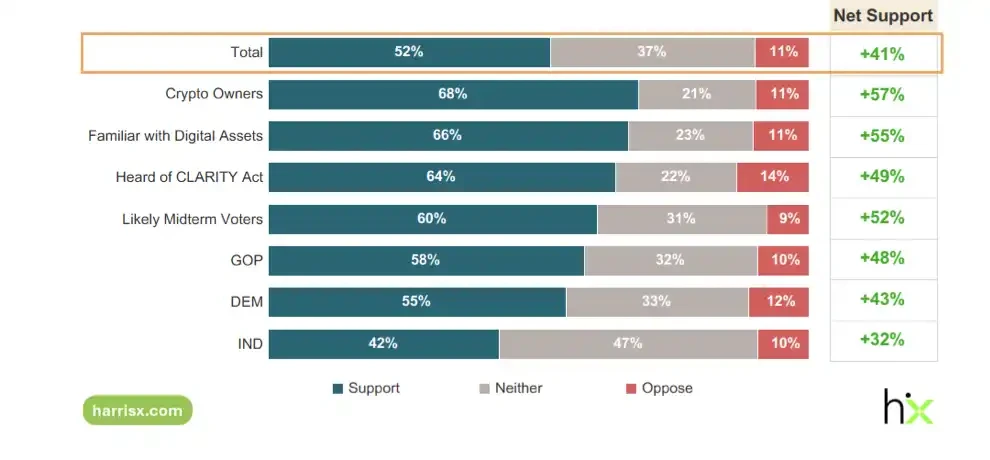
Survey Question CL12: The CLARITY Act would clarify which federal agency, the SEC or the CFTC, regulates different types of digital assets; establish registration rules for cryptocurrency exchanges and custodians; and establish consumer protection standards for the industry. Based solely on this description, would you support or oppose this legislation?
The CLARITY Act garners strong support among key groups
· Support is clearly bipartisan: Republican voters have a net support rate of +48, Democratic voters are +43, likely midterm voters are +52, and Independent voters are +32.
· Only 10% of Independent voters oppose the bill, with the vast majority sitting in the persuadable middle ground: 47% neither support nor oppose it.
· Voters most familiar with the issue show the highest support: cryptocurrency holders have a net support rate of +57, voters familiar with digital assets are +55, and voters aware of the CLARITY Act are +49. Education and information exposure increase support.
Support for the CLARITY Act is built on broader national security concerns
When asked which reason best supports passing the CLARITY Act, voters' responses included:
· National Security & Dollar Dominance (23%): "Keeping the dollar and US payment system at the center of global finance is a national security priority."
· Law Enforcement & Illicit Finance (17%)
· Consumer Protection & Fraud Prevention (16%)
· Jobs & Businesses Leaving the US (11%)
Electoral Impact of Supporting the CLARITY Act
Voting to pass the CLARITY Act is a clear electoral positive across party lines. Nearly half of voters say such an issue could prompt them to cross party lines when voting.
Senators who vote for the CLARITY Act will gain support across various voter groups
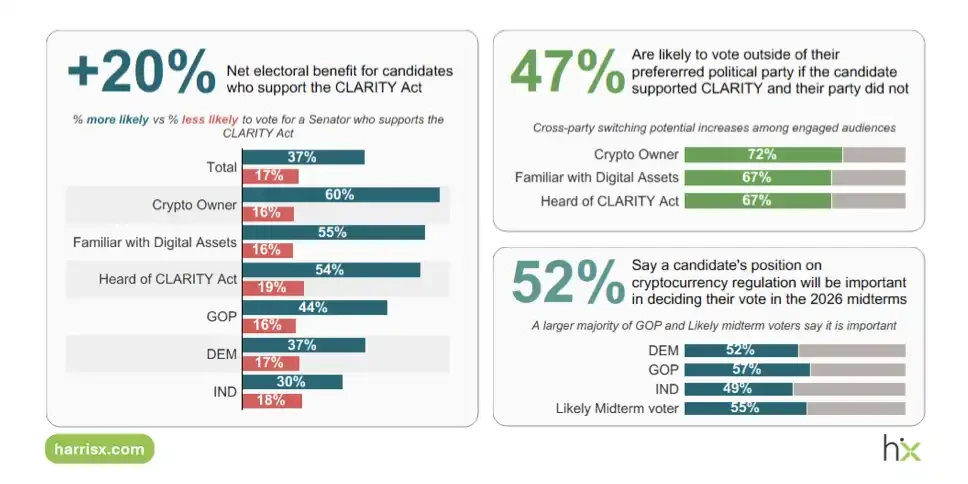
37% of voters say they would be more likely to support a senator who voted to pass the CLARITY Act; 17% say they would be less likely; 46% say it would have no impact. Overall, the net gain is +20.
This impact is strongest among Republican voters, with 44% saying they would be more likely to support; it is also positive among Democratic voters at 37%; and among Independent voters at 31%.
Cross-party appeal: 47% of voters would consider changing their party vote based on this issue
· In a midterm environment where most issues reinforce existing partisan divides, the CLARITY Act stands out as one of the few legislative issues capable of creating cross-party movement.
· 47% of voters say that if a candidate supports the CLARITY Act and their preferred party does not, they would at least somewhat consider voting for a candidate outside their preferred party.
· This willingness to cross party lines is even higher among cryptocurrency holders (72%), voters familiar with digital assets (67%), and voters aware of the CLARITY Act (67%).
A majority of voters say this issue will influence their 2026 vote
· 52% of voters say a candidate's position on cryptocurrency regulation will be "extremely important" or "somewhat important" to their vote in the 2026 midterm elections.
· This percentage rises to 78% among cryptocurrency holders and 74% among voters familiar with digital assets.
· Issue intensity is moderate, with 16% of voters saying it is "extremely important." While it's not yet a top-tier voting driver, it has broad political reach: many voters are willing to incorporate crypto regulation into their 2026 voting considerations.
Crypto Voters are a Significant and Influential Voting Bloc
Beyond the support of the general electorate for the CLARITY Act, the survey results also demonstrate the unique political value of courting crypto voters. Crypto voters are a sizable and influential group; previous HarrisX research shows they are highly engaged, issue-driven, and willing to cross party lines when a candidate