






Kalshi再融10億美元,預測市場被資本推上金融主桌


- 核心觀點:預測市場Kalshi完成10億美元融資,估值達220億美元,標誌著預測市場正從邊緣事件交易工具向主流金融基礎設施演變,資本押注其能將現實世界的不確定性轉化為可交易、對沖的風險資產。
- 關鍵要素:
- Kalshi估值7個月內從20億美元躍升至220億美元,漲幅超10倍,由Coatue Management領投。
- 預測市場的價值在於將選舉、經濟數據、政策變化等難以定價的不確定性拆分為可交易合約,形成新的「事件交易市場」。
- Kalshi的核心護城河是受CFTC監管的合規牌照,使其能吸引機構資金,並將預測市場納入聯邦金融監管框架。
- 監管爭議焦點在於事件合約的定性——屬於金融衍生品還是變相博彩,這將決定行業擴張上限和產品邊界。
- 內幕交易是預測市場面臨的關鍵公平性問題,知情者參與可提升資訊效率但破壞市場公平,機構要求更完善的監控與處罰機制。
- 2026年4月預測市場月交易量達約300億美元,Kalshi份額50%領先,Polymarket占34%,其他平台如predict.fun等也在加速增長。
Original: Odaily Planet Daily (@OdailyChina)
Author: Asher (@Asher_0210)

Kalshi has once again thrust prediction markets into the spotlight of capital markets.
Last night, prediction market Kalshi announced a new $1 billion funding round, led by Coatue Management, at a post-money valuation of $22 billion. Prediction markets are moving from being fringe tools for event wagering into the purview of mainstream capital and institutional finance.
In the past, prediction markets were mostly discussed in the context of elections, sports, entertainment, and short-term hot topics. This round of funding for Kalshi shows that capital is looking beyond just how hot a particular market is; it's asking whether the uncertainties of the real world can be structured into a long-term, functioning trading mechanism. If this path is successful, prediction markets will no longer just be a traffic-driven business, but something closer to financial infrastructure.
Behind the $1 Billion Raise, Capital is Betting on a New Market Category
Kalshi's latest funding round is not an isolated high-valuation event.
Over the past 7 months, Kalshi has completed three consecutive funding rounds, with its valuation nearly doubling each time. In June 2025, Kalshi closed a $185 million Series C at a ~$2 billion valuation; in October, a ~$300 million Series D at a $5 billion valuation; in December, a $1 billion Series E at an $11 billion valuation. Following this latest round, Kalshi's post-money valuation has reached $22 billion. In just a few months, the valuation has surged from $2 billion to $22 billion, an increase of over 10 times.
It would be difficult to sustain such a valuation if it were solely reliant on attracting users to bet on elections, sports, and trending events. The real story Kalshi is telling is that prediction markets have the opportunity to evolve from a niche trading venue into a new market for event trading.
Traditional financial markets allow trading of stocks, bonds, commodities, forex, interest rates, and volatility. However, there is immense uncertainty in the real world that is difficult to price directly. Election outcomes, policy changes, economic data, weather events, and geopolitical shifts all impact corporate decisions, asset prices, and public expectations, yet they have long lacked standardized trading tools.
What prediction markets aim to do is break down this uncertainty into tradable contracts, allowing prices to directly reflect the probability of an event occurring. This is where Kalshi's potential lies. It's not just about enabling more people to bet on the future; it's about attempting to turn the uncertainty of the future into a risk asset that can be traded, managed, and hedged.
From Election Betting to Pricing Real-World Risk
Prediction markets first gained mainstream attention through elections. Compared to polls, they are more direct, compressing diverse opinions into a real-time price. A candidate's win probability, the likelihood of a policy passing, whether economic data will beat expectations—all can be quickly expressed through market prices.
But relying solely on elections and sports can't justify today's valuation. The real story Kalshi wants to tell is whether prediction markets can enter broader risk-pricing scenarios. Think interest rate decisions, CPI reports, employment data, weather disasters, policy changes, and supply chain shocks. In the past, most of these risks could only be traded indirectly; now, they can potentially be broken down into individual event contracts.
Therefore, the long-term value of prediction markets lies not in enabling more people to guess outcomes correctly, but in transforming the uncertainties of the real world—which were previously difficult to trade—into a continuously updated set of prices that the market can reference.
Kalshi's Most Valuable Asset is its Regulatory License
In Kalshi's growth story, trading volume and fees are certainly important, but its position within the U.S. regulatory framework is even more critical.
Unlike platforms like Polymarket, which are more crypto-native and focused on global liquidity, Kalshi pursues a U.S. domestic compliance route. It is a Designated Contract Market (DCM) regulated by the CFTC, meaning Kalshi is attempting to place prediction markets within the federal financial regulatory framework, rather than just operating them as open event betting platforms.
For the average user, a prediction market is just a platform to trade event outcomes. But for institutional capital, compliance is the first and foremost hurdle. For hedge funds, asset managers, and market makers to get involved, they first need clarity on contract attributes, clearing and settlement processes, audit trails, and risk control procedures.
Consequently, part of Kalshi's valuation prices its growth, and another part prices its license. The more prediction markets move towards mainstream finance, the more important regulatory status becomes. For Kalshi, which has secured a federally compliant entry point, regulation is not just a constraint; it could become its most critical moat.
The Biggest Debate Remains: Are Prediction Markets Finance or Gambling?
The core issue for prediction markets remains whether event contracts are financial derivatives or a form of disguised gambling. This is especially contentious in markets for sports, entertainment, and elections, which easily blur the lines with traditional gambling. Regulators in multiple states argue that some of Kalshi's products circumvent state-level gambling regulations. Kalshi, on the other hand, maintains that event contracts are financial products under CFTC oversight and should be handled within the framework of the Commodity Exchange Act.
This battle doesn't just concern Kalshi; it determines the ceiling for the entire prediction market industry. If state-level gambling logic prevails, prediction markets may be forced into a model of applying for licenses state-by-state and seeking approval for each product category, limiting their expansion speed and product scope. If federal financial regulatory logic is further solidified, event contracts have the chance to exist as independent financial products, and Kalshi's license value will be amplified even further.
Therefore, the regulatory debate is not a sidebar in Kalshi's story; it's part of the valuation logic. Capital is willing to give Kalshi a high valuation precisely because it believes Kalshi has a chance to win this regulatory game and convert its compliance advantage into market share.
Insider Trading: The Inescapable Dark Side of Prediction Markets
Beyond regulatory classification, prediction markets face a more difficult problem: insider trading.
The value of a prediction market comes from information being reflected in prices. The more informed participants trade, the closer the market price gets to the true probability. However, information distribution in real-world events is inherently unequal. Politicians, campaign staff, athletes, production crews, and corporate insiders often know results earlier or are closer to the outcome than average users.
This creates a dilemma. If insiders don't participate, the market's information efficiency may decrease. If insiders participate heavily, ordinary users may feel they are just liquidity to be harvested. The more prediction markets emphasize information efficiency, the harder it is to escape the fairness issues arising from information asymmetry.
Currently, Kalshi has strengthened its monitoring and penalty mechanisms, including restricting related parties from trading their own markets, investigating anomalous trades, and penalizing violative accounts. But this is far from sufficient. If prediction markets are to evolve from traffic platforms into financial markets, they must not only prove they can attract trading volume but also demonstrate their ability to handle insider trading, information asymmetry, and market fairness issues. Otherwise, it will be difficult for institutional capital to truly regard them as serious, long-term markets.
Kalshi is Not an Isolated Case; Prediction Markets are Heating Up Overall
Looking at data from April 2026, the prediction market landscape is no longer just a two-horse race between Kalshi and Polymarket. Kalshi captured approximately 50% market share with $14.8 billion in trading volume, becoming the first platform to secure a majority share in a single month this year, and has maintained a volume lead for eight consecutive months. Polymarket's volume for the same period was $10.2 billion, representing 34% share, making it still one of the most significant competitors. Notably, predict.fun and Limitless also recorded trading volumes of $1.5 billion and $1.7 billion, respectively.
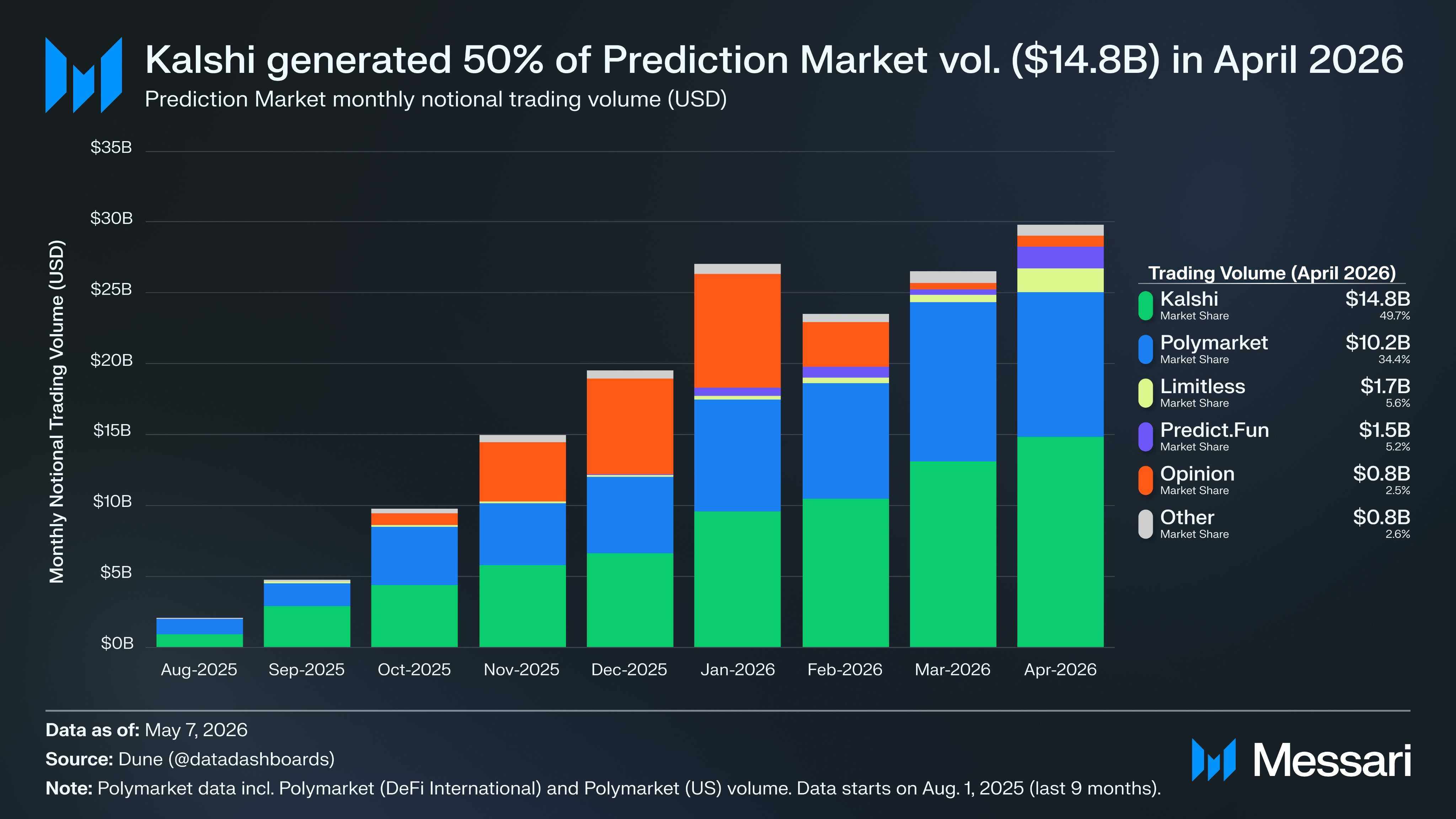
Prediction Market Platform Trading Volume Data - April
Kalshi holds a leading advantage, but prediction markets haven't become a one-company show; other platforms are also accelerating their efforts. More accurately, Kalshi's lead hasn't suppressed the growth of other platforms; instead, it indicates that demand for prediction markets is spreading from the top platform to more entry points.
It's likely that the future of prediction markets won't have just one winner. Compliant institutional markets, crypto-native markets, exchange-integrated segments, and vertical event markets may all coexist. The competition between platforms isn't just for users, but for the liquidity and pricing power of real-world events.
Capital Has Entered the Arena; Prediction Markets Must Prove They Belong at the Big Table
Funding is not the finish line, but the beginning of a greater test.
The significance of Kalshi's funding round goes beyond pushing its own valuation to $22 billion. It has brought prediction markets into the mainstream financial narrative with unprecedented clarity. Previously, they were seen more as trading gateways for elections, sports, and trending topics. Now, capital is beginning to believe that the uncertainties of the real world can be structured into a continuously functioning price system.
But this task cannot be accomplished by Kalshi alone. Platforms like Polymarket, predict.fun, and Limitless are also expanding liquidity, improving user experience, and exploring different market entry points. Kalshi represents the compliant institutional route; Polymarket represents the crypto-native and global liquidity route; predict.fun leverages Binance resources to bring prediction markets to exchange users, while also using differentiated events to generate discussion and virality on Platform X.
Prediction markets will only truly earn their seat at the main table of finance when they are used not just for chasing hot topics, but for institutional hedging, corporate decision-making, and as a signal for the market to observe real-world risks.
Capital has already priced this potential in advance. Now, Kalshi and the entire prediction market industry must prove that prediction markets are more than just turning news into trades; they can genuinely transform the uncertainty of the real world into a price that can be trusted and utilized.


