Aya × 邱達根香江對話|ETH HK Hub啟幕日談以太坊基金會「減法哲學」:成功意味著EF做得更少,而以太坊變得更強


- 核心觀點:以太坊基金會主席Aya Miyaguchi與香港立法會議員邱達根在ETH HK Hub開幕對談中強調,基金會長期目標是透過「減法哲學」和系統韌性(如Walk-away Test)實現去中心化,而香港憑藉其連接東西方的金融優勢與人才流動,正成為數字資產發展的關鍵節點。
- 關鍵要素:
- 以太坊基金會堅持「Walk-away Test」:即便沒有基金會參與,系統也應能獨立運行,因此選擇客戶端多樣性等更困難但更可持續的路徑。
- 「減法哲學」避免生態依賴:基金會不構建所有基礎設施,而是支持社區自主創新,以太坊潛力不能由單一組織掌控。
- 香港數字資產戰略:從2022年起推動穩定幣立法、代幣化產品及鏈上基礎設施,旨在保持國際金融中心競爭力。
- 應用採用是創新結果:邱達根指出,監管滯後,真正的採用源於用戶驅動的產品創新,而非強行推動。
- 以太坊核心優勢:擁有全球最大開發者生態,提供無中心化系統保障,避免單點故障風險(如2024年全球軟體故障案例)。
- 成功定義變化:Aya認為基金會成功意味著其作用減少,以太坊像網際網路一樣成為自然使用的基礎設施。
Authorized collation and publication by ETH HK Hub
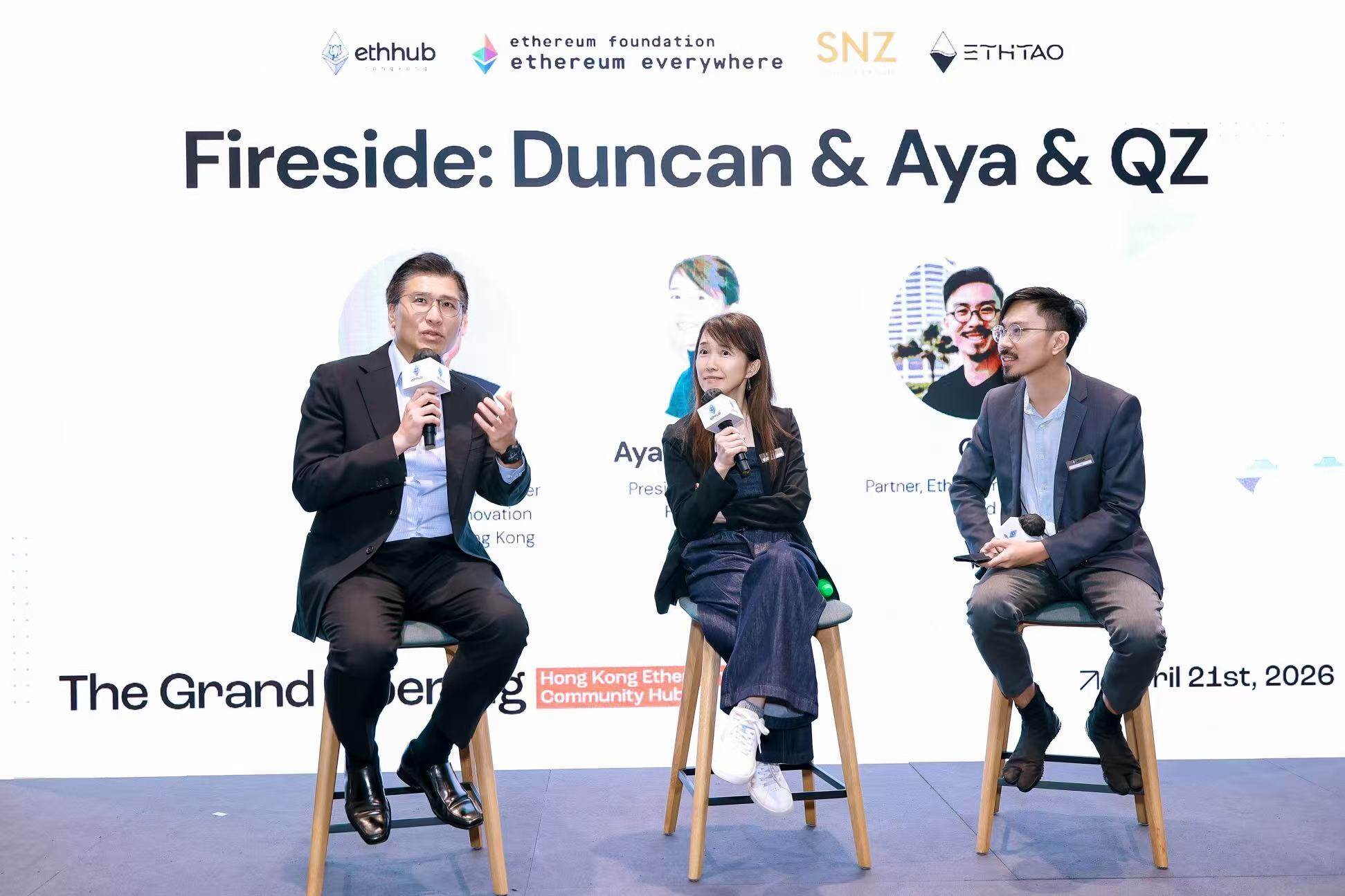
On April 21, the ETH HK Hub, jointly operated by SNZ and ETHTAO, was officially launched in Hong Kong. Aya Miyaguchi, President of the Ethereum Foundation; Duncan Chiu, Member of the Legislative Council of the Hong Kong Special Administrative Region (Innovation, Technology and Industry); and QZ, Partner of the Ethereum Ecosystem Fund, engaged in a panel discussion at the opening ceremony.
The conversation revolved around the Ethereum Foundation's long-term philosophy, its principle of subtraction, the Walk-away Test, the development of Hong Kong's digital asset ecosystem, and the significance of the ETH HK Hub for the Asian Ethereum community.
As Ethereum marks its tenth anniversary, Aya emphasized that the Foundation's goal is not to become the control center of the ecosystem, but to enable the system to operate sustainably without its involvement. Duncan Chiu shared Hong Kong's unique advantages as a node for digital asset development from the perspectives of local policies, financial infrastructure, and talent flow.
Below is the full transcript of the translated conversation, edited and slightly abridged for clarity.
Moderator QZ: This year marks the tenth year of Ethereum's development. Seeing the ecosystem evolve here in Hong Kong, from small early gatherings and discussions to a physical community hub today, is a very significant sign of progress.
Ethereum has always represented something that transcends technology itself — it embodies the possibility of building large-scale systems, even a new form of digital civilization. But this path is not easy.
The Ethereum Foundation recently put forward an important philosophy: a system must not only function effectively today but also avoid becoming a bottleneck in the future. This reflects the Foundation's core principle — even when faster paths to short-term growth exist, choosing the more difficult but more sustainable long-term direction is paramount.
Aya, from your perspective, have there been truly difficult moments in adhering to this principle?
Aya Miyaguchi: This tension exists every single day.
I joined the Ethereum Foundation during the ICO boom. The market had strong momentum for growth, accompanied by immense external pressure. Many suggested the Foundation should expand rapidly, actively hire, and operate like a traditional large company, for instance, by creating roles like CTO or CMO.
That sounded like the natural choice, but we didn't do it.
Because Ethereum must pass what we call the "Walk-away Test" — meaning the entire system must be able to function normally even without the Ethereum Foundation. That is our long-term goal.
A classic example is The Merge in 2022. It was an extremely complex upgrade, involving numerous already-running applications and collaboration from multiple client teams. It would have been much simpler if a single team within the Foundation had executed it.
But we deliberately chose client diversity. While this increased the difficulty, it enhanced the protocol's resilience in the long run. So, in many cases, we choose the harder path to achieve long-term sustainability.
QZ: If the Foundation had chosen a centralized development path back then, what things wouldn't exist today?
Aya Miyaguchi: We have always emphasized the "philosophy of subtraction."
If the Foundation built everything for the entire ecosystem, participants would become dependent on it. In the long run, this weakens competition, and without competition, optimal solutions cannot emerge.
Ethereum's potential is too vast to be controlled by a single organization. Many important innovations in the ecosystem today happened without direct Foundation involvement.
This is precisely Ethereum's strength. Our role is to support and coordinate, not to over-control. The community hub we see here in Hong Kong today is itself a manifestation of this philosophy.
QZ: Duncan, from your perspective, how did you get into this field?
Duncan Chiu: Before answering, I'd like to first welcome Aya to Hong Kong. I hope this won't be your last visit.
I first encountered Ethereum around 2014, before the ICO era. As a venture capitalist, we were looking at some blockchain projects at the time, but due to limited understanding, we didn't make large-scale investments. However, we kept following the field's development.
Starting in 2021, as a Legislative Council member, I became involved in analyzing technological trends and policy research. By 2022, the Hong Kong government realized that blockchain would profoundly impact financial infrastructure. As an international financial center, we had to maintain our competitiveness.
Therefore, we began promoting a series of developments, including stablecoin legislation, tokenized financial products (like bonds and deposits), and encouraging financial institutions to explore on-chain infrastructure. This progression moved step by step across products, ecosystems, infrastructure, and regulation.
QZ: What is the biggest challenge regarding adoption?
Duncan Chiu: Any technology takes time to develop. If you look at artificial intelligence, it has evolved over decades, while blockchain is still in a relatively early stage. Adoption cannot be forced; it is the result of innovation. When products that truly meet user needs emerge, adoption will happen naturally. Institutions will follow, and regulation will follow. Regulation is always lagging. Therefore, the most important thing is to have builders continuously driving innovation and creating new products.
QZ: Why is an "intermediary-free system" so important?
Aya Miyaguchi: Because without this guarantee, there is no reason for anyone to build on top of it.
Being intermediary-free means no single entity can shut down the system. We have already seen the fragility of centralized systems. For example, a global software failure in 2024 led to massive system outages, flight cancellations, and billions of dollars in economic losses.
This demonstrates the immense risk of relying on centralized systems. So, this is not just a matter of philosophy, but a practical necessity.
QZ: Why should developers choose Ethereum?
Aya Miyaguchi: It depends on the characteristics Ethereum offers. It has the largest developer ecosystem globally and is the most active development platform. When developers join Ethereum, they are not just building products; they are participating in a global systemic exploration. Ultimately, the focus is not on Ethereum itself, but on the world it can create.
QZ: What does "success" mean for the Ethereum Foundation?
Aya Miyaguchi: Success means the Foundation does less, and Ethereum becomes stronger. The ecosystem is healthy when the community can develop independently and innovation doesn't rely on the Foundation. Ideally, Ethereum will become like the internet - an infrastructure that is used naturally.
QZ: Duncan, what makes Hong Kong unique in the development of digital assets?
Duncan Chiu: Hong Kong has multiple advantages, including connecting East and West, attracting global talent, and a mature financial system. It's a place where connections can be made quickly, collaboration happens, and ideas are put into action. In recent years, we have also seen an increasing inflow of talent, and changes in the global landscape have further highlighted Hong Kong's importance.
Ultimately, the development of technology depends on people, and Hong Kong is a place where people want to come and build.
QZ: Thank you, Duncan. Thank you, Aya. And thank you all for participating.