Perp: Z世代的金融武器,對抗一個永不天亮的時代


- 核心觀點:永續合約(Perp)作為一種無到期日的高槓桿衍生品,正被全球年輕人(尤以韓國、奈及利亞、印度為代表)用作對抗結構性的經濟不平等與階級固化、突破傳統金融交易時間壁壘的集體行動工具,其需求正指數級增長,並驅動 RWA 資產上鏈與監管框架的加速落地。
- 關鍵要素:
- 2025年初,韓國32%的人口(1620萬)持有加密帳戶,超越股票帳戶;奈及利亞約1/3成年人持有加密資產,全球採用率最高。
- 印度散戶衍生品交易佔比從2018年的2%飆升至2025年的41%,帳戶數達1.54億;40%以上交易者年齡不到30歲,且收入極低。
- 2025年,中心化交易所永續合約年交易量達86.2萬億美元(同比+47%),鏈上DEX永續合約達6.7萬億美元(同比+346%),佔全部加密衍生品交易量的78%。
- 傳統金融中,夜間交易時段(00:00-09:30)對高波動股票如AMC產生了高達30,000%的收益率,而日內交易虧損99.6%,揭示了時間與資訊權的階級壁壘。
- 2026年4月,CFTC主席公開宣布將為永續合約建立美國本土監管框架;Kraken、Coinbase、Robinhood等均加速佈局相關產品。
- 鏈上RWA永續合約在傳統市場週末時成為全球唯一定價機器,曾短暫佔Hyperliquid總交易量的44%,資產擴展至NVIDIA、Samsung、原油等。
In a rented apartment in Seoul's Gangnam district, a 27-year-old programmer stares at his computer screen late into the night.
He's not gaming. On the screen flickers the position page of Hyperliquid — a long position on an ETH perpetual contract, with 20x leverage, the margin being three months of his savings. He did the math: at his salary level and current housing prices in Seoul, it would take about 30 years of saving every penny to afford a standard apartment. But by then, he would be 57.
He is not an isolated case. He represents a generation.
In early 2025, over 16.2 million South Koreans held crypto accounts, roughly 32% of the national population, already surpassing the number of stock account holders. Within just weeks after Trump's election victory, over 500,000 South Koreans opened new crypto trading accounts. An observation about this group describes it thus: Young people in Seoul are making concentrated, high-leverage bets. Hundreds of thousands of accounts move in roughly synchronized patterns, generating market impact that no single institutional investor can match.
You can call it gambling culture, but it's also the rationality of desperation.
The same story unfolds in a different language on the other side of the globe.
In Lagos, the purchasing power of the Naira evaporates visibly. Following a sudden currency devaluation in March 2025, on-chain transaction volumes in Sub-Saharan Africa surged to nearly $25 billion in a single month, against a backdrop of general contraction elsewhere. About one-third of Nigerian adults hold or use cryptocurrency, making it the country with the highest adoption rate globally. For many Nigerians, this isn't speculation. In a nation where owning a bank account is difficult, it's the only trustworthy store of value.
In Mumbai, the participation rate of Indian retail investors in the derivatives market skyrocketed from 2% in 2018 to 41% in 2025. The number of trading accounts soared from 36 million to 154 million in five years. A SEBI study of nearly 10 million individual stock derivatives traders found that over 40% are under 30 years old, and more than three-quarters earn less than the equivalent of 50,000 RMB annually. They engage in high-leverage trading with extremely limited income buffers, unable to stop despite regulatory warnings.
Seoul, Lagos, Mumbai — it's a microcosm of the world. Young people today are converging on a single instrument: the perpetual contract.
This isn't just a crypto industry story. It's a global collective action driven by structural inequality, where young people use leverage as a tool to fight against the relentless pressure of their times.
A Brilliant Idea, Waiting Thirty Years
The perpetual contract (commonly called "Perp" in the industry) is not a crypto invention.
In 1993, Nobel laureate economist Robert Shiller formally proposed this concept. In his design, it was an ultimate cash-settled instrument with no expiry date, capable of tracking the long-term value of illiquid assets, initially conceived to hedge real estate price risk.
However, the timing was off; the machinery of traditional finance was too cumbersome. Wall Street built a massive system around fixed expiry dates, batch settlement, and centralized clearing. That old machinery, driven by paper documents and layers of intermediaries, inherently resisted the flexibility of "never settling." Shiller's idea lay dormant in academic journals for over twenty years, with no one capable or motivated enough to implement it.
Until 2016, when BitMEX's Arthur Hayes introduced perpetual contracts to cryptocurrency.
In those two years, BitMEX leveraged perpetual contracts to rapidly rise from the periphery to become an industry powerhouse.
The secret wasn't Bitcoin itself, but that perpetual contracts unleashed one of humanity's oldest impulses: directional betting with leverage. No expiry date, no Greek letters, no rollovers, no strike prices. Only one thing remained: a judgment call — up or down, and by how many multiples.
In a recently widely discussed report, a16z Investment Partner Jay Drain defined the essence of this with one sentence: "Perpetual swaps strip away all the complexity of options. No need to choose a strike price, manage expiry, or worry about time decay eating into a correct directional thesis. They keep only one thing: a pure bet on price direction. The explosive growth of 0DTE options has already proven the scale of this demand."
The 0DTE he refers to is another exploding instrument in the US stock market: zero days to expiration options. In 2025, the average daily volume of 0DTE SPX options reached 2.3 million contracts, up 51% year-over-year, accounting for 59% of total S&P 500 options volume. Retail traders make up 50% to 60% of this volume.
No waiting, no complexity. Right now, give me leverage.
Perp simply takes this demand to its extreme.
The numbers are the most honest footnote to this evolution. In 2025, the total trading volume of perpetual contracts on centralized exchanges reached $86.2 trillion, up 47% year-over-year. The growth on-chain DEX perpetuals was even more staggering, with an annual volume of $6.7 trillion, up 346% year-over-year. Perpetual contracts now account for over 70% of all centralized crypto trading volume and roughly 78% of all crypto derivatives volume.
The notional trading volume of Bitcoin perpetual contracts is about six times that of Bitcoin spot trading.
This market structure, where derivatives dominate pricing, has never been seen before in any traditional asset class like gold, crude oil, or the S&P 500.
Dopamine, Tribes, and PNL: Trading as a Lifestyle
The crazy spring of 2021 is the starting point for understanding all of this.
Robinhood, with its colorful interface and zero-commission slogan, simplified complex financial games into a slide-and-tap game on a phone. This product design collided with the historical vacuum of global lockdowns: tens of millions of young people had government stimulus checks, had lost traditional outlets for gambling like sports, casinos, and bars, and the stock market became the world's largest, only-ever-open arena.
Retail traders on Reddit's WallStreetBets forum discovered hedge fund Melvin Capital's massive short position in GME. They rallied via social media, using call options to drive the stock price up dozens of times, forcing a top-tier Wall Street hedge fund to capitulate and seek a bailout.
The GME event declared one thing to the world: Retail traders discovered that through derivatives and leverage, they could directly rewrite pricing logic.
But GME was just a flashpoint. Deeper forces were already in place.
Modern trading apps are increasingly designed like games: real-time jumping numbers, flashing red and green colors, notification sounds upon execution. This is essentially a high-frequency feedback dopamine system. In the past, trading required turning on a computer and reading research reports. Now, a trade can be executed with a swipe on the phone while on the subway, on the toilet, or waiting in line for coffee. When the barrier to trading is low enough, it becomes a fragmented pastime just like scrolling through short videos or playing mobile games.
PNL (Profit and Loss statements) become a new kind of status symbol. Screenshots of profitable trades are proof of "skill," while self-deprecating posts about losses are a form of "sincere" social currency. In Discord channels or on X, this real-time financial fluctuation is far more impactful than any static life photo. People who buy the same Meme coin naturally form a community of shared interest. The emotional bond of "getting rich together" or "going to zero together" is much stronger than mere shared hobbies.
Thus, trading has become a daily social activity and lifestyle for a new generation of young people.
And among all trading tools, the perpetual contract is the perfect dopamine vehicle.
It lacks the complexity of options and the expiry anxiety of futures. It only has positions, leverage, and unrealized P&L visible anytime. It perfectly aligns with this generation's sense of time — not three-year holding, not quarterly reviews, but right now, tonight, the next two hours.
Derivative instruments originally designed for risk management in traditional finance are being weaponized by a new generation of retail traders for directional bets. Perp, with its minimalist design and "fast, satisfying, intense" trading rhythm, perfectly matches this demand.
A Class Barrier Hidden for Two Hundred Years
However, the significance of perpetual contracts goes far beyond "low-barrier gambling."
It is breaking down an older wall.
For a long time, the restricted trading hours of traditional stock markets represented a hidden class barrier. Academic research reveals a startling fact: due to the "overnight drift" effect, a disproportionate share of long-term returns in US stocks occurs outside regular trading hours. Earnings releases and major news are typically scheduled to avoid market open, locking retail investors into a 9-to-5 window. They can only watch helplessly as prices gap at the opening bell — profits that should have been theirs are already carved up by institutions with access to extended-hours trading.
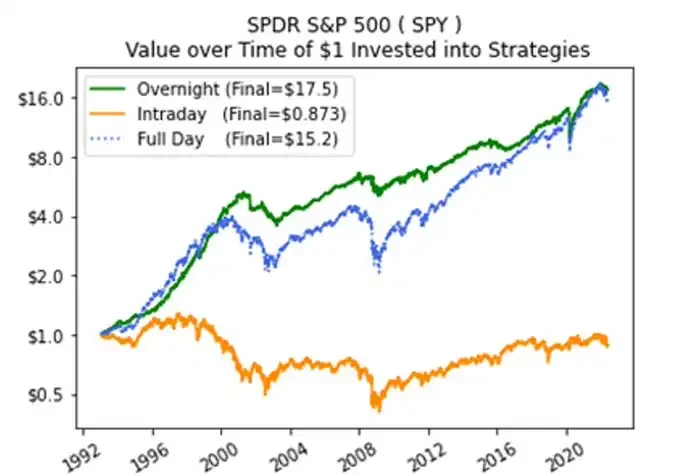
The data coldly confirms this. If, between 2019 and 2022, you bought the high-volatility retail favorite AMC at the open each day and sold at the close, your principal would have been nearly wiped out, losing up to 99.6%. But if you only held it overnight during the same period, your return would have been an astonishing 30,000%.
This isn't a story about luck. It's about the structurally unequal distribution of information rights, time rights, and pricing rights — an imbalance that has existed for two hundred years.
On-chain perpetual contract platforms are arguably one of the only pieces of infrastructure in the world today that can truly break down this wall.
This is no longer a theoretical concept. In March of this year, during the panic-stricken weekend following an Iranian attack, major global stock exchanges shut their doors. Retail traders could only frantically scroll through social media, while Hyperliquid's crude oil perpetual contract traded $1 billion within 24 hours.
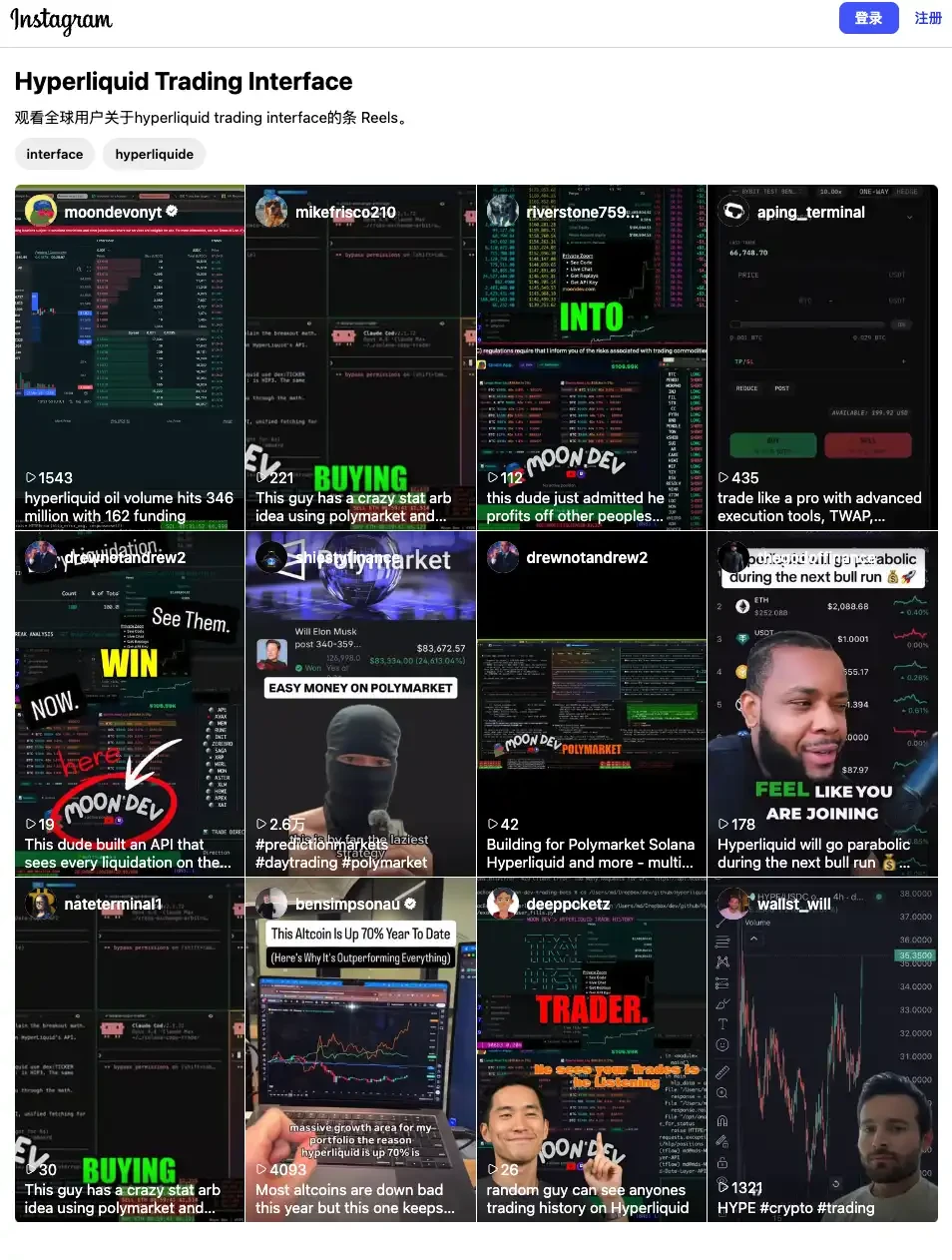
Hyperliquid gains popularity among new-generation traders on Instagram
Simultaneously, the Intercontinental Exchange (ICE), the Chicago Mercantile Exchange (CME), and Nasdaq have all announced plans to launch 7×24-hour trading services. The wall of restricted trading hours, standing for two hundred years, is being dismantled from both sides simultaneously.
The Endgame of RWA: Everything Can Become a Perp
In the past, perp traders could only bet on crypto assets — BTC, ETH, SOL, and a long list of altcoins.
This boundary is disappearing.
Starting from the second half of 2025, despite an overall bearish crypto market, RWA (Real World Asset) perpetual contracts have risen against the trend. Several DEXs have already launched commodity, stock, and index contracts, with tradeable assets expanding to NVIDIA, Samsung, SpaceX, as well as commodities like silver and palladium.
Recently, RWA assets briefly accounted for 44% of Hyperliquid's total trading volume, consistently ranking among the platform's highest revenue-generating pairs. During weekends when traditional markets are closed, Hyperliquid's on-chain crude oil perpetual contract becomes the only functioning crude oil pricing machine globally.
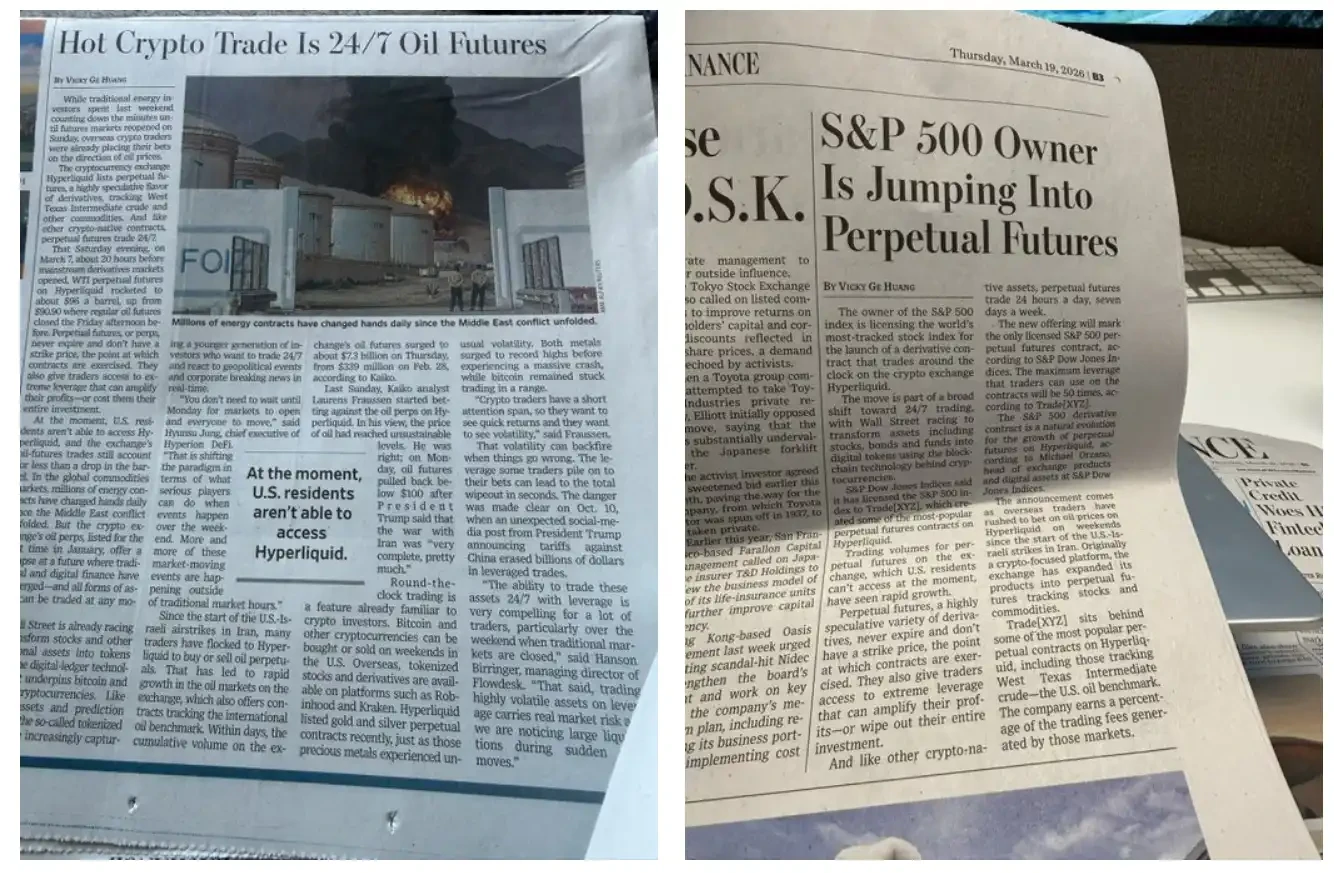
The Wall Street Journal reports on Hyperliquid and TradeXYZ twice
This is a paradigm shift in progress.
In its latest outlook report, a16z explicitly states that synthetic products (like perpetual contracts) offer deeper liquidity and are a more crypto-native RWA solution than simple tokenization. This is essentially a historical choice between "perpetual contract vs. tokenization," and the answer is becoming clear.
Coinbase Institutional Research is even more direct: Given the long-term trend of increasing global retail participation in US stocks, stock perpetuals are poised to become the go-to tool for a new generation of retail traders, offering both 24/7 access and capital efficiency.
Capital has already sensed this direction.
On April 28, 2026, crypto derivatives platform Liquid announced the completion of an $18 million Series A funding round, co-led by Neo and Left Lane Capital, with participation from Haun Ventures, K5 Global, SV Angel, and others. Previously, the company had raised a $7.6 million seed round led by Paradigm, bringing total funding to $25.6 million.
Liquid was founded by Franklyn Wang, a former Two Sigma quantitative researcher and Harvard graduate. He is 25 years old. The company started as a simple perpetual contract aggregator, integrating on-chain derivatives exchanges like Hyperliquid, Lighter, and Ostium into one interface. It has now expanded to stocks, forex, commodities, and prediction markets, supporting over 500 trading instruments, including positions from Polymarket, with leverage up to 200x.
Hundreds of millions of young people around the world are waiting for a tool simple enough to allow them to bet on the direction of the world with minimal friction.
And the brightest minds in traditional finance are also gravitating towards Perp.
Regulation Opens Up; On-Chain Never Gets Dark
In April 2026, CFTC Chairman Michael Selig stated in a public address that the regulator would establish a complete regulatory framework for perpetual contracts "in the near term" within the United States.
His exact words were: "The previous administration failed to create a path for these markets to exist onshore. Under my leadership, the CFTC will use every tool at its disposal to bring perpetuals and other novel derivatives onshore and allow them to thrive in both centralized and decentralized markets."
It was almost an open declaration of intent.
Global exchanges have already started moving. Kraken's parent company acquired Bitnomial, which holds a perpetual contract license, for as much as $550 million. Coinbase launched a long-term futures product approximating perpetual contracts. Robinhood announced it is introducing perp for US users. Polymarket and Kalshi also announced their entry into the perpetual contract space. Even before Robinhood's prediction market launch, its product line traded a record 11 billion contracts in 2025 with over 1 million active users — the fastest-growing revenue line in the platform's history.
Previously, the primary perp markets were offshore platforms based outside the US, gathering young people from Seoul, Lagos, Mumbai, Hanoi, and São Paulo, using leverage born from fiat currency depreciation anxiety to bet on the direction of the world.
The official opening of the US market means the deepest liquidity pool in the world will meet the most popular financial instrument of our era on the same stage.
An on-chain trading platform founded in 2022, Hyperliquid, now has daily trading volumes that can challenge top global centralized exchanges. A perpetual contract aggregator, Liquid, which launched only in August 2025, processed $3 billion in trading volume within eight months and just completed a Series A funding round led by top-tier venture capital firms.
They are all built on the same foundation: Gen Z doesn't want to wait for markets to open, doesn't want to fill out account opening documents, and doesn't want to pay for the layers of obstacles traditional finance has erected for their "protection." What they want is right now, leverage, and any asset with a story, available in any time zone.
In late 18th century New York, anyone could become a stockbroker. There were no tickers or fixed trading venues. Trading usually happened under a buttonwood tree on Wall Street, a central gathering point where brokers and merchants bought and sold stocks and government bonds. Trading hours were simply "when everyone was around." When it got dark, people dispersed, and trading stopped.
Today, that tree has grown on the chain, and it never gets dark.