






各州圍剿、CFTC反訴,預測市場正被監管撕裂


- 核心觀點:美國預測市場正面臨聯邦與州監管的正面衝突,多州以非法賭博為由起訴平台,而CFTC則力主事件合約屬於其排他監管範疇,行業增長邏輯被迫轉向合規攤牌。
- 關鍵要素:
- 多州(如亞利桑那、紐約等)起訴Polymarket、Kalshi、Coinbase等平台,認為其事件合約實為未經許可的賭博,繞過了博彩牌照、年齡限制等監管體系。
- CFTC親自下場起訴多州政府,主張事件合約屬於聯邦監管的衍生品市場,州政府不能以地方賭博法干預,衝突升級為聯邦與州監管權的正面爭奪。
- 平台的核心抗辯邏輯是,它們提供受CFTC監管的金融市場,而非賭場,預測市場具有價格發現功能(如選舉、通膨等),並依託聯邦監管實現全國性擴張。
- 新澤西案中法院支持Kalshi,確認聯邦優先權,成為平台重要勝利;但不同州對體育、選舉等合約的監管風險各異,合規路徑仍不清晰。
- 監管壓力已從原生平台擴展至Coinbase、Robinhood等主流交易平台,預測市場連同交易所、經紀商共同面臨新的合規變數,行業擴張效率可能被碎片化市場結構限制。
Original | Odaily Planet Daily (@OdailyChina)
Author | Asher (@Asher_0210)

The expansion of prediction markets in the United States is colliding with increasingly dense regulatory pushback.
In the past, platforms like Polymarket and Kalshi rapidly gained notoriety by leveraging sports, elections, macroeconomics, crypto assets, and social events, packaging "trading future outcomes" as a new form of information and financial market. However, as user scale and trading categories expand, several U.S. states are providing a starkly different definition: This is not innovative financial products, but unlicensed online gambling.
From Arizona, Connecticut, and Illinois to New York, Massachusetts, Michigan, Washington, and Nevada, prediction markets are facing lawsuits, injunctions, cease-and-desist letters, and regulatory investigations. More critically, the CFTC (Commodity Futures Trading Commission) has entered the fray, suing multiple states in an attempt to assert its exclusive regulatory authority over event contract markets. In other words, the controversy over prediction markets is no longer just about whether a specific platform is compliant, but a direct conflict between U.S. federal regulation and state-level gambling oversight.
Multiple States Sue, Prediction Markets Face Regulatory Scrutiny
On the surface, the regulatory actions by U.S. states target different platforms. Some states target Kalshi, others Polymarket, and some have Crypto.com, Robinhood, Coinbase, Gemini, etc., in their sights. But when viewed together, a core concern among regulators becomes highly consistent: Prediction markets are using the guise of "event contracts" to bypass the regulatory systems established by states for gambling, sports betting, and consumer protection.
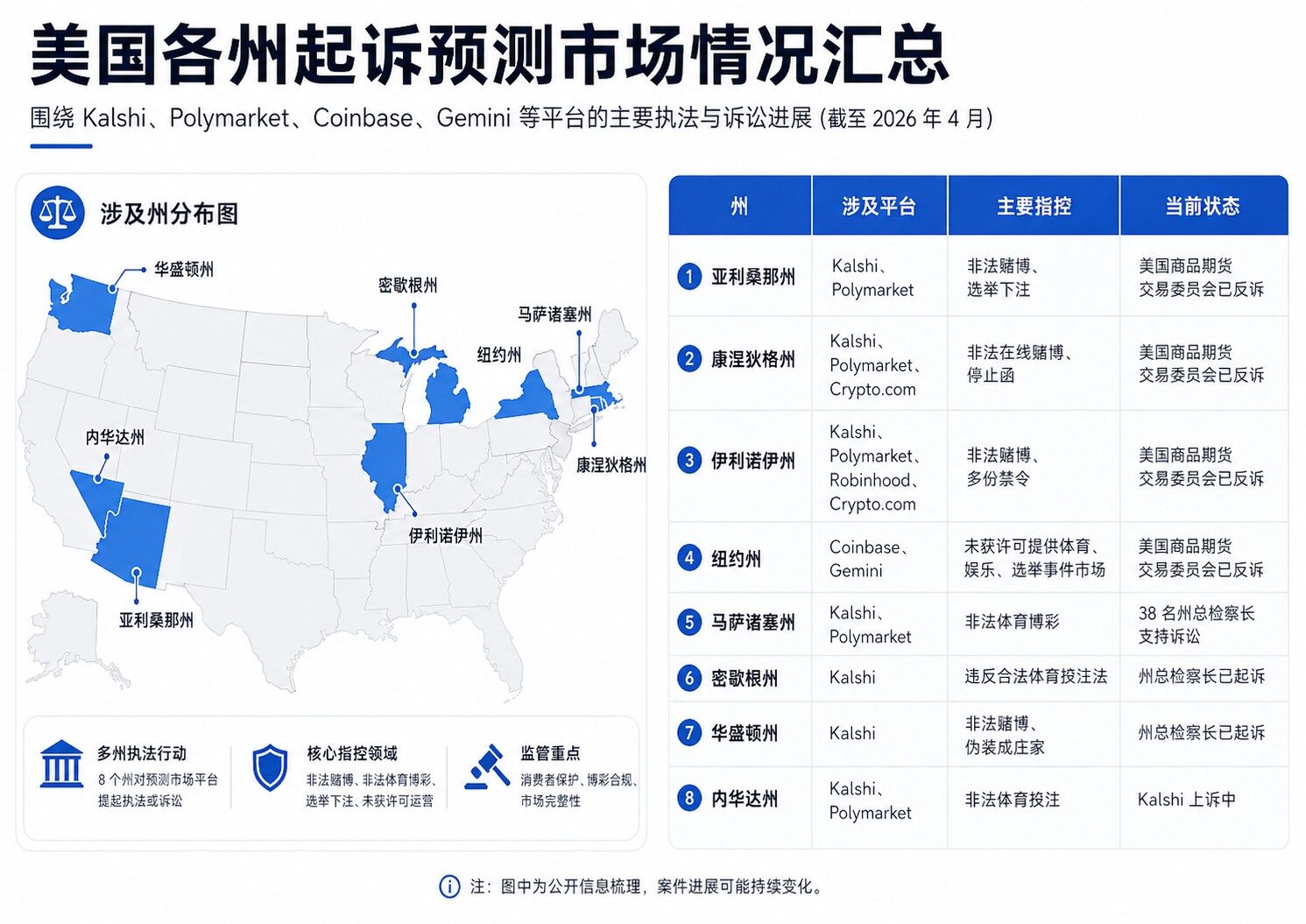
Arizona, Connecticut, and Illinois were the first three states to trigger federal counter-lawsuits. These states took regulatory action against platforms like Kalshi, Polymarket, Crypto.com, and Robinhood, arguing that the event contracts they offer potentially violate state gambling laws. Arizona even filed criminal charges against Kalshi, accusing it of facilitating illegal gambling and touching upon the state's restrictions on election betting. Subsequently, the CFTC sued these three states, arguing that state governments cannot use local gambling laws to interfere with the federally regulated national derivatives market.
New York has further escalated this regulatory conflict. New York Attorney General Letitia James sued Coinbase Financial Markets and Gemini Titan, alleging their prediction market businesses constitute unlicensed gambling. New York authorities emphasize that these platforms, without a license from the New York State Gaming Commission, allow users to trade on the outcomes of events like sports and elections; simultaneously, the platforms permit users aged 18 to 20 to participate, whereas the minimum age requirement for mobile sports betting in New York is 21.
The common thread in these cases is that state governments are not opposing "prediction" itself, but believe platforms are packaging wagering as financial transactions to circumvent gambling licenses, age restrictions, tax rules, and consumer protection requirements. From the states' perspective, the boundary between many event contracts and traditional gambling is unclear. Whether a user bets on a team winning, the point spread of a game, a candidate's election, or the occurrence of a political or entertainment event, it essentially involves wagering on an external outcome beyond the user's control. While platforms use terms like "contracts," "markets," and "trading," what states see is users putting up capital, betting on an outcome, profiting if correct, and losing their principal if wrong.
Sports-related events are the most concentrated area of this regulatory conflict. Massachusetts previously sued Kalshi, claiming it offers sports betting services without a license. Recently, 38 state attorneys general joined an amicus brief supporting Massachusetts' lawsuit, opposing Kalshi's narrative of packaging sports predictions as financial instruments. The logic in Michigan, Washington, Wisconsin, and other states is largely similar. Their focus is not on whether prediction markets can enhance information efficiency, but on whether platforms are providing sports or other event betting services to state residents without obtaining a gambling license.
This means the pressure on prediction markets is no longer limited to native platforms like Polymarket and Kalshi. When mainstream trading platforms like Coinbase, Gemini, Robinhood, and Crypto.com are also drawn in, the issue becomes a compliance problem for the entire industry's gateway. Prediction markets are no longer just a vertical niche but have become a new regulatory variable confronting exchanges, brokerages, and crypto platforms alike.
Platforms Fight Back: We Are Not Casinos, But Federally Regulated Financial Markets
Faced with lawsuits from various states, the core counter-argument from platforms like Kalshi and Polymarket is clear: They are not casinos but provide event contract markets regulated by the CFTC.
The key to this logic lies in "regulatory attribution." If event contracts are deemed financial derivatives, they should be uniformly regulated by a federal agency, and states cannot individually restrict them with local gambling laws; if event contracts are considered gambling products, then platforms must navigate the fragmented state gambling license requirements, age thresholds, tax systems, and market access rules.
This is the line Kalshi, Polymarket, and other platforms must defend. For them, the greatest commercial value of prediction markets is the ability to expand nationally using a financial market framework. If they had to reapply for gambling licenses, comply with local sports betting rules, and submit to state gambling regulators in every state, the efficiency of their expansion would plummet, and many products might become unviable.
Furthermore, platforms emphasize that prediction markets are not merely entertainment betting but can provide price discovery functionality for the real world. Elections, interest rates, inflation, sports, policies, geopolitical conflicts, and crypto events are all fundamentally about uncertainty. Prediction markets incentivize participants with real money to express their judgments, thereby forming a tradable, observable probability price.
CFTC Enters the Fray, Escalating the Conflict
The true escalation of this conflict began when the CFTC itself sued state governments.
The CFTC has sued Arizona, Connecticut, and Illinois to prevent these states from using gambling laws to regulate prediction markets. Its core argument is that event contracts fall under federally regulated markets, and state governments cannot disrupt the national derivatives regulatory framework with local enforcement actions. Recently, the agency also sued New York State, arguing that New York's enforcement actions against prediction markets infringe on its exclusive regulatory authority.
This makes the regulatory debate over prediction markets even more complex. Previously, the public saw conflicts between state governments and platforms; now, the true adversaries are state governments and the federal regulator. One side believes it has the right to protect its residents from illegal gambling, while the other argues that states are interfering with federal financial market regulation. Prediction markets are merely the trigger; behind this is a struggle over jurisdictional boundaries within the U.S. regulatory system itself.
The New York case is particularly representative. After the New York Attorney General sued Coinbase and Gemini, the CFTC quickly took legal action against New York State. New York argues that its state gambling laws must apply to these platforms because "gambling by another name is still gambling"; the federal regulator contends that states cannot redefine a federally regulated event contract market as local gambling activity.
Platforms Aren't Without Victories, But Risks Are Still Growing
Despite the flurry of state regulatory actions, platforms are not solely on the defensive. The New Jersey case stands as a pivotal point. The Third Circuit Court of Appeals recently ruled in favor of Kalshi, stating that New Jersey cannot regulate Kalshi's prediction market business. This is seen as a significant victory for platforms on the issue of "federal preemption."
This ruling sends a signal to the prediction market industry — at least in the view of some courts, state governments cannot easily reclassify federally regulated prediction markets into their state gambling oversight systems. For platforms like Kalshi, this is not just a win in a single state lawsuit but a crucial support for its narrative of national expansion.
However, this does not mean platforms are safe. Different states, different courts, and different product types may still yield varied judgments. The regulatory risks for sports contracts, election contracts, crypto-asset-related contracts, and macroeconomic contracts are not the same. The real challenge for platforms is proving they belong to the financial market while explaining why products highly resembling sports betting or political wagering should not be treated as gambling.
The regulatory pressure on prediction markets isn't solely from licensing issues. As trading categories expand, platforms are entering inherently sensitive areas, including sports, elections, war, diplomacy, and judicial events. Sports contracts easily clash with gambling laws, election contracts run into political ethics, while war and diplomatic events can touch upon insider information and national security.
From a Growth Story to a Compliance Showdown
Previously, the narrative for prediction markets was about growth. Polymarket broke out via political and crypto events, Kalshi expanded event contracts by leveraging its compliant exchange status, and platforms like Coinbase, Gemini, and Robinhood also entered this arena. The industry's story was clear: All future uncertainties can be priced, traded, and financialized.
But now, prediction markets are forced into another phase. It's no longer enough to prove users want to trade events; they must also prove this trading isn't becoming more efficient gambling. It's no longer enough to prove market prices have informational value; they must also prove that insiders, candidates, athletes, government officials, and the platforms themselves won't abuse informational advantages. They must not only address user growth but also navigate the complex conflict between federal regulation, state gambling oversight, and consumer protection.
This is the true signal sent by the wave of state lawsuits. U.S. regulators are not simply rejecting prediction markets; they are forcing the industry to answer a fundamental question: When sports, elections, wars, macroeconomics, and crypto events can all be bet upon, is this a financial market or an online casino?
If the CFTC ultimately wins the jurisdictional battle, prediction markets may find a clearer path to federal compliance, accelerating industry financialization and platformization. However, if states prevail in key cases, the expansion pace of prediction markets will be significantly recalibrated. Different states might impose varying restrictions on sports, elections, entertainment, and political events, leading platforms to face higher compliance costs and a more fragmented market structure.
Now, U.S. states, the CFTC, courts, and platforms are all in the game, and this regulatory battle over prediction markets has only just begun.
Related Content
Polymarket's Stalled Progress: The Real Test Beyond Traffic Bonanza Arrives


