Dự đoán thị trường có phải là cây hái ra tiền không? Phân tích sâu về mô hình lợi nhuận của nó


- Quan điểm cốt lõi: Mô hình kinh doanh của thị trường dự đoán không đơn giản chỉ là thu phí khi mở cửa. Thay vào đó, nó biến sự bất đồng quan điểm thị trường thành nhu cầu giao dịch, tận dụng cơ chế phí Taker khác biệt để chuyển đổi các hành vi khớp lệnh chủ động một cách ổn định thành doanh thu của nền tảng. Thành công của Polymarket đã xác nhận sự chuyển đổi từ "câu chuyện về lưu lượng truy cập" sang "xác nhận doanh thu có hệ thống".
- Các yếu tố chính:
- Bản chất của mô hình lợi nhuận là "biến bất đồng thành Phí": Giá càng gần mức 50/50, thị trường càng bất đồng, xung lực giao dịch càng mạnh, doanh thu phí của nền tảng càng cao; ngược lại, khi kết quả đã rõ ràng, giá trị thông tin cao nhưng tỷ trọng phí lại thấp.
- Cấu trúc phí của các nền tảng chính thống có sự khác biệt rõ rệt: Polymarket áp dụng định giá khác biệt theo lĩnh vực (Phí Crypto 0.07) và định giá dựa trên mức độ bất đồng (p×(1-p)); Kalshi gần giống với mô hình sàn giao dịch tuân thủ; Opinion nhấn mạnh hệ thống chiết khấu phức tạp và phân tầng người dùng; Predict.fun thì sử dụng mức phí thống nhất 2%.
- Dòng thời gian thương mại hóa và các mốc quan trọng của Polymarket: Tháng 1 năm 2026, bắt đầu thu phí từ mảng Crypto trước tiên, tháng 2 mở rộng sang Sports, sau khi thu phí toàn diện vào tháng 3 cho thấy khả năng tạo ra lợi nhuận mạnh mẽ, với 7D Fees đạt 9,27 triệu đô la Mỹ.
- Khối lượng giao dịch không đồng nghĩa với lợi nhuận thực tế: Mảng Sport có khối lượng giao dịch 7 ngày (401 triệu đô la Mỹ) cao nhất, nhưng phí ước tính của nó (3,31 triệu đô la Mỹ) lại thấp hơn so với mảng Crypto (4,39 triệu đô la Mỹ). Nguyên nhân là do tỷ lệ lệnh thị trường (75%) và mức phí (0.07) của Crypto đều cao hơn Sport (60% và 0.03).
- Rào cản thực sự của thị trường dự đoán nằm ở "quyền định giá liên tục": Năng lực cốt lõi không phải là phát hiện ra các chủ đề nóng, mà là biến các chủ đề nóng thành các thị trường giao dịch có chiều sâu và tần suất giao dịch, khiến cho mức giá trở thành một tín hiệu có thể được tham chiếu bên ngoài.
Original authors: Changan, Amelia, Biteye Content Team
In the past, discussions about prediction markets focused on whether they were accurate, had high trading volumes, and could become new information markets. However, when we view a prediction market as a business, the core question changes: What is the profit model of a prediction market?
In the commercial world, high trading volume does not equal platform profitability. A market can generate significant buzz, and users can trade frequently, but if the majority of transactions cannot be effectively monetized through fees, or if activity is solely maintained by subsidies and points, then the trading volume is merely an impressive statistic, not a healthy source of revenue.
For prediction markets, the true test of business acumen is not "how many markets were created" or "how popular an event was," but whether the platform can seamlessly connect three things:
- The impulse to execute real trades;
- Maintaining sufficiently deep order book liquidity;
- Converting aggressive order-taking demand (Taker) into Fees.
This is precisely why the business model of a prediction market is far from a simple "tax on opening a market." On the surface, it's just a YES/NO gambling game, but the true foundation supporting the platform's revenue is the underlying trading structure, liquidity mechanisms, fee structures, and user behavior.
Especially since leading platforms like Polymarket began systematically introducing Taker Fees, the narrative around prediction markets has shifted from being "information tools" to entering a "revenue validation" phase.
This article will deeply analyze the underlying mechanisms of prediction markets from a business perspective:
- How do prediction market platforms make money?
- Why does the Maker/Taker dynamic determine a platform's success or failure?
- What are the fundamental differences in fee structures between @Polymarket, Kalshi, @opinionlabsxyz, and @predictdotfun?
- Why is the sector with the highest trading volume not necessarily the most profitable?
💡 Core Conclusion: Prediction markets don't sell answers; they sell dissent.
The closer the price is to 50/50, the greater the market dissent, the stronger the urge to trade, and the easier it is for the platform to generate fees from aggressive trades. The closer the price is to 0 or 100, the more certain the outcome, and while the informational value remains, the corresponding fee weight will significantly decrease.
Therefore, the true business moat of a prediction market is not turning "events" into markets, but turning "dissent" into trades, and then steadily converting those trades into revenue.
I. How Prediction Markets Make Money: It's Not About Opening Markets, It's About Turning Dissent into Fees
To dissect the cash flow of a prediction market, we must first clarify the four core drivers of its revenue. They intertwine to form the closed loop from traffic to monetization.
1️⃣ Transaction Fees - Direct Revenue Source
Most prediction markets charge fees to the party that actively executes the trade, usually the Taker. This is because Takers consume liquidity while Makers provide it.
This means not all trades on a prediction market generate revenue. The trades that truly contribute fees to the platform are typically those where users are willing to actively trade, paying for speed and certainty.
2️⃣ Liquidity - The Foundation for Sustained Trading
The hardest part of a prediction market isn't opening a market; it's giving that market depth.
If a market has no resting orders, users can't buy when they want to buy, and can't sell when they want to sell. Even a market with high buzz will struggle to form an effective price.
Therefore, many platforms reduce costs for Makers and even provide incentives for them.
This isn't a direct "source of revenue," but it determines whether transaction fees can exist in the long run.
Without liquidity, there are no sustained trades, and fee revenue naturally cannot be stable.
3️⃣ Informational Value - Mindshare Capture
Unlike regular trading platforms, a prediction market is not just a trading tool; it also generates information.
When a market has sufficient trading volume and liquidity, its price becomes a probabilistic signal. Media outlets cite it, KOLs interpret it, traders observe it, and average users use it to gauge market sentiment.
This part may not directly translate into fees, but it brings the platform attention, user mindshare, and external dissemination. Long-term, this informational value feeds back into trading demand.
4️⃣ User Operations and Discount Systems - Converting Activity into Revenue
Beyond basic transaction fees, different platforms also use discounts, referral programs, events, points, and rebates to increase trading frequency. These measures may not directly bring in revenue, but they impact the platform's long-term monetization capability. For example, Opinion offers user discounts, transaction discounts, and referral discounts; Predict.fun employs a simpler base fee and discount mechanism; Polymarket focuses on differentiated fee rates across sectors and Maker rebates. The essence of discounts and incentives is not merely subsidization; it's about sacrificing some profit margin in exchange for user retention, and then gradually converting that activity into revenue.
II. Horizontal Comparison of Fee Structures Among Major Prediction Market Platforms
Looking at the fee designs of several major prediction markets, the industry's strategic direction is highly convergent: encourage placing orders to provide liquidity and convert aggressive trading into revenue. However, in tactical execution, due to different positioning, the platforms exhibit clear strategic divergence.
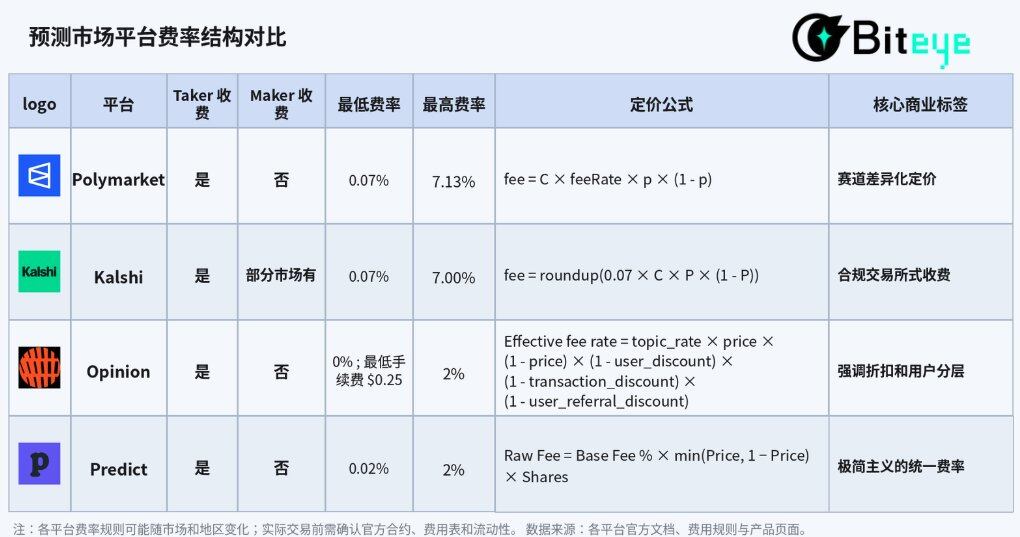
1️⃣ Polymarket: Sector-specific Pricing
Polymarket's Taker fee logic combines "sector differentiation" and "dissent-based pricing" to an extreme. Its official core formula is:
fee = C × feeRate × p × (1 - p)
Where C is the number of shares traded, p is the execution price, and feeRate is determined by the market sector.
This mechanism involves two core variables:
- Sector Refinement: Based on currently verified fee rates, the Crypto sector has a feeRate of 0.07, Sports is 0.03, Politics / Finance / Tech is 0.04, Culture / Weather is 0.05, and some Geopolitics markets are 0. This means Polymarket does not charge a uniform fee for all markets; instead, it uses differentiated rates based on the trading frequency, sensitivity, and user willingness to pay for each sector.
- Dissent-Based Pricing: Perfectly aligns with the mathematical curve of p × (1 - p). The closer the price is to 50/50 (maximum market dissent), the higher the fee; the more certain the outcome (close to 0 or 100), the lower the fee.
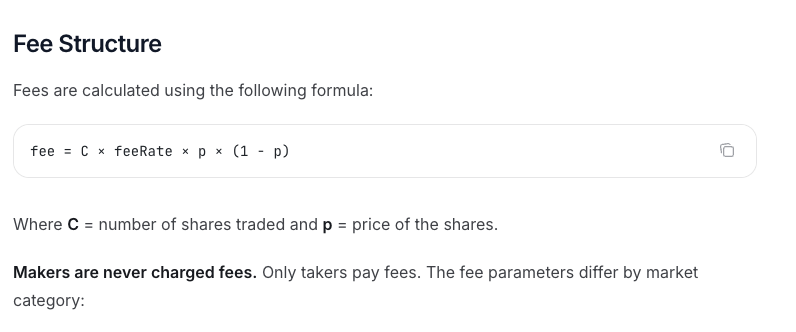
https://docs.polymarket.com/trading/fees
2️⃣ Kalshi: Closer to a Compliant Exchange Model
Kalshi's fee design, within its compliance framework, is more akin to traditional financial derivatives exchanges. Its standard Taker fee formula is also linked to price dissent:
fee = round up(0.07 × C × P × (1 - P))
Where C is the number of contracts and P is the contract price. Fees are rounded up to the nearest cent. This structure is very close to Polymarket's C × feeRate × p × (1-p).
Kalshi's fee structure shares similarities with Polymarket: its transaction fee also depends on the contract price—the closer to 50¢, the higher the fee; the closer to 1¢ / 99¢, the lower the fee. Kalshi's fee schedule shows that the taker fee for 100 contracts varies roughly between $0.07 and $1.75.
But a key difference is that Kalshi may also have Maker fees for some markets, charged only when those orders are eventually filled, and canceling an order incurs no fee. This indicates Kalshi's fee structure is closer to a compliant exchange: instead of Makers being permanently free, it sets more complex two-sided fee rules depending on the market.
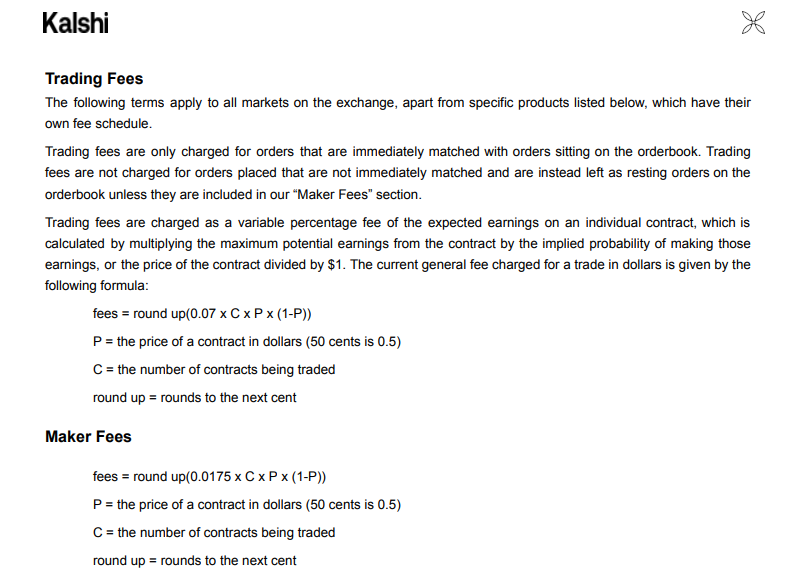
https://kalshi.com/docs/kalshi-fee-schedule.pdf
3️⃣ Opinion: Emphasizes Discounts and User Tiering
Opinion introduces a highly complex "multi-dimensional discount system." Its effective fee rate formula is:
Effective fee rate = topic_rate × price × (1 − price)× (1 − user_discount)× (1 − transaction_discount)× (1 − user_referral_discount)
This means Opinion's fee depends not only on the market price and topic_rate but is also affected by user discounts, transaction discounts, referral discounts, and other factors.
Opinion also sets a $5 minimum order size and a $0.25 minimum fee to prevent small transactions from generating negligible fees.
This shows that Opinion's fee design leans more towards user operations:
- topic_rate is used to differentiate markets
- user_discount is used for user tiering
So, compared to Polymarket's "sector-differentiated pricing," Opinion treats the fee structure more as an operational tool: on one hand, using a discount system to guide user trading, retention, and acquisition; on the other hand, keeping Makers free to lower the barrier for order placement and maintain market liquidity.
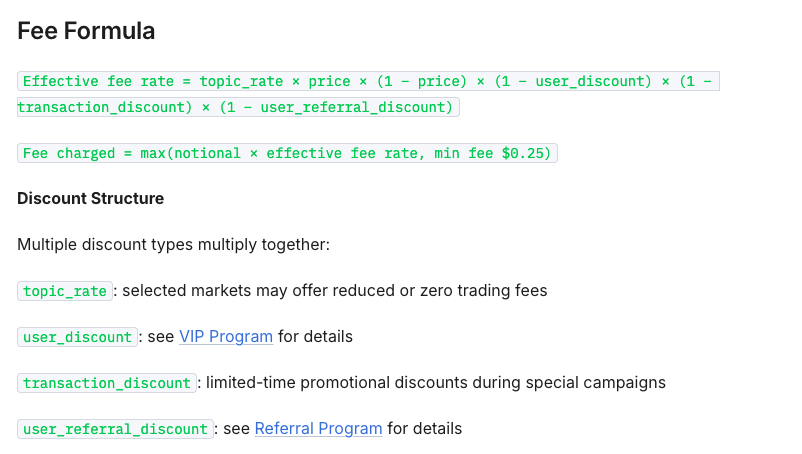
https://docs.opinion.trade/trade-on-opinion.trade/fees
4️⃣ Predict.fun: Minimalist Uniform Fee
Predict.fun's fee structure is relatively simpler, suitable for reducing user cognitive load.
According to its current public information, its fee calculation formula is:
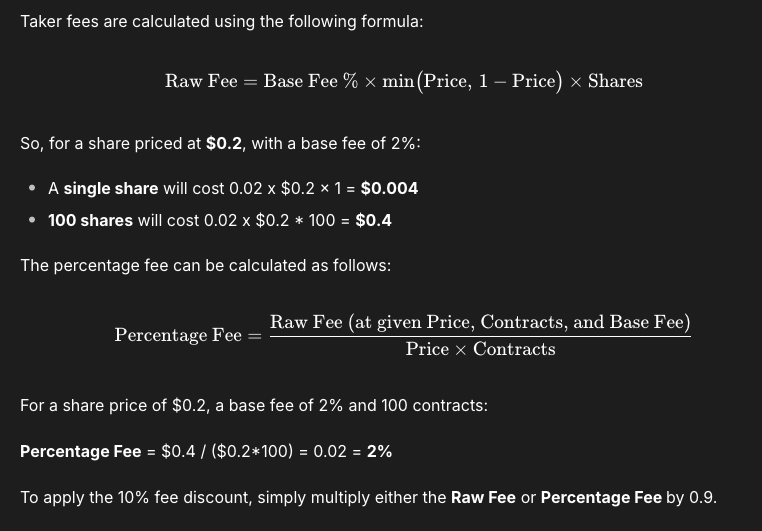
Raw Fee = Base Fee % × min(Price, 1 − Price) × Shares
The current Base Fee is 2%. The actual rate varies with the execution price: below 50%, the rate is basically fixed at 2%; above 50%, the closer the price gets to 1, the lower the actual rate.
Additionally, Predict.fun also supports fee discounts, which further lower the fee.
The characteristic of this design is its intuitiveness: users don't need to judge which side of the market they're on; they only need to focus on the execution price to understand the fee change.
https://docs.predict.fun/the-basics/predict-fees-and-limits#limits
It's clear that the common ground among prediction market platforms is that they all attempt to convert aggressive trading behavior into revenue.
This also illustrates that the commercialization of prediction markets doesn't have a single path. Ultimately, they all answer the same question: Are users willing to pay for trading?
III. Deep Dive into Polymarket: Trading Volume Doesn't Equal Real Revenue
Although various platforms employ different tactics, Polymarket remains the most suitable sample platform for observing the real monetization efficiency of prediction markets.
There are two main reasons:
- Its monetization path is the clearest: from a pilot in Crypto to expansion in Sports, and finally to near-universal fee application across more categories.
- Its data is also more complete: official feeRates, 7D / 30D Fees can all be used to further dissect the revenue structure.
So next, using Polymarket as an example, let's answer a more specific question: Is the sector with the highest trading volume really the most profitable?
3.1 From Free to Fee: Polymarket's Commercialization Timeline
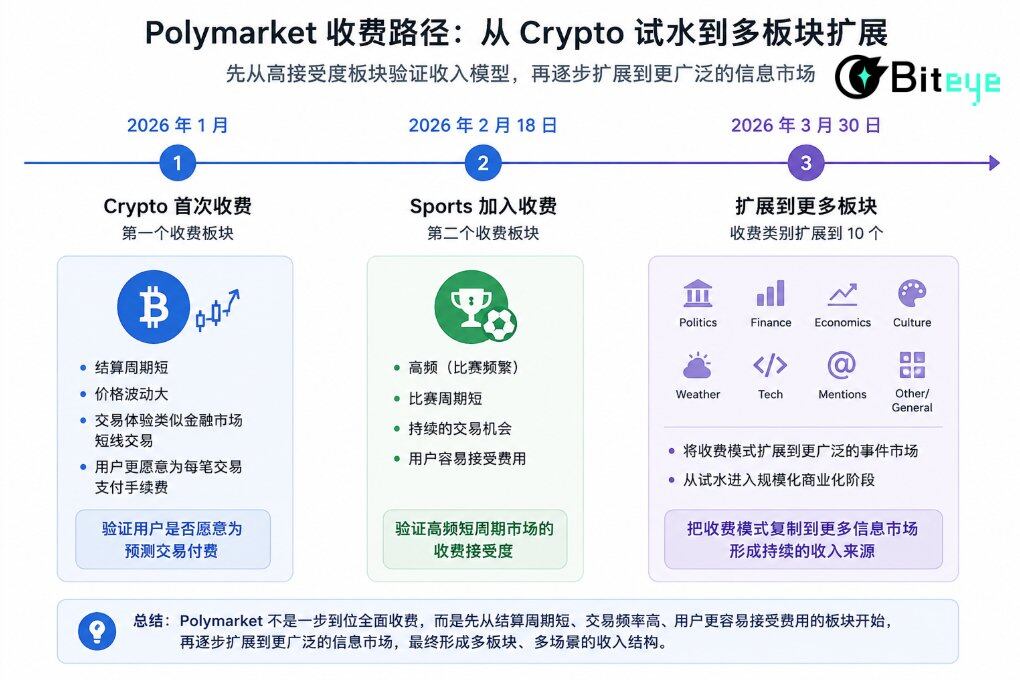
January 2026: Crypto Becomes the First Paid Sector
After returning to US users, Polymarket was the first to introduce Taker Fees in the Crypto sector. Crypto markets have short settlement cycles, high price volatility, and trading behavior similar to short-term secondary markets. Users' desire for execution speed far outweighs their sensitivity to friction costs, making it an ideal testbed for fees.
February 18, 2026: Sports Becomes the Second Paid Sector
Shortly after, on February 18, 2026, the Sports sector became the second paid sector. Sports markets have inherently high-frequency, short-cycle characteristics, providing a continuous trading scenario. Therefore, Sports was a natural extension of the fee model.
So, Polymarket's initial focus on charging for Crypto and Sports was essentially validating the revenue model on two sectors with higher user acceptance.
March 30, 2026: Fee Expansion to More Sectors
On March 30, 2026, Polymarket expanded taker fees to more categories including Politics, Finance, Economics, Culture, Weather, Tech, Mentions, Other/General, bringing the total charged categories to 10.
After the blanket fee implementation, Polymarket didn't simply charge the same fee across all sectors but adopted a more granular fee structure. This step can be seen as a key milestone in Polymarket's commercialization, marking the start of extending the fee model to a wider range of markets.
The results of blanket fees are extremely impressive. According to the latest data, Polymarket has demonstrated immense revenue-generating power: 7D Fees reached $9.27M, and 30D Fees reached $36.3M. Its 7-day revenue has entered the top six among all crypto projects on the public chain Crypto sector, officially crossing into the tier of revenue-generating projects.
3.2 Breakdown of Core Sector Market Order Types and Price Distribution
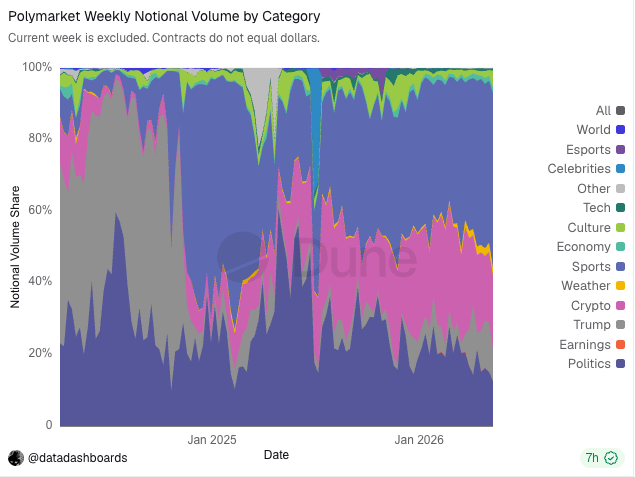
To estimate the real revenue for each sector of Polymarket as accurately as possible, we used Polymarket's trading data from 2021 to February 2026 to estimate fees for five major sectors 1.
Looking at the proportion of market orders, the differences among the five sectors are significant:
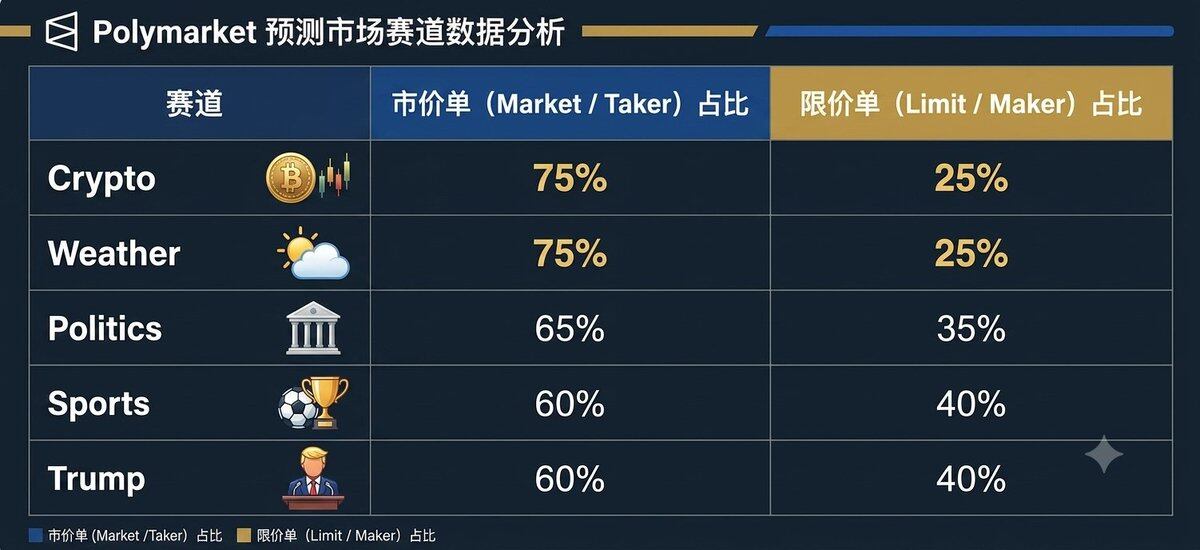
Crypto has the highest Market (market order) share, reaching 75%. This perfectly aligns with the "ever-changing" nature of crypto assets, where users prefer using market orders to lock in profits or cut losses. Similarly, the Weather sector, driven by real-time, sudden meteorological data, also sees users placing extreme emphasis on reaction speed.
Secondly, the amount of fees heavily depends on the price range of the executed trades.
The reason is that not all trades entering the fee scope generate the same fee. Polymarket's fee is related to p × (1 - p): the closer the price is to 50/50 (greater market dissent), the higher the fee weight; the closer the price is to 0% or 100% (more certain outcome), the lower the fee weight.
Data from the five major sectors shows that most trades are concentrated in the 30-50 range, especially the 40-50 range:
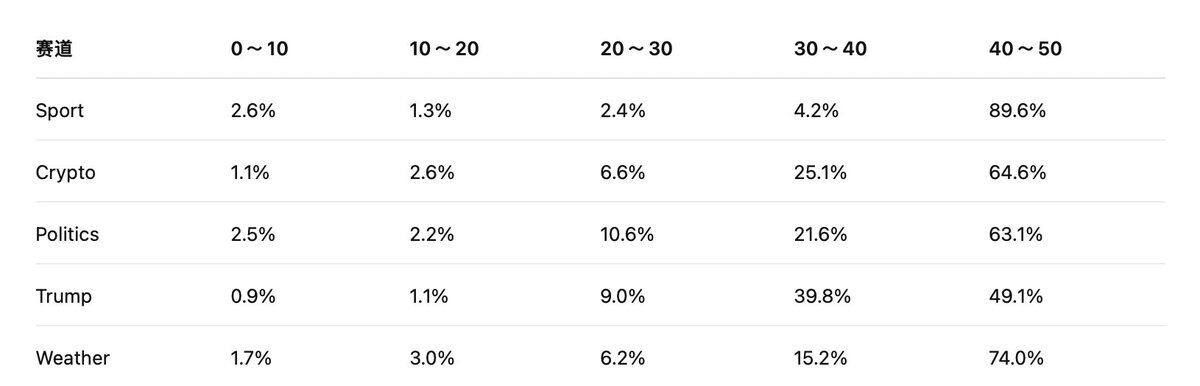
This data indicates that Polymarket's main trading activity does not occur when the outcome is nearly certain, but rather when there is significant market dissent.
3.3 Revenue Estimation: Which is the Cash Cow?
We estimate Polymarket's fee revenue across the five sectors by using each sector's Market (market order) trading volume, combined with its corresponding feeRate, and the p × (1-p) weight for different price ranges. We also consider that after fee implementation, some fee-sensitive users might switch from Taker to Limit orders. This is especially true for users trading near expiration, doing low-odds arbitrage, or engaging in frequent short-term trades, who will calculate their return on investment more carefully.
Therefore, we make a more conservative assumption on top of our initial estimate: we assume that after fee implementation, the market order volume for each sector decreases by 20%.
The adjusted formula becomes:
Adjusted Estimated Fee ≈ Market Order Volume × 80% × feeRate × p × (1 - p)
Based on the 7D total trading volume and each sector's volume share, we estimated the 7D market order trading volume for the five major sectors.