






CLARITY hasn’t passed yet, but Wall Street has already opened for business


- Core Insight: In May 2026, while the "Clarity Act" crypto market structure bill is still awaiting passage in the Senate, mainstream Wall Street brokerages (such as E*Trade and Charles Schwab) have already begun offering crypto spot trading to retail investors at fees significantly lower than native exchanges. Meanwhile, the "ethics clause" in the bill, which aims to restrict the President's family from profiting from cryptocurrencies, has become a key point of political contention.
- Key Elements:
- On May 6, E*Trade opened BTC, ETH, and SOL spot trading at a 0.50% fee rate to its 8.6 million retail customers, setting a record low fee among Wall Street brokerages and roughly two-thirds lower than Coinbase's retail fee rate (1.5%-3.5%).
- The compliance confidence for the concentrated Wall Street entry (April-May 2026) stems from the enactment of the "GENIUS Act" stablecoin legal framework and a high probability of the "Clarity Act" passing, reducing regulatory uncertainty.
- The "Clarity Act" divides digital assets into three major pools: "Digital Commodities" regulated by the CFTC, "Investment Contract Assets" regulated by the SEC, and "Payment Stablecoins" regulated by banks. It also adds DeFi activity exemptions and dual registration requirements for intermediaries.
- The "ethics clause" demanded by Democrats aims to prohibit officials from profiting from crypto assets, directly targeting the Trump family's approximately $4.3 billion crypto holdings (including $1.47 billion realized and $2.8 billion unrealized). This has become the core obstacle to the bill's advancement in the Senate.
- The bill has passed the House (294:134), but Senate review is deadlocked over the ethics clause. If the August recess or the November midterm elections are missed, the probability of passage in 2026 will significantly decrease (historical success rate: only 1 crypto bill has been signed into law in 6 years).
On May 4, the White House expressed its desire for Congress to send the Clarity Act to the President's desk before July 4. This crypto market structure bill passed the House of Representatives by a vote of 294 to 134 in July 2025 but has been stalled in the Senate for nearly a year.
The Senate Banking Committee, chaired by Tim Scott, has locked in the markup to be completed within May, aiming to bring the bill to a full Senate vote in June or July. The sticking point is the "ethics clause" demanded by Democratic lawmakers, which prohibits senior government officials from personally profiting from crypto assets while in office. The target of this clause is the President himself.
Two days later, on May 6, Morgan Stanley's E-Trade opened spot trading for Bitcoin, Ethereum, and Solana to 8.6 million retail customers at a fee of 0.50%, the lowest retail crypto fee currently offered by a major Wall Street brokerage. The bill hasn't passed yet, but traditional big banks have already started operating.
Whether Congress waits for the bill or not, Wall Street has already given its answer.
Wall Street Has Already Started
Even before the bill's passage, traditional brokerages made a concentrated entry in April and May 2026, pushing retail fees to a new floor.
Here's the timeline. On February 22, 2018, Robinhood was the first to add crypto trading to its retail internet brokerage, launching with zero commissions (including spreads). In the same year, Coinbase launched its retail app with fees ranging from 0.99% to 2.99% plus a 0.5% spread. In 2022, Coinbase introduced Advanced Trade, lowering retail fees to between 0.40% and 0.60%. In 2023, Fidelity Crypto launched with a 1% fee. Then there were two blank years.
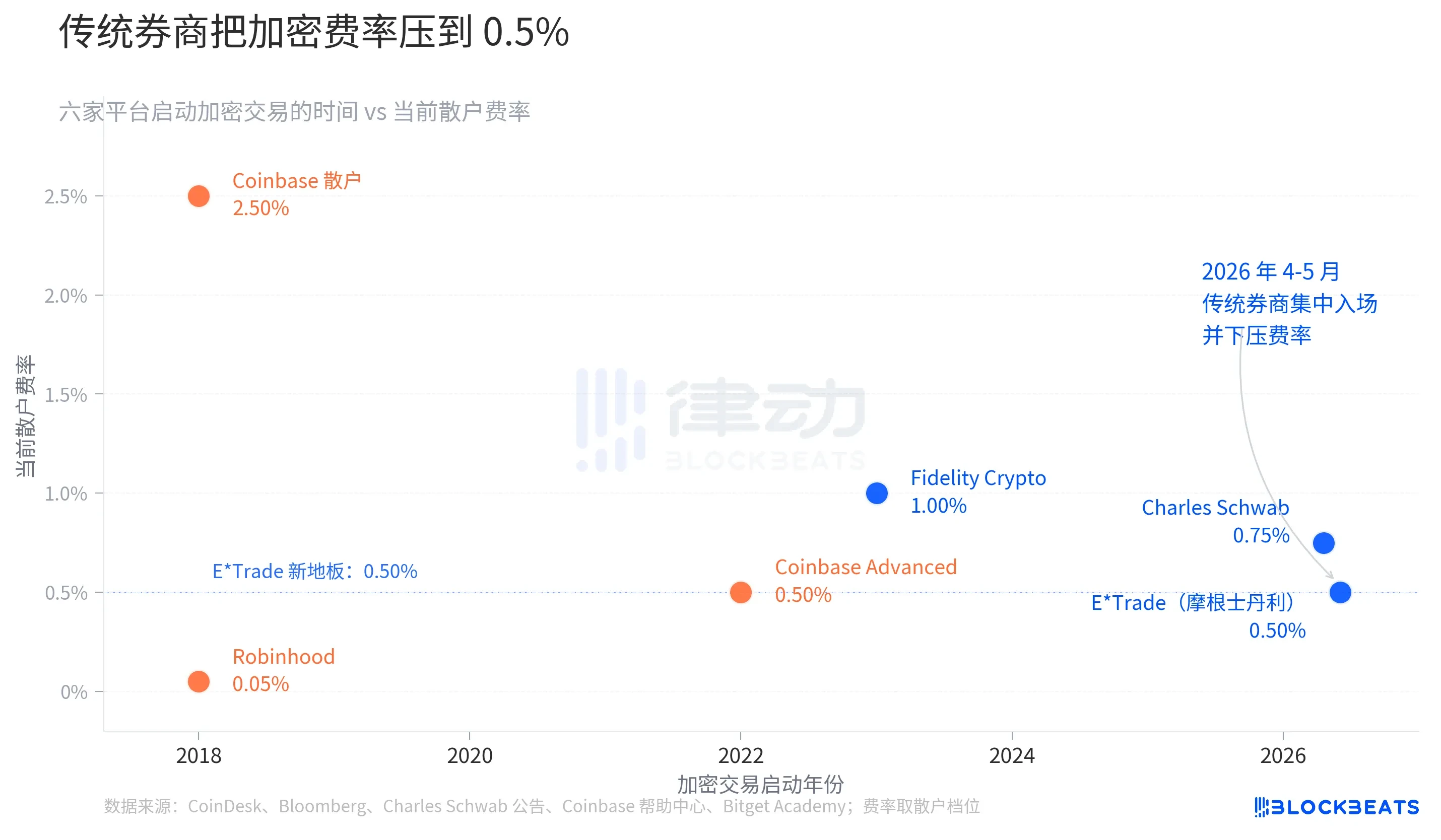
In early April 2026, Charles Schwab launched Schwab Crypto, progressively opening spot trading in Bitcoin and Ethereum to retail customers at a 0.75% fee. A month later, on May 6, Morgan Stanley's E-Trade followed suit with 0.50%, covering Bitcoin, Ethereum, and Solana. According to BeInCrypto, this is currently the lowest retail crypto trading fee among traditional major banks.
A comparison of fee structures reveals the pressure. Coinbase's standard app commonly charges retail users 0.99%-2.99% plus a 0.5% spread, equivalent to an effective payment of 1.5%-3.5%. E-Trade's 0.5% cuts this figure to a third. Fidelity's 1% has become the most expensive among peers. Coinbase Advanced Trade remains competitive, but it's a professional interface for high-frequency and high-net-worth users, not the retail-first choice for average investors.
Why the concentrated opening in April-May 2026? Two key time anchors. One is the GENIUS Act, the stablecoin legal framework, signed into law in July 2025, providing compliant clarity for traditional financial institutions to custody and settle stablecoins. The other is the Clarity Act heading into Senate markup. Regardless of the final outcome, the contours of the mainstream market structure have become clear. Traditional big banks no longer worry about regulatory retroactivity after entering. Wall Street is making decisions based on the probability distribution that "the Clarity Act will likely pass," rather than waiting for the bill to be signed.
The "Ethics Clause" Targets the President
The ethics clause demanded by Democratic lawmakers has been repeatedly submitted to the White House since 2025 and repeatedly returned. The reason is not abstract. According to a January 2026 Bloomberg report, about one-fifth of the Trump family's $6.8 billion fortune comes directly from crypto projects.
A closer look at these projects reveals more specifics. Realized cash flow stands at approximately $1.47 billion, primarily from four products. The token sale of World Liberty Financial (WLFI) is the largest contributor. As of December 2025, the Trump family had profited approximately $1 billion from this DeFi project, including $550 million raised from the public offering.
The $TRUMP memecoin, launched three days before the inauguration in January 2025, brought the family $362 million in fees and trading profits. Melania's $MELANIA memecoin followed closely, contributing about $65 million. Interest from the USD1 stablecoin reserves amounted to $42 million.
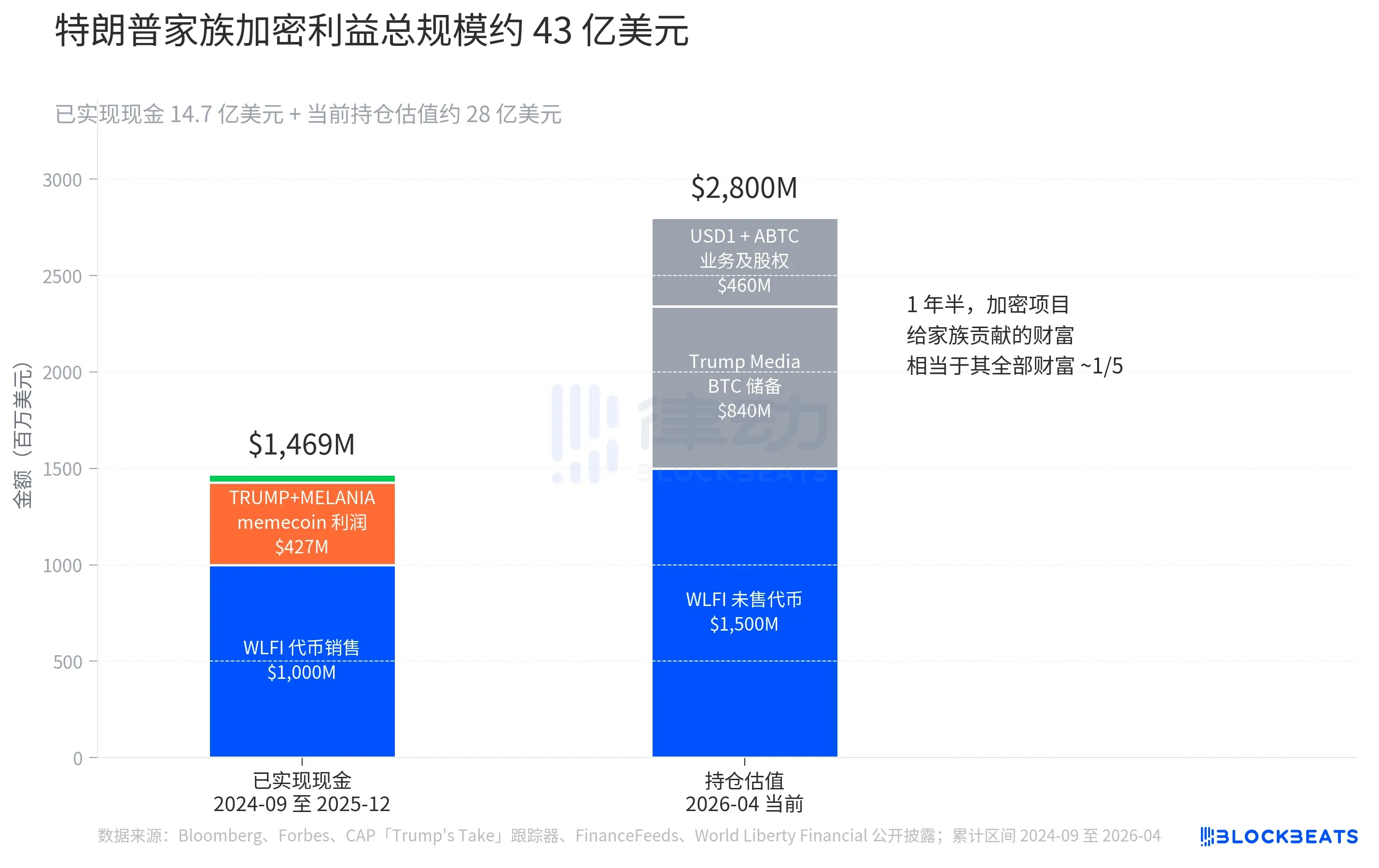
Unrealized holdings are valued at approximately $2.8 billion. WLFI still has $1.5 billion in unsold tokens on its books, though this is highly volatile based on WLFI's price. According to estimates from FinanceFeeds, Trump Media's Bitcoin reserves range between 9,500 and 11,500 BTC, worth about $840 million at current prices. The USD1 business valuation and equity in ventures like American Bitcoin mining total around $460 million.
Combining realized and unrealized value totals approximately $4.3 billion. That's the real number behind the ethics clause. The version pushed by Senator Elizabeth Warren and others explicitly states, "Prohibits senior officials from personally profiting from crypto assets while in office." A compromise version that entered the White House was returned. Whether the bill includes this clause for a full Senate vote essentially asks each senator: Are you willing to cast a public vote, openly cutting into this $4.3 billion pie belonging to the President's family?
Will the CLARITY Act Pass This Year?
The Clarity Act forcefully categorizes all digital assets into three buckets. The first bucket is "digital commodities," regulated by the CFTC, corresponding to tokens operating on "mature blockchain systems." The bill defines "mature" with two hard criteria: first, the network is functionally complete and capable of reaching consensus; second, it is sufficiently decentralized, with no single entity able to unilaterally modify the protocol or governance.
The second bucket is "investment contract assets," under SEC jurisdiction, corresponding to tokens representing equity, debt, or similar rights, such as tokenized stocks, traditional securities distributed on-chain, and RWAs (real estate, notes, accounts receivable). The third bucket is payment stablecoins, overseen by banking regulators, requiring compliance with capital, custody, and anti-manipulation standards.
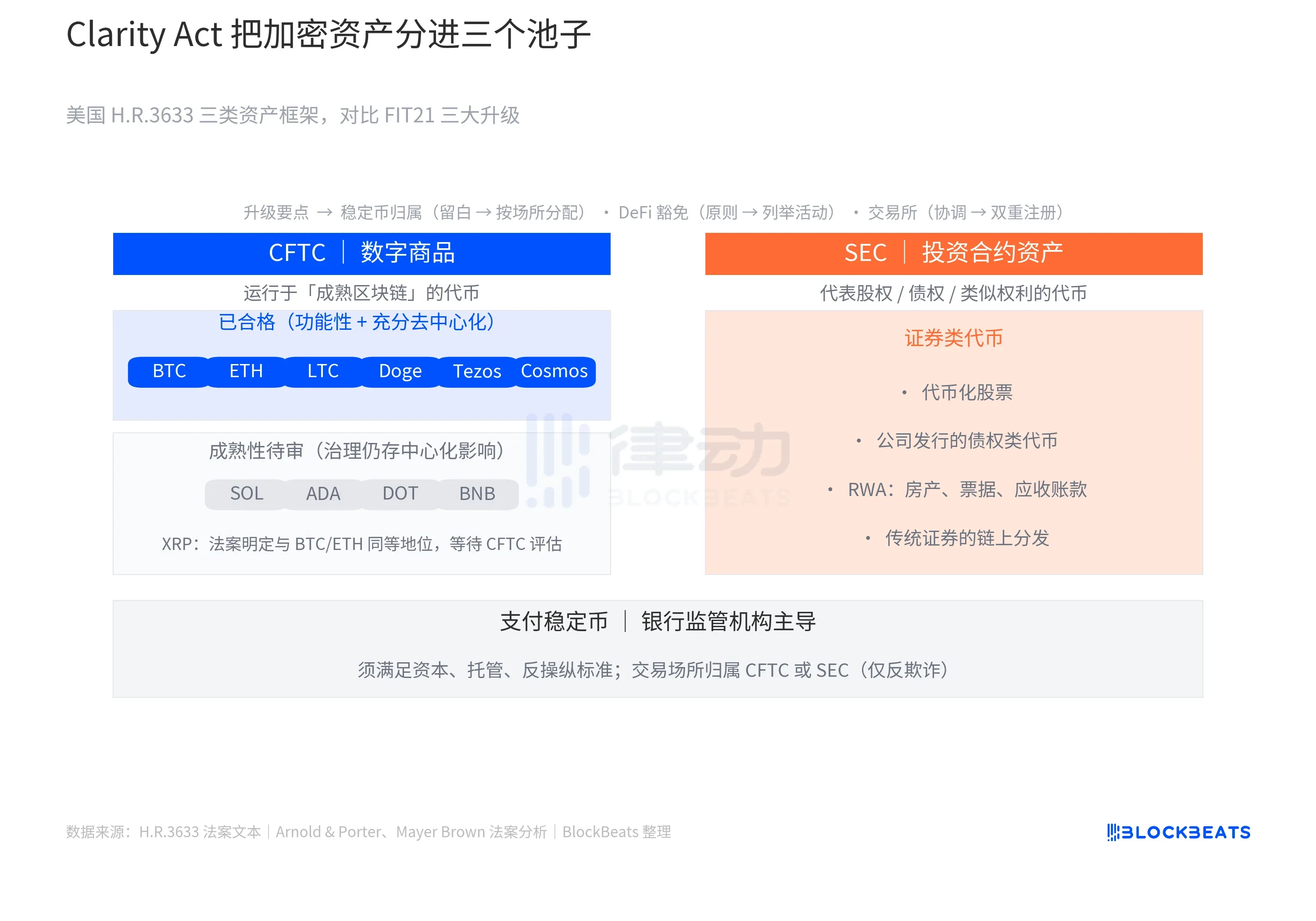
Compared to FIT21, which died in the Senate in 2024, the Clarity Act has three upgrades. Stablecoin attribution changed from "left unspecified" to "allocated by trading venue." Stablecoin trades on CFTC platforms are governed by the CFTC, while those on SEC platforms are governed by the SEC, but the SEC retains only anti-fraud authority.
DeFi exemptions shifted from a principled safe harbor to an enumerated list of specific activity exemptions. Custody front-ends, running nodes, and publishing code do not trigger registration obligations. Exchange registration changed from "cross-agency coordination" to requiring mandatory dual registration for intermediaries handling digital commodities, even if the intermediary is already an SEC-licensed broker-dealer.
The bill's logic is clear: to codify into law the biggest uncertainty in the crypto industry over the past few years—"Who exactly has jurisdiction over this?"
Where the Clarity Act stands now, it has few predecessors.
According to public statements from Representative French Hill's office, over 40 crypto and blockchain-related bills were introduced just during the 116th Congress (2019-2020). The final passage rate for these bills was zero. The 118th Congress (2023-2024) saw FIT21, which passed the House in May 2024. It was the first crypto market structure bill to pass a full House vote, but it also died in the Senate.
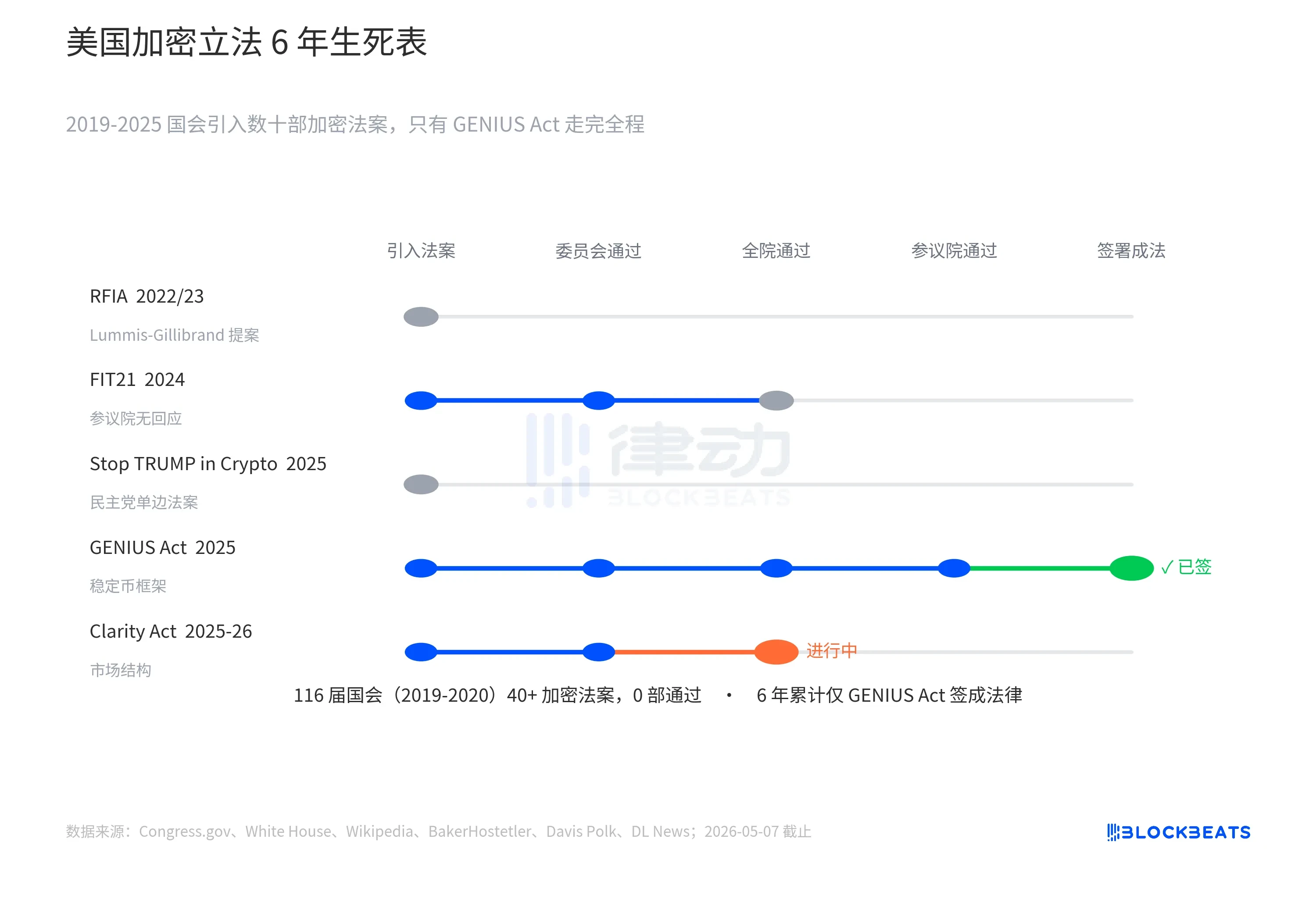
On July 18, 2025, President Trump signed the GENIUS Act into law, establishing regulations for payment stablecoins. This was the first, and so far the only, crypto-related federal bill signed into law in six years. On July 17 of the same year, the House passed the Clarity Act by 294 votes to 134. Theoretically, the Clarity Act has reached the same position as FIT21 did that year: passed the House, awaiting a Senate vote.
The difference lies in the political environment. During the FIT21 era, Democrats controlled the White House, leaving crypto legislation without top-level impetus. Now, the Trump administration is publicly pushing for it. However, the compromise version of the ethics clause was rejected by the White House, and key Democratic lawmakers remain unconvinced. If the window before the first week of August is missed, the Senate will recess until September 14. Considering the November 3 midterm elections, whether a signature can be secured in 2026 is no longer entirely a matter of "what the White House wants."
Historically, out of 50+ bills over 6 years, only one has become law. Whether the Clarity Act becomes the second will be decided in the next couple of months.


