






Đều là ai đang giao dịch trên Trade.xyz?


- 核心观点:对Trade.xyz的链上分析发现,该平台确实存在大规模女巫钱包(占总数44%),但它们仅贡献了0.77%的交易量;真正支撑超过500亿美元月交易量的核心力量是少数专业做市商(如Jump、Selini、Wintermute)、Bybit出身的套利机器人,以及一个与Polymarket高度重合的散户群体。
- 关键要素:
- 女巫层与交易量脱钩:35453个女巫钱包可追溯到同一Polymarket账号“Themino”,采用接力式小额双向交易策略,但累计交易量仅约4亿美元,占总量的0.77%。
- 高度集中的做市商力量:363个做市商钱包(占0.46%)推动了63%的总交易量(3275亿美元),其中前5名占据了做市量的一半,包括Powell、Jump Crypto、Selini和Wintermute。
- 专业套利机器人(SAT)主导激进交易:522个HFT机器人贡献了6.7%的交易量,前4名占据了该类别89%的份额,且大部分资金来源可追溯到Bybit交易所。
- 散户群体与Polymarket高度重合:在交易量最高的400个散户钱包中,22%的交易量(163亿美元)来自可识别的Polymarket用户,表明预测市场用户是核心交易驱动者。
- 算法交易增加真实流动性:Tread.fi等算法产品通过挂maker单刷分,为传统做市商缺席的时段(如夜间、周末)提供了盘口顶部深度,结构上区别于女巫洗单。
Original Title: "Who is actually trading on Trade.xyz?"
Original Author: @web3_pastel, Arrakis Finance
Translation: Jaleel and Liu, BlockBeats
Editor's Note:
On the map of Hyperliquid, one of the most unavoidable names in 2026 is Trade.xyz. It was the first real product to emerge after the launch of the HIP-3 "permissionless perpetual market deployment framework," bringing assets like US stocks, crude oil, and silver—traditionally confined to traditional financial hours—onto a 7×24 hour, non-stop on-chain order book.
In just a few months, it has grown from a niche experiment with only the XYZ100 index into an on-chain trading venue hosting multiple markets like Oil, Tesla, and Silver, with a monthly average trading volume exceeding $50 billion.
But at the same time, its controversy has sparked considerable discussion overseas: among those impressive wallet numbers, how many are real people, and how many are sybils created in bulk, aiming for the yet-to-be-issued token?
This research from Arrakis provides quite an interesting result: the sybil layer does exist, with over thirty thousand wallets traceable to a single Polymarket account, "Themino"; but it inflates user counts, not dollar volumes. The real volume is driven by a few professional market makers, some taker bots from Bybit, and a long tail of retail traders heavily overlapping with Polymarket.
The full text follows:
Abstract
When we wrote our first article, "Who is trading on HIP-3?", our attribution method was statistical. We classified wallets based on their trading behavior over the past three months: addresses mainly posting orders were categorized as market makers, high-frequency takers as arbitrageurs, and orders with low fill rates and builder tags as retail. While this revealed some interesting market structure characteristics, the classification was probabilistic, and about 70% of wallets remained unclassified.
This article replaces statistical inference with mechanical classification. Every order on @HyperliquidX carries a set of deterministic tags signed and published by the exchange itself: time-in-force (ALO, GTC, IOC, FrontendMarket), builder code, fill flag, and holding time. We use these order metadata to classify each wallet into one of four categories: Retail, Market Maker, Arbitrage Bot, and Airdrop Hunter Account.
The second step is to identify the entities behind these categorized wallets, extracting identity and trading behavior data from the APIs of @arkham and HyperTracker. The top 450 wallets accounted for 78% of the total trading volume. Within this group, we identified several @Polymarket-linked accounts, @jump_, @SeliniCapital, @wintermute_t, Abraxas Capital, and others.
Through this two-step classification, we observed several patterns. These are detailed below.
Trade.xyz Wallet Analysis
Our observation window was from March 10, 2026, to March 31, 2026, a total of 21 days. During this period, the four markets on @tradexyz (xyz:CL Crude Oil, xyz:SILVER Silver, xyz:TSLA Tesla, xyz:XYZ100) recorded 79,622 unique participating wallets, with a total trading volume of $51.95 billion.
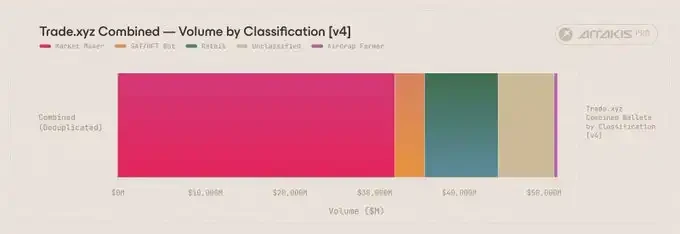
79,622 participating wallets broken down by trading volume. Market makers, though less than 0.5% of total wallets, accounted for 63% of every dollar traded.
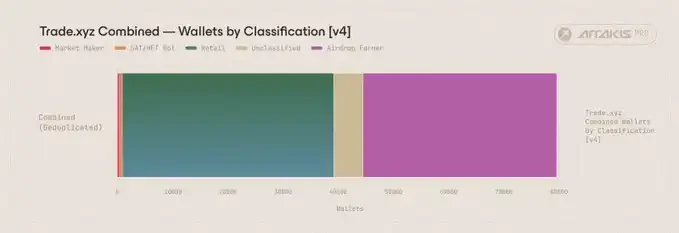
Classified by wallet count (not trading volume). The airdrop hunter category alone comprises 35,091 wallets, nearly half of all identified wallets.
The airdrop hunter category is one of the largest by wallet count but the smallest by trading volume share. 35,091 wallets account for 44.07% of the total wallets, but generated only $0.4 billion in volume over the entire window, a mere 0.77% of the venue's $51.95 billion total. Nearly half of Trade.xyz's active wallets contributed less than 1% of the total volume.
Breaking it down by market reveals another distinct pattern.
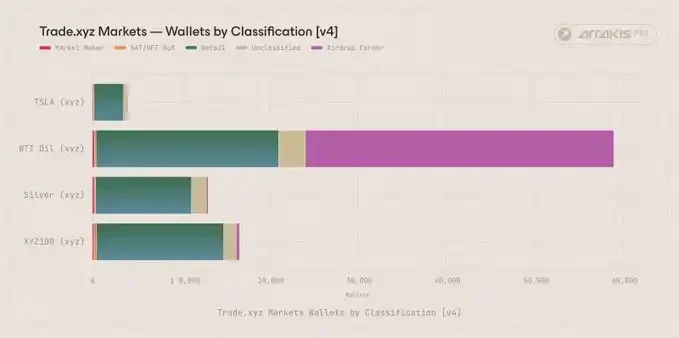
Wallet distribution by market. xyz:CL absorbed 99.3% of airdrop hunter wallets, due to its optimal execution costs.
Of the 35,091 airdrop hunter wallets, 34,859 (99.3%) traded xyz:CL during the window, with the remaining 232 spread across xyz:SILVER, xyz:TSLA, and xyz:XYZ100. This pattern aligns with airdrop hunter behavior: each wallet performs repetitive small two-way trades to generate volume without taking price risk. This strategy relies on tight execution costs and is extremely sensitive to slippage. xyz:CL, having the best depth among Trade.xyz's four markets, naturally became the preferred venue for this activity.
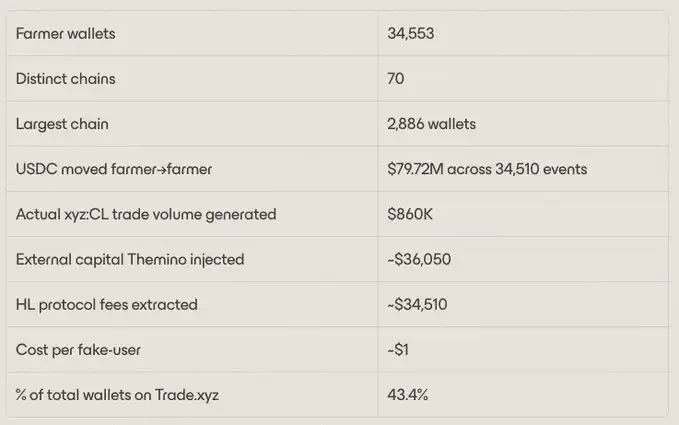
Another notable phenomenon is who is behind these addresses. The on-chain tracing detailed below shows that 34,553 airdrop hunter wallets are linked to the same Polymarket operator. This single entity accounted for 43.4% of all participating wallets on Trade.xyz during this window.
On the other end of the classification is market making. 363 wallets, 0.46% of active addresses, drove $32.75 billion in volume during the window, accounting for 63% of every dollar on Trade.xyz. The remaining three categories fall in between. 522 SAT/HFT bots contributed $3.5 billion (6.7%). 38,307 wallets classified as retail contributed $8.7 billion (16.7%). 5,339 unclassified wallets contributed $6.61 billion (12.7%).
For the 12.7% volume in the unclassified category, metadata alone cannot qualitatively assign it to a specific strategy. A reasonable guess is that a significant portion comes from retail traders placing limit orders via the Hyperliquid frontend, or retail traders placing market and limit orders via the Trade.xyz frontend. Neither channel attaches explicit builder codes or specialized TIF tags to orders, rendering these fills invisible to metadata-driven classification.
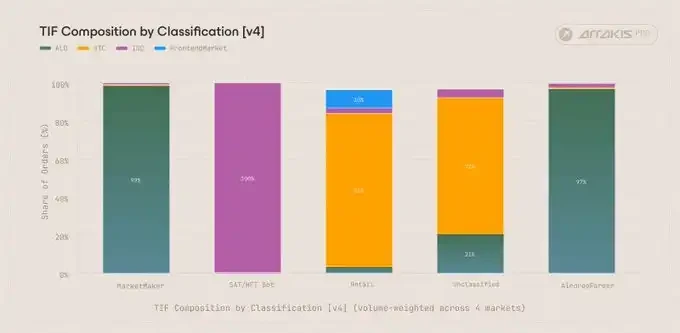
Time-in-force distribution weighted by order count per category. Unsurprisingly, 98.5% of market maker orders are ALO, arbitrage bots use 100% IOC. The unclassified category has 71.5% GTC, a hallmark of manual limit orders placed by frontend users.
The TIF composition supports this hypothesis: 71.5% of orders in the unclassified category carry the GTC (Good Till Cancel) time-in-force tag, typically used by frontend users placing resting limit orders.
"Themino" Uncovered Over 30,000 Wallets
In recent weeks, there has been much debate: is Trade.xyz's impressive user count driven by real human participation, or is it inflated by airdrop hunter activity ahead of the anticipated TGE? We don't intend to comment on the broader airdrop hunting landscape for this exchange, but after analyzing transaction-level data for the four Trade.xyz markets in March, a pattern worth presenting emerged.
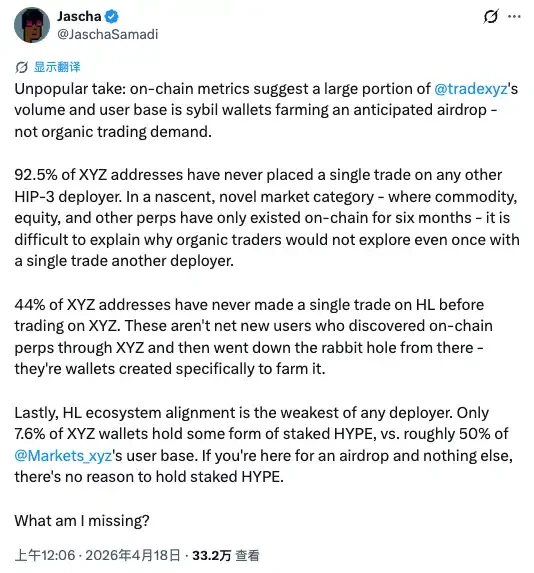
Analyst Jascha points out that 92.5% of XYZ addresses have never conducted a single trade on any other HIP-3 deployer.
Of the 34,602 wallets classified as airdrop hunters, 34,553, or 99.9%, can be traced back to the same Polymarket identity named "Themino."
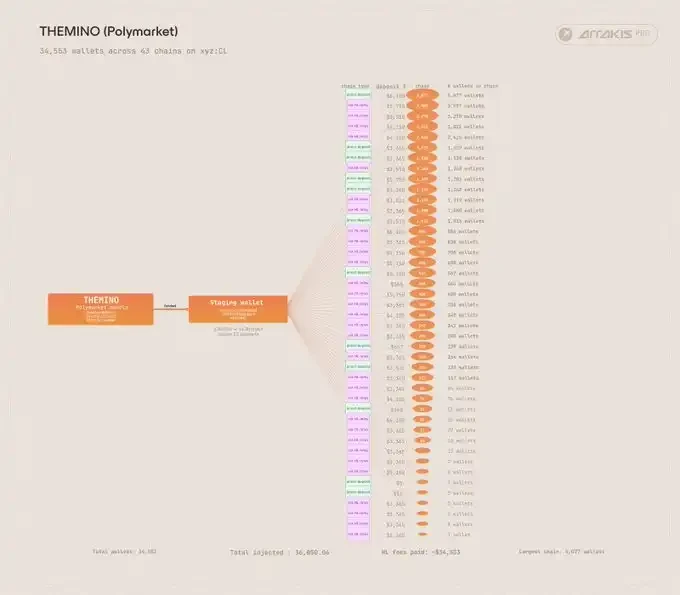
"Themino," a Polymarket identity on Arbitrum, spawned 70 independent linear chains covering 34,553 wallets.
How did it work? Hyperliquid's L1 provides a primitive called internalTransfer, allowing USDC transfers between wallets for a fixed fee of $1 regardless of amount. The operator of Themino used this primitive to pass an initial seed deposit sequentially through tens of thousands of new wallets. Each wallet would execute the same five-step action within approximately 26 seconds:
1. Receive $X from the previous airdrop wallet via internalTransfer, losing $1 to the HL transfer fee.
2. Transfer $14 to the xyz sub-account.
3. Execute two IOC orders on xyz:CL – one buy, one sell – generating two fills and some trading volume.
4. Transfer approximately $13.99 back to the main account (the $0.01 difference accounts for execution slippage and trading fees).
5. Transfer $X minus $1 to the next airdrop wallet via internalTransfer.
The next wallet then repeats the same set of actions.
The 34,510 internal transfers in this entire operation cost Themino a total of $34,510 in protocol fees, a tactic consistent with his trading history on Polymarket.
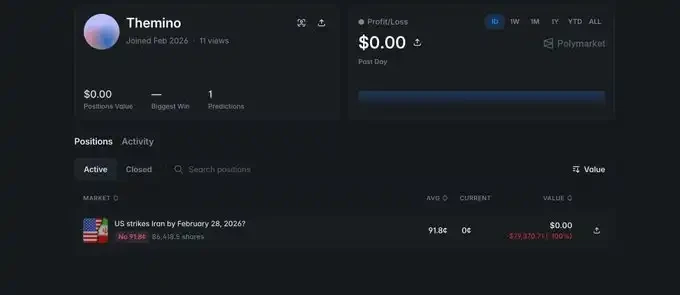
Themino also bet "No" on Polymarket on "Will the US launch a strike on Iran before February 28, 2026?", losing approximately $80,000. The strike occurred on February 28.
What Types of Builders Are There?
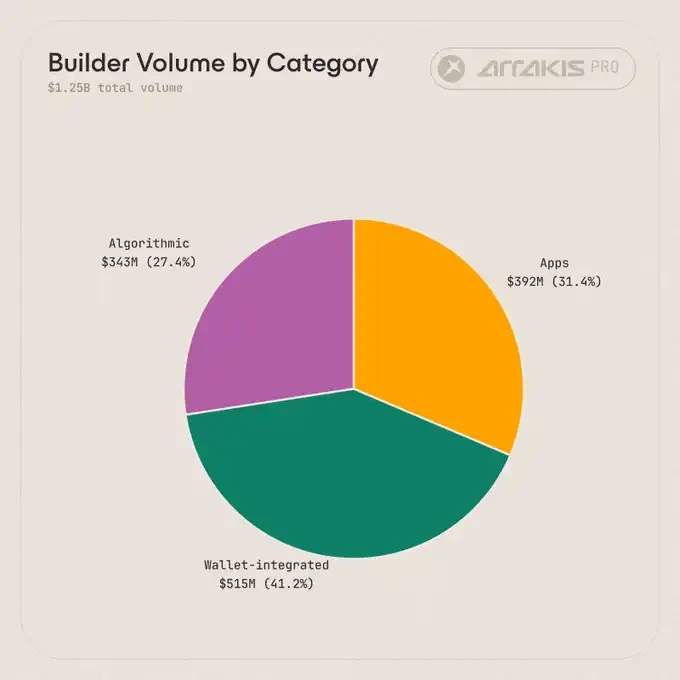
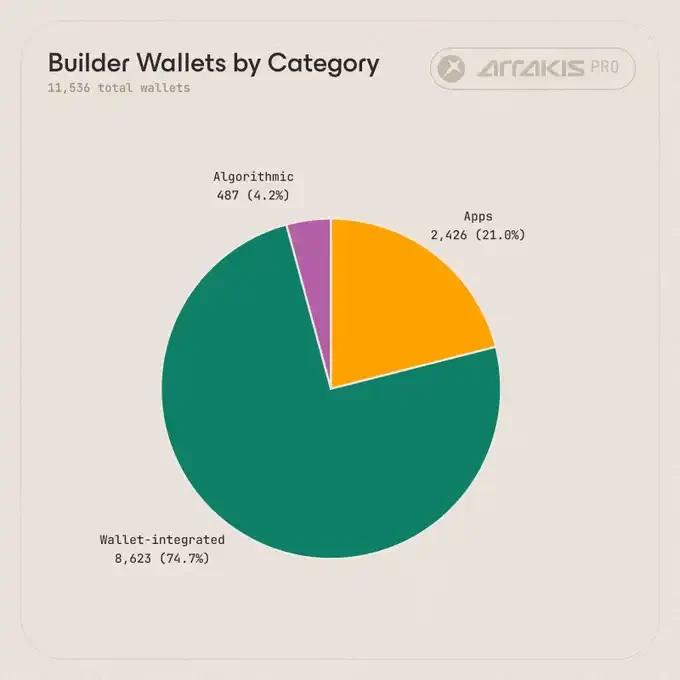
Hyperliquid attaches an identifier to orders routed through third-party frontends, allowing these applications to collect custom frontend fees. This identifier is the builder code, and it's the most direct way to determine which interface a wallet used, if any. Among wallets that traded across the four markets, these builders can be broadly classified into three types.
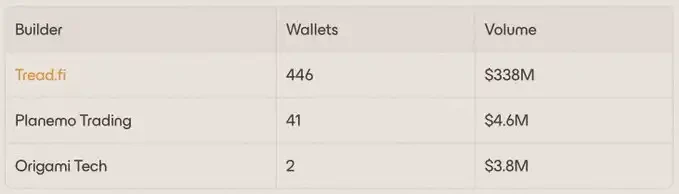
Algorithmic Builders: These are products designed for retail users to maximize trading volume on DEXs and farm points for potential airdrops. Before late 2025, farming points on a perpetual DEX meant either wash trading or using algorithms for non-directional taker-to-taker trades, which was costly for participants and net negative for the exchange. Retail market-making bots like @tread_fi, @PlanemoTrading, and @origamitech_ replaced wash trading with genuine market making. Every order these products send is post-only, meaning the wallet adds liquidity to the order book rather than consuming it.
As @davidyjeong, CEO of @tread_fi, stated: "Before retail market-making solutions, farming points on perpetual DEXs meant wash trading, inflating volume at the cost of execution fees, slippage, and the risk of account bans. We solved this with a new farming method: the bot places maker orders on both sides. Users farm points at lower cost, often profit from capturing the spread, and a byproduct is that the market gets genuine top-of-book liquidity, which is exactly what HIP-3 equity perpetuals need during nights and weekends when traditional market makers are absent. It's a better way to farm, and it's why HIP-3 markets have excellent execution today."
The contribution of these market-making bots is most evident during periods when traditional market makers are offline. CME's WTI futures close on Friday afternoon and don't open until Sunday evening; equity perpetuals face a similar "night and weekend" gap. During these times, retail market-making bots support the top of the book on markets like xyz:CL and xyz:TSLA.
Note: In this analysis, we classified wallets routed through these algorithmic products as airdrop hunters, but their trading behavior and market impact are structurally entirely different from sybil activity.
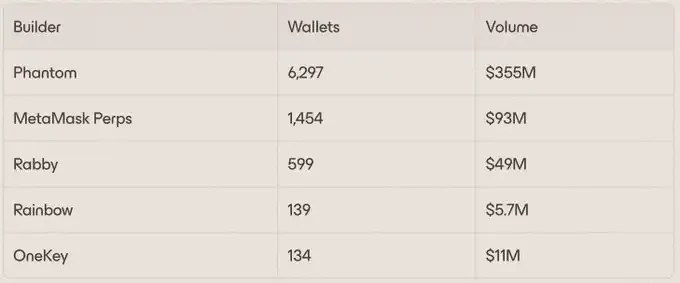
Wallet-Embedded Builders are perpetual interfaces embedded within consumer-grade wallets. Since early 2026, this type of integration has become one of the largest sources of retail order flow on HIP-3. This group includes @phantom, @MetaMask, @Rabby_io, @rainbowdotme, and @OneKeyHQ. Their median trading volume per wallet ranges between $1,000 and $3,000, consistent with the order size of a retail segment that prioritizes ease of use over marginal builder fees.
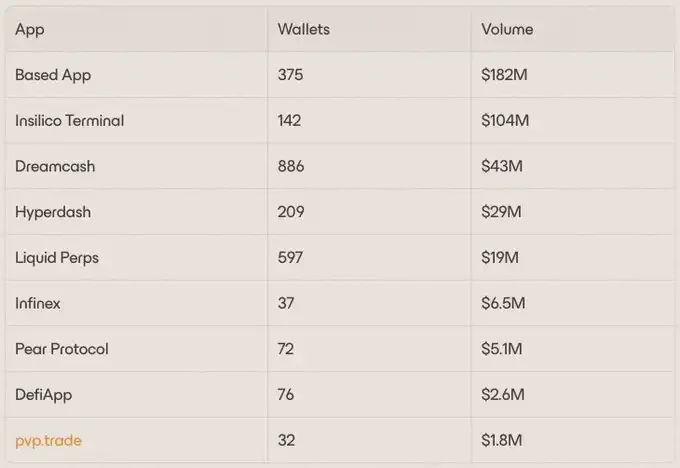
Application Builders are standalone perpetual frontends and integrated products: offerings designed for traders, providing specialized workflows for users who find wallet plugins insufficient and need better order placement, charting, position management, and execution tools. This group has fewer wallets than the wallet-embedded type, but higher volume per wallet, aligning with a more sophisticated user base that values functional depth over plug-and-play convenience. These products include the @InsilicoTrading terminal, @liquidtrading, @hypurrdash, @BasedOneX, @Dreamcash, @infinex, @pear_protocol, @defiapp, and @pvp_dot_trade.
@0xVKTR, growth lead at @InsilicoTrading (the team behind the Insilico terminal), describes it: "At Insilico, we see HIP-3 markets as the next step in making real-world exposure native to crypto rails. Traders don't just want another frontend. They want fast execution, clean market access, and the ability to seamlessly switch between crypto and macro assets without leaving their existing workflow. Trade.xyz is one of the clearest examples of this demand. The order flow routed through Insilico proves that when a venue has depth, the product is useful, and the trading experience is built for serious participants, there is a genuine base of sophisticated users for on-chain perpetuals."
Who is the Largest Market Maker on Trade.xyz?
The market-making landscape across Trade.xyz's markets is highly concentrated. The top 5 market makers account for 50% of market-making volume, the top 13 for 80%, and the top 21 for 90%. A handful of market-making desks support the vast majority of this exchange's market-making book.
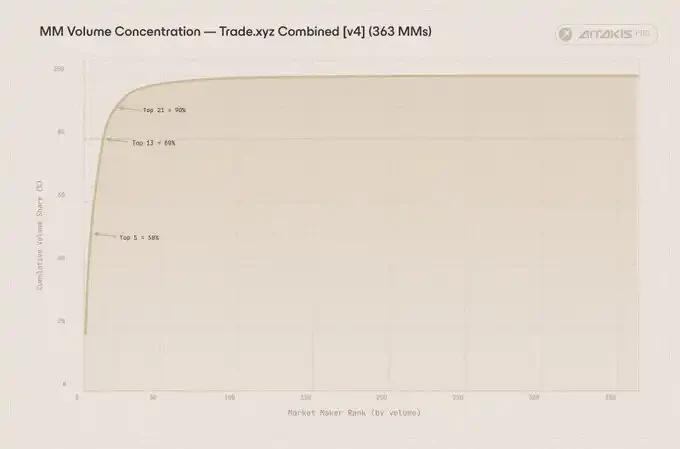
Cumulative share of market-making volume by wallet rank. The top 5 desks account for 50% of all market-making flow, top 13 for 80%, top 21 for 90%.
The second-largest market maker is the most interesting wallet in the entire sample. 0xc926ddba…98d3 has a volume of $4.39 billion and a fill rate of 0.52%, a textbook maker profile. Arkham tags this address as "Powell" on Polymarket. One of the largest market makers on Trade.xyz is a Polymarket user running a market-making book across multiple markets on HIP-3.
Other notable market-making desks:
Jump Crypto operated two wallets, totaling $3.


