AI Era’s First Large-Scale Strike Comes from the Factory That Builds AI


- Key Point: Samsung Electronics workers are threatening to strike over pay distribution issues. The core conflict lies in the explosive growth of the AI industry; employees demand a greater share of the profits, while the company insists on a differentiated bonus system based on formulas. This exposes a deep-seated conflict between technological advancement and labor dignity.
- Key Elements:
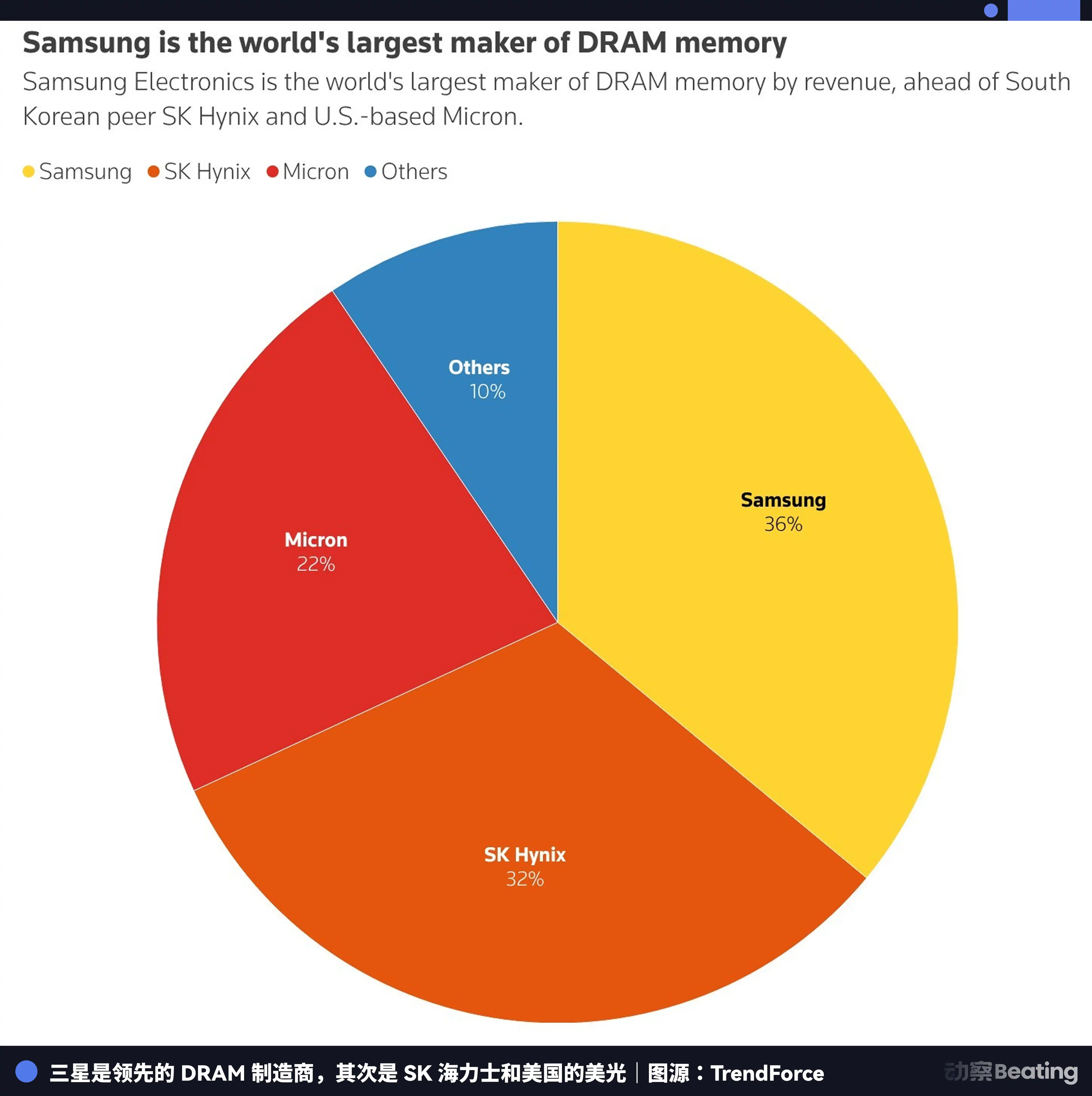
- Samsung and SK Hynix together control approximately two-thirds of the global memory chip market. A strike could disrupt 3-4% of global DRAM supply and 2-3% of NAND supply, impacting the AI industry chain.
- Samsung union's core demands: a 7% increase in base salary, 15% of annual operating profit as a bonus pool, and the removal of the bonus cap (currently around 50% of annual salary).
- Benchmark comparison: SK Hynix has already reached an agreement to allocate 10% of its operating profit to employees annually for the next decade. In 2025, the average bonus per person is expected to be around 450,000 RMB, with projections even higher for 2026.
- Samsung posted record revenue in Q1 2026, with its semiconductor division achieving an operating profit of 53.7 trillion Korean Won. Employee dissatisfaction stems from the fact that during periods of rising profits, they are unable to receive corresponding bonuses due to complex formulas (such as EVA).
- The South Korean government is closely monitoring the situation because semiconductor exports account for about 35% of the country's total exports, and Samsung represents roughly a quarter of the KOSPI market capitalization. A strike concerns the nation's economic stability.
Original Author: Sleepy
AI may be able to redefine the future, but it still cannot pay the salary that belongs to labor's dignity.
On May 20, wage negotiations between Samsung Electronics and its union once teetered on the brink of collapse. The union had originally prepared to launch an 18-day strike starting May 21. At the last moment, both sides reached a tentative agreement, putting the strike on hold pending a vote by union members. However, the real issues have not disappeared.
Strikes are not unfamiliar to us.
Those past events were equally weighty. Some occurred in old industrial bases, some in the automotive supply chain, and some in export-oriented factories supported by cheap manual labor. The key themes were always low wages and unpaid debts. Initially, people were taken for granted as durable consumables, slotted into various plans under the banner "the greater good." It wasn't until life became so squeezed that it was hard to breathe that people suddenly realized they hadn't yet degraded into iron parts. They straightened their backs from within that cold order, making sounds that belonged to humanity.
But this time is different.
This time, it's the workers of Samsung Electronics stepping forward.
They are not workers with no way out in the tide of globalization; they are the people deepest inside the AI supply chain, closest to the "future." Within this massive chaebol machine of Samsung—a giant holding the lifeline of global semiconductors—the company has been pressed to a pause by its own workers.
A Strike Threatening Global AI
This strike is precisely targeting the throat of the global AI industry chain.
Samsung and SK Hynix together produce roughly two-thirds of the world's memory chips.
While memory chips have always been important, they weren't considered a glamorous business. That changed with the arrival of AI, making them a fiercely contested battleground. Large model training, inference, data center expansion—it's not enough to just have GPUs. Data needs to be fed in, stored, and retrieved at high speed. This requires high-bandwidth memory (HBM) and other technologies.
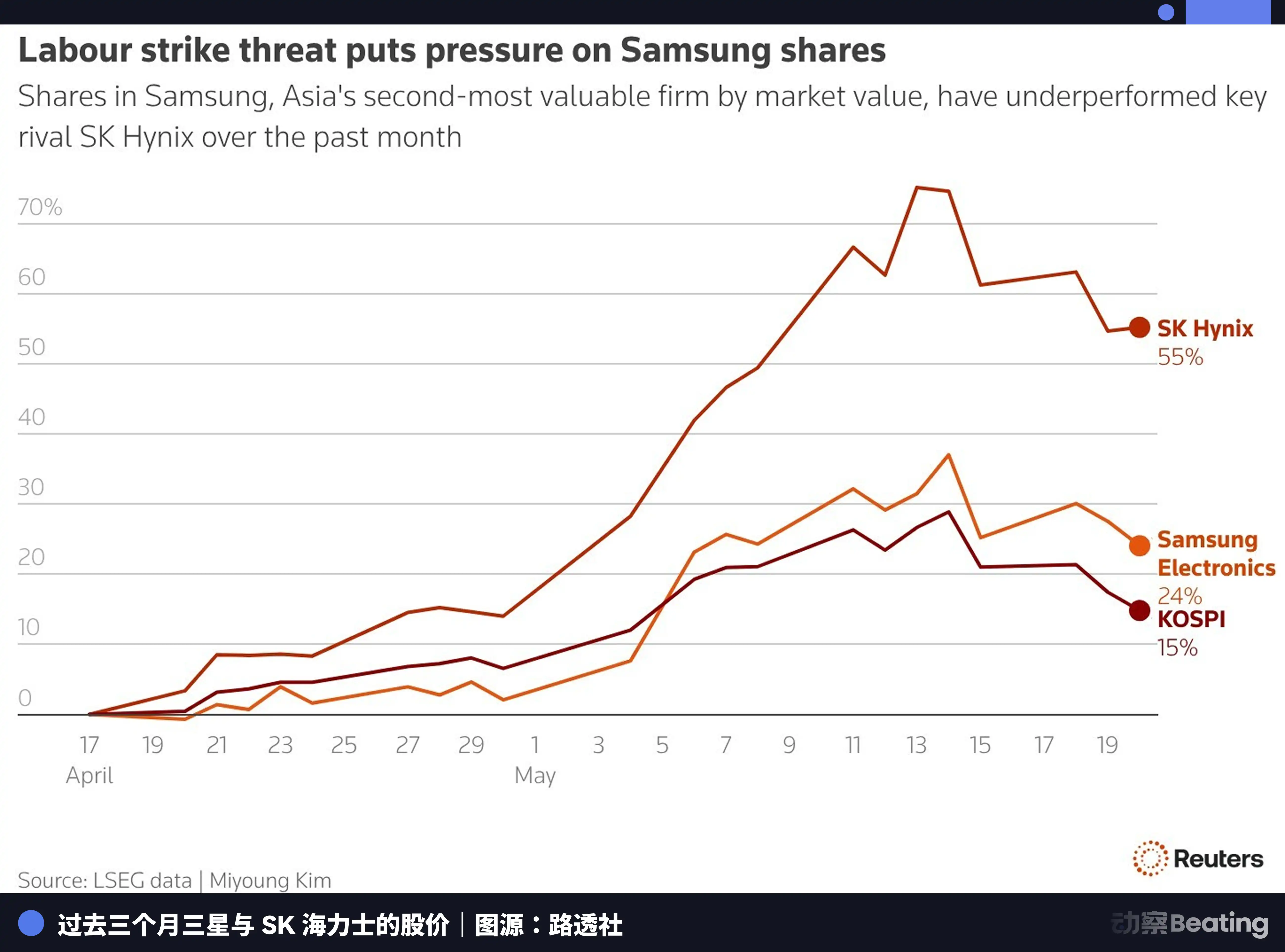
According to estimates by KB Securities analyst Jeff Kim, this 18-day strike could disrupt 3% to 4% of global DRAM supply and 2% to 3% of NAND supply. While not catastrophic, it's enough to tighten price expectations, customer production schedules, cloud vendor costs, and the nerves of tech stocks.
The South Korean government is even more unsettled. Samsung is not an ordinary company; it is more like an embodiment of national strength.
Yonhap News Agency reported that semiconductor exports account for about 35% of South Korea's total exports. In Q1 2026, South Korea's exports reached a record high of $219.9 billion, with semiconductor exports surging 139% year-on-year to $78.5 billion.
Samsung itself accounts for roughly a quarter of the market capitalization of South Korea's KOSPI index. In other words, a tremor in Samsung's production lines doesn't just shake the income statement of one company—it shakes South Korea's exports, stock market, exchange rate expectations, and the country's confidence in telling its story to the world.
More critically, AI has arrived too suddenly. In the past, South Korea's narrative of a technological powerhouse revolved around phones, panels, cars, home appliances, and semiconductors. Now, the global narrative has been reshuffled by large models, with the spotlight on OpenAI, Google, Anthropic, a group of Chinese large model companies, and computing giants like Nvidia. South Korea naturally wants its own sovereign AI; the government is promoting national AI infrastructure, and Nvidia has announced plans to deploy over 260,000 AI chips in South Korea. But South Korea knows clearly that relying solely on models will make it difficult to exert overwhelming international influence squeezed between the US and China.
What it truly holds onto is that harder, heavier, less glamorous path: memory chips, HBM, DRAM, NAND, advanced manufacturing, and the underlying supply chain that feeds AI data centers. This is why Samsung is more important today than ever.
The more AI advances, the more the world realizes that large models aren't magic floating in the cloud; they need electricity, GPUs, and memory. South Korea may not change the world with one model, but it can ensure that models worldwide cannot bypass it through its chips.
The AI industry usually likes to talk about computing power, models, the battles of giants, and who has defeated whom.
The Samsung strike suddenly pulls everyone back from the clouds to the ground. No matter how high the computing power, it ultimately lands on factory floors, shifts, bonus formulas, and labor-management negotiations.
The future doesn't just float in the clouds. The future also requires paying wages.
Why Are They Striking?
The union's core demands include:
A 7% increase in basic wages;
Allocating 15% of Samsung's annual operating profit to an employee bonus pool;
Abolishing the current bonus cap (approximately 50% of annual salary), and clearly defining how bonuses are calculated, when they are paid, and whether they will continue to count towards other benefits.
Samsung disagrees. The company believes the union's demands are too high, especially extending large bonuses to loss-making business divisions, which would break the established rule of "those who earn more get higher bonuses."
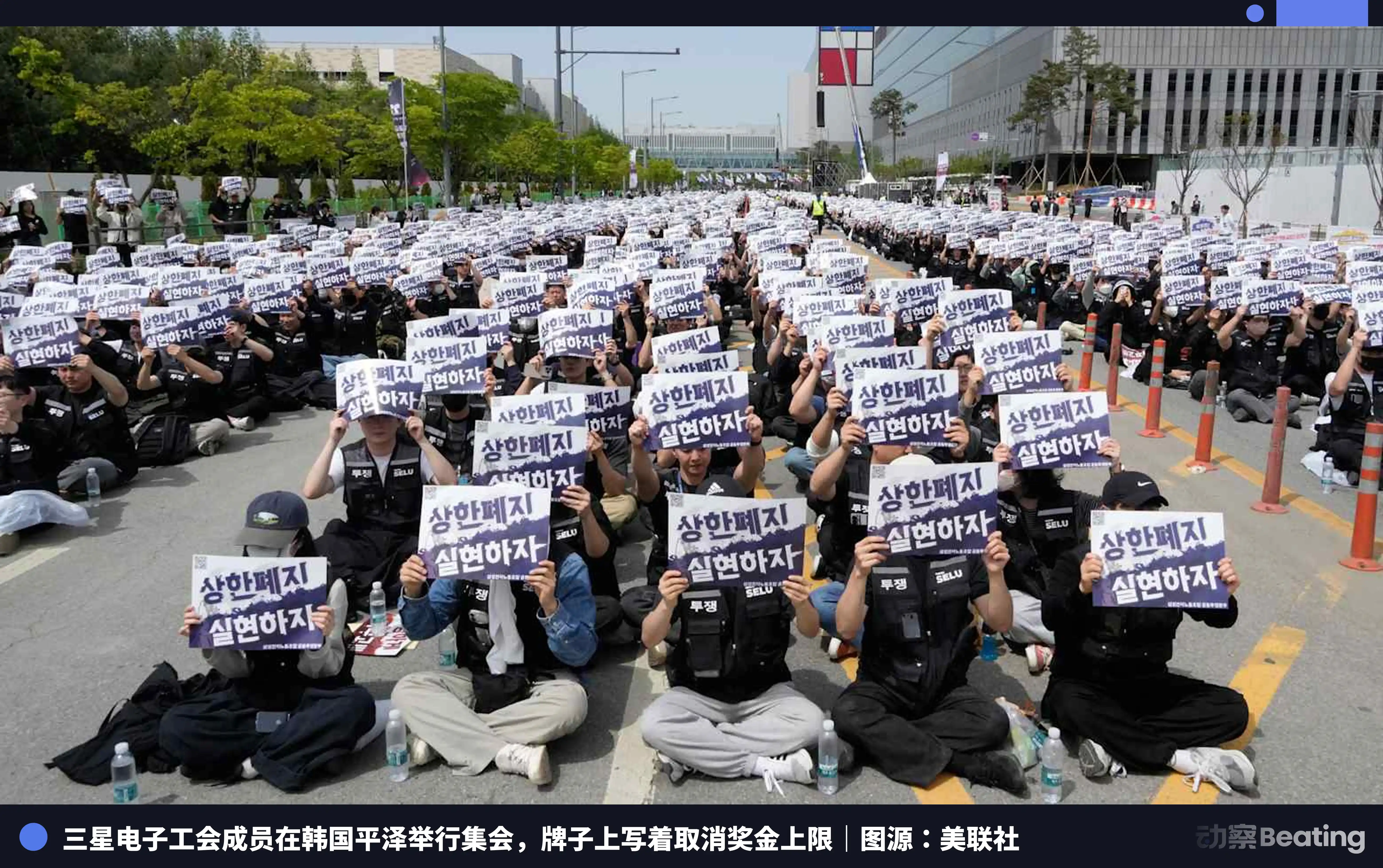
According to reports, a key point of contention in the final mediation was precisely the issue of profit-sharing between different divisions within the semiconductor segment. The memory business is profitable, while other divisions face pressure or even losses. Should employees in loss-making divisions also receive large bonuses?
In modern large corporations, ordinary employees less frequently negotiate pay directly with the boss. Money is embedded in seemingly objective metrics: performance, coefficients, costs, cycles, business units, profit margins, and bonus caps.
Samsung's bonuses have long been tied to a complex formula. Korean media frequently uses the term EVA. The gist is that profits must first cover taxes, investments, and various capital costs; only the remainder is available for bonuses. The financial logic is sound, but it's hard for people to accept. Employees don't understand: if the company's profits are rising, why aren't my bonuses increasing? Am I losing out because of my performance, or because of this formula? Does my sweat count as a contribution in the company's eyes?
The reason Samsung employees' anger has built up to this point is the existence of a mirror next door: SK Hynix.
SK Hynix secured an excellent position in the AI memory space, excelling in the HBM supply chain. More importantly, it knows how to translate this success into tangible numbers on employees' paychecks.
In September 2025, SK Hynix and its union negotiated a new rule: over the next decade, the company will allocate 10% of its annual operating profit to employees and abolished the existing bonus cap.
The JoongAng Ilbo reported at the time that under the new agreement, employees were expected to receive approximately 100 million won (about 450,000 RMB) in bonuses per person that year. By early 2026, the Seoul Economic Daily reported based on the company's 2025 performance that approximately 34,500 SK Hynix employees would receive performance bonuses averaging around 140 million won (about 630,000 RMB).
Even more striking, the Seoul Economic Daily, citing FnGuide forecasts, reported that SK Hynix's 2026 operating profit could reach 230.0885 trillion won. Ten percent would mean a bonus pool of about 23 trillion won. Dividing this by 34,549 employees gives an average of about 670 million won (approximately 3.04 million RMB) per person.
The neighbor has already put the meat on the table. When Samsung employees hear the company talk about EVA, capital costs, and divisional differences now, they are naturally infuriated.
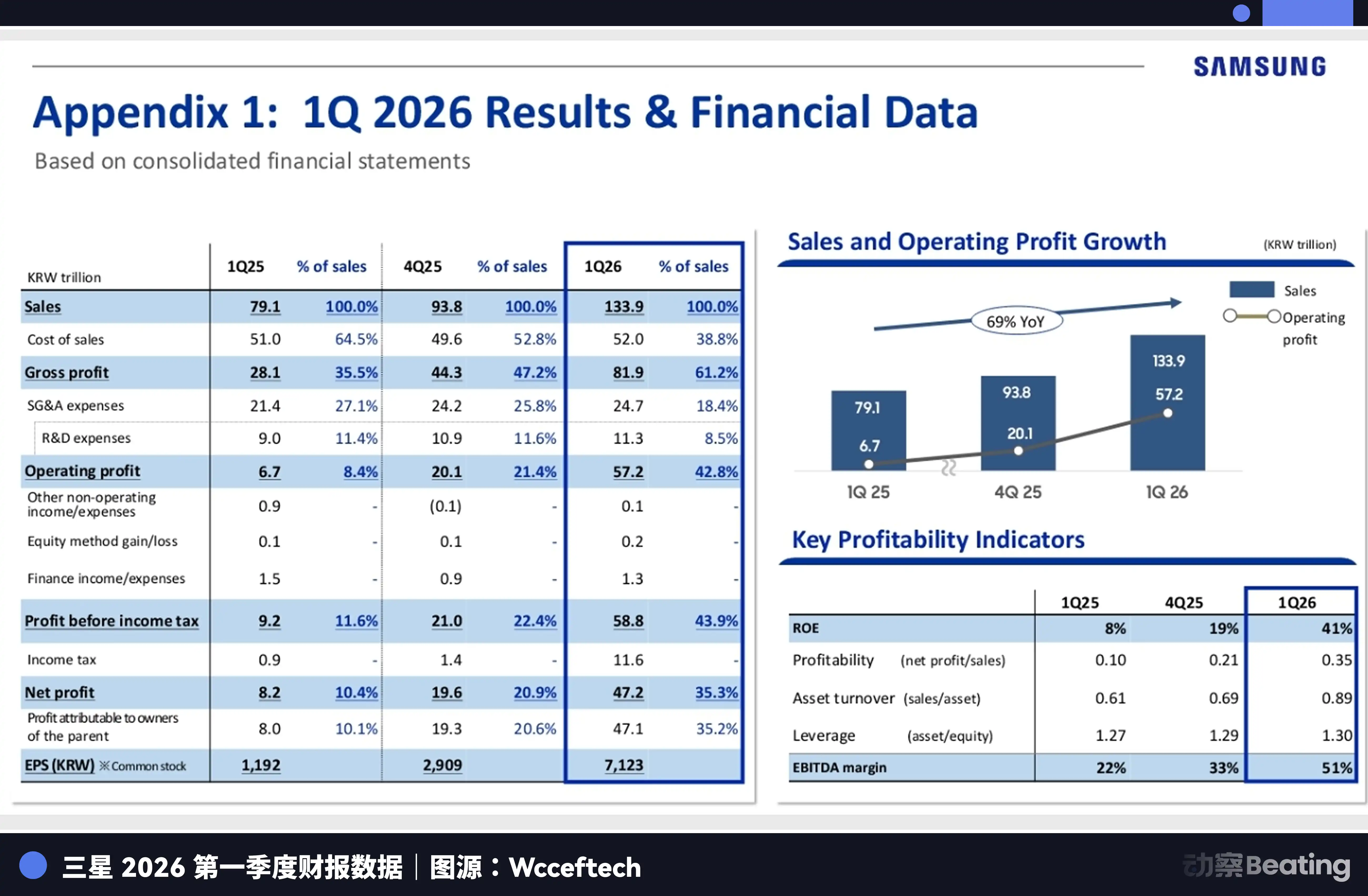
Samsung's official financial report shows that in Q1 2026, the company's consolidated revenue reached 133.9 trillion won, a record quarterly high; operating profit reached 57.2 trillion won. The semiconductor division alone recorded Q1 revenue of 81.7 trillion won and an operating profit of 53.7 trillion won. The profits are primarily generated from AI-related demand, such as high-value AI memory, rising industry memory prices, HBM4, and AI data center expansion.
This is where the situation becomes awkward.
When the company is losing money, employees have no leverage. The boss advises patience, saying the cycle will turn. Employees might not be convinced, but with no visible profits on the books, they let it go. But when the company becomes prosperous again, and the fat is literally on the table, who gets the chopsticks, who sits at the head of the table, and who just stands by smelling the aroma—this can no longer be glossed over with sentimental appeals.
The Root of the Problem
To understand why Samsung has made its employees so angry today, you can't just look at a single paycheck. You have to look back at the long-tensioned line between South Korea's chaebols and its workers.
South Korea's modernization process was more like a forced march led by the state. Big companies were pulled to the front, workers trudging along behind. The vehicle ran fast, but seating arrangements were never decided through collective discussion.
Post-war South Korea was destitute. Starting from the Park Chung-hee era, the state became the general dispatcher of industrialization, heavily supporting chaebols to secure orders, build factories, and catch up on technology. Names like Samsung, Hyundai, and SK gradually became the nation's face. They were presumed to be standard-bearers who must win, because South Korea needed that victory. To this end, the state provided resources, banks provided loans, and society provided endless patience, while the factory floor was governed by ironclad discipline.
In this system, the role of labor was clear: first, build the country; first, make the company big; first, endure. Wages could wait, rights could wait, unions could wait, and dignity could be compromised. Don't ask about seat comfort before the vehicle has even started moving.
1987 was a watershed. The monolithic order cracked. Workers emerged from the factories through the fissures. Unions in large enterprises began to take root. Workers were no longer willing to be a vague backdrop in the grand narrative of the "economic miracle." They stepped to the front, demanding wages, demanding safety, and demanding to be treated as living creators, not as worn-out parts to be discarded.
But Samsung was a long-standing exception. Samsung's "union-free management" was a deeply ingrained part of its corporate culture. In 2019, senior Samsung executives and employees were found to have interfered with and obstructed legitimate union activities through various means; Samsung Electronics Board Chairman Lee Sang-hoon was imprisoned for union-busting activities. In 2020, Lee Jae-yong publicly apologized and pledged to abolish this old system within the Samsung Group, finally cracking the iron curtain.
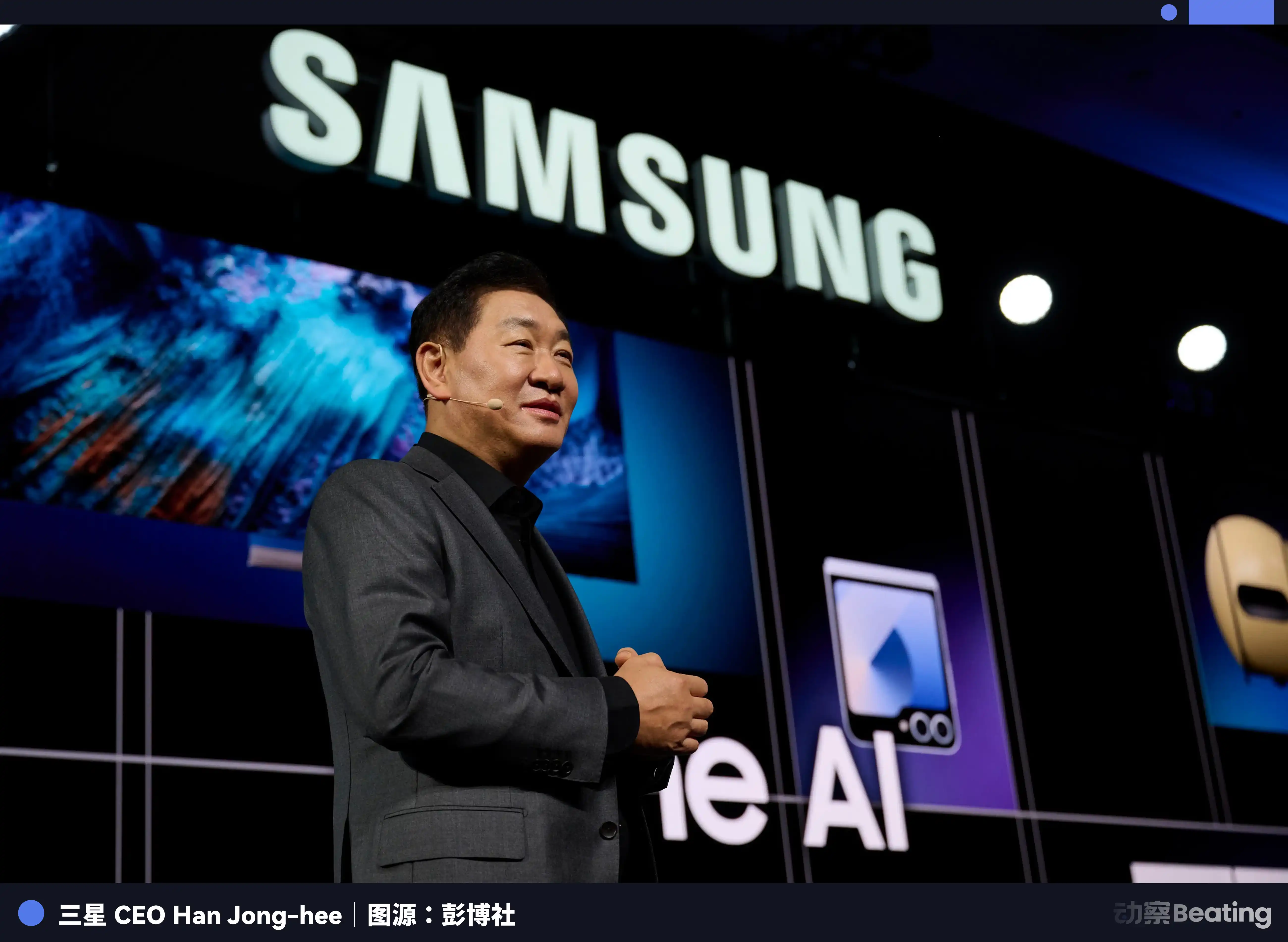
Therefore, this strike is not abrupt. Behind it lies post-war Korean industrialization, the old ways of the chaebols, the labor movement after 1987, Samsung's long tradition of being union-free, and the belated apology of 2020.
The most hurtful part of the whole affair isn't the money itself; it's that some capitalists are only willing to "share hardships," not "enjoy prosperity."
When the company is struggling, employees are often told they are like family. When the company is profitable, employees are reminded it's a company. The first statement appeals to emotion, the second to system. The problem is, people don't only have emotions during hard times.
Writing this, it's no longer just a Korean story.
"Get through difficulties together," "reduce costs and increase efficiency," "improve quality and efficiency," "embrace AI," "enhance workforce efficiency," "optimize costs"—these are phrases we are all too familiar with now.
This might be the most undignified aspect of the AI era.
We thought AI would liberate people from labor. Instead, people often must cooperate with AI to help the company save money; people must learn about AI to make their departments more efficient; people must accept role reconfiguration, performance reassessment, and salary redefinition. As for the dividends, someone always advises waiting, not rushing, because the company still needs to invest, do R&D, resist the cycle, and maintain competitiveness.
These reasons might all be true. But the problem is, if they always push in one direction, they become a very respectable form of evasion. In reality, many companies operate this way: everyone earns the money together, but when it comes time to discuss how to share it, you'd better not speak up.
The Samsung workers have spoken up now.
But they may not win. The South Korean government might invoke emergency mediation; courts have already restricted some actions; Samsung also possesses complex production and legal tools. A semiconductor fab isn't a small workshop that can be shut down at will, and the union cannot afford to stop such a precise system without cost. The real world isn't a satisfying story; workers don't achieve victory easily.
Snowpiercer
In Bong Joon-ho's *Snowpiercer*, humanity is crammed onto a train that cannot stop.
The front holds order, technology, the future; the back is crowded, silent, and full of predetermined fates. The most poignant aspect of the story isn't the forced hierarchy of the cars, but that everyone accepts a premise: the train absolutely cannot stop.
As long as the train must keep moving forward, then your suffering in whatever car, and whether you're eating cockroaches, all become "necessary costs" for maintaining the system. For the sake of that grand motive, specific living people always seem expendable.
Samsung's strike is similarly trapped on a "cannot stop" train.
Wafers cannot be damaged, production lines cannot be halted, AI servers cannot wait, South Korea's export data absolutely cannot decline, and global tech companies don't want memory chip prices pushed higher. Each reason is undeniably correct and stated with conviction. From the standpoint of national economy, Samsung cannot stop; in the ledger of the global supply chain, Samsung cannot stop; in the undecided race of AI competition, Samsung absolutely cannot stop.
The more a machine is not allowed to stop, the more those inside it are told to "endure it."
Endure the production line, endure the cycle, endure the performance review, endure the company strategy, endure global competition. After enduring it all, people find they are always making way for something bigger. Big for the company. Big for the industry. Big for the future.
The lives of ordinary people seem so small in the face of these big words, small like a single screw. But even a screw has its own metal fatigue.
What the Samsung union did this time does not negate the benefits AI brings to the world, nor does it dismiss the semiconductor industry, nor does it say technological progress is unimportant.
It's not an old story of the poor resisting the rich, nor a minor tale of high-paid employees seeking larger bonuses.
It actually strikes a chord on a deeply unsettling proposition for the AI era: As technology becomes more advanced, will labor become more silent? As machines become more powerful, is the bargaining power of ordinary people destined to shrink? As growth becomes more dazzling, will the certainty in our lives become weaker?
We like to talk about the future, and the word 'future' is indeed very useful. It's like a high-wattage spotlight, always capable of illuminating the blueprints at product launches, the ambitions in financing plans, and the fluctuating market capitalizations of companies. But the future shouldn't just light up the front of the train. It also needs to move towards the back, shine on the grueling night shifts, the badges on chests, the resumes in graduates' hands, and those constantly told to "embrace change" but ushered out when the good things are being shared.
The Samsung strike may ultimately end with compromise, arbitration, partial concessions, or a new bonus formula. Labor negotiations often go this way—starting with a bang, ending with a set of percentages, a written agreement, and a few cautiously worded press releases. News cycles will pass, stock prices will continue to fluctuate, AI companies will release new models, and servers will consume more chips.
But some problems won't be cleared from the negotiation table.
The most crucial question for the AI era isn't just how powerful the computing power is, how fast the models are, or how expensive the chips are. We must also ponder whether those who personally dragged the "future" into reality will ultimately receive a share of a secure life from that future.
This sentence may not sound grand, but what ordinary people want isn't grand anyway. It's simply meaningful work, fair income, hope in life, and not being easily cast aside when the era takes a turn.
The future certainly needs to move forward. But a train truly heading towards the future cannot have only its front cars brightly lit.