






USDC strikes back at USDT, with the real battlefield on Hyperliquid


- Key insight: The stablecoin competition is shifting from compliance to distribution channel control. The core of the Coinbase-Hyperliquid deal isn't about short-term revenue sharing—it’s about embedding USDC into perpetual futures, a high-frequency trading use case, to gain a global distribution channel against USDT’s network effect.
- Key elements:
- In May 2026, USDC trading volume exceeded USDT for the first time at $355 billion, but its market share only increased slightly from 27.6% to 28.1%, indicating growth primarily came from the U.S. domestic market.
- Hyperliquid holds 30% of the on-chain perpetual futures market share and 46% of open interest. Its trading volume is already comparable to some centralized exchanges, giving it global reach.
- After the deal, Hyperliquid received approximately twice the revenue share compared to its previous model, and regained access to user-trusted USDC. Coinbase, in turn, secured a structural distribution channel for USDC within the core perpetual trading use case.
- Due to regulatory constraints, Coinbase itself covers only about 100 countries—far fewer than Binance—and cannot independently replicate Hyperliquid’s global reach advantage.
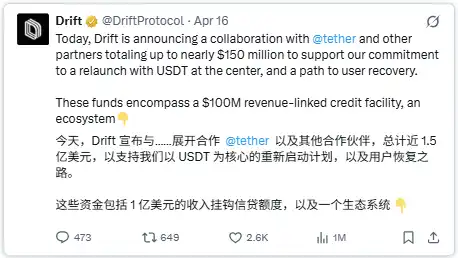
- Tether is also mimicking this strategy: after the Drift attack, it invested $147.5 million to make USDT the settlement asset, vying for the perpetual futures market in the Solana ecosystem.
Original Title: How USDC Wins the Hyperliquid Deal
Original Author: David Christopher
Translation: Peggy
Editor's Note: The stablecoin competition is shifting from "who is more compliant" to "who can capture more transaction entry points."
Following the passage of the GENIUS Act, USDC has indeed gained new growth momentum. Circle's U.S.-based background and compliance advantages have allowed USDC to catch up to and even periodically surpass USDT in transaction volume. However, from a market share perspective, the landscape hasn't changed significantly: USDT still commands the majority of the stablecoin market and maintains a strong position outside the U.S.
This is also the core significance of the deal between Coinbase, Circle, and Hyperliquid. On the surface, it's a stablecoin asset swap: USDC re-emerges as Hyperliquid's primary pricing asset, and Hyperliquid receives a higher revenue share. But at a deeper level, it's a battle over distribution channels.
Hyperliquid is a core platform in the on-chain perpetual futures market, which inherently relies on stablecoins as pricing and settlement assets. Whoever becomes the primary quote asset in these markets gains long-term usage scenarios through higher trading volume, collateral, deposits, withdrawals, and on-chain activity. Tether has proven this path through Binance; USDT's strength isn't just from its issuance size but from its deep integration into the global trading system.
For Coinbase and Circle, Hyperliquid offers global reach that they struggle to replicate themselves. Coinbase, constrained by regulations, cannot cover as broad a market as Binance or Hyperliquid. Therefore, embedding USDC into Hyperliquid's trading infrastructure may be a practical path to counter USDT's network effects.
The most noteworthy aspect of this article isn't whether Coinbase conceded on terms, or how much revenue share Hyperliquid received, but that USDC is attempting to evolve from a "U.S.-compliant stablecoin" into a broader "on-chain base trading currency." As perpetual futures continue to grow, the main battlefield of the stablecoin war may increasingly concentrate on these high-frequency trading scenarios.
The following is the original text:
Tether still dominates Binance, but Coinbase has just reinserted USDC into Hyperliquid. The battle for stablecoin distribution channels is intensifying.
Hyperliquid is becoming one of the most contested assets in the crypto industry today. Last week, spot HYPE ETFs launched by 21Shares and Bitwise went live on U.S. trading platforms, followed closely by Grayscale and VanEck. Behind this rush of institutional capital is a longer-running race: who gets a piece of this trading platform's economic returns.
Last autumn, Hyperliquid issued a public RFP soliciting proposals for its native stablecoin USDH, aiming to recapture revenue that had previously flowed to Coinbase and Circle. At the time, approximately $5.6 billion in USDC was held in Hyperliquid's cross-chain bridge, generating roughly $200 million in annual interest income. However, this income went to its centralized competitors. The platform creating real demand wasn't benefiting itself. Ultimately, Native Markets won the community vote against bidders like Paxos and Ethena, and USDH launched subsequently.
Bankless previously reported on Hyperliquid's bidding war around USDH.
But just last week, Native Markets sold USDH to Coinbase and agreed to gradually phase out this stablecoin tied to Hyperliquid's interests, allowing USDC to become the platform's primary pricing asset again. In exchange, 90% of related revenue will flow back to Hyperliquid, though the specific revenue capture mechanism remains unclear. The market widely interprets this as a victory for Hyperliquid, borne by Coinbase and Circle. This interpretation is understandable but not entirely accurate.
What Hyperliquid gains from this deal is clear: a significantly improved revenue share, roughly double that under the USDH model; stronger regulatory resources through alignment with one of the most influential voices for the U.S. crypto industry in Washington; and a return to the stablecoin experience the platform was originally built around and users highly trust. Especially in the HIP-3 market, which has drawn significant attention to Hyperliquid over the past six months, USDC remains the primary asset in use.
From Coinbase and Circle's perspective, many view this deal as a PR win: strengthening ties with one of the most crypto-native and successful projects of the previous cycle. However, if you combine USDC's current market position with the growth trajectory of the perpetual futures market, another beneficiary emerges.
What Coinbase and Circle truly gained is a distribution channel for USDC. And this scalable distribution may be more important than any other aspect of the deal.

How is Its Home Turf Performing?
Since the GENIUS Act passed, USDC has indeed shown robust growth momentum. Circle has long been prepared for the environment shaped by this regulatory framework: USDC is headquartered in the U.S. and has always been compliance-oriented. This positioning has translated into real trading volume.
Allium data shows that in May 2026, USDC trading volume reached $355 billion, surpassing USDT for the first time in recent months, reflecting accelerating growth since the GENIUS Act's passage last July.
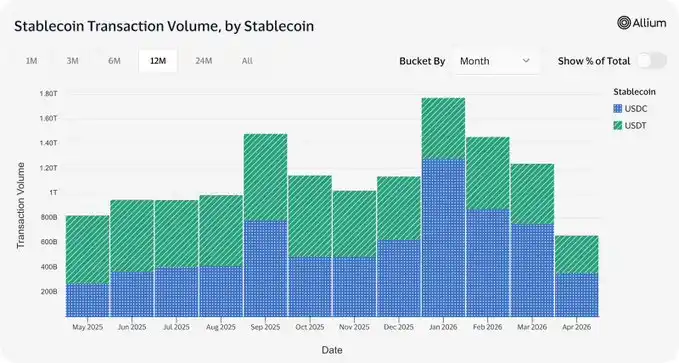
But the structural landscape of the stablecoin market hasn't changed.
In April 2025, just before the GENIUS Act's passage, USDT held 67% of the stablecoin market share, with USDC at 27.6%. One year later, USDT's share is 67.3%, and USDC's is 28.1%. The change is barely half a percentage point. In other words, despite accelerating USDC transaction volume, its supply share has remained virtually unchanged.
An Artemis report from last October indicated that the U.S. is USDC's strongest market. Given the correlation between USDC growth after the GENIUS Act and the U.S. regulatory environment, it's reasonably safe to conclude that the U.S. is also the primary source of USDC growth.
But the problem is that the U.S. is also where new competitors are flooding in most intensely. Stripe, through Tempo and other acquisitions, has clearly entered the stablecoin business. Major financial institutions are also launching their own domestically-focused stablecoins compliant with the GENIUS Act. They are all encroaching on USDC's core market.
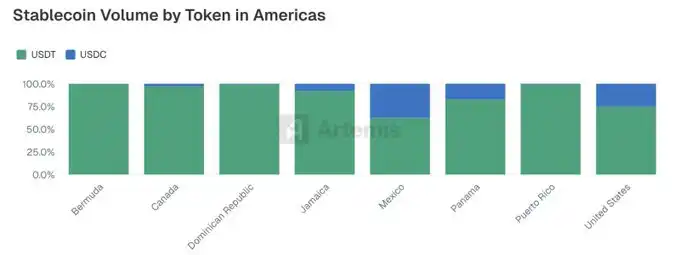
If the squeeze in its home market intensifies further, USDC lacks a sufficiently solid overseas base to fall back on. In almost all markets outside the U.S., USDT is still the default dollar stablecoin, widely used for savings, investment, and trading, and it continues to expand aggressively. Over the past year, several new chains have been launched specifically to expand USDT distribution; meanwhile, Tether launched USAT, attempting to enter the U.S. regulatory perimeter under the GENIUS Act framework, directly challenging USDC's home market.
Coinbase and Circle currently have momentum for continued expansion, but the window to lock down distribution channels before competition fully heats up is narrow. Trading scenarios, particularly the perpetual futures market, are precisely the best battleground for capturing this distribution entry point.
Bankless previously reported on Tether launching the U.S.-regulated USA₮ stablecoin.
Perpetual Futures Are the Real Battlefield
Like stablecoins, perpetual futures are among the fastest-growing categories in crypto, maintaining year-over-year growth rates in the double or even triple digits.
Perpetual futures and stablecoins are structurally highly intertwined, as stablecoins typically serve as the primary pricing asset in perpetual futures markets. USDT has already established a significant position here: on Binance, the world's largest perpetual futures trading platform, most trading markets use USDT as the primary pricing asset. Any user trading on Binance's core markets primarily does so via USDT. This further solidifies USDT's supply within the exchange, naturally creating downstream demand for deposits, withdrawals, and on-chain activity around that exchange.
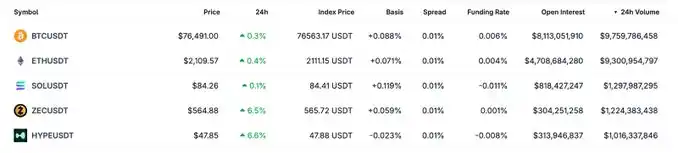
Although Hyperliquid's trading volume is far lower than Binance's, it is already the largest on-chain perpetual futures platform, commanding 30% of the entire on-chain perpetual futures market and holding 46% of open interest. This position has remained stable despite repeated competitive challenges.
Meanwhile, while Hyperliquid is not a centralized exchange, it has clearly demonstrated the ability to compete with centralized platforms. As of April 30, its trading volume was roughly 50% of Bybit's, 30% of OKX's, and 79% of Coinbase International's. All of this combined amounts to only about 13% of Binance's volume. However, the key point is that this number is still growing, and the growth curve points in only one direction.
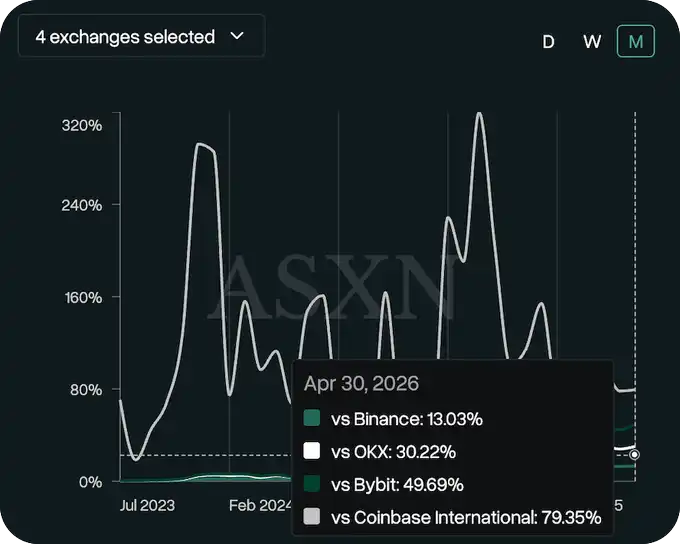
While still in its early stages, Hyperliquid's dominance in the on-chain perpetual futures market, coupled with its ability to match or even occasionally exceed centralized exchange volumes, gives it a global reach approaching Binance's coverage outside the U.S. This opens a new channel for Coinbase and Circle: they can leverage Hyperliquid to compete with Tether and turn it into a structural distribution channel for USDC.
Coinbase Chooses Its Battlefield
However, this raises a question: why doesn't Coinbase simply develop its own perpetual futures business further and build this distribution channel itself?
The reason is that Coinbase is constrained by its regulatory framework, limiting both the customer range it can serve and the number of markets it can list. Currently, Coinbase covers about 100 countries, slightly more than half of Binance's 180. Hyperliquid, benefiting from a more "relaxed" operational environment, can reach a broader market, giving it an advantage over both Binance and Coinbase—an advantage Coinbase would find difficult to replicate on its own.
Therefore, Coinbase and Circle choose to let Hyperliquid play the role of global reach, with USDC entering these markets as the underlying asset. This deal allows them to share in the upside from USDC supply growth and resulting revenue without directly engaging in a jurisdictional battle they are unlikely to win. They capture only a portion of the economic returns, but it's a scale Coinbase cannot achieve on its own.
Tether Is Copying the Same Playbook
Tether is also executing its own version, albeit on a much smaller scale. After the Drift attack in April, Tether committed up to $147.5 million to support its recovery. This deal established USDT as Drift's settlement asset, set up Tether-backed USDT credit lines for designated market makers, and funded the trading incentive layer.
In other words, Tether leveraged the Drift crisis to change the base currency of a major Solana perpetual futures DEX. Before this deal, USDC's stablecoin presence on Solana was more than double USDT's, a pattern prevalent across the entire Solana chain.
Both sides of the stablecoin war have recognized the same thing: the perpetual futures market is a critical battleground in the stablecoin competition.
Overall, to capitalize on the growth momentum from the GENIUS Act, Coinbase and Circle need more distribution channels. The Hyperliquid deal may be exactly such an entry point: disseminating USDC in the core scenarios of on-chain trading, entering one of the fastest-growing segments of the crypto industry, and gaining the potential to compete on equal footing with USDT and Binance.
It may also be a bet on further opening of U.S. domestic regulatory boundaries. CFTC Chairman Selig has explicitly stated his desire for perpetual futures to be allowed for trading in the U.S., and the passage of the CLARITY Act could ensure this. Reports this week indicate the SEC is preparing to introduce an "innovation exemption" under its Project Crypto initiative, allowing crypto-native platforms to offer on-chain trading of tokenized U.S. stocks under lighter registration requirements.
Combining the CFTC's stance under Selig and the SEC's direction under Atkins, Coinbase seems to be positioning early: enabling Hyperliquid to gain distribution capabilities in the U.S. market with USDC already installed as a core asset.
Bankless previously reported on the window of opportunity opening for perpetual futures trading.
Of course, this remains speculative. But it aligns with how Wall Street and institutional players might view Hyperliquid: as their entry point into the future regulatory framework for perpetual futures. For an asset, this is almost one of the most attractive tailwinds possible.


