






The world is confronting a new wave of inflation, with a "long-term bond storm" sweeping across the globe


- Core Viewpoint: The conflict in the Middle East has pushed up oil prices and inflation expectations, causing US long-term Treasury yields to surge to their highest levels since 2007 and triggering a global bond sell-off. Markets now expect the Federal Reserve to raise, rather than cut, interest rates, potentially ushering in a new era of structurally higher rates.
- Key Factors:
- The yield on the US 30-year Treasury bond broke through 5%, a 16-year high. Demand at the 30-year auction was lackluster, indicating investors are still reluctant to buy at these elevated levels.
- Traders now see a rate hike by March next year as a high-probability event, a fundamental reversal from late February expectations of a rate cut in 2026, with the inflation narrative dominating market pricing.
- The blockade of the Strait of Hormuz continues to drive up oil prices and inflation expectations, becoming the core driver of bond market turbulence. Unless this situation changes, pressure on the bond market is unlikely to ease.
- Markets are concerned that the next CPI report could show an annual inflation rate of 4%, its highest since 2023. The expanding US fiscal deficit further reinforces the demand for term premium compensation.
- JPMorgan's survey of US Treasury investors shows short positions at their highest in 13 weeks, with increasing bets on further bond market declines. Some investors are choosing to wait on the sidelines.
Original author: Zhao Ying
Original source: Wall Street CN
The global bond market is at a historic turning point. Surging oil prices driven by the Middle East conflict and rising inflation expectations are pushing U.S. Treasury yields to two-decade highs, triggering a cascade of sell-offs in major markets such as the UK and Japan. A new era of persistently high interest rates may have quietly begun.
The yield on the 30-year U.S. Treasury bond has breached the 5% mark, reaching its highest level since 2007. Demand at last week's 30-year Treasury auction was tepid, failing to ignite buying enthusiasm even at these elevated levels. Meanwhile, market expectations for the Federal Reserve's policy path have undergone a fundamental reversal. Traders currently see a rate hike next March as a distinct possibility, with about a three-in-four chance of a hike by December. This contrasts sharply with expectations at the end of February this year, when the market anticipated two rate cuts by 2026.
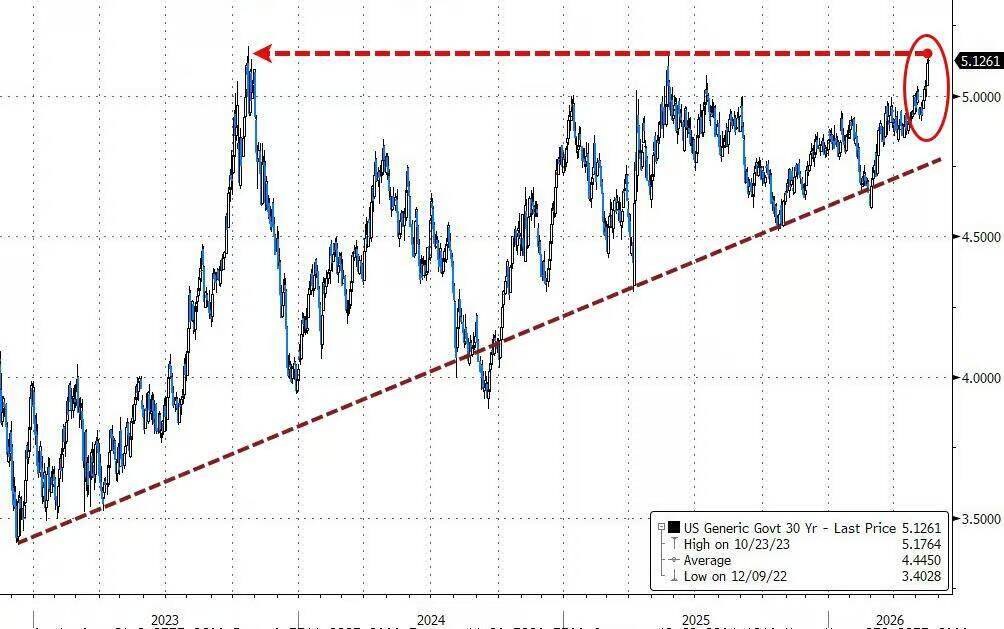
This bond market turmoil has weighed on equities and caught the attention of G7 finance ministers, who will dedicate part of their meeting this week to discussing the ongoing bond sell-off. Priya Misra, a portfolio manager at J.P. Morgan Asset Management, warned, "Long-end yields are rising synchronously across the globe, which often reinforces itself. And the expectation of a Fed rate hike is also entering the market narrative."
Iran Conflict Inverts Bond Market Narrative
The blockade of the Strait of Hormuz is the core driver of this bond market turbulence. The disruption to this critical global oil transit chokepoint continues to push oil prices higher, reigniting inflation expectations.
Investors widely believe that as long as the standoff in the Middle East remains unresolved, pressure on the bond market will be difficult to dissipate. Priya Misra stated bluntly, "Unless the strait reopens, the entire interest rate range has shifted higher."
Data shows that U.S. Treasury yields are currently about 50 basis points or more above levels seen at the end of February. The 2-year yield briefly rose to 4.09%, its highest since February 2025; the 10-year yield stood at 4.58%, a near one-year high. Year-to-date, U.S. Treasuries have posted negative returns, compared to a gain of nearly 2% earlier in the year at the end of February.
Inflation Narrative Dominates Market Pricing
The core concern for the market right now is the re-anchoring of inflation expectations. Karen Manna, fixed income strategist and portfolio manager at Federated Hermes, stated, "We are seeing a world that is truly grappling with a new wave of inflation."
Kevin Flanagan, Head of Fixed Income Strategy at WisdomTree, expects the next Consumer Price Index (CPI) report to show an annual inflation rate of 4%, which would be the highest since 2023—April's CPI was already recorded at 3.8%. He noted, "The inflation narrative is dominating the market. The bond market is demanding a higher premium to compensate for holding newly issued Treasury debt."
Concerns over the expanding U.S. fiscal deficit, coupled with signs of economic resilience despite the headwinds from the war, have further strengthened the logic for investors to demand higher term premiums. Last week's Treasury auctions confirmed this: the 30-year auction yield reached 5%, the first time since 2007, but demand was lackluster; investor demand for the 3-year and 10-year auctions was also tepid.
Rate Hike Expectations Reshape Fed Outlook
This inflation storm has also put immense pressure on incoming Fed Chair Kevin Warsh, dashing market bets that he would cut rates soon after taking office.
Chicago Fed President Austan Goolsbee said last week that broad price pressures could even signal an overheating economy; Fed Governor Michael Barr described inflation as an "overwhelming" risk to the economy. This Wednesday, the minutes of the Fed's April meeting will be released, and the market will closely watch the level of support dissenting members received among officials.
In the latest J.P. Morgan U.S. Treasury investor survey, bearish positions on Treasuries reached their highest level in 13 weeks, indicating a clear increase in market bets that bond prices will fall further.
Investors Wait-and-See, Awaiting More Signals
Faced with persistent selling pressure, some investors are choosing to hold their fire. Kevin Flanagan stated that his firm is sticking with floating rate notes and maintaining a lower interest rate exposure, preferring to "buy late rather than buy too early." He views the 4.5% level for the 10-year yield as "more of a psychological barrier," adding that if the Middle East situation escalates again, pushing oil prices higher, yields could retest last year's highs around 4.62%.
Hank Smith, Head of Investment Strategy at Haverford Trust, adopted a more cautious stance. He said the question of whether the rise in consumer and producer prices is temporary "or will extend into 2027" remains an open question, requiring more data to determine the bond market's direction.


