






Meme-Shell Contracts: Is alt.fun True Innovation or Fake Demand?


- Core Thesis: alt.fun, as a novel Meme issuance platform in the Hyperliquid ecosystem, binds Meme tokens with leveraged tokens to deliver a dual experience of "playing Memes + opening contracts." However, its mechanism faces bottlenecks such as homogenized underlying assets and a lack of community consensus, limiting future development.
- Key Elements:
- alt.fun's platform mechanism resembles a combination of Pump.fun and leveraged tokens. When users create or purchase a Meme token, the platform simultaneously mints a corresponding leveraged token (e.g., 3x long HYPE) on BounceTech. The token price is driven by both trading sentiment and the performance of the underlying asset.
- The market cap threshold for a token to graduate (migrate to HyperSwap V2) is $9,000, achievable through buying pressure or an increase in the underlying asset's value. However, leverage decay and price spike/liquidations can lead to the token's value dropping to zero, making it suitable only for trending markets.
- Currently, the platform has only 41 graduated tokens, with only ALT (5x long HYPE) and STONKS (5x long S&P 500) exceeding a million-dollar market cap. The platform has around 1,000 users and only 14 underlying assets, leading to severe token homogenization.
- The core pain point is that Meme tokens lack community consensus. Investors buy based on price expectations rather than narrative or culture, making it difficult to generate a virality effect. Additionally, users can issue leveraged tokens themselves to avoid premiums.
Original: Odaily (@OdailyChina)
Author: Golem (@web3_golem)
Last week, a new Meme launch platform called alt.fun on the Hyperliquid ecosystem caught the attention of many Meme traders. Within just one week of its launch, its flagship token ALT reached a peak market cap of $8.8 million, which has since retraced, stabilizing around $6.7 million.
The novelty of alt.fun can be understood as a combination of Pump.fun and Hyperliquid, allowing users to experience the dual thrill of playing with Memes and opening leveraged contracts simultaneously.
Introduction to the alt.fun Platform Mechanism
Specifically, each Meme token launched on alt.fun has a corresponding contract position matched on Hyperliquid as its underlying asset.
Similar to Pump.fun, any user can launch a Meme coin on HyperEVM via the alt.fun platform with a single click. The token price is still influenced by a bonding curve. The total supply of the created Meme coin is 1 billion. When 75% of the tokens are sold, the token successfully "graduates" and is migrated to the HyperSwap V2 liquidity pool.
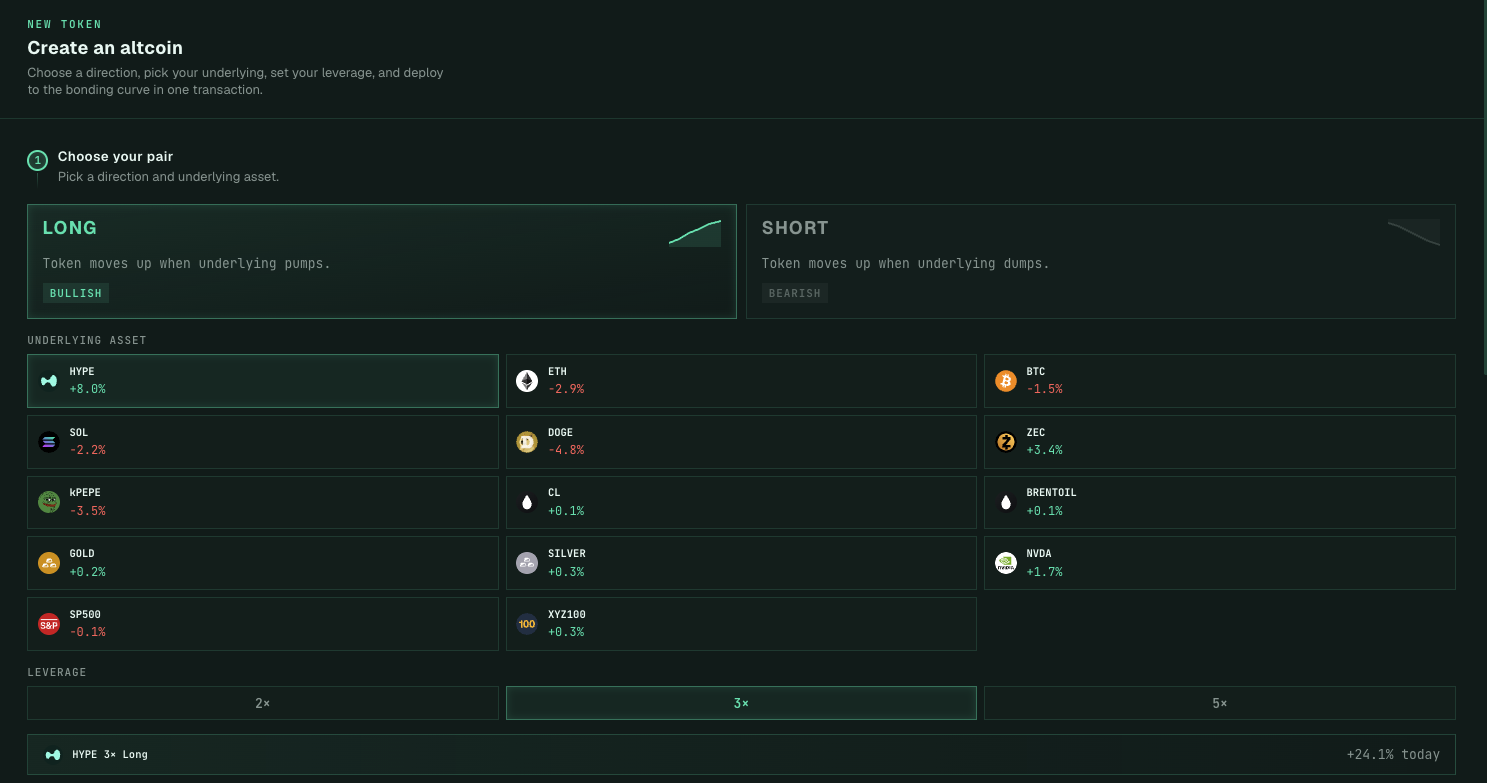
The difference from Pump.fun is that when creating a token on alt.fun, users must also select an underlying asset and choose a direction (short/long) with a limited leverage multiple (2x/3x/5x). At the moment of token creation, the platform mints a corresponding amount of Leveraged Tokens (LT) on BounceTech(Odaily note: A permissionless leveraged token platform on Hyperliquid) and sends them to the user. This leveraged token corresponds to a perpetual contract position established on Hyperliquid. For example, if a user creates a token based on 3x long HYPE, what they essentially receive is a leveraged token tracking 3x the gains of HYPE.
As shown below, users can currently choose from 14 different assets as the underlying when creating a token on alt.fun. Similarly, when a player buys a Meme coin on this platform, the platform mints the corresponding leveraged token on BounceTech. If a player sells, the process is reversed, the leveraged token is redeemed, and the user receives USDC.
This model of wrapping leveraged tokens as underlying assets and then selling them is similar to securitizing specific risk exposures from derivatives like futures and options in traditional finance, such as 3x Short Nasdaq ETFs or 5x Short Crude Oil products. In this process, the alt.fun platform acts like an asset management company, managing the long-term positions behind the leveraged tokens for users.
The core price of such financial products typically tracks the net asset value. However, because the token price on the alt.fun platform is also simultaneously influenced by the Meme coin's bonding curve mechanism, the graduation model and price drivers for Meme coins on this platform are not singular.
Dual Graduation Model and Price Drivers
This also means that the token price on the alt.fun platform is influenced by two factors: first, the sentiment of the buying and selling market, and second, the performance of the underlying asset. So now you might understand the alt.fun platform's slogan: "Your token pumps even when nobody's buying."
For example, if a user creates a token based on 3x long HYPE and invests an initial capital of $20 (the platform's minimum buy-in), and then HYPE rises by 10%, the user's position value would increase by 30% to $26, even if no one else buys the token.
Based on this dual price driver, the graduation model for tokens on the alt.fun platform is not limited to just one method. Specifically, the token graduation condition requires the market cap to reach $9,000. This essentially calculates the value of the leveraged token. Besides making a token graduate by purchasing it, if the token itself reaches a market cap of $9,000 due to an increase in the underlying asset, it can also graduate successfully. Therefore, whether a token can meet the graduation threshold is often a combined result of both price mechanisms.
Ideally, an increase in the underlying asset drives the leveraged token up, which, combined with the emotional catalyst of the Meme market, could send the token into a spiral ascent. However, if the underlying asset falls, the value of the leveraged token continuously shrinks, potentially triggering panic selling and a sudden collapse in the token's price.
Therefore, while alt.fun's mechanism can effectively amplify leverage, it is only effective in trending markets and requires users to accurately catch the trend. In a choppy market for the underlying asset, users will also suffer from leverage decay. Because when the underlying asset price is volatile, the platform must perform "rebalancing" to manage positions and avoid liquidation. This means that even if the underlying asset drops and then recovers, the leveraged token will incur losses due to forced position reduction during the decline, gradually losing value.
In extreme cases like flash crashes, the platform might be unable to react in time, potentially causing the leveraged token's value to go to zero.
Meme or Not Meme
The alt.fun platform currently has a total of 41 graduated tokens. Only two tokens have a market cap exceeding one million dollars: ALT, based on 5x long HYPE, and STONKS, based on 5x long the S&P 500. The total number of users is approximately over 1,000. Although alt.fun is still in its early stages, its current development bottlenecks are apparent.
First, the platform has too few underlying assets. Based on the current 14 underlying assets, there can be a maximum of 84 different combinations of leveraged tokens. Indeed, alt.fun already has leveraged tokens shorting and longing the same underlying asset with the same leverage multiple. For instance, the current top token by market cap, ALT, is based on 5x long HYPE, while another token, ATH, which also reached a high market cap, is also based on 5x long HYPE. Apart from their token names and creation times, they are identical. If so, why would investors buy ATH, which has a lower market cap?
Although alt.fun might support more underlying assets in the future, its core pain point is its inability to consolidate community consensus for a Meme coin.
The fundamental reason investors don't open leverage on Hyperliquid themselves but instead buy leveraged tokens on the alt.fun platform is to gain greater price leverage. Additionally, since the platform handles rebalancing management of user positions on the backend, individual users can be "hands-off" and not worry about liquidation risks.
However, this is also the problem. An investor's decision to buy an alt.fun token is ultimately based on their future price expectation for its underlying asset, not on narratives, market dynamics, or attention – these "intangible things" are precisely the core values that support a Meme. A Meme rises or gains market recognition not because of any real value backing or financial design, but more importantly, because of its community transmission attributes.
As a Meme player, I find it hard to develop a love for a leveraged token's community culture akin to that of a specific Meme. If one truly has conviction in the underlying asset of a leveraged token, it's better to create one's own leveraged token rather than buying an existing one and bearing unnecessary premiums.
Therefore, while the mechanism of the alt.fun platform appears novel, in my view, it is merely a mechanical innovation. If alt.fun were to pivot towards developing as a DeFi platform, it might have a chance. But if it insists on forcing its way into the Meme launch platform race, it is destined to be a flash in the pan.


