






2026年การศึกษาเกี่ยวกับสถานการณ์การอายัด stablecoin ขนาดใหญ่: การวิเคราะห์ลักษณะ วิวัฒนาการความเสี่ยง และกลยุทธ์การตอบโต้


- ประเด็นหลัก: ระหว่างเดือนมีนาคมถึงเมษายน 2026 จากเหตุการณ์ต่างๆ เช่น ความขัดแย้งระหว่างสหรัฐฯ และอิหร่าน ได้เกิดการอายัด USDT และ USDC บนเชน TRON และ ETH ครั้งใหญ่ โดยธุรกรรมที่ผิดกฎหมายของ stablecoin คิดเป็น 84% ที่อยู่ที่เกี่ยวข้องกับเงินทุนในกลุ่มภาษาจีนคิดเป็น 56% ของจำนวนการอายัดทั้งหมด และมีสัดส่วนปริมาณธุรกรรมในอดีตสูงถึง 91% แต่เงินทุนที่ถูกอายัดโดยตรงคิดเป็นเพียง 5% ซึ่งเผยให้เห็นความเสี่ยงในเส้นทางเงินทุนในเชิงลึก
- ปัจจัยสำคัญ:
- ในช่วงเดือนมีนาคม-เมษายน 2026 มีการอายัด USDT/USDC บนเชน TRON และ ETH เพิ่มขึ้น 1,397 ที่อยู่ โดยมีมูลค่าเงินทุนประมาณ 722 ล้านดอลลาร์สหรัฐ และมูลค่าธุรกรรมในอดีตมากกว่า 25,000 ล้านดอลลาร์สหรัฐ
- ช่วงเวลาสูงสุดของการอายัด USDT ของ Tether ครอบคลุมหลายเขตเวลา (เช่น เวลาปักกิ่ง 12:00-13:00 น.) สะท้อนถึงการปฏิบัติตามกฎระเบียบทั่วโลก การอายัด USDC กระจุกตัวในช่วงเวลา 16:00 น. ตามเวลาตะวันออกของสหรัฐฯ สะท้อนถึงรูปแบบการบริหารความเสี่ยงเชิงสถาบัน
- ที่อยู่ที่ถูกอายัดซึ่งเกี่ยวข้องกับเงินทุนในกลุ่มภาษาจีนมีจำนวน 779 แห่ง (คิดเป็น 56%) แต่เงินทุนที่ถูกอายัดจากกลุ่มนี้มีเพียง 19% (ประมาณ 135 ล้านดอลลาร์สหรัฐ) ซึ่งแสดงให้เห็นลักษณะเด่นคือ "สัดส่วนของที่อยู่และปริมาณธุรกรรมสูง แต่สัดส่วนของเงินทุนที่ถูกอายัดต่ำ"
- พฤติกรรมการอายัดมีความสัมพันธ์สูงกับเหตุการณ์ทางภูมิรัฐศาสตร์ (ความขัดแย้งระหว่างสหรัฐฯ และอิหร่าน) โดยปรากฏเป็นจุดสูงสุดเป็นช่วงๆ และเป็นการโจมตีที่แม่นยำต่อห่วงโซ่เงินทุนที่มีมูลค่าสูง เช่น การที่ Tether ร่วมมือกับ OFAC อายัด USDT มูลค่า 344 ล้านดอลลาร์ที่เกี่ยวข้องกับธนาคารกลางอิหร่าน
- รายงานแนะนำว่าอุตสาหกรรมจำเป็นต้องสร้างความสามารถในการตรวจสอบบนเชนและวิเคราะห์พฤติกรรม ระบุรูปแบบการโอนที่ผิดปกติ และใช้เครื่องมือ KYT เฉพาะทาง (เช่น Beosin KYT) เพื่อประเมินความเสี่ยงและแจ้งเตือน
Original Source: Beosin
In recent years, the global regulatory landscape for virtual asset Anti-Money Laundering (AML) and Counter-Financing of Terrorism (CFT) has undergone profound changes. Regulatory agencies in various countries have significantly increased their focus on virtual assets, particularly stablecoins. The Financial Action Task Force (FATF) report "Stablecoins and Unhosted Wallets Special Report", published in March 2026, clearly states that stablecoins accounted for 84% of illegal virtual asset transaction volume in 2025, being widely used for money laundering, terrorist financing, and the proliferation financing of weapons of mass destruction.
Against this backdrop, the concentrated freezing operations on USDT and USDC on the TRON and ETH chains from March to April 2026 serve as a crucial window for observing the evolution of on-chain AML practices. This article, leveraging monitoring data from the Beosin Stablecoin Monitor, analyzes dimensions such as freezing scale, on-chain fund associations, and off-chain intelligence, aiming to accurately present the stablecoin freezing situation, analyze potential fund chain risks, and provide targeted blockchain AML response strategies.
1. Analysis of Stablecoin Freezing Characteristics
According to monitoring data, during the period from March to April 2026, the number of newly frozen addresses and the amount of frozen funds for USDT and USDC on the TRON and ETH chains both increased significantly. There were 1,397 frozen addresses, with a total of approximately $722 million in funds directly frozen. The historical transaction volume of the frozen addresses exceeded $25 billion.
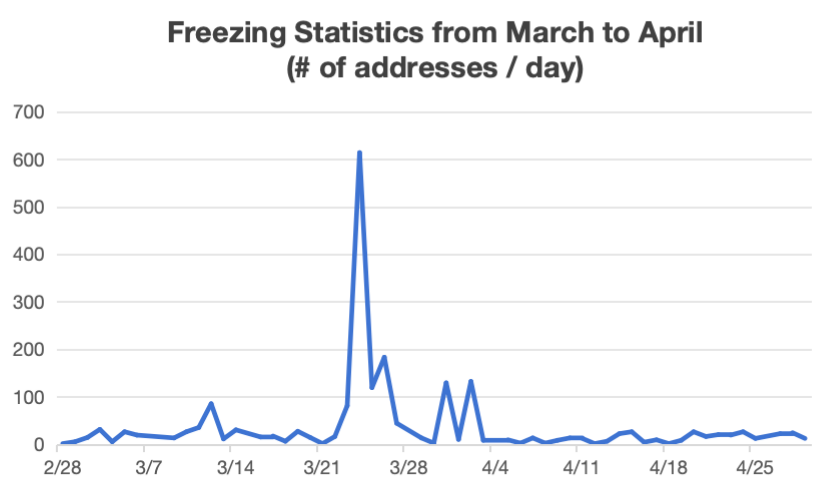
Looking at the daily distribution of frozen address counts, the number of frozen addresses increased following the onset of the US-Iran conflict. A peak processing day occurred after March 21, with the number of addresses exceeding 600.
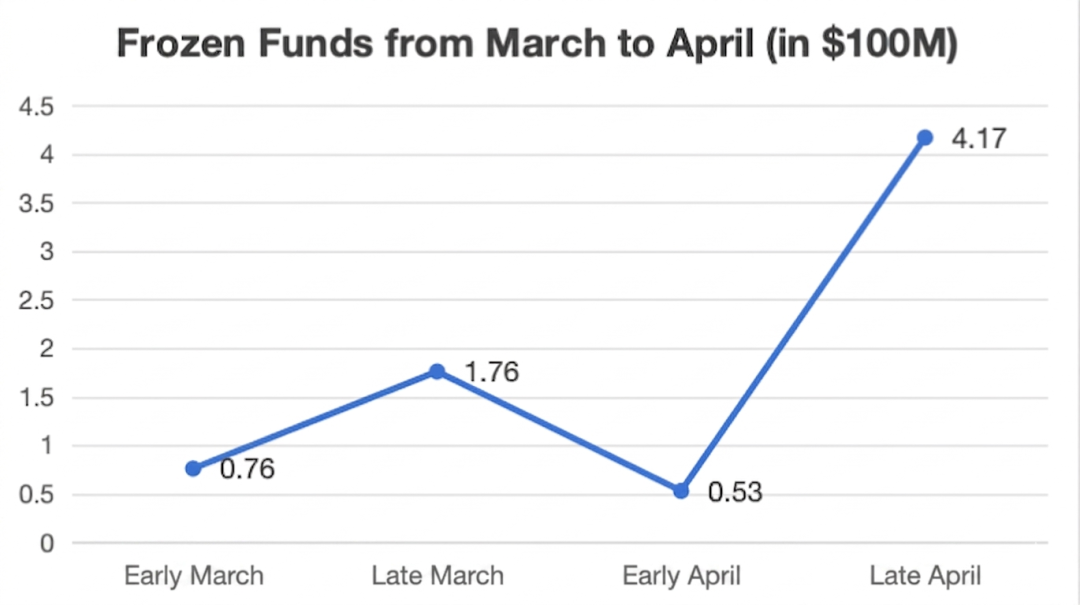
Regarding changes in the scale of frozen funds, the amount of frozen funds showed a stepped upward trend. This directly corresponds to Tether's cooperation with OFAC at the end of April to freeze 344 million USDT related to the Central Bank of Iran. This incident indirectly illustrates that on-chain freezes involve not only large-scale address blocking but also precise strikes against high-value fund chains.
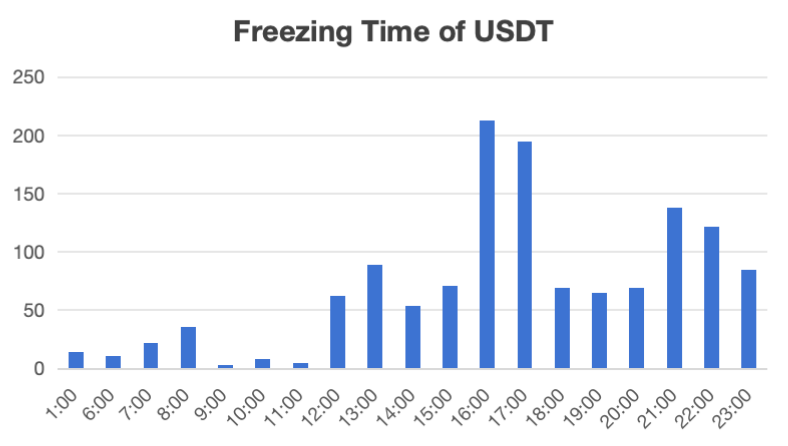
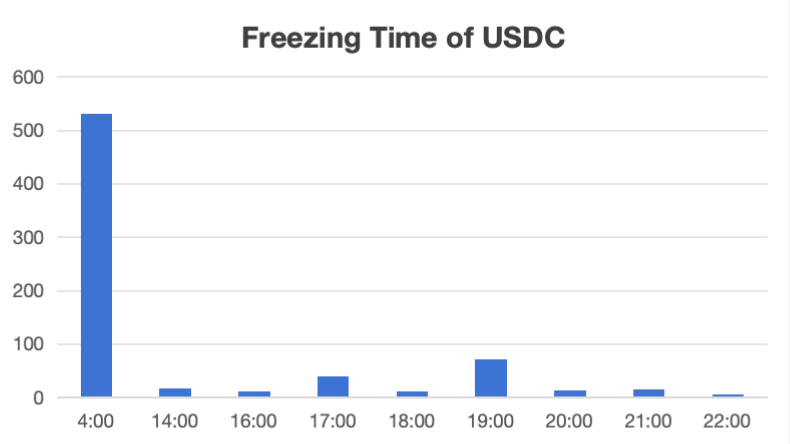
Furthermore, the on-chain freezing data from March to April 2026 shows that stablecoin freezing activities exhibit distinct time clustering patterns, with USDC and USDT showing significant temporal differentiation. This reflects different control logics and user scenarios for different issuers. The peak freezing times also indirectly reveal the differing attitudes of issuers towards regulatory responses in specific regions.
USDT freezing activities show several notable peaks: 12:00-13:00, 16:00-17:00, and 21:00-22:00 (corresponding to 8:00 Dubai time, 9:00 UK time, and 9:00 US Eastern Time, respectively). Frequency is lower from late night to midday Beijing time, demonstrating Tether's response to law enforcement in multiple countries and its global risk control situation.
USDC freezing activities are highly concentrated at 4:00 AM Beijing time (4:00 PM US Eastern Time), with relatively few operations at other times. This distribution pattern closely matches its processing model and user scenarios. The primary users of USDC are institutions, and suspicious address handling is executed uniformly by the issuer, with batch compliance risk control and address review actions concentrated during US business hours.
2. Fund Chain Risk Assessment
Based on a multi-dimensional comprehensive assessment using Beosin KYT's address label database (exceeding 5 billion entries), on-chain transaction memos (Simplified Chinese), address-related public sentiment, and Chinese token data, the correlation between Chinese-linked funds and frozen addresses can be categorized into three types:
- Directly Related Addresses: Determined by on-chain label matching of the frozen address itself and its counterparty addresses, combined with conditions such as tags indicating Chinese grey/black market shops, underground banks, risk warnings related to cases, and Chinese text in on-chain transfers.
- Indirectly Related Addresses: Determined by matching on-chain user behavior, such as frozen addresses transferring Chinese tokens, using wallet applications commonly favored by Chinese users, or having direct fund flows with platforms known for Chinese user associations.
- Suspected Related Addresses: Determined by conditions such as suspected multi-transaction RMB exchange scenarios (e.g., identifying more than 10 transactions with values in integer multiples of the RMB equivalent in the historical USDT/USDC trades of a frozen address) or indirect associations between counterparties.
Based on the newly frozen USDT and USDC addresses on the TRON and ETH chains and related transaction data from March to April 2026, we can observe the high-risk situation faced by Chinese-linked fund chains:
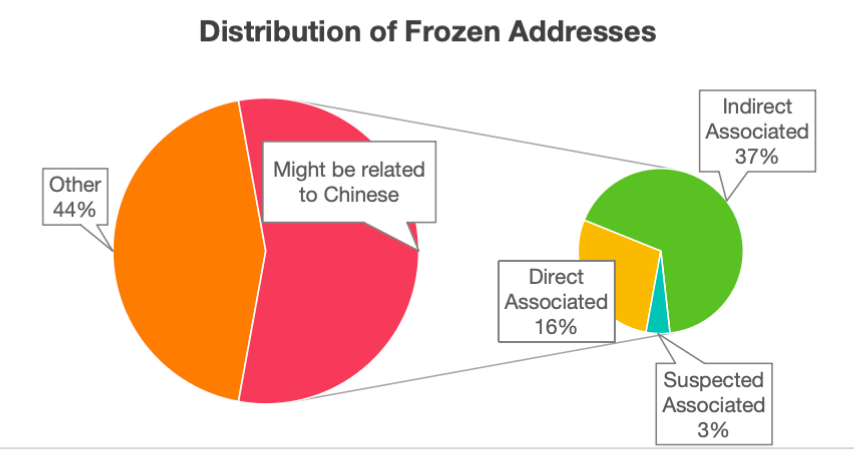
1. Number of Frozen Addresses: Of the 1,397 frozen addresses in the sample, a total of 779 addresses might be related to Chinese-linked funds (including direct, indirect, and suspected), accounting for 56%. Among these, directly related frozen addresses numbered 220 (16%), indirectly related numbered 523 (37%), and suspected related numbered 36 (3%).
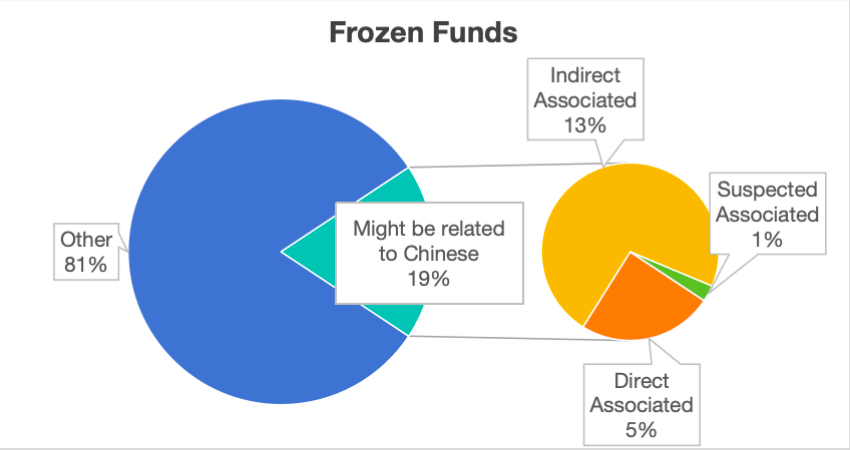
2. Scale of Frozen Funds: Of the approximately $722 million in frozen funds in the sample, funds potentially directly, indirectly, or suspectedly related to Chinese-linked sources total approximately $135 million, accounting for 19%. Directly related frozen funds amounted to about $33.32 million (5%), indirectly related about $97.41 million (13%), and suspected related about $4.1 million (1%).
3. Historical Transaction Volume: The total historical volume of the frozen addresses in the sample exceeded $25.9 billion. Addresses potentially directly, indirectly, or suspectedly related to Chinese-linked funds accounted for approximately $23.6 billion, a striking 91%. The historical transaction amount for directly related frozen addresses was approximately $6.216 billion (24%), indirectly related was approximately $15.787 billion (60.6%), and suspected related was approximately $1.693 billion (6.5%).
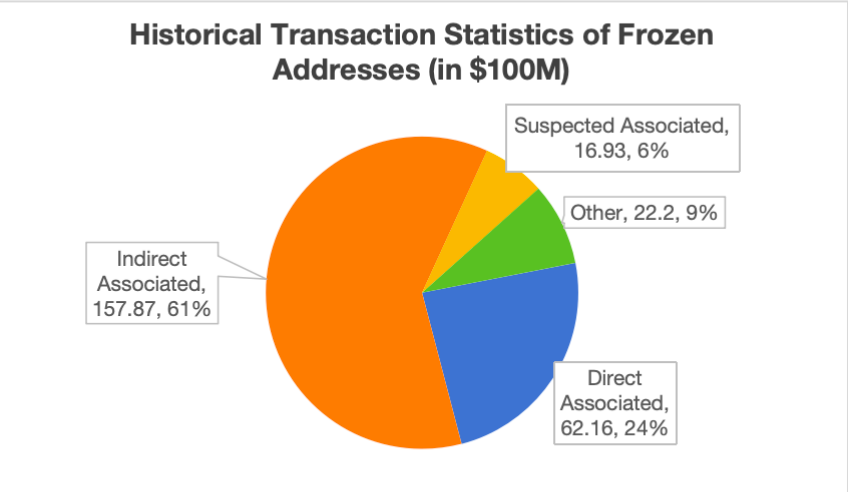
We can observe that the direct/indirect/suspected correlation of Chinese-linked funds exhibits a pattern of "High address count ratio, low frozen fund ratio, extremely high transaction volume ratio". This indicates that although the directly frozen amounts for these related addresses are relatively limited, they serve as nodes for fund flow, carrying immense historical transaction volumes. The potential risks in the related fund chains require close attention.
3. Blockchain AML Solutions
The above analysis of concentrated stablecoin freezes details the distribution of on-chain AML activities in terms of frozen count, amounts, and time periods, revealing the high-risk situation faced by Chinese-linked fund chains within the blockchain ecosystem. Currently, blockchain compliance is advancing rapidly, placing higher demands on the risk control capabilities of Virtual Asset Service Providers (VASPs). Related compliance teams should:
1. Build On-Chain Monitoring Capabilities: Monitor newly frozen or imminently high-risk addresses, along with related address clusters and counterparties' on-chain and off-chain activities, to formulate corresponding risk control plans and response strategies.
2. Develop On-Chain Behavior Analysis Capabilities: Identify potential abnormal behaviors (e.g., large transfers to brand new addresses, fund dispersion to multiple addresses), confirm that the team's main wallet and business wallets are unaffected, and provide real-time warnings for suspicious addresses.
3. Leverage Professional Blockchain AML Tools to Enhance Risk Control: Address issues such as on-chain fund risk assessment, monitoring, and alerts. Through its massive address label database, transaction pattern analysis, and cross-chain analytics capabilities, Beosin KYT can accurately identify high-risk entities and provide risk scores for various addresses and transactions.
Looking ahead, blockchain AML technology will continue to upgrade, and cooperation between stablecoin issuers and law enforcement agencies will become even closer. Beosin will continue to delve deeper into blockchain security and compliance technologies, continuously expand its global partner ecosystem, and collaborate with regulatory and law enforcement agencies, industry organizations, and enterprises to jointly build a secure, compliant, and efficient virtual asset ecosystem.


