Hyperliquid's "Wall Street Moment": ETF Absorbs $100 Million, DAT Listed in Russell 3000


- Core Thesis: Jeff Sprecher, CEO of ICE (parent company of the New York Stock Exchange), publicly praised decentralized exchange Hyperliquid, calling it “bigger than Nasdaq.” His prior lobbying alongside CME for CFTC regulation was not an attempt to shut it down, but rather to seek regulatory easing so traditional exchanges can also participate in the on-chain derivatives market.
- Key Elements:
- ICE CEO publicly praised Hyperliquid on May 27, just 12 days after jointly issuing a regulatory warning to the CFTC with CME. This stark contrast in stance has drawn market attention.
- Sprecher clarified that the true intention of the regulatory lobbying was to demand a level playing field, allowing traditional exchanges to legally conduct on-chain derivatives businesses, rather than to suppress Hyperliquid.
- Hyperliquid has already listed SpaceX derivative contracts. Its on-chain notional exposure could potentially surpass the ~$1.75 trillion IPO value itself (as of June 12), and is viewed as a potential "shadow pricing market."
- Two HYPE spot ETFs saw cumulative net inflows exceeding $100 million within 10 days of launch. Their absorption performance relative to market cap outpaces that of Bitcoin and Ethereum ETFs during their respective initial launch periods.
- Hyperliquid Strategies (PURR) has been selected for the Russell 3000 Index. Passive funds tracking the index will be required to buy in, creating a transmission channel for HYPE into traditional capital markets.
- Hyperliquid founder Jeff Yan has traveled to Washington D.C. to meet with policymakers and is proactively addressing regulatory issues through the independent Hyperliquid Policy Center, advocating for the establishment of a regulatory framework for on-chain derivatives.
Original Author: Claude, Shenchao TechFlow
Introduction: Jeff Sprecher, founder and CEO of ICE (the parent company of the New York Stock Exchange), publicly praised Hyperliquid at the Bernstein investor conference on May 27, calling it "bigger than Nasdaq" and stating, "I wish I were younger so I could get in on the action myself." This statement came just 12 days after ICE and CME jointly lobbied the CFTC to "crack down" on Hyperliquid.
Sprecher also revealed that the NYSE has secretly integrated a blockchain settlement system. The HYPE token hit an all-time high of $64 this week, with two spot ETFs attracting over $100 million in inflows within 10 days of launch. Its DAT company, PURR, has been included in the Russell 3000 Index.
On May 27, Jeff Sprecher, founder and CEO of Intercontinental Exchange (ICE), gave a rare and clearly personal assessment of Hyperliquid during an interview at Bernstein's Annual Strategic Decisions Conference.
"This thing we're talking about, Hyperliquid, if you haven't heard of it, it's bigger than Nasdaq, okay? Eleven people. You see this, and you say, wow, that's remarkable," Sprecher said. He quickly added: "I love this. I wish I were younger so I could go do it myself. By the way, the people doing this are minting billionaires right now."
ICE is the parent company of the New York Stock Exchange and also operates one of the world's largest energy futures markets. Sprecher's comments represent the most direct public endorsement of Hyperliquid from the highest levels of traditional finance to date.
<12 Days After Jointly Lobbying for a 'Crackdown,' the CEO Changes His Tone
The reason Sprecher's praise is so striking lies in the timeline.
On May 15, Bloomberg reported that CME and ICE executives had warned the CFTC and Capitol Hill officials that Hyperliquid's decentralized perpetual contract trading could pose risks of market manipulation and sanctions evasion, demanding it be brought under the traditional financial regulatory framework. Following the news, HYPE fell nearly 9%.
Just 12 days later, the head of ICE publicly expressed admiration at one of Wall Street's most important investor conferences.
Sprecher directly addressed this contradiction at the Bernstein conference: "There was an article with a headline that made it seem like we were scared. We're not scared. We're actually talking to these people, understanding what they're doing. They're learning about our world, and we're learning about theirs. In that sense, it's mutual admiration."
He then shifted the discussion to the core regulatory issue: "What we're saying to regulators is, can we do this too? Why are you prohibiting us from doing it when it's already happening? Can we have a level playing field? This administration is very supportive of digitalization. If you think it's legitimate, then let us do it; if you think it's not, then how come they haven't received the same harsh letters you've been sending us?"
This statement reveals ICE's true logic behind lobbying the CFTC: it's not about shutting down Hyperliquid, but about demanding regulatory relaxation so that traditional trading platforms can also participate in the on-chain derivatives market.
<On the Eve of SpaceX's IPO: Hyperliquid as a 'Shadow Pricing Platform'
Sprecher's interest in Hyperliquid is not superficial; he has a very specific observation window: SpaceX is set to list on Nasdaq on June 12 with a valuation of approximately $1.75 trillion, and Hyperliquid is already trading derivative contracts based on SpaceX.
"I think what really takes it to the next level is SpaceX. They've already listed trading for SpaceX derivatives. It will be very interesting when SpaceX officially prices on June 11 to see what price the private market discovers and whether that price influences the IPO itself," Sprecher said. "Regulators and market participants will say this is either completely irrelevant or highly relevant."
He then calculated an extreme scenario: considering Hyperliquid allows leverage of up to 100:1, if retail investors flood into SpaceX derivatives, the on-chain notional exposure "could potentially be larger than the IPO itself."
"So I say you can't ignore it. I don't know yet if we should embrace it or hate it, but I think by June we'll all have our answer."
<HYPE ETF Attracts $100 Million in 10 Days, PURR Listed in Russell 3000
Sprecher's comments come at a time when Hyperliquid is experiencing an intense wave of mainstream adoption.
On May 12 and 15, 21Shares and Bitwise launched the first US spot HYPE ETFs on Nasdaq and the NYSE, respectively (tickers THYP and BHYP).
According to bitcoin.com, the two funds saw cumulative net inflows exceeding $100 million within 10 trading days, absorbing 1.04% of HYPE's total market capitalization. Proportionally, this outperformed the initial launch performance of Bitcoin and Ethereum ETFs. Bitwise recorded a single-day net inflow of $19.05 million on May 27, becoming the world's largest HYPE ETF.
On May 22, FTSE Russell published the preliminary list for the June 2026 Russell US Index reconstitution. Hyperliquid Strategies (Nasdaq ticker: PURR) appeared on the additions list for the Russell 3000 Index, with the change expected to take effect on June 26.
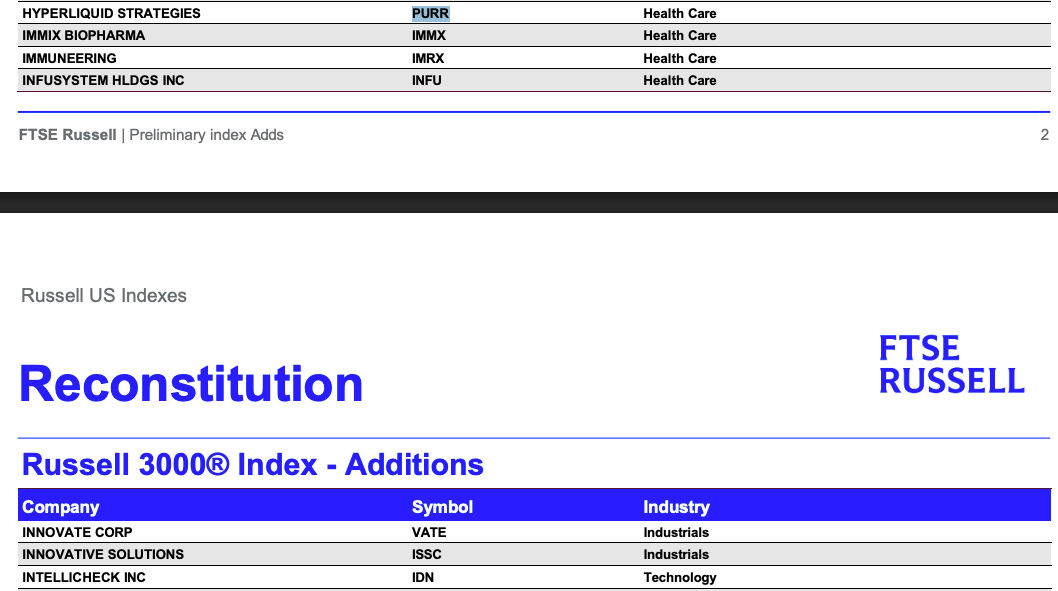
PURR is currently the largest HYPE token treasury company, holding approximately 20 million HYPE (valued at about $799 million as of April 29), along with $103 million in cash and no debt. Inclusion in the Russell 3000 means passive funds tracking the index will be compelled to buy PURR, further opening the conduit for HYPE into traditional capital markets.
The HYPE token broke through $64 this week to reach a new all-time high, with year-to-date gains of approximately 150%, significantly outperforming Bitcoin over the same period. According to CoinGecko data, HYPE's current market capitalization is around $12.7 billion, ranking tenth among crypto assets.
<Jeff Yan Heads to Washington, Hyperliquid Policy Center Goes on the Offensive
In response to the lobbying pressure from CME and ICE, Hyperliquid chose to engage directly.
On May 15, Hyperliquid founder Jeff Yan revealed that he and the Hyperliquid Policy Center (HPC) had met with policymakers in Washington D.C.
The HPC is an independent research and advocacy organization established in February 2026, led by Jake Chervinsky, former Head of Policy at the Blockchain Association and former Chief Legal Officer at Variant. Its startup funding consisted of 1 million HYPE allocated by the Hyper Foundation.
Yan stated on the X platform that the discussions covered "how on-chain trading as a financial innovation has clear global user demand" and "the regulatory pathway for bringing the on-chain derivatives market to the US."
In response to Bloomberg's report on the CME and ICE lobbying efforts, the HPC stated that the market provided by Hyperliquid is "more beneficial and lower risk than traditional centralized trading platforms" and anticipates that the CFTC will establish a dedicated regulatory framework for on-chain derivatives platforms.
An interesting detail: CME and ICE themselves are currently facing parallel investigations by the CFTC and the Department of Justice regarding "timely" oil futures trades that occurred on their respective platforms just before federal policy announcements.