






五大巨头财报周前瞻:市场在看什么?


- 核心观点:本周微软、谷歌、亚马逊、Meta和苹果的财报,将集中验证科技巨头的高额AI投入能否持续兑现为收入增长与利润效率,从而决定当前科技板块高估值是否具备基本面支撑。
- 关键要素:
- AI投入持续性:微软、谷歌、亚马逊、Meta预计2026年资本开支合计超6000亿美元,财报电话会对资本开支的谨慎或乐观信号,将直接决定整条AI产业链的估值。
- 云与广告业务韧性:微软Azure、Google Cloud和AWS的增速是衡量企业IT与AI需求的关键;谷歌与Meta的广告收入则代表平台现金流稳定性,是支撑高投入的基础。
- AI商业化兑现度:微软需证明企业客户为Copilot等AI付费;谷歌压力在于将Cloud Next愿景转化为财报数字;需关注亚马逊高投入下利润率能否守住。
- Meta的AI效率逻辑:核心是AI推荐优化能否持续提升广告曝光、价格和变现效率,而非单纯看资本开支高低;苹果则需证明终端入口价值依然稳固。
- 市场交叉验证:五家公司共同回答“AI投入真实兑现还是预期驱动”,若正面则支撑估值,若分化则市场将转向只奖励兑现能力最强的公司。
Preface: This Is Not an Ordinary Earnings Week, But a Collective Test of the Tech Main Narrative
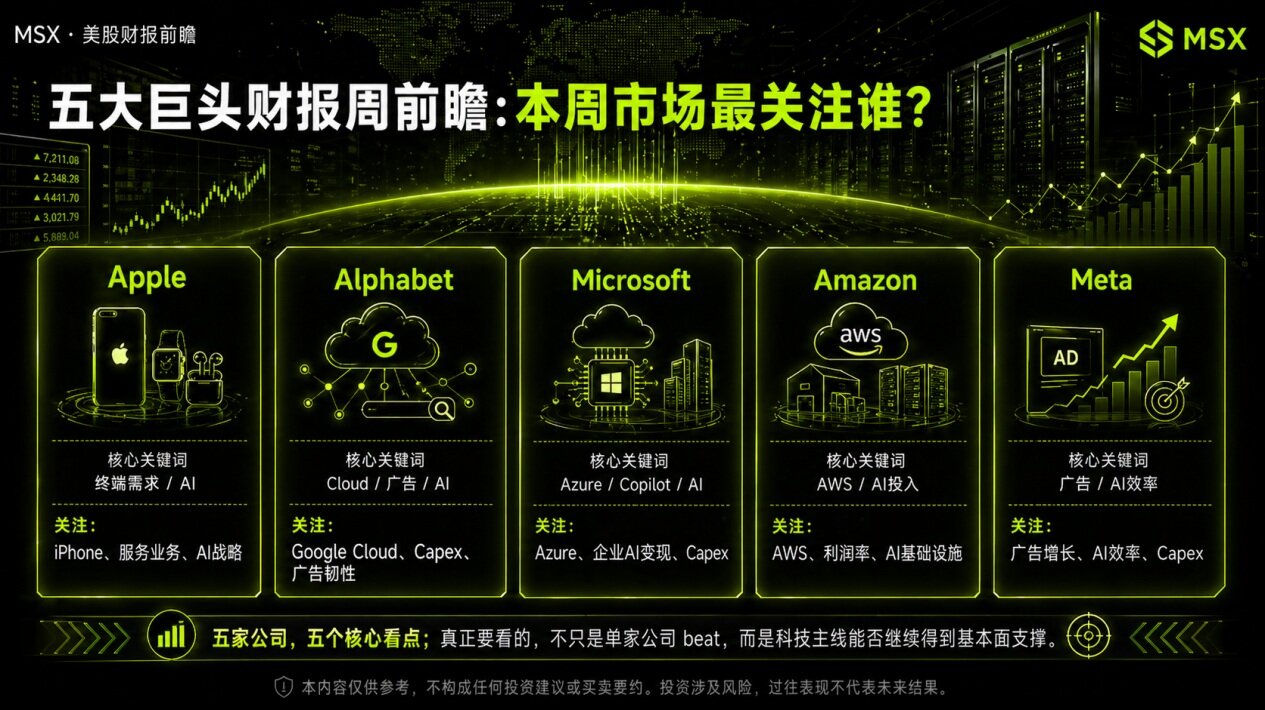
This week, the U.S. stock market will face a true "Core Asset Exam Week." Microsoft, Google, Amazon, and Meta will all release their earnings after the market closes on April 29, with Apple following suit after the close on April 30. Since these five companies cover nearly all of the most critical tech narratives today – including cloud computing, advertising, consumer electronics, e-commerce, enterprise software, and AI infrastructure – their earnings reports will impact not just their own stock prices, but the entire Nasdaq and technology sector's willingness to trade in the coming period.
If we were to distill the market narrative of the past few months into one sentence, it would be: Tech giants continue to increase AI spending, and the market continues to revise up valuations of tech leaders. However, the problem is that after valuations have risen to this level, the market is no longer satisfied with just "the company is investing in AI." It is now starting to ask more practical questions: Are these investments continuing to drive cloud business growth? Are they improving advertising efficiency? Are they supporting end-user demand? And most importantly, are they beginning to translate more clearly into revenue, profits, and future guidance?
Microsoft's revenue guidance midpoint for the current quarter was approximately $81.2 billion, with Azure growth guidance at 37%–38%; Alphabet has outlined its 2026 capital expenditure plan between $175 billion and $185 billion; Amazon expects 2026 capital expenditure to be around $200 billion; Meta has raised its 2026 capital expenditure target to $115 billion–$135 billion. These numbers themselves indicate that the true theme of this earnings season remains "whether the market will continue to buy into high spending."
I. What Does the Market Really Want to Confirm This Earnings Season?
1. Are the Tech Giants Still Willing to Spend on AI?
Because the valuations of many AI infrastructure companies are essentially based on one premise: that mega-buyers like Microsoft, Google, Amazon, and Meta will continue to place orders, expand data centers, and procure computing power, networking, and power infrastructure. If management signals any caution regarding capital expenditure during earnings calls, the impact won't be limited to them alone but will reverberate across the entire AI supply chain.
2. Can the Cash Cows – Cloud and Advertising – Hold Steady?
Microsoft Azure, Google Cloud, and AWS are the most direct windows into enterprise IT spending and AI demand. Meanwhile, Google and Meta's advertising businesses represent the core cash flow resilience of internet platforms. If both cloud and advertising remain stable, the market will continue to believe that: even with high capital expenditure, tech giants still have the capacity to use their mature businesses to support future investments.
3. Is AI Still Just a Story, or Is It Starting to Translate into Profits?
All five companies are talking about AI, but they validate it differently: Microsoft looks at enterprise payments, Google at cloud and search, Amazon at AWS and its custom chip synergies, Meta at advertising efficiency, and Apple at the terminal entry point and ecosystem position. It is precisely because of these different angles that this earnings season is particularly interesting.
II. What Questions Must Each of the Five Giants Answer?
1. Microsoft: The First Question Isn't Growth, But How Far AI Commercialization Has Come
Among the five giants, Microsoft most resembles the "showcase" of this AI cycle. The market's willingness to consistently give Microsoft a premium over the past year isn't just because it's a cloud leader, but because it's seen as the company most likely to truly turn AI into a business first. By embedding Copilot into Office, development tools, and enterprise workflows, and layering it on top of Azure as the underlying cloud platform, Microsoft's advantage lies in its ability to not only provide model capabilities but also directly reach the most willing-to-pay enterprise customers.
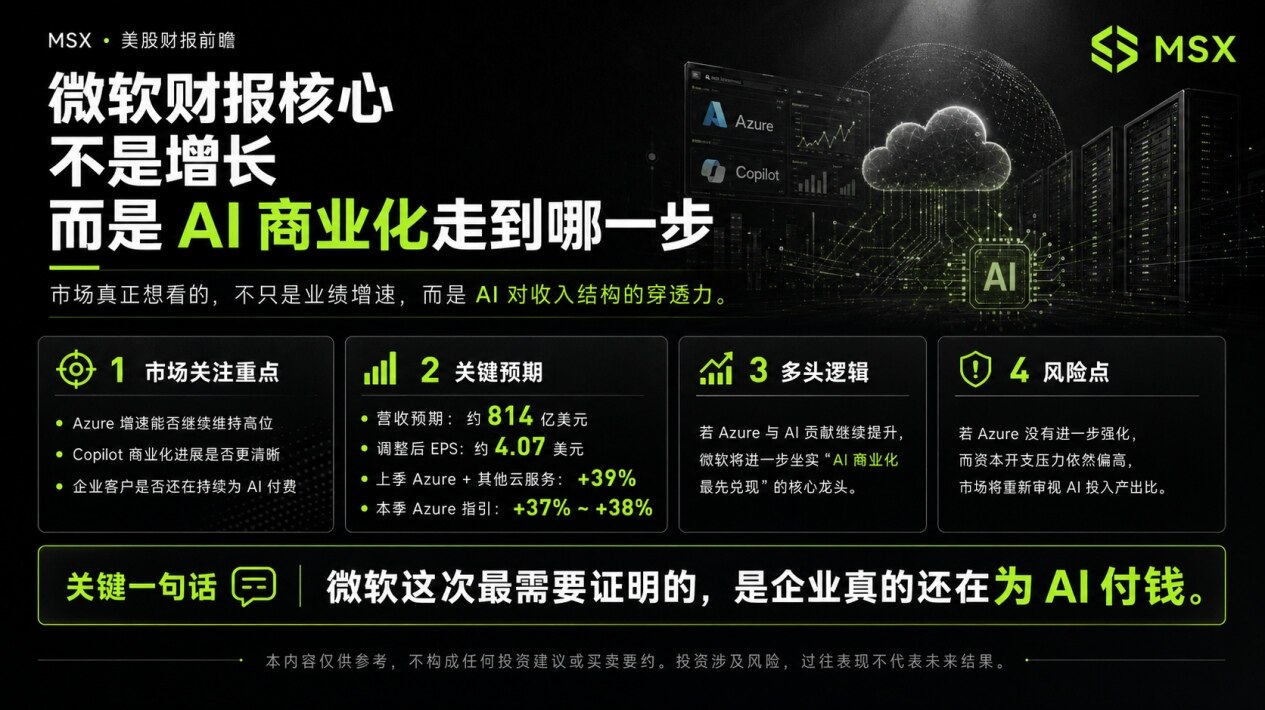
Therefore, the most important thing in Microsoft's earnings report this time is not just revenue growth, but whether AI's "penetration" into the revenue structure continues to strengthen. The current market consensus expects Q3 FY2026 revenue to be around $81.4 billion and adjusted EPS of $4.07. Microsoft's own revenue guidance range for the quarter was $80.65 billion to $81.75 billion, closely aligned with market expectations.
The key metrics to watch are whether Azure growth can remain in a high range, and whether AI products like Copilot show clearer commercialization progress. Last quarter, Microsoft reported Azure and other cloud services revenue growth of 39%, with guidance for the current quarter at 37%–38% growth. This means the core market expectation for this report isn't really "will there be growth," but "is AI still driving growth acceleration."
If Microsoft can continue to demonstrate that enterprise budgets for AI tools haven't shrunk and that Azure's AI contribution is still increasing, the market will view it as the core leader in "AI commercialization being realized first," benefiting related enterprise software, cloud, and data center chains. Conversely, if Azure doesn't show further strength while capital expenditure pressure remains high, the market will refocus on the return on investment.
In other words, the most critical thing about Microsoft's earnings is not proving that AI is important, but proving that enterprises are still paying for AI.
2. Google: Just After Cloud Next Told the Story, Earnings Must Deliver the Report Card
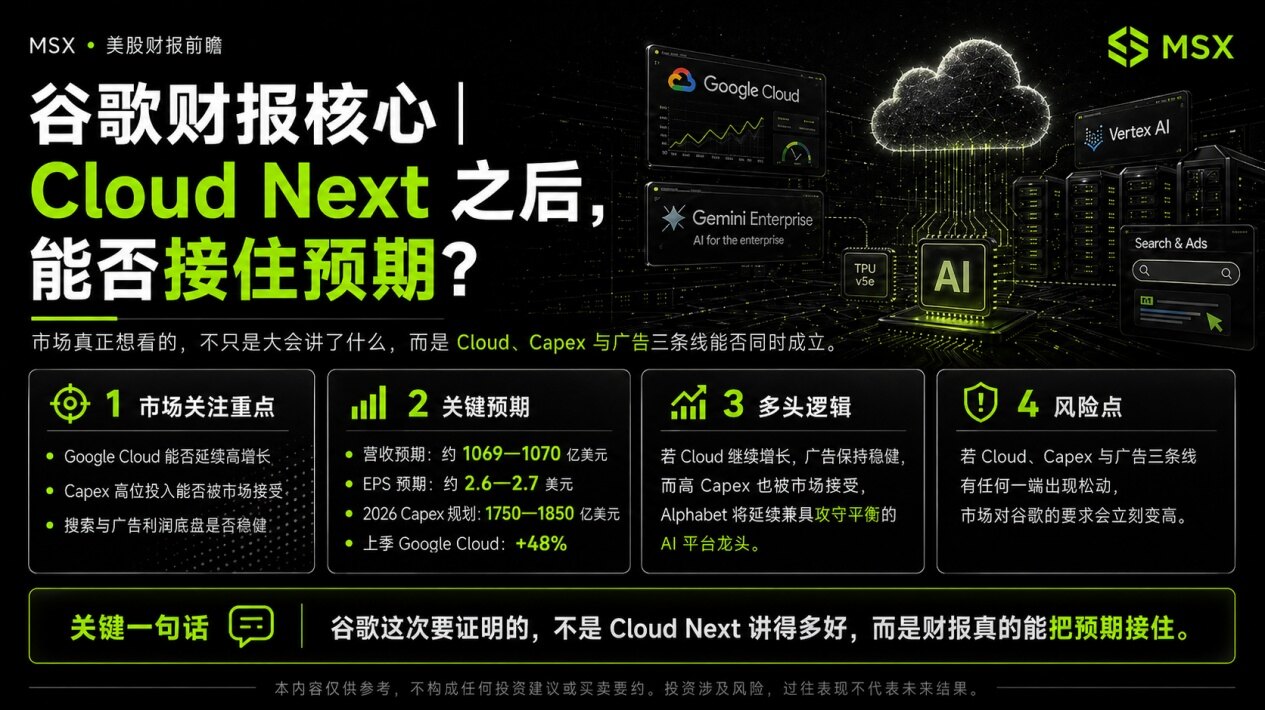
Compared to Microsoft, Google's situation this time is more like "holding a conference first, then taking a small exam." Cloud Next 2026 has just concluded, where Google released many signals about AI agents, Gemini Enterprise, Vertex AI, TPUs, and infrastructure investment. The market has consequently raised its expectations for Google Cloud. However, the conference was about vision, while earnings are about execution. The most significant pressure on Alphabet's earnings this time is precisely that it must quickly turn "stories" into "numbers."
Google's uniqueness lies in not being a pure cloud company or a pure advertising company, but one that straddles two major narratives: one is Google Cloud and AI infrastructure, the other is the mature cash flow machine of search and advertising. Current market consensus roughly estimates Q1 revenue at $106.9–$107.0 billion and EPS around $2.73. But more important than just looking at revenue and EPS is whether three things can hold true simultaneously: Google Cloud continues to grow, capital expenditure remains high, and search advertising stays robust. In February, Alphabet explicitly outlined a 2026 capital expenditure plan of $175–$185 billion. Last quarter, Google Cloud revenue grew 48% to $17.7 billion, with an annualized run rate exceeding $70 billion and rapidly increasing backlog orders. This means the market has already partially priced in the "strong Cloud, heavy AI investment" narrative.
So, Google's real exam question this time isn't whether Cloud can grow, but whether it can maintain its search and advertising profit foundation while continuing heavy investment. If all three lines hold firm, Alphabet could be redefined by the market as the most "balanced attack-and-defense" AI platform leader. However, if any weakness appears among Cloud, CapEx, and advertising, the market's demands will immediately become stricter.
Google's earnings this time represent not whether a single business beats expectations, but whether the earnings can live up to the narrative set after Cloud Next.
3. Amazon: The Real Challenge Isn't AWS, But "Investing While Profiting"
The difficulty of Amazon's earnings this time differs from Microsoft and Google. The market will certainly focus on AWS, but that alone isn't enough because Amazon isn't just a pure cloud platform company. It simultaneously carries retail, e-commerce, logistics, advertising, and cash flow lines. In other words, when the market looks at Microsoft and Google, it's largely about AI and enterprise demand. When it looks at Amazon, it's about whether a company can simultaneously bet on the future without sacrificing current earnings quality.
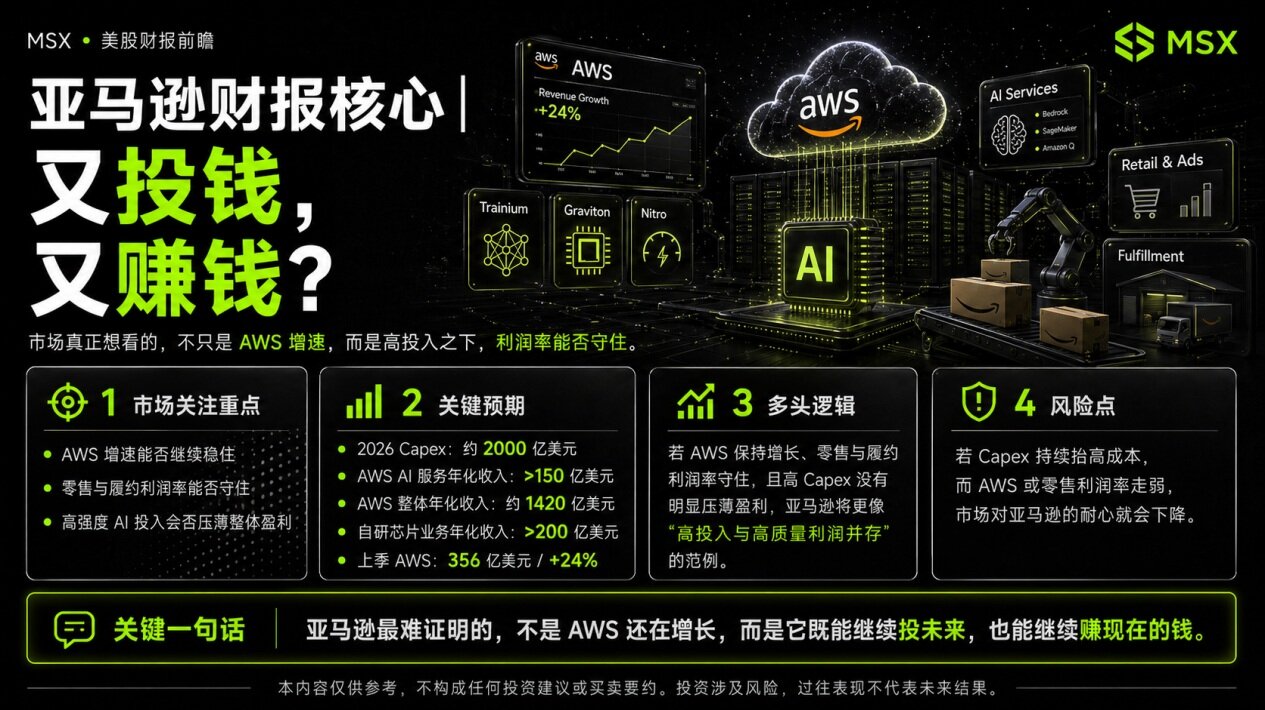
Based on disclosed information, Amazon's investment in AI is very aggressive. The company stated in its Q4 February earnings that 2026 capital expenditure is expected to be around $200 billion, primarily for AI infrastructure. CEO Andy Jassy later disclosed in a shareholder letter that AWS's AI services annualized revenue run rate has exceeded $15 billion, while AWS's total annualized revenue run rate is approximately $142 billion. Simultaneously, the annualized revenue run rate from custom chips like Trainium, Graviton, and Nitro has surpassed $20 billion. This shows that Amazon is no longer just saying "we are also doing AI," but rather "we want AI to be the core engine for AWS's next growth phase."
However, the problem is that Amazon cannot only talk about the future. AWS is its growth and profit engine, but the retail and fulfillment system determines whether overall profit margins can be maintained. Last quarter, AWS revenue grew 24% year-over-year to $35.6 billion, with full-year AWS revenue reaching $128.7 billion. The company guided Q1 operating profit between $16.5 billion and $21.5 billion, with the midpoint not being particularly aggressive. This means that when the market looks at Amazon this time, it's not just about AWS growth itself, but about a more realistic question: Will high-intensity AI investment squeeze profit margins again? If the answer is no, Amazon will be seen as an example of "high investment coexisting with high-quality profits." If the answer becomes ambiguous, the market's patience will decrease.
What's truly difficult for Amazon is not proving that AWS is still growing, but proving that it can continue to invest in the future while still making money in the present.
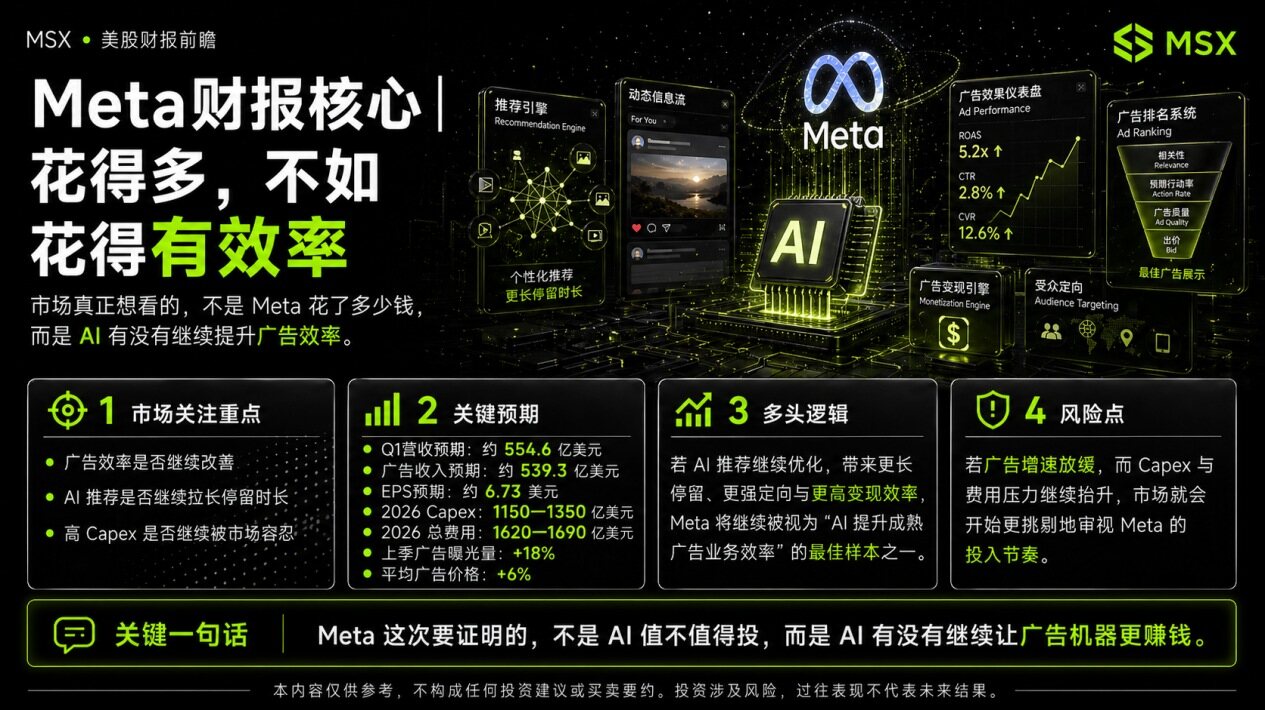
4. Meta: The Market Is Willing to Pay Up, Not Because It Spends a Lot, But Because It Spends Efficiently
Among the five giants, Meta's logic is the most easily misjudged. On the surface, Meta, like the others, is aggressively increasing capital expenditure. However, the market's willingness to grant it a high valuation isn't because it also holds AI press conferences, but because it has repeatedly proven that AI directly improves its core business – advertising. For Meta, AI is not a distant new story but more of an ongoing "efficiency revolution."
Looking at last quarter's earnings, Meta's advertising business remains the foundation supporting all its AI investments. In Q4 2025, Meta's ad impressions grew 18% year-over-year, and the average ad price increased 6%. Full-year capital expenditure reached $72.2 billion. Simultaneously, the company has raised its 2026 capital expenditure guidance further to $115–$135 billion, and its total expense guidance has increased to $162–$169 billion. This means investors now truly need to observe not how much Meta spent, but whether that spending continues to translate into stronger recommendation capabilities, longer user engagement, better ad targeting, and higher ad monetization efficiency.
Pre-earnings market consensus likely estimates Q1 revenue at $55.46 billion, ad revenue at $53.93 billion, and EPS at $6.73. These numbers are certainly important, but what will truly determine market sentiment is the underlying logic chain: AI recommendation optimization → increased user engagement → improved ad efficiency → higher ad revenue → market tolerance for high CapEx continues. If this chain holds, Meta will continue to be viewed as one of the best examples of "AI improving mature business efficiency." Conversely, if ad revenue growth slows while capital expenditure pressure mounts, the market will scrutinize its spending pace more critically.
In other words, Meta's earnings this time are not about answering "is AI worth investing in," but about answering: Is AI continuing to make this advertising machine more profitable?
5. Apple: The Market Doesn't Expect It to Be the Most Aggressive, But Just Wants to Confirm It Hasn't Fallen Behind
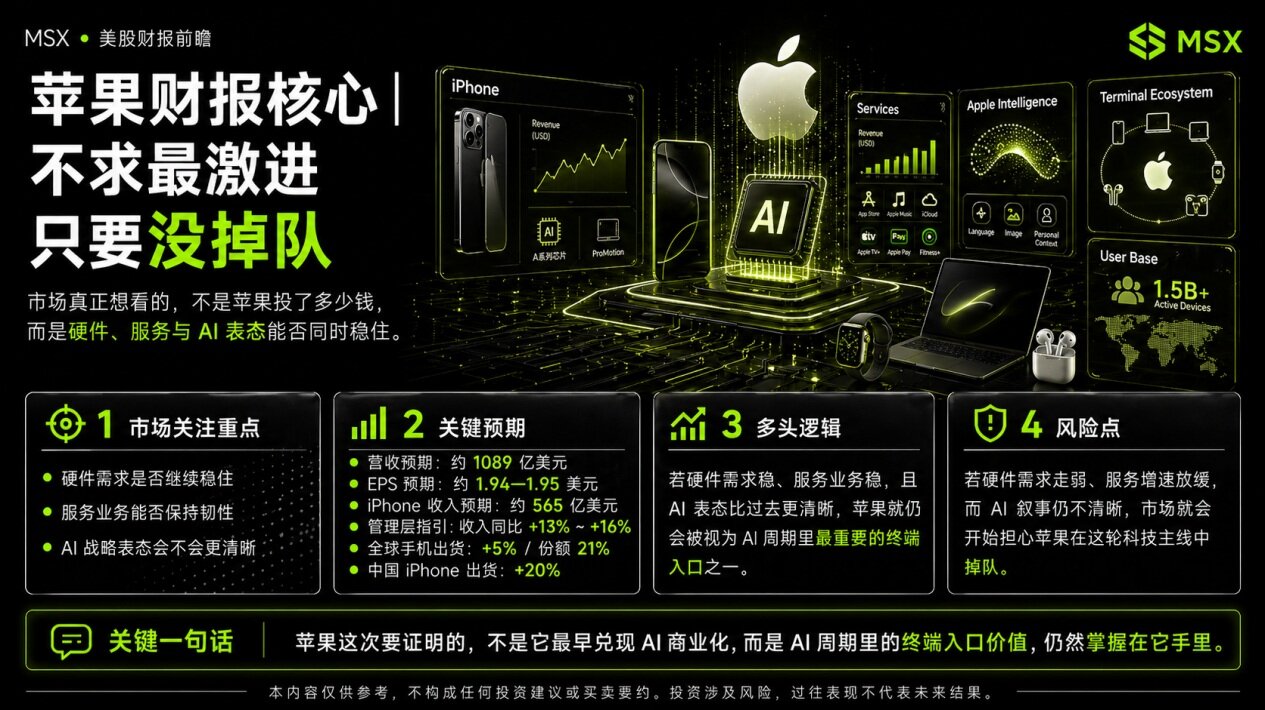
If the previous four companies revolve around "AI investment and commercialization" to some extent, Apple's logic is entirely different. The market does not expect Apple to present the most aggressive AI story this earnings season, nor will it measure Apple by "how much capital expenditure did you spend." Apple's single most critical question is: In this AI cycle, does it still firmly hold the most important terminal entry point.
This is why Apple's focal point this time will be a more subtle combination: hardware demand, services business, and clarity of AI strategy. Apple's guidance from its previous quarterly earnings in January indicated revenue growth of 13%–16% year-over-year for this quarter. Based on this guidance, revenue is estimated to fall within the $107.8 billion to $110.7 billion range. Current mainstream market consensus is roughly around $108.9 billion in revenue and EPS of $1.94–$1.95. S&P Global's preview shows market expectations for iPhone revenue this quarter around $56.5 billion. Meanwhile, Apple's global smartphone shipments in Q1 2026 grew 5% year-over-year, capturing a 21% global market share. In the Chinese market, iPhone shipments also grew 20% year-over-year. This indicates that, at least before the earnings report, the market has not seen significant signs of weakening terminal demand for Apple.
Therefore, Apple's real observation point this time is not whether it will aggressively emphasize AI investment like Microsoft or Google, but whether it can continue to prove that even without the most aggressive pace in the AI cycle, it still possesses the most important terminal ecosystem, the strongest user base, and the most stable source of high-quality profits. As long as hardware demand is stable, the services business is stable, and its AI narrative is clearer than before, the market will not easily exclude Apple from this tech main narrative.
Apple represents not the earliest realization of AI commercialization, but rather: the value of the terminal entry point in the AI cycle is still in its hands.
III. Looking at All Five Companies Together, the Market is Essentially Conducting a Cross-Validation
If you look at just one company, this week is obviously five separate earnings reports. But when viewed together, you find that the market is actually conducting a larger cross-validation. Microsoft tests whether AI has formed an enterprise payment loop; Google tests whether conference narratives can quickly translate into dual execution in Cloud and advertising; Amazon tests whether high investment can coexist with high-quality profits; Meta tests whether AI consistently improves mature business efficiency; Apple tests whether its terminal entry point and ecosystem position remain solid.
These appear to be five different threads, but they all point to the same question: Are the current high valuations of tech leaders based on actual execution, or are they still largely built on expectations? If the answers from the five companies are mostly positive, the market will be more willing to continue pushing valuations higher for AI, cloud, advertising platforms, and terminal ecosystems. However, if there is significant divergence, the market will shift from "broadly raising valuations" back to "only rewarding the strongest executioners."
IV. What Might the Market Reprice After Earnings?
After earnings week, what the market is most likely to reprice is not a single company, but several major narratives.
The first is undoubtedly the AI infrastructure chain: If the tech giants continue to maintain high capital expenditure guidance, sectors like data centers, networking, optical interconnects, power, and cooling will continue to receive fundamental support.
The second is cloud and enterprise AI: As long as Microsoft, Google, and Amazon continue to prove enterprise demand is still there, the market will continue to view cloud platforms as the core infrastructure for AI commercialization.
The third is internet platforms and ad efficiency: If Meta and Google continue to prove that AI is improving ad monetization efficiency, the valuation frameworks for platform-based internet companies will also become more stable.
Finally, there is terminal AI and ecosystem entry points


